



Abstract
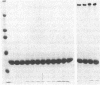
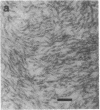
I have compared the effects of microtubule-associated protein 2 (MAP-2) and tau on the packing density of sedimented microtubules. Microtubules assembled in vitro in taxol were pelleted by centrifugation. The volumes of the resulting pellets were calculated from their weights assuming a specific gravity of 1 and then were normalized to the amount of protein in the pellet, yielding a value for pellet specific volume in microliter/mg of protein. The specific volume of the pellets reflects the intermicrotubule spacing within the pellet. Microtubules were assembled from tubulin alone or tubulin plus various amounts of MAP-2 or tau and collected by centrifugation, and the pellet specific volume was measured. The specific volume of microtubules composed of pure tubulin ranged from 6.4 to 7.7 microliter/mg of protein. Tau had no detectable effect on this value even at saturating levels on the microtubules. In contrast, MAP-2 increased pellet specific volume as the MAP-2/tubulin weight ratio increased; at the highest ratio examined, 0.43, the pellet specific volume was approximately 33. Even at the relatively low MAP-2/tubulin ratio of 0.09, pellet specific volume was approximately 2-fold greater than that of microtubules containing tubulin alone or tubulin plus tau. Electron microscopy confirmed that the observations on pellet specific volume reflected differences in the effects of MAP-2 and tau on the packing density of sedimented microtubules. These results are discussed in the context of observations showing that neighboring microtubules are more widely spaced in dendrites than in axons and that MAP-2 is enriched on microtubules in dendrites compared to microtubules in axons, whereas the converse is true for tau.
Full text
PDF


Images in this article



Selected References
These references are in PubMed. This may not be the complete list of references from this article.
- Bartlett W. P., Banker G. A. An electron microscopic study of the development of axons and dendrites by hippocampal neurons in culture. I. Cells which develop without intercellular contacts. J Neurosci. 1984 Aug;4(8):1944–1953. doi: 10.1523/JNEUROSCI.04-08-01944.1984. [DOI] [PMC free article] [PubMed] [Google Scholar]
- Bartlett W. P., Banker G. A. An electron microscopic study of the development of axons and dendrites by hippocampal neurons in culture. II. Synaptic relationships. J Neurosci. 1984 Aug;4(8):1954–1965. doi: 10.1523/JNEUROSCI.04-08-01954.1984. [DOI] [PMC free article] [PubMed] [Google Scholar]
- Bernhardt R., Matus A. Light and electron microscopic studies of the distribution of microtubule-associated protein 2 in rat brain: a difference between dendritic and axonal cytoskeletons. J Comp Neurol. 1984 Jun 20;226(2):203–221. doi: 10.1002/cne.902260205. [DOI] [PubMed] [Google Scholar]
- Binder L. I., Frankfurter A., Rebhun L. I. The distribution of tau in the mammalian central nervous system. J Cell Biol. 1985 Oct;101(4):1371–1378. doi: 10.1083/jcb.101.4.1371. [DOI] [PMC free article] [PubMed] [Google Scholar]
- Black M. M., Greene L. A. Changes in the colchicine susceptibility of microtubules associated with neurite outgrowth: studies with nerve growth factor-responsive PC12 pheochromocytoma cells. J Cell Biol. 1982 Nov;95(2 Pt 1):379–386. doi: 10.1083/jcb.95.2.379. [DOI] [PMC free article] [PubMed] [Google Scholar]
- Bloom G. S., Schoenfeld T. A., Vallee R. B. Widespread distribution of the major polypeptide component of MAP 1 (microtubule-associated protein 1) in the nervous system. J Cell Biol. 1984 Jan;98(1):320–330. doi: 10.1083/jcb.98.1.320. [DOI] [PMC free article] [PubMed] [Google Scholar]
- Brown P. A., Berlin R. D. Packing volume of sedimented microtubules: regulation and potential relationship to an intracellular matrix. J Cell Biol. 1985 Oct;101(4):1492–1500. doi: 10.1083/jcb.101.4.1492. [DOI] [PMC free article] [PubMed] [Google Scholar]
- Caceres A., Binder L. I., Payne M. R., Bender P., Rebhun L., Steward O. Differential subcellular localization of tubulin and the microtubule-associated protein MAP2 in brain tissue as revealed by immunocytochemistry with monoclonal hybridoma antibodies. J Neurosci. 1984 Feb;4(2):394–410. doi: 10.1523/JNEUROSCI.04-02-00394.1984. [DOI] [PMC free article] [PubMed] [Google Scholar]
- De Camilli P., Miller P. E., Navone F., Theurkauf W. E., Vallee R. B. Distribution of microtubule-associated protein 2 in the nervous system of the rat studied by immunofluorescence. Neuroscience. 1984 Apr;11(4):817–846. [PubMed] [Google Scholar]
- Detrich H. W., 3rd, Jordan M. A., Wilson L., Williams R. C., Jr Mechanism of microtubule assembly. Changes in polymer structure and organization during assembly of sea urchin egg tubulin. J Biol Chem. 1985 Aug 5;260(16):9479–9490. [PubMed] [Google Scholar]
- Drubin D. G., Feinstein S. C., Shooter E. M., Kirschner M. W. Nerve growth factor-induced neurite outgrowth in PC12 cells involves the coordinate induction of microtubule assembly and assembly-promoting factors. J Cell Biol. 1985 Nov;101(5 Pt 1):1799–1807. doi: 10.1083/jcb.101.5.1799. [DOI] [PMC free article] [PubMed] [Google Scholar]
- Drubin D. G., Kirschner M. W. Tau protein function in living cells. J Cell Biol. 1986 Dec;103(6 Pt 2):2739–2746. doi: 10.1083/jcb.103.6.2739. [DOI] [PMC free article] [PubMed] [Google Scholar]
- Herzog W., Weber K. Fractionation of brain microtubule-associated proteins. Isolation of two different proteins which stimulate tubulin polymerization in vitro. Eur J Biochem. 1978 Dec 1;92(1):1–8. doi: 10.1111/j.1432-1033.1978.tb12716.x. [DOI] [PubMed] [Google Scholar]
- Hoffman P. N., Griffin J. W., Price D. L. Control of axonal caliber by neurofilament transport. J Cell Biol. 1984 Aug;99(2):705–714. doi: 10.1083/jcb.99.2.705. [DOI] [PMC free article] [PubMed] [Google Scholar]
- Huber G., Matus A. Differences in the cellular distributions of two microtubule-associated proteins, MAP1 and MAP2, in rat brain. J Neurosci. 1984 Jan;4(1):151–160. doi: 10.1523/JNEUROSCI.04-01-00151.1984. [DOI] [PMC free article] [PubMed] [Google Scholar]
- Kim H., Binder L. I., Rosenbaum J. L. The periodic association of MAP2 with brain microtubules in vitro. J Cell Biol. 1979 Feb;80(2):266–276. doi: 10.1083/jcb.80.2.266. [DOI] [PMC free article] [PubMed] [Google Scholar]
- Langford G. M. Length and appearance of projections on neuronal microtubules in vitro after negative staining: evidence against a crosslinking function for MAPs. J Ultrastruct Res. 1983 Oct;85(1):1–10. doi: 10.1016/s0022-5320(83)90111-9. [DOI] [PubMed] [Google Scholar]
- Letourneau P. C., Ressler A. H. Inhibition of neurite initiation and growth by taxol. J Cell Biol. 1984 Apr;98(4):1355–1362. doi: 10.1083/jcb.98.4.1355. [DOI] [PMC free article] [PubMed] [Google Scholar]
- Ludueña R. F., Fellous A., Francon J., Nunez J., McManus L. Effect of tau on the vinblastine-induced aggregation of tubulin. J Cell Biol. 1981 Jun;89(3):680–683. doi: 10.1083/jcb.89.3.680. [DOI] [PMC free article] [PubMed] [Google Scholar]
- Peng I., Binder L. I., Black M. M. Biochemical and immunological analyses of cytoskeletal domains of neurons. J Cell Biol. 1986 Jan;102(1):252–262. doi: 10.1083/jcb.102.1.252. [DOI] [PMC free article] [PubMed] [Google Scholar]
- Peng I., Binder L. I., Black M. M. Cultured neurons contain a variety of microtubule-associated proteins. Brain Res. 1985 Dec 30;361(1-2):200–211. doi: 10.1016/0006-8993(85)91290-9. [DOI] [PubMed] [Google Scholar]
- Pollard T. D., Selden S. C., Maupin P. Interaction of actin filaments with microtubules. J Cell Biol. 1984 Jul;99(1 Pt 2):33s–37s. doi: 10.1083/jcb.99.1.33s. [DOI] [PMC free article] [PubMed] [Google Scholar]
- Sasaki-Sherrington S. E., Jacobs J. R., Stevens J. K. Intracellular control of axial shape in non-uniform neurites: a serial electron microscopic analysis of organelles and microtubules in AI and AII retinal amacrine neurites. J Cell Biol. 1984 Apr;98(4):1279–1290. doi: 10.1083/jcb.98.4.1279. [DOI] [PMC free article] [PubMed] [Google Scholar]
- Vallee R. B. A taxol-dependent procedure for the isolation of microtubules and microtubule-associated proteins (MAPs). J Cell Biol. 1982 Feb;92(2):435–442. doi: 10.1083/jcb.92.2.435. [DOI] [PMC free article] [PubMed] [Google Scholar]
- Vallee R. B., Borisy G. G. Removal of the projections from cytoplasmic microtubules in vitro by digestion with trypsin. J Biol Chem. 1977 Jan 10;252(1):377–382. [PubMed] [Google Scholar]
- Vallee R. B., Davis S. E. Low molecular weight microtubule-associated proteins are light chains of microtubule-associated protein 1 (MAP 1). Proc Natl Acad Sci U S A. 1983 Mar;80(5):1342–1346. doi: 10.1073/pnas.80.5.1342. [DOI] [PMC free article] [PubMed] [Google Scholar]
- Voter W. A., Erickson H. P. Electron microscopy of MAP 2 (microtubule-associated protein 2). J Ultrastruct Res. 1982 Sep;80(3):374–382. doi: 10.1016/s0022-5320(82)80051-8. [DOI] [PubMed] [Google Scholar]
- Witman G. B., Cleveland D. W., Weingarten M. D., Kirschner M. W. Tubulin requires tau for growth onto microtubule initiating sites. Proc Natl Acad Sci U S A. 1976 Nov;73(11):4070–4074. doi: 10.1073/pnas.73.11.4070. [DOI] [PMC free article] [PubMed] [Google Scholar]
- Wuerker R. B., Kirkpatrick J. B. Neuronal microtubules, neurofilaments, and microfilaments. Int Rev Cytol. 1972;33:45–75. doi: 10.1016/s0074-7696(08)61448-5. [DOI] [PubMed] [Google Scholar]
- Zingsheim H. P., Herzog W., Weber K. Differences in surface morphology of microtubules reconstituted from pure brain tubulin using two different microtubule-associated proteins: the high molecular weight MAP 2 proteins and tau proteins. Eur J Cell Biol. 1979 Jun;19(2):175–183. [PubMed] [Google Scholar]