



Abstract
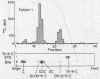
[24-14C]Dehydrocholic acid (triketo-5-β-cholanoic acid) was synthesized from [24-14C]cholic acid, mixed with 200 mg of carrier, and administered intravenously to two patients with indwelling T tubes designed to permit bile sampling without interruption of the enterohepatic circulation. More than 80% of infused radioactivity was excreted rapidly in bile as glycine- and taurine-conjugated bile acids. Radioactive products were identified, after deconjugation, as partially or completely reduced derivatives of dehydrocholic acid. By mass spectrometry, as well as chromatography, the major metabolite (about 70%) was a dihydroxy monoketo bile acid (3α,7α-dihydroxy-12-keto-5β-cholanoic acid); a second metabolite (about 20%) was a monohydroxy diketo acid (3α-hydroxy-7,12-di-keto-5β-cholanoic acid); and about 10% of radioactivity was present as cholic acid. Reduction appeared to have been sequential (3 position, then 7 position, and then 12 position) and stereospecific (only α epimers were recovered).
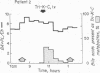
Bile flow, expressed as the ratio of bile flow to bile acid excretion, was increased after dehydrocholic acid administration. It was speculated that the hydroxy keto metabolites are hydrocholeretics. The proportion of cholesterol to lecithin and bile acids did not change significantly after dehydrocholic acid administration. In vitro studies showed that the hydroxy keto metabolites dispersed lecithin poorly compared to cholate; however, mixtures of cholate and either metabolite had dispersant properties similar to those of cholate alone, provided the ratio of metabolite to cholate remained below a value characteristic for each metabolite. These experiments disclose a new metabolic pathway in man, provide further insight into the hydrocholeresis induced by keto bile acids, and indicate the striking change in pharmacologic and physical properties caused by replacement of hydroxyl by a keto substituent in the bile acid molecule.
Full text
PDF


Images in this article

Selected References
These references are in PubMed. This may not be the complete list of references from this article.
- Björkhem I., Gustafsson J. On the conversion of cholestanol into allocholic acid in rat liver. Eur J Biochem. 1971 Jan;18(2):207–213. doi: 10.1111/j.1432-1033.1971.tb01232.x. [DOI] [PubMed] [Google Scholar]
- Dowling R. H., Mack E., Small D. M. Effects of controlled interruption of the enterohepatic circulation of bile salts by biliary diversion and by ileal resection on bile salt secretion, synthesis, and pool size in the rhesus monkey. J Clin Invest. 1970 Feb;49(2):232–242. doi: 10.1172/JCI106232. [DOI] [PMC free article] [PubMed] [Google Scholar]
- ELLIN R. I., MENDELOFF A. I., TURNER D. A. Quantitative determination of 3,7,12-triketocholanic acid in biological fluids by gas-liquid chromatography. Anal Biochem. 1962 Sep;4:198–203. doi: 10.1016/0003-2697(62)90002-7. [DOI] [PubMed] [Google Scholar]
- Eneroth P., Gordon B., Ryhage R., Sjövall J. Identification of mono- and dihydroxy bile acids in human feces by gas-liquid chromatography and mass spectrometry. J Lipid Res. 1966 Jul;7(4):511–523. [PubMed] [Google Scholar]
- Entemnan C., Holloway R. J., Albright M. L., Leong G. F. Bile acids and lipid metabolism. I. Stimulation of bile lipid excretion by various bile acids. Proc Soc Exp Biol Med. 1968 Apr;127(4):1003–1006. doi: 10.3181/00379727-127-32855. [DOI] [PubMed] [Google Scholar]
- Go V. L., Hofmann A. F., Summerskill W. H. Pancreozymin bioassay in man based on pancreatic enzyme secretion: potency of specific amino acids and other digestive products. J Clin Invest. 1970 Aug;49(8):1558–1564. doi: 10.1172/JCI106373. [DOI] [PMC free article] [PubMed] [Google Scholar]
- HOFMANN A. F. CLINICAL IMPLICATIONS OF PHYSICOCHEMICAL STUDIES ON BILE SALTS. Gastroenterology. 1965 Apr;48:484–494. [PubMed] [Google Scholar]
- HOFMANN A. F., MOSBACH E. H. IDENTIFICATION OF ALLODEOXYCHOLIC ACID AS THE MAJOR COMPONENT OF GALLSTONES INDUCED IN THE RABBIT BY 5-ALPHA-CHOLESTAN-3-BETA-OL. J Biol Chem. 1964 Sep;239:2813–2821. [PubMed] [Google Scholar]
- Hardison W. G., Apter J. T. Micellar theory of biliary cholesterol excretion. Am J Physiol. 1972 Jan;222(1):61–67. doi: 10.1152/ajplegacy.1972.222.1.61. [DOI] [PubMed] [Google Scholar]
- Hardison W. G. Metabolism of sodium dehydrocholate by the rat liver: its effect on micelle formation in bile. J Lab Clin Med. 1971 May;77(5):811–820. [PubMed] [Google Scholar]
- Hepner G. W., Hofmann A. F. Different effects of free and conjugated bile acids and their keto derivatives on (Na + ,K + )-stimulated and Mg 2 +ATPase of rat intestinal mucosa. Biochim Biophys Acta. 1973 Jan 2;291(1):237–245. doi: 10.1016/0005-2736(73)90415-x. [DOI] [PubMed] [Google Scholar]
- Hofmann A. F., Bokkenheuser V., Hirsch R. L., Mosbach E. H. Experimental cholelithiasis in the rabbit induced by cholestanol feeding: effect of neomycin treatment on bile composition and gallstone formation. J Lipid Res. 1968 Mar;9(2):244–253. [PubMed] [Google Scholar]
- Hofmann A. F., Poley J. R. Role of bile acid malabsorption in pathogenesis of diarrhea and steatorrhea in patients with ileal resection. I. Response to cholestyramine or replacement of dietary long chain triglyceride by medium chain triglyceride. Gastroenterology. 1972 May;62(5):918–934. [PubMed] [Google Scholar]
- Hofmann A. F., Small D. M. Detergent properties of bile salts: correlation with physiological function. Annu Rev Med. 1967;18:333–376. doi: 10.1146/annurev.me.18.020167.002001. [DOI] [PubMed] [Google Scholar]
- Kallner A. On the biosynthesis and metabolism of allodeoxycholic acid in the rat. Bile acids and steroids 175. Acta Chem Scand. 1967;21(2):315–321. doi: 10.3891/acta.chem.scand.21-0315. [DOI] [PubMed] [Google Scholar]
- Kikuchi H. The metabolic sequence for the occurrence of an anomalous bile acid, 12-ketochenodeoxycholic acid, found in the bile of hepatobiliary diseased patients. J Biochem. 1972 Jul;72(1):165–172. doi: 10.1093/oxfordjournals.jbchem.a129882. [DOI] [PubMed] [Google Scholar]
- Mekjian H. S., Phillips S. F., Hofmann A. F. Colonic secretion of water and electrolytes induced by bile acids: perfusion studies in man. J Clin Invest. 1971 Aug;50(8):1569–1577. doi: 10.1172/JCI106644. [DOI] [PMC free article] [PubMed] [Google Scholar]
- NORMAN A., SJOVALL J. On the transformation and enterohepatic circulation of cholic acid in the rat: bile acids and steroids 68. J Biol Chem. 1958 Oct;233(4):872–885. [PubMed] [Google Scholar]
- Nakayama F. Quantitative microanalysis of bile. J Lab Clin Med. 1967 Apr;69(4):594–609. [PubMed] [Google Scholar]
- Nilsson S., Scherstén T. Importance of bile acids for phospholipid secretion into human hepatic bile. Gastroenterology. 1969 Nov;57(5):525–532. [PubMed] [Google Scholar]
- OGURA M., YAMASAKI K. The fate of C14-labeled dehydrocholic acid in guinea pig. J Biochem. 1961 Jun;49:649–659. doi: 10.1093/oxfordjournals.jbchem.a127355. [DOI] [PubMed] [Google Scholar]
- Ogura M., Yamasaki K. Non-stereospecific reduction of 3-oxochol-4-enoic-[24-14C] acid in the rat. Steroids. 1967 Jun;9(6):607–622. doi: 10.1016/0039-128x(67)90067-0. [DOI] [PubMed] [Google Scholar]
- Roovers J., Evrard E., Vanderhaeghe H. An improved method for measuring human blood bile acids. Clin Chim Acta. 1968 Mar;19(3):449–457. doi: 10.1016/0009-8981(68)90272-6. [DOI] [PubMed] [Google Scholar]
- Small D. M., Penkett S. A., Chapman D. Studies on simple and mixed bile salt micelles by nuclear magnetic resonance spectroscopy. Biochim Biophys Acta. 1969 Jan 21;176(1):178–189. doi: 10.1016/0005-2760(69)90086-1. [DOI] [PubMed] [Google Scholar]
- Snyder F. Zonal scanning of thin-layer chromatograms. Adv Tracer Methodol. 1965;2:107–113. doi: 10.1007/978-1-4684-8622-3_11. [DOI] [PubMed] [Google Scholar]
- Soloway R. D., Carlson H. C., Schoenfield L. J. A balloon-occludable T-tube for cholangiography and quantitative collection and reinfusion of bile in man. J Lab Clin Med. 1972 Mar;79(3):500–504. [PubMed] [Google Scholar]
- Swell L., Bell C. C., Jr, Entenman C. Bile acids and lipid metabolism. 3. Influence of bile acids on phospholipids in liver and bile of the isolated perfused dog liver. Biochim Biophys Acta. 1968 Oct 22;164(2):278–284. [PubMed] [Google Scholar]
- Thistle J. L., Schoenfield L. J. Induced alterations in composition of bile of persons having cholelithiasis. Gastroenterology. 1971 Oct;61(4):488–496. [PubMed] [Google Scholar]
- Wheeler H. O., King K. K. Biliary excretion of lecithin and cholesterol in the dog. J Clin Invest. 1972 Jun;51(6):1337–1350. doi: 10.1172/JCI106930. [DOI] [PMC free article] [PubMed] [Google Scholar]
- Young D. L., Hanson K. C. Effect of bile salts on hepatic phosphatidylcholine synthesis and transport into rat bile. J Lipid Res. 1972 Mar;13(2):244–252. [PubMed] [Google Scholar]