



Abstract

A tandem C-H olefination/annulation sequence directed by N-acylsulfonamides affords a variety of isoindolinones. This transformation is compatible with aliphatic alkenes as well as conjugated alkenes. Notably, molecular oxygen can be used as the sole, eco-friendly oxidant.
Pd(II)-mediated aromatic C(sp2)-H olefinations (Fujiwara-Moritani reaction) have emerged as a powerful tool for C-C bond formation.1, 2 Indeed, the utility and unique characteristics of this reaction have been cogently demonstrated in the total synthesis of polyfunctional natural products of current interest and for the efficient construction of bioactive scaffolds.3 Generally, nitrogen- or oxygen-containing directing groups are required for acceptable reactivity and selectivity using the Fujiwara-Moritani reaction.4, 5 Hence, it is apparent that both synthetic efficiency and atom economy would be greatly extended if the heteroatom served as both the directing group and as the precursor to a C-X bond (X=N, O). An early example of this concept was provided by Miura and co-workers who revealed benzoic acid could direct tandem C-H olefination and C-O formation, albeit in unsatisfying yield;6 more recently, the Yu group demonstrated that a triflamide or tertiary hydroxyl were competent directing groups for the cascade process of C-H olefination/C-X bond formation resulting in six-membered heterocycles.7,8 However, in those cases, the annulation was strictly limited to electron-deficient olefins. Herein, we disclose tosyl amide as a new directing group that affords the isoindolinone motif via a sequence of C-H olefination followed by C-N bond formation. Another notable feature is the use of molecular oxygen as the sole oxidant and shows the preference for the PdII/Pd0 redox cycle. Importantly, this transformation is broadly compatible with aliphatic alkenes as well as activated alkenes; the specific type of adduct formed is dictated by the electronic properties of the alkene (eq 1).
 |
(1) |
For the initial survey of reaction conditions and optimization, N-tosylbenzamide and tert-butyl acrylate were selected as the model substrates since they were commercially available and amenable to deprotection and/or manipulation following annulation. Subsequent screening campaigns established some important reaction parameters:9 (i) Pd(OAc)2 performed as well or better than other commercial Pd(II)-catalysts, (ii) bathophenanthroline was much superior to other intermediaries of the catalytic PdII/Pd0 redox cycle, and (iii) toluene furnished better yields than THF, CH3CN, DMSO, and other common solvents. While benzoquinone (BQ) is one of the most commonly used oxidant for Pd(II) catalyzed C-H activations, and also works in our reaction, we were delighted to discover eco-friendly molecular oxygen had a higher turnover number than BQ and could function as the sole oxidant in the absence of other co-oxidants.10 Indeed, the anticipated annulation adduct 3a was isolated in good chemical yield when the optimized conditions were employed (eq 2).
 |
(2) |
Encouraged by this result, we applied the method to a variety of substituted N-tosylbenzamides (Scheme 1). The tandem process readily provided isoindolinones regardless of the electronic properties of the aryl substituent(s). For instance, the electron-donating methoxy (3c) and methyl group (3d) as well as fluoride (3f) all furnished their respective adducts in high yields. The chemoselective formation of 3g, without competitive Heck reaction by the aryl bromide is noteworthy, as the latter provides functionality for subsequent Pd(0)-mediated cross coupling reactions. Acceptable yields of adduct when strong electron–withdrawing groups were present, e.g., CF3, generally required prolonged reaction times (3e). The facile annulation of 3h compared with the somewhat sluggish closure of the regioisomeric 3i is also of interest and can be attributed to the torsional hinderance from the ortho-methoxy in 3i, which prevents the amide from achieving optimum overlap with the aromatic ring. To confirm this hypothesis, a comparable experiment was carried out by replacing the bulky ortho-methoxy with an ortho-fluoro group. As might be anticipated from the foregoing discussion, the annulation of 3j proceeded with an obviously better reaction rate and in higher yield than 3i.
Scheme 1.

Reaction Scope using Various N-tosylbenzamidesa,b
a1 (0.1 mmol), alkene (0.12 mmol), Pd(OAc)2 (0.01 mmol), ligand (0.012 mmol) and O2 (1 atm). bIsolated yield. c72 h. dPerformed for 80 h using 20 mol % Pd(OAc)2 and 24 mol % bathophenanthroline.
The range of acceptable alkenes was also investigated. When subjected to the preceding reaction conditions, electron-deficient alkenes, e.g., a conjugated ester (4a), ketone (4b) and amide (4c), smoothly evolved adducts 4 (Scheme 2). Even 2,4-pentadienoate and the α-branched olefin methacrylate were suitable, affording 4d and 4e, respectively.
Scheme 2.

Reaction Scope with Activated Alkenesa,b
a1 (0.1 mmol), alkene (0.12 mmol), Pd(OAc)2 (0.01 mmol), ligand (0.012 mmol) and O2 (1 atm). bIsolated yield. cReaction performed for 72 h using 20 mol % Pd(OAc)2 and 24 mol % bathophenanthroline. ddr = 1.4:1, separated by preparative TLC.
Despite the otherwise rare participation of simple aliphatic alkenes in C-H olefinations owing to their poor reactivity, we found terminal aliphatic alkenes were readily converted into annulated adducts (Table 1). Not only simple alkene (5a) but also functionalized alkenes such as aliphatic ester (5b), aliphatic chloride (5c) and aryl substituted alkene (5d) were suitable substrates for the annulation cascade. An intriguing example of specificity was found in 1,7-octadiene wherein one terminal alkene underwent annulation while the other survived (5e). A distinguishing feature of the adducts in Table 1, as opposed to those in Scheme 2, is the retention and positional shift of the olefin (exclusively E-configuration by 1H NMR) indicating a significant variation in the termination step. Additionally, a small amount of isoquinolinone 6 was also produced. The overall process represents an unprecedented tandem C-H olefination/annulation involving simple aliphatic alkenes.
Table 1.
Reaction Scope with Non-Conjugated Alkenesa
 | |||
|---|---|---|---|
| entry | alkene | isoindolinone | combined yield (%)b |
| 1 |  |
 5a |
68 (5a/6a 3.1/1)c |
| 2 |  |
 5b |
65(5b/6b 3.0/1) |
| 3 |  |
 5c |
60 (5c/6c 3.1/1) |
| 4 |  |
 5d |
63 (5d/6d 2.7/1) |
| 5 |  |
 5e |
38d |
1 (0.1 mmol), alkene (0.12 mmol), Pd(OAc)2 (0.01 mmol), ligand (0.012 mmol) and O2 (1 atm).
Isolated yield.
Ratio of 5/6 calculated from isolated yields.
Trace of 6e only detected by 1H NMR.
While the mechanism of Pd(II)-mediated C(sp2)-H cleavage has attracted considerable attention in past decades, the precise details remain controversial. 11 However, the data gained from the competitive reactions agree with an electrophilic palladation mechanism as originally proposed by Ryabov and coworkers (Scheme 3).11a Specifically, tosyl amides bearing substituents with various electronic properties were subjected to parallel experiments in which the conversion ratio was determined by 1H NMR. Substrates with electron donating groups, e.g., (1c), showed the highest reaction rates while an unsubstituted case (1a) was intermediate and the electron deficient substrate (1e) had the lowest reactivity. These results are consistence with the pathway of arenium (Wheland) intermediate of which the efficacy is highly relying on the electronic property of arene.11a
Scheme 3.

Electronic Effects on Reaction Rate
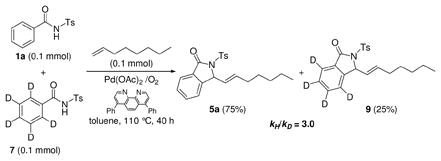
To further study the C-H cleavage step, we prepared deuterium-labeled compound 7 and subjected it to competitive, intermolecular experiments (eqs 3 and 4). An equimolar mixture of 1a and 7 were treated with 1 equiv of electron-deficient alkene (or aliphatic alkene), the measured product isotope effect of 3.2 (or 3.0) might suggest that the deprotonation was involved as the rate-limiting step.4a,4j,12
 |
(3) |
 |
(4) |
To clarify the influence of the acidic N-H sulfonamide, control experiments, utilizing the standard reaction conditions, were conducted using benzamides in which the tosyl group was replaced by H, Ph, or OMe.13 The results cogently showed that the acid N-H was essential and could dramatically improve the reactivity (Scheme 4). Illuminated by the preceding investigations, the postulated mechanism is depicted in Scheme 5. We speculate that the increased acidity of the N-H, a consequence of the combined inductive effects of the carbonyl and tosyl, facilitates the formation of the Pd-N bond that in turn promotes the formation of palladacycle (I). Alkene insertion leads to intermediate II from which III is derived via β-H elimination. The electronic properties of the alkenes determines the ultimate fate of III. Electron-deficient alkenes likely participate by a Michael addition (path A),6a,7a,8 while non-conjugated alkenes are annulated in a Wacker-type amination (path B).14 Confirmation was obtained by subjecting 10 (mixture of Z/E-olefins) to the standard annulation conditions (eq 5). The Wacker amination was complete within a few hours and afforded the anticipated product 5a irrespective of original olefin configuration.15
Scheme 4.

Dependency of Reactivity on N-H Acidity
Scheme 5.

Proposed Mechanism
If the parent nitrogen heterocycle is desired, the tosyl can be conveniently removed in just one-half hour using sodium naphthalenide, e.g., 3a to isoindolinone 11 (eq 6).
In summary, a tandem process of C-H olefination/annulation for heterocyclic synthesis is described. Tosyl amides were employed as a novel directing group to afford a series of isoindolinones. Impressively, this transformation is broadly compatible with electron-rich and -deficient alkenes. For more eco-friendly transformations, molecular oxygen or even atmospheric air could be used without the need of other co-oxidants. From a practical point of view, the only waste is water and thus this transformation meets the goal of green chemistry. Further applications are ongoing in our group.
 |
(5) |
 |
(6) |
Supplementary Material
Acknowledgments
Financial support was provided by the Robert A. Welch Foundation (GL625910) and the NIH (GM31278, DK38226).
Footnotes
Supporting Information Available: Experimental procedures, characterization data and spectra of new compounds. This material is available free of charge via the Internet at http://pubs.acs.org.
References
- 1.For the initial reports, see: Moritani I, Fujiwara Y. Tetrahedron Lett. 1967;8:1119.Fujiwara Y, Moritani I, Matsuda M, Teranishi S. Tetrahedron Lett. 1968;9:633.
- 2.For reviews, see: Moritani I, Fujiwara Y. Synthesis. 1973:524.Jia C, Kitamura T, Fujiwara Y. Acc Chem Res. 2001;34:633. doi: 10.1021/ar000209h.Beccalli EM, Broggini G, Martinelli M, Sottocornola S. Chem Rev. 2007;107:5318. doi: 10.1021/cr068006f.Chen X, Engle KM, Wang DH, Yu JQ. Angew Chem, Int Ed. 2009;48:5094. doi: 10.1002/anie.200806273.Lyons TW, Sanford MS. Chem Rev. 2010;110:1147. doi: 10.1021/cr900184e.
- 3.(a) Trost BM, Godleski SA, Genêt JP. J Am Chem Soc. 1978;100:3930. [Google Scholar]; (b) Cushing TD, Sanz-Cervera JF, Williams RM. J Am Chem Soc. 1993;115:9323. [Google Scholar]; (c) Baran PS, Corey EJ. J Am Chem Soc. 2002;124:7904. doi: 10.1021/ja026663t. [DOI] [PubMed] [Google Scholar]; (d) Garg NK, Caspi DD, Stoltz BM. J Am Chem Soc. 2004;126:9552. doi: 10.1021/ja046695b. [DOI] [PubMed] [Google Scholar]; (e) Beck EM, Hatley R, Gaunt MJ. Angew Chem, Int Ed. 2008;47:3004. doi: 10.1002/anie.200705005. [DOI] [PubMed] [Google Scholar]
- 4.For the examples of Pd(II) catalyzed C-H olefination with directing groups, see: Boele MDK, van Strijdonck GPF, de Vries AHM, Kamer PCJ, de Vries JG, van Leeuwen PWNM. J Am Chem Soc. 2002;124:1586. doi: 10.1021/ja0176907.Zaitsev VG, Daugulis O. J Am Chem Soc. 2005;127:4156. doi: 10.1021/ja050366h.Cai G, Fu Y, Li Y, Wan X, Shi Z. J Am Chem Soc. 2007;129:7666. doi: 10.1021/ja070588a.Cho SH, Hwang SJ, Chang S. J Am Chem Soc. 2008;130:9254. doi: 10.1021/ja8026295.Houlden CE, Bailey CD, Ford JG, Gagné MR, Lloyd-Jones GC, Booker-Milburn KI. J Am Chem Soc. 2008;130:10066. doi: 10.1021/ja803397y.(f) García-Rubia A, Arrayás RG, Carretero JC. Angew Chem, Int Ed. 2009;48:6511. doi: 10.1002/anie.200902802.Wang DH, Engle KM, Shi BF, Yu JQ. Science. 2010;327:315. doi: 10.1126/science.1182512.Shi BF, Zhang Y-H, Lam JK, Wang D-H, Yu J-Q. J Am Chem Soc. 2010;132:460. doi: 10.1021/ja909571z.Engle KM, Wang DH, Yu JQ. Angew Chem, Int Ed. 2010;49:6169. doi: 10.1002/anie.201002077.Nishikata T, Lipshutz BH. Org Lett. 2010;12:1972. doi: 10.1021/ol100331h.García-Rubia A, Urones B, Arrayás RG, Carretero JC. Chem Eur J. 2010;16:9676. doi: 10.1002/chem.201001126.
- 5.For the examples of Pd(II) catalyzed C-H olefinations without directing groups, see: Fujiwara Y, Maruyama O, Yoshidomi M, Taniguchi H. J Org Chem. 1981;46:851.Itahara T, Ikeda M, Sakakibara T. J Chem Soc, Perkin Trans. 1983;1:1361.Ferreira EM, Stoltz BM. J Am Chem Soc. 2003;125:9578. doi: 10.1021/ja035054y.Beccalli EM, Broggini G. Tetrahedron Lett. 2003;44:1919.Ma S, Yu S. Tetrahedron Lett. 2004;45:8419.Liu C, Widenhoefer RA. J Am Chem Soc. 2004;126:10250. doi: 10.1021/ja046810i.Grimster NP, Gauntlett C, Godfrey CRA, Gaunt MJ. Angew Chem, Int Ed. 2005;44:3125. doi: 10.1002/anie.200500468.Zhang X, Fan S, He C-Y, Wan X, Min QQ, Yang J, Jiang ZX. J Am Chem Soc. 2010;132:4506. doi: 10.1021/ja908434e.
- 6.Miura M, Tsuda T, Satoh T, Pivsa-Art S, Nomura M. J Org Chem. 1998;63:5211.Also see: Ueura K, Satoh T, Miura M. Org Lett. 2007;9:1407. doi: 10.1021/ol070406h.Ueura K, Satoh T, Miura M. J Org Chem. 2007;72:5362. doi: 10.1021/jo070735n.
- 7.(a) Li JJ, Mei TS, Yu JQ. Angew Chem, Int Ed. 2008;47:6452. doi: 10.1002/anie.200802187. [DOI] [PubMed] [Google Scholar]; (b) Lu Y, Wang DH, Engle KM, Yu JQ. J Am Chem Soc. 2010;132:5916. doi: 10.1021/ja101909t. [DOI] [PMC free article] [PubMed] [Google Scholar]
- 8.An example of tandem C(sp3)-H olefination/C-N formation, see: Wasa M, Engle KM, Yu JQ. J Am Chem Soc. 2010;132:3680. doi: 10.1021/ja1010866.
- 9.See Supporting Information for details of reaction parameter screening.
- 10.For the examples of using O2 as oxidant in C-H olefination, see: Zhang YH, Shi BF, Yu JQ. J Am Chem Soc. 2009;131:5072. doi: 10.1021/ja900327e.Engle KM, Wang DH, Yu JQ. J Am Chem Soc. 2010;132:14137. doi: 10.1021/ja105044s.
- 11.For mechanistic studies of Pd(II) mediated C-H cleavages, see:. Ryabov AD, Sakodinskaya IK, Yatsimirsky AK. J Chem Soc, Dalton Trans. 1985:2629.Canty AJ, van Koten G. Acc Chem Res. 1995;28:406.Gómez M, Granell J, Martinez M. Organometallics. 1997;16:2539.Gómez M, Granell J, Martinez M. J Chem Soc, Dalton Trans. 1998:37.Biswas B, Sugimoto M, Sakaki S. Organometallics. 2000;19:3895.Davies DL, Donald SMA, Macgregor SA. J Am Chem Soc. 2005;127:13754. doi: 10.1021/ja052047w.Tunge JA, Foresee LN. Organometallics. 2005;24:6440.
- 12.(a) Davidson JM, Triggs C. J Chem Soc A. 1968:1324. [Google Scholar]; (b) Shue RS. J Am Chem Soc. 1971;93:7116. [Google Scholar]; (c) Lane BS, Brown MA, Sames D. J Am Chem Soc. 2005;127:8050. doi: 10.1021/ja043273t. [DOI] [PubMed] [Google Scholar]; (d) Campeau LC, Parisien M, Jean A, Fagnou K. J Am Chem Soc. 2006;128:581. doi: 10.1021/ja055819x. [DOI] [PubMed] [Google Scholar]
- 13.For the examples of Pd(II)-mediated C-H activation involving benzamides, see: Kametani Y, Satoh T, Miura M, Nomura M. Tetrahedron Lett. 2000;41:2655.Shabashov D, Daugulis O. Org Lett. 2006;8:4947. doi: 10.1021/ol0619866.Wang DH, Wasa M, Giri R, Yu JQ. J Am Chem Soc. 2008;130:7190. doi: 10.1021/ja801355s.Wasa M, Yu JQ. J Am Chem Soc. 2008;130:14058. doi: 10.1021/ja807129e.Yeung CS, Zhao X, Borduas N, Dong VM. Chem Sci. 2010;1:331.
- 14.Trend RM, Ramtohul YK, Stoltz BM. J Am Chem Soc. 2005;127:17778. doi: 10.1021/ja055534k. [DOI] [PMC free article] [PubMed] [Google Scholar]
- 15.Formation of byproduct isoquinolinone 6 was not observed in the experiment. It presumably derived from intermediate II via reductive elimination and subsequent dehydrogenation.
Associated Data
This section collects any data citations, data availability statements, or supplementary materials included in this article.