



1. Procedure
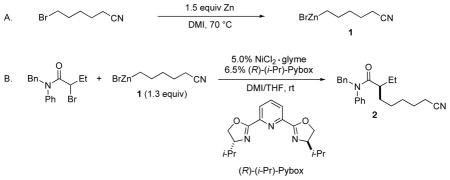
A. (5-Cyanopentyl)zinc(II) bromide (1)
An oven-dried, 200-mL, pear-shaped Schlenk flask equipped with a magnetic stirbar and an argon line connected to the standard taper outer joint was purged with argon for 5 min. Zinc powder (9.80 g, 150 mmol, 1.50 equiv) (Note 1) was added through the open neck, and then the flask was capped with a rubber septum and heated in an oil bath under high vacuum (0.5 torr) at 70 °C for 30 min. Then, the flask was refilled with argon, and anhydrous 1,3-dimethyl-2-imidazolidinone (DMI; 100 mL) (Note 2) was added via syringe. Next, I2 (634 mg, 2.50 mmol, 0.0250 equiv) (Note 3) was added in one portion through the neck. The neck was re-capped with a rubber septum, and the reaction mixture was stirred at 70 °C in an oil bath until the red color faded (~5 min). 6-Bromohexanenitrile (13.2 mL, 100 mmol, 1.00 equiv) (Note 4) was added via syringe over 4 min, and the reaction mixture was stirred at 70 °C for 12 h. Then, the oil bath was removed, and the mixture was allowed to cool at rt for 1 h without stirring. During this time, the unreacted zinc powder settled at the bottom of the flask. The supernatant solution was filtered under argon as illustrated in Figure 1. The resulting clear yellow solution was employed in the next step without further purification. No-D 1H NMR spectroscopy was used to determine that the concentration of the alkylzinc solution was 0.78 M (Note 5). This organozinc solution can be stored under argon at 0–4 °C for up to 3 weeks without deterioration.
Figure 1.

B. (S)-N-Benzyl-7-cyano-2-ethyl-N-phenylheptanamide (2)
An oven-dried, 1000-mL, three-necked, round-bottomed flask equipped with a thermometer inlet, thermometer, magnetic stirbar, and argon inlet was purged with argon for 20 min. NiCl2 glyme (383 mg, 1.75 mmol, 0.0500 equiv) (Note 6), (R)-(i-Pr)-Pybox (686 mg, 2.28 mmol, 0.0650 equiv) (Note 7), and N-benzyl-2-bromo-N-phenylbutanamide (11.6 g, 35.0 mmol, 1.00 equiv) (Note 8) were then added through the open neck under a positive pressure of argon. The open neck was capped with a rubber septum, and DMI (77 mL) (Note 2) and THF (17.5 mL) (Note 9) were each added via syringe. The resulting orange solution was stirred at rt for 10 min, and then the organozinc reagent (1) (0.78 M in DMI; 58.3 mL, 45.5 mmol, 1.30 equiv) was added via syringe over 6 min. The resulting dark-brown reaction mixture was stirred at rt (temperature of the solution: 23 °C) for 24 h. The progress of the reaction can be monitored by 1H NMR analysis of an aliquot of the reaction mixture. After the α-bromo amide starting material had been completely consumed (determined by observing the disappearance of a resonance at δ 3.95), the excess organozinc reagent was quenched by adding ethanol (15 mL). The brown reaction mixture was diluted with Et2O (500 mL), and the resulting solution was transferred to a separatory funnel and washed with H2O (300 mL × 3). The organic layer was dried over anhydrous Na2SO4 (30 g) and filtered through a Büchner funnel that contained a bed of celite (1.0 cm height). The filtrate was concentrated by rotary evaporation (20 torr), and the resulting orange oil was purified by column chromatography on silica gel (wet packed in hexanes; 8 cm diameter × 30 cm height; 350 g; eluting with a gradient of EtOAc in hexanes (500 mL of 10% EtOAc/hexanes, 1.0 L of 15% EtOAc/hexanes, 1.0 L of 20% EtOAc/hexanes, 1.0 L of 30% EtOAc/hexanes, 500 mL of 40% EtOAc/hexanes; 100-mL fractions) (Note 10). The cross-coupling product 2 has Rf = 0.5 (TLC analysis on silica gel: 30% EtOAc/hexanes as eluent, visualization with a UV lamp) (Note 11). The desired product was obtained as a white solid (10.8–11.1 g, 88–91% yield, 93% ee) (Note 12).
Waste Disposal Information
All toxic materials were disposed of in accordance with “Prudent Practices in the Laboratory”; National Academy Press; Washington, DC, 1995.
3. Discussion
Substantial advances have recently been described in the development of catalysts that cross-couple alkyl electrophiles. 3 For couplings of unsymmetrical secondary electrophiles, there is the potential to control the stereochemistry at the carbon that bears the leaving group. 4 This stereochemical aspect adds an important dimension to carbon–carbon bond-forming reactions of alkyl electrophiles. In 2003, we reported that Ni(cod)2/(s-Bu)-Pybox catalyzes Negishi reactions of secondary alkyl bromides and iodides. 5 Our observation that a chiral Pybox is the ligand of choice raised the obvious question of whether it might be possible to develop a highly enantioselective alkyl–alkyl cross-coupling.
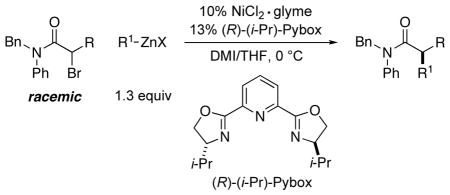
We have determined that this objective can be achieved with certain electrophiles, including α-bromo amides.6,7 Thus, NiCl2 glyme/(i-Pr)-Pybox catalyzes the cross-coupling of a racemic mixture of an a-bromo amide with an array of alkylzinc reagents8 in good ee and yield (Table 1). The catalyst tolerates a variety of functional groups, such as olefins, ethers, imides, and nitriles.
Table 1.
Enantioselective, Stereoconvergent Negishi Cross-Couplings of α-Bromo Amides with Alkylzinc Reagents.
 | ||||
|---|---|---|---|---|
| entry | R | R1-ZnX | ee (%) | yield (%) |
| 1 | Et | Hex–ZnBr | 96 | 90 |
| 2a | Et | 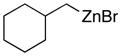 |
92 | 58 |
| 3 | n-Bu |  |
96 | 79 |
| 4 | i-Bu | MeZnl | 87 | 78 |
| 5 | Et | 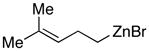 |
95 | 78 |
| 6 | Et | 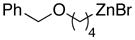 |
96 | 77 |
| 7 | Et | 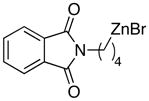 |
96 | 51 |
| 8 | Et |  |
93 | 70 |
The coupling was conducted at room temperature.
In this stereoconvergent process, both enantiomers of the racemic substrate are transformed into the same enantiomer of the product with good stereoselectivity. There is no evidence for kinetic resolution of the starting material during the catalytic asymmetric Negishi reaction. The cross-coupling product can be converted into other useful families of compounds, such as primary alcohols (reduction with LiAlH4).
Appendix Chemical Abstracts Nomenclature; (Registry Number)
6-Bromohexanenitrile: Hexanenitrile, 6-bromo-; (6621-59-6)
Zinc; (7440-66-6)
N-Benzyl-2-bromo-N-phenylbutanamide: Butanamide, 2-bromo-N-phenyl-N-(phenylmethyl)-; (851073-30-8)
Nickel(II) chloride, dimethoxyethane adduct (NiCl2 glyme): Nickel, dichloro[1,2-di(methoxy- κO)ethane]-; (29046-78-4)
(R)-i-Pr-Pybox: Pyridine, 2,6-bis[(4R)-4,5-dihydro-4-(1-methylethyl)-2- oxazolyl]-; (131864-67-0)
(S)-N-Benzyl-7-cyano-2-ethyl-N-phenylheptanamide: Heptanamide, 7-cyano-2-ethyl-N-phenyl-N-(phenylmethyl)-, (2S)-; (851073-44-4)
Footnotes
Zinc powder (99.9%, ~100 mesh) was purchased from Alfa Aesar and used as received.
1,3-Dimethyl-2-imidazolidinone (≥ 99.5%, over molecular sieves, water content: ≤0.04%) was purchased from Aldrich and used as received.
I2 (≥99%, chips) was purchased from Aldrich and used as received.
6-Bromohexanenitrile (95%) was purchased from Aldrich and used as received.
For the No-D NMR experiment, a 1H NMR spectrum of a blank CDCl3 sample was taken to lock the sample and determine the reference. Then, an unlocked No-D NMR spectrum of the alkylzinc sample in DMI was taken (pw = 1.5). The resonances for DMI appear at δ 4.08 and 3.51. The resonance for the CH2Zn protons of RZnBr appears at δ 0.89. The resonance for the terminal Me group of the reduction product appears at δ 1.71. The molar ratio of DMI : RZnBr : RH (X : 1 : Y) was determined by No-D NMR to be 11.2 : 1 : 0.13. The density (d) of the solution was measured to be 1.20 g/mL. The final concentration of alkylzinc was calculated to be 0.78 M according to the equation: [RZnBr] = d × 1000/(X × MWDMI + MWRZnBr + Y × MWRH).
NiCl2 glyme was purchased from Strem and used as received.
(R)-(i-Pr)-Pybox (99%) was purchased from Aldrich and used as received.
N-Benzyl-2-bromo-N-phenylbutanamide 2 (97%) may be purchased from Aldrich.
THF (99+%) was purchased from J.T. Baker (water content: 24 ppm) and purified by passage through activated alumina column under argon.
Column chromatography was performed on Sorbent Technologies 60 Å silica gel.
Analytical thin-layer chromatography was performed using EMD 0.25 mm silica gel 60-F plates.
Compound 2 has the following properties: 1H NMR (CDCl3, 500 MHz) δ 7.29–7.31 (m, 3H), 7.22–7.24 (m, 3H), 7.16–7.18 (m, 2H), 6.89–6.91 (m, 2H), 4.92 (d, J = 14.0 Hz, 1H), 4.83 (d, J = 14.0 Hz, 1H), 2.26 (t, J = 7.0 Hz, 2H), 2.13–2.17 (m, 1H), 1.54–1.65 (m, 4H), 1.27–1.38 (m, 4H), 1.16–1.23 (m, 2H), 0.78 (t, J = 7.0 Hz, 3H); 13C NMR (CDCl3, 125 MHz) d 175.7, 142.2, 137.8, 129.5, 129.0, 128.3, 127.9, 127.4, 119.8, 53.0, 43.5, 32.5, 28.7, 26.6, 26.2, 25.1, 17.0, 12.1; IR (film): 3031, 2933, 2860, 2245, 1652, 1595, 1495, 1456, 1403, 1242, 1200, 1079, 701 cm−1; LRMS (ESI) calcd for C23H29N2O (M+H) 349.2, found, 349.2; [α]23D = −29.3 (c = 1.05, CHCl3); mp 83–86 °C. The spectral data are in agreement with reported values.2 The ee was determined by HPLC analysis with an Agilent 1100 Series HPLC system equipped with a CHIRALPAK AS-H column (length 250 mm, I.D. 4.6 mm) (hexanes/isopropanol 97:3, 1.0 mL/min) with tr (major) = 22.0 min, tr (minor) = 25.4 min. The ee can also be determined by supercritical fluid chromatography (SFC) analysis on a Berger SFC MiniGram system: CHIRALPAK AD-H column (length 250 mm, I.D. 4.6 mm); solvent system: 15% MeOH, 3.0 mL/min; retention times: tr (major) = 2.39 min, tr (minor) = 2.57 min. The purity of compound 2 (99%) was determined by HPLC analysis (tr = 6.30 min) with an Agilent 1100 Series HPLC system equipped with an Eclipse XDB-C18 column (length 150 mm, I.D. 4.6 mm, particle size 5 μm), using a 2% → 98% MeOH/(0.2% AcOH in water) gradient for 3 min, then 98% MeOH/(0.2% AcOH in water) for 5 min, with a flow rate of 0.8 mL/min.
References
- 2.Fischer C, Fu GC. J Am Chem Soc. 2005;127:4594–4595. doi: 10.1021/ja0506509. [DOI] [PubMed] [Google Scholar]
- 3.For leading references, see: Rudolph A, Lautens M. Angew Chem Int Ed. 2009;48:2656–2670. doi: 10.1002/anie.200803611.Frisch AC, Beller M. Angew Chem Int Ed. 2005;44:674–688. doi: 10.1002/anie.200461432.Netherton MR, Fu GC. In: Topics in Organometallic Chemistry: Palladium in Organic Synthesis. Tsuji J, editor. Springer; New York: 2005. pp. 85–108.Netherton MR, Fu GC. Adv Synth Catal. 2004;346:1525–1532.
- 4.For some examples of other types of metal-catalyzed enantioselective cross-coupling processes, see: Hayashi T. In: Comprehensive Asymmetric Catalysis. Jacobsen EN, Pfaltz A, Yamamoto H, editors. Chapter 25 Springer; New York: 1999. Yin J, Buchwald SL. J Am Chem Soc. 2000;122:12051–12052.Shimada T, Cho YH, Hayashi T. J Am Chem Soc. 2002;124:13396–13397. doi: 10.1021/ja0282588.Hamada T, Chieffi A, Åhman J, Buchwald SL. J Am Chem Soc. 2002;124:1261–1268. doi: 10.1021/ja011122+.Willis MC, Powell LHW, Claverie CK, Watson SJ. Angew Chem Int Ed. 2004;43:1249–1251. doi: 10.1002/anie.200352648.
- 5.Zhou J, Fu GC. J Am Chem Soc. 2003;125:14726–14727. doi: 10.1021/ja0389366. [DOI] [PubMed] [Google Scholar]
- 6.α-bromo amides (Negishi): Fischer C, Fu GC. J Am Chem Soc. 2005;127:4594–4595. doi: 10.1021/ja0506509.1-haloindanes (Negishi): Arp FO, Fu GC. J Am Chem Soc. 2005;127:10482–10483. doi: 10.1021/ja053751f.allylic chlorides (Negishi): Son S, Fu GC. J Am Chem Soc. 2008;130:2756–2757. doi: 10.1021/ja800103z.α-bromo esters (Hiyama): Dai X, Strotman NA, Fu GC. J Am Chem Soc. 2008;130:3302–3303. doi: 10.1021/ja8009428.homobenzylic bromides (Suzuki): Saito B, Fu GC. J Am Chem Soc. 2008;130:6694–6695. doi: 10.1021/ja8013677.propargylic halides (Negishi): Smith SW, Fu GC. J Am Chem Soc. 2008;130:12645–12647. doi: 10.1021/ja805165y.α-bromo ketones (Negishi): Lundin PM, Esquivias J, Fu GC. Angew Chem Int Ed. 2009;48:154–156. doi: 10.1002/anie.200804888.
- 7.For the work of others, see: Caeiro J, Sestelo JP, Sarandeses LA. Chem Eur J. 2008;14:741–746. doi: 10.1002/chem.200701035.
- 8.Huo S. Org Lett. 2003;5:423–425. doi: 10.1021/ol0272693. Preliminary efforts to employ commercially alkylzinc halides (Aldrich) were not successful. [DOI] [PubMed] [Google Scholar]