



Abstract
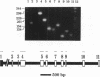
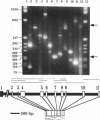
Aberration within the p53 tumor suppressor gene is the most frequently identified genetic damage in human cancer. Regulatory functions proposed for the p53 protein include modulation of the cell cycle, cellular differentiation, signal transduction, and gene expression. Additionally, the p53 gene product may guard the genome against incorporation of damaged DNA. To facilitate study of its role in carcinogenesis using a common animal model, we determined the structure of the rat p53 gene. We identified 18 splice sites and defined 25 bases of the intervening sequences adjacent to these sites. We also discovered an allelic polymorphism that occurs within intron 5 of the gene. The rat gene approximates the mouse ortholog. It is 12 kb in length with the non-coding exon 1 separated from exon 2 by 6.2 kb of intervening sequence. The location and size of all rat gene introns approximate those of the mouse. Whereas the mouse and human genes each contain 11 exons, the rat p53 gene is composed of only 10. No intervening sequence occurs between the region of the rat gene corresponding to exons 6 and 7 of the mouse and human p53 genes. This implies intron 6 may be functionally insignificant for species in which it is retained. To extrapolate to p53 involvement in human tumorigenesis, we suggest that mutational events within intron 6 may not be of pathological significance unless splicing is hindered.
Full text
PDF


Images in this article
Selected References
These references are in PubMed. This may not be the complete list of references from this article.
- Bienz B., Zakut-Houri R., Givol D., Oren M. Analysis of the gene coding for the murine cellular tumour antigen p53. EMBO J. 1984 Sep;3(9):2179–2183. doi: 10.1002/j.1460-2075.1984.tb02110.x. [DOI] [PMC free article] [PubMed] [Google Scholar]
- Bressac B., Kew M., Wands J., Ozturk M. Selective G to T mutations of p53 gene in hepatocellular carcinoma from southern Africa. Nature. 1991 Apr 4;350(6317):429–431. doi: 10.1038/350429a0. [DOI] [PubMed] [Google Scholar]
- Czosnek H. H., Bienz B., Givol D., Zakut-Houri R., Pravtcheva D. D., Ruddle F. H., Oren M. The gene and the pseudogene for mouse p53 cellular tumor antigen are located on different chromosomes. Mol Cell Biol. 1984 Aug;4(8):1638–1640. doi: 10.1128/mcb.4.8.1638. [DOI] [PMC free article] [PubMed] [Google Scholar]
- Ginsberg D., Mechta F., Yaniv M., Oren M. Wild-type p53 can down-modulate the activity of various promoters. Proc Natl Acad Sci U S A. 1991 Nov 15;88(22):9979–9983. doi: 10.1073/pnas.88.22.9979. [DOI] [PMC free article] [PubMed] [Google Scholar]
- Hollstein M., Sidransky D., Vogelstein B., Harris C. C. p53 mutations in human cancers. Science. 1991 Jul 5;253(5015):49–53. doi: 10.1126/science.1905840. [DOI] [PubMed] [Google Scholar]
- Hulla J. E. The rat genome contains a p53 pseudogene: detection of a processed pseudogene using PCR. PCR Methods Appl. 1992 May;1(4):251–254. doi: 10.1101/gr.1.4.251. [DOI] [PubMed] [Google Scholar]
- Isola N. R., Harn H. J., Cooper D. L. Screening recombinant DNA libraries: a rapid and efficient method for isolating cDNA clones utilizing the PCR. Biotechniques. 1991 Nov;11(5):580–582. [PubMed] [Google Scholar]
- Kainz P., Schmiedlechner A., Strack H. B. In vitro amplification of DNA fragments greater than 10 kb. Anal Biochem. 1992 Apr;202(1):46–49. doi: 10.1016/0003-2697(92)90203-j. [DOI] [PubMed] [Google Scholar]
- Kastan M. B., Onyekwere O., Sidransky D., Vogelstein B., Craig R. W. Participation of p53 protein in the cellular response to DNA damage. Cancer Res. 1991 Dec 1;51(23 Pt 1):6304–6311. [PubMed] [Google Scholar]
- Kern S. E., Pietenpol J. A., Thiagalingam S., Seymour A., Kinzler K. W., Vogelstein B. Oncogenic forms of p53 inhibit p53-regulated gene expression. Science. 1992 May 8;256(5058):827–830. doi: 10.1126/science.1589764. [DOI] [PubMed] [Google Scholar]
- Lane D. P. Cancer. p53, guardian of the genome. Nature. 1992 Jul 2;358(6381):15–16. doi: 10.1038/358015a0. [DOI] [PubMed] [Google Scholar]
- Levine A. J., Momand J., Finlay C. A. The p53 tumour suppressor gene. Nature. 1991 Jun 6;351(6326):453–456. doi: 10.1038/351453a0. [DOI] [PubMed] [Google Scholar]
- Lozano G., Levine A. J. Tissue-specific expression of p53 in transgenic mice is regulated by intron sequences. Mol Carcinog. 1991;4(1):3–9. doi: 10.1002/mc.2940040103. [DOI] [PubMed] [Google Scholar]
- Makino H., Ishizaka Y., Tsujimoto A., Nakamura T., Onda M., Sugimura T., Nagao M. Rat p53 gene mutations in primary Zymbal gland tumors induced by 2-amino-3-methylimidazo[4,5-f]quinoline, a food mutagen. Proc Natl Acad Sci U S A. 1992 Jun 1;89(11):4850–4854. doi: 10.1073/pnas.89.11.4850. [DOI] [PMC free article] [PubMed] [Google Scholar]
- Martinez J., Georgoff I., Martinez J., Levine A. J. Cellular localization and cell cycle regulation by a temperature-sensitive p53 protein. Genes Dev. 1991 Feb;5(2):151–159. doi: 10.1101/gad.5.2.151. [DOI] [PubMed] [Google Scholar]
- Michalovitz D., Halevy O., Oren M. p53 mutations: gains or losses? J Cell Biochem. 1991 Jan;45(1):22–29. doi: 10.1002/jcb.240450108. [DOI] [PubMed] [Google Scholar]
- Nigro J. M., Baker S. J., Preisinger A. C., Jessup J. M., Hostetter R., Cleary K., Bigner S. H., Davidson N., Baylin S., Devilee P. Mutations in the p53 gene occur in diverse human tumour types. Nature. 1989 Dec 7;342(6250):705–708. doi: 10.1038/342705a0. [DOI] [PubMed] [Google Scholar]
- Ohgaki H., Hard G. C., Hirota N., Maekawa A., Takahashi M., Kleihues P. Selective mutation of codons 204 and 213 of the p53 gene in rat tumors induced by alkylating N-nitroso compounds. Cancer Res. 1992 May 15;52(10):2995–2998. [PubMed] [Google Scholar]
- Oren M. The p53 cellular tumor antigen: gene structure, expression and protein properties. Biochim Biophys Acta. 1985 Nov 12;823(1):67–78. doi: 10.1016/0304-419x(85)90015-0. [DOI] [PubMed] [Google Scholar]
- Patel P., Stephenson J., Scheuer P. J., Francis G. E. p53 codon 249ser mutations in hepatocellular carcinoma patients with low aflatoxin exposure. Lancet. 1992 Apr 4;339(8797):881–881. doi: 10.1016/0140-6736(92)90332-w. [DOI] [PubMed] [Google Scholar]
- Puisieux A., Lim S., Groopman J., Ozturk M. Selective targeting of p53 gene mutational hotspots in human cancers by etiologically defined carcinogens. Cancer Res. 1991 Nov 15;51(22):6185–6189. [PubMed] [Google Scholar]
- Sanger F., Nicklen S., Coulson A. R. DNA sequencing with chain-terminating inhibitors. Proc Natl Acad Sci U S A. 1977 Dec;74(12):5463–5467. doi: 10.1073/pnas.74.12.5463. [DOI] [PMC free article] [PubMed] [Google Scholar]
- Schärer E., Iggo R. Mammalian p53 can function as a transcription factor in yeast. Nucleic Acids Res. 1992 Apr 11;20(7):1539–1545. doi: 10.1093/nar/20.7.1539. [DOI] [PMC free article] [PubMed] [Google Scholar]
- Sherley J. L. Guanine nucleotide biosynthesis is regulated by the cellular p53 concentration. J Biol Chem. 1991 Dec 25;266(36):24815–24828. [PubMed] [Google Scholar]
- Sommer S. S., Cunningham J., McGovern R. M., Saitoh S., Schroeder J. J., Wold L. E., Kovach J. S. Pattern of p53 gene mutations in breast cancers of women of the midwestern United States. J Natl Cancer Inst. 1992 Feb 19;84(4):246–252. doi: 10.1093/jnci/84.4.246. [DOI] [PubMed] [Google Scholar]
- Soussi T., Caron de Fromentel C., Breugnot C., May E. Nucleotide sequence of a cDNA encoding the rat p53 nuclear oncoprotein. Nucleic Acids Res. 1988 Dec 9;16(23):11384–11384. doi: 10.1093/nar/16.23.11384. [DOI] [PMC free article] [PubMed] [Google Scholar]
- Soussi T., Caron de Fromentel C., May P. Structural aspects of the p53 protein in relation to gene evolution. Oncogene. 1990 Jul;5(7):945–952. [PubMed] [Google Scholar]
- Takahashi T., Takahashi T., Suzuki H., Hida T., Sekido Y., Ariyoshi Y., Ueda R. The p53 gene is very frequently mutated in small-cell lung cancer with a distinct nucleotide substitution pattern. Oncogene. 1991 Oct;6(10):1775–1778. [PubMed] [Google Scholar]
- Unger T., Nau M. M., Segal S., Minna J. D. p53: a transdominant regulator of transcription whose function is ablated by mutations occurring in human cancer. EMBO J. 1992 Apr;11(4):1383–1390. doi: 10.1002/j.1460-2075.1992.tb05183.x. [DOI] [PMC free article] [PubMed] [Google Scholar]
- Vähäkangas K. H., Samet J. M., Metcalf R. A., Welsh J. A., Bennett W. P., Lane D. P., Harris C. C. Mutations of p53 and ras genes in radon-associated lung cancer from uranium miners. Lancet. 1992 Mar 7;339(8793):576–580. doi: 10.1016/0140-6736(92)90866-2. [DOI] [PubMed] [Google Scholar]
- Zakut-Houri R., Oren M., Bienz B., Lavie V., Hazum S., Givol D. A single gene and a pseudogene for the cellular tumour antigen p53. Nature. 1983 Dec 8;306(5943):594–597. doi: 10.1038/306594a0. [DOI] [PubMed] [Google Scholar]