


Abstract
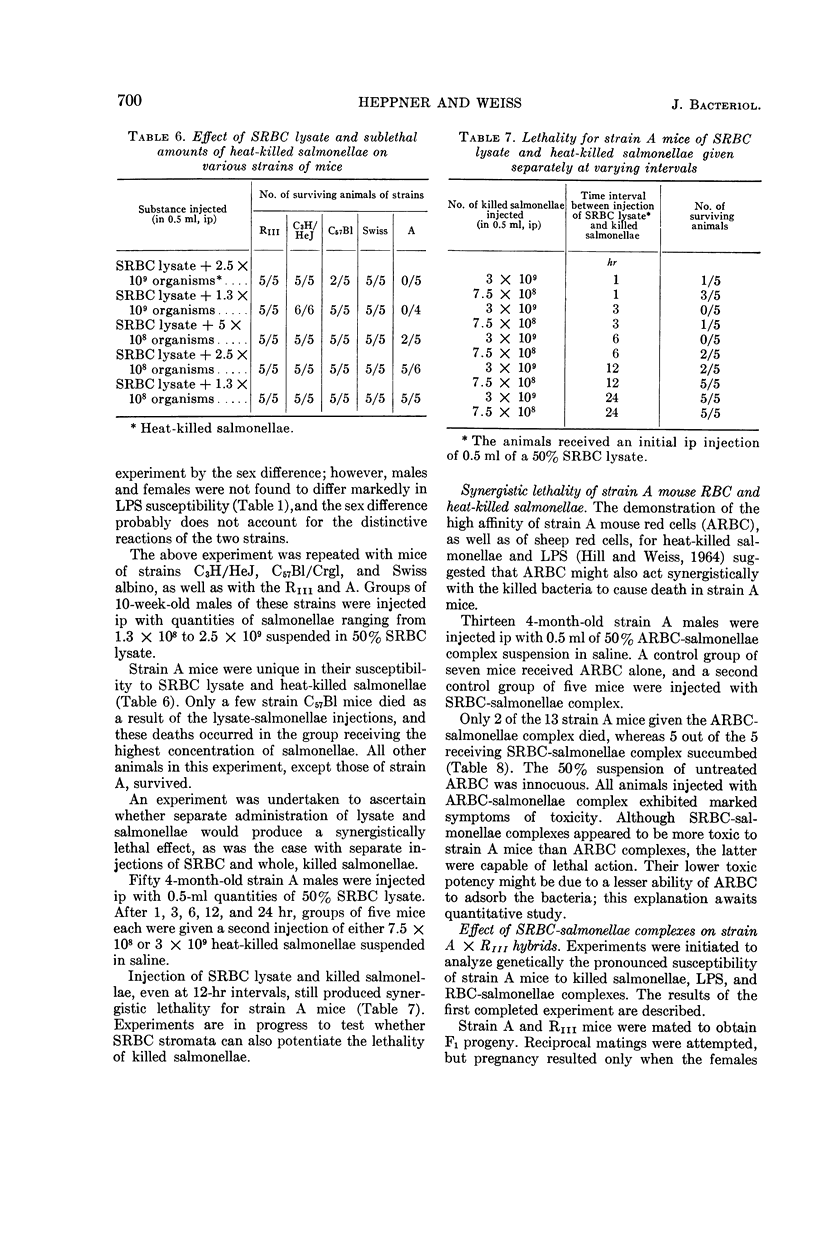
Heppner, Gloria (University of California, Berkeley), and David W. Weiss. High susceptibility of strain A mice to endotoxin and endotoxin-red blood cell mixtures. J. Bacteriol. 90:696–703. 1965.—Strain A mice were shown to be considerably more susceptible to lethal effects of endotoxin lipopolysaccharide (LPS) than mice of several other strains. Complexes of sublethal quantities of LPS and sheep red blood cells were synergistically toxic for strain A mice. Separate administration of sheep red blood cells and heat-killed salmonellae, in either order and as long as 24 hr apart, also proved to be synergistically lethal for strain A mice, but not for RIII animals studied comparatively. Sheep red blood cell lysates possessed the ability of the intact cells in forming lethal combinations for strain A mice with killed salmonellae. Strain A red blood cell-killed salmonellae complexes were also lethal for strain A mice, but less so then complexes made with sheep red blood cells. A × RIII F1 hybrid animals showed the same resistance characteristics as the resistant RIII parental strain. Possible explanations for these findings are suggested, and their relevance to an immunological mode of action of endotoxin lethality is discussed.
Full text
PDF




Selected References
These references are in PubMed. This may not be the complete list of references from this article.
- DAVIDSOHN I., STERN K. Heterohemoantibodies in inbred strains of mice. II. Immune agglutinins and hemolysins for sheep and chicken red cells. J Immunol. 1954 Mar;72(3):216–223. [PubMed] [Google Scholar]
- DAVIS J. H., YULL A. B. The red blood cell: an essential component of the toxicity of strangulation intestinal obstruction. Proc Soc Exp Biol Med. 1961 Oct;108:252–253. doi: 10.3181/00379727-108-26906. [DOI] [PubMed] [Google Scholar]
- KLEIN E., LINDER O. Factorial analysis of the reactivity of C57BL females against isologous male skin grafts. Transplant Bull. 1961 Apr;27:457–460. doi: 10.1097/00006534-196104000-00043. [DOI] [PubMed] [Google Scholar]
- NETER E. Bacterial hemagglutination and hemolysis. Bacteriol Rev. 1956 Sep;20(3):166–188. doi: 10.1128/br.20.3.166-188.1956. [DOI] [PMC free article] [PubMed] [Google Scholar]
- NETER E., WHANG H. Y., SUZUKI T., GORZYNSKI E. A. DIFFERENCES IN ANTIBODY RESPONSE OF RABBIT TO INTRAVENOUSLY INJECTED SOLUBLE AND CELL-ATTACHED ENTEROBACTERIAL ANTIGEN. Immunology. 1964 Nov;7:657–664. [PMC free article] [PubMed] [Google Scholar]
- THOMAS L. The physiological disturbances produced by endotoxins. Annu Rev Physiol. 1954;16:467–490. doi: 10.1146/annurev.ph.16.030154.002343. [DOI] [PubMed] [Google Scholar]
- WHITE R. G. FACTORS AFFECTING THE ANTIBODY RESPONSE. Br Med Bull. 1963 Sep;19:207–213. doi: 10.1093/oxfordjournals.bmb.a070058. [DOI] [PubMed] [Google Scholar]