



Abstract
INTRODUCTION
The Faculty of Dental Surgery, The Royal College of Surgeons of England (RCSE), published a national guideline document in 1997 detailing specific selection criteria for National Health Service (NHS) funded dental implant treatment. The aim of this audit was to assess whether patients selected for NHS-funded dental implants at Bristol Dental Hospital (BDH) met the RCSE national criteria for treatment and received funding from their primary care trust (PCT).
PATIENTS AND METHODS
A retrospective audit over a period of 2 years was undertaken using medical records and an existing Microsoft Excel database. All patients who had an application submitted to their local PCT for NHS-funded dental implants by BDH were included in this audit.
RESULTS
A total of 82 applications for dental implant funding were made by BDH and 100% met the RCSE criteria. Fifty-one patients (62.2%) in total had their application for funding approved. Thirty-one patients (37.8%) that met the RCSE guidelines for NHS-funded dental implant treatment had their applications refused. Twenty-five (49%) out of 51 cases in the partially dentate category and six (27.3%) cases in the edentulous group were unsuccessful in their application for NHS-funded dental implants. However, all applications for patients with acquired maxillofacial defects were successful.
CONCLUSIONS
Patient selection by the BDH for NHS-funded implants complied with the RCSE guidelines. However, there was significant variation in funding between PCTs for those patients who apparently fulfilled the RCSE guidelines. NHS resources are not being allocated equitably for dental implant ‘high-priority’ patients and it would appear that a so-called ‘postcode lottery’ exists between PCTs.
Keywords: Dental implants, Health resources, Guideline, Clinical audit
The use of dental implants has dramatically increased over the past few years and they are highly predictable in providing support for missing teeth and related structures.1 Patient awareness has markedly risen and demand outweighs the available resources for dental implant treatment within the National Health Service (NHS). The Faculty of Dental Surgery, The Royal College of Surgeons of England (RCSE), published a national guideline document in 1997 detailing specific selection criteria for NHS-funded dental implant treatment.2 The aim was to assist providers and primary care trusts (PCTs) to make an informed assessment of patients considered suitable for dental implant treatment within the NHS and to improve consistency in the selection.
The RCSE guidelines outline three clinical categories for patients who are considered high priority for NHS-funded dental implants: (i) edentulous with severe denture intolerance or significant alveolar bone loss; (ii) partially dentate with missing teeth due to developmental disorders, hypodontia, cleft or trauma; and (iii) patients with extensive ridge deformities, patent clefts or major jaw resections requiring replacement of hard and soft tissues in the maxillofacial and cranial region.
The exceptional funding application process is a means of requesting access to care that is not routinely commissioned or is commissioned on a restricted basis. Healthcare professionals may apply to PCTs for exceptional funding for patients that fulfil the RCSE criteria for dental implants within the NHS. Each PCT has a multidisciplinary panel to consider requests based on individual exceptional circumstances. However, there is anecdotal evidence of variation in funding of treatment throughout the UK.3
The aim of this audit was to assess whether patients selected for NHS-funded dental implants at Bristol Dental Hospital (BDH) meet the RCSE national criteria and whether this treatment is being funded by PCTs. Furthermore, are referred patients to the BDH, with similar clinical needs, experiencing differences in funding decisions between their respective PCTs?
Patients and Methods
A retrospective audit over a period of 2 years (October 2005 to September 2007) was undertaken using medical records and an existing Microsoft Excel database. All patients who had an application submitted to their local PCT for NHS-funded dental implants by BDH were included. Information was collected on: (i) reason for submitting an application for NHS-funded dental implants using the RCSE guideline priority groups; (ii) type of implant therapy required; and (iii) funding decision by the PCT.
The audit standards were based on the RCSE national guidelines and the target was set at 100%. All funding applications made by BDH for dental implants should meet the RCSE criteria and all patients who meet the RCSE criteria for receiving dental implants should be funded on the NHS for treatment.
Results
A total of 82 applications for dental implant funding were made by BDH within the 2-year period from October 2005 to September 2007.
All applications made met the RCSE criteria (Fig. 1). Of these, the highest number of applications made were for trauma (31.7%; n = 26) followed by denture intolerance (22%; n = 18) and anodontia/oligodontia (20.7%; n = 17).
Figure 1.
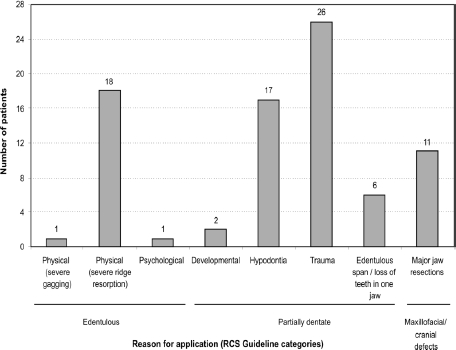
Clinical indications for funding application.
Fifty-one of these patients (62.2%) had their application for funding approved. Thirty-one patients (37.8%) who were considered suitable for dental implant treatment according to the RCSE guidelines had their applications refused. The results show that there is significant variation between the PCTs in funding for dental implants (Fig. 2). The PCTs with the highest number of applications that were not granted funding were: South Gloucestershire (85.7% of applications; n = 6), North Somerset (71.4% of applications; n = 5), Gloucestershire (50% of applications; n = 6) and Wiltshire (42.9% of applications; n = 6).
Figure 2.
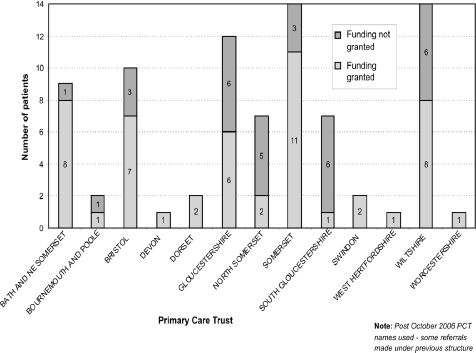
Funding decision according to PCT.
Twenty-five (49%) out of 51 cases in the partially dentate category and six (27.3%) cases in the edentulous group were unsuccessful in their application for NHS-funded dental implants. However, all applications for patients with acquired maxillofacial defects were successful. The partially dentate group appeared to provide the greatest disparity between patients meeting RCSE guidelines and approval for funding by PCTs (Fig. 3). The type of dental implant most commonly applied for by BDH over the 2-year audit period was a single tooth implant (Fig. 4). For a large majority of cases, PCTs made the decision to decline funding for this type of implant therapy. Twenty (74.1%) out of 27 applications were rejected. Of these 20 patients, all were in the partially dentate group.
Figure 3.
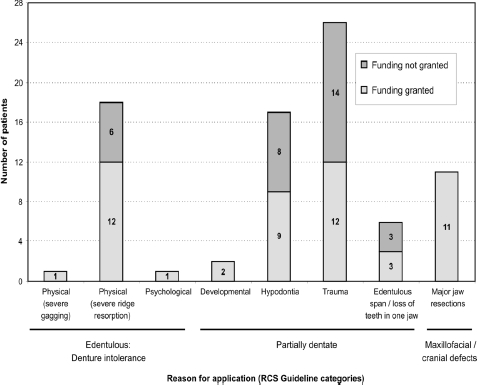
Funding decision according to reason for application.
Figure 4.
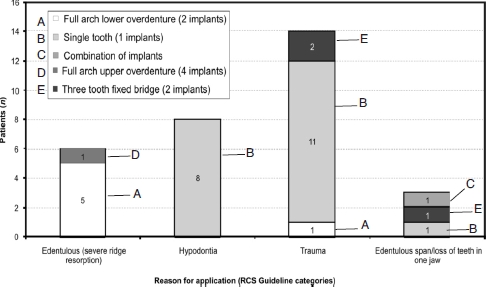
Type of implant and clinical reason for application where funding is not granted.
Discussion
Anecdotally, there is a disparity between NHS resources and demand for dental implant therapy. This audit aimed to investigate whether BDH was selecting patients in accordance with the RCSE national guidelines and if PCTs in the South West of England were allocating funds to identified ‘high-priority’ patients.
A relatively high percentage of patients (37.8%) who appeared to meet both the RCSE guidelines and also considered suitable for NHS-funded dental implants by the BDH did not receive funding from a number of the PCTs. There appeared to be a difference in funding decisions according to geographical location. It also seems that the PCTs have clinical priority ratings: patients who have received treatment for head and neck cancer, who have significant developmental hypodontia and extensive oral pathology or trauma, are often considered high-priority whereas patients with mild hypodontia or trauma as well as the edentulous are often considered lower priority. This is evident when comparing the type of implant cases that are not funded despite identified clinical need. Single dental implants are most likely to be rejected in the hypodontia and trauma categories. The RCSE guidelines state that patients with developmentally missing teeth and those that have acquired loss through trauma should be considered to be equal priority. The magnitude or impact of the patient's disability does not necessarily correlate with the aetiology or the size of the deformity.2 There is considerable need to open a debate within the profession to reach a consensus on the treatment of choice for patients with hypodontia and trauma in an otherwise intact dentition.
There needs to be further research into quality of life after treatment with dental implants and long-term studies on cost effectiveness of dental implants versus conventional treatment. It is likely that there will be an increased demand for economic analyses of dental implants by the public and those funding healthcare and the National Institute for Health and Clinical Excellence (NICE) may have an important role in this area in the future. Only by improving research in economic evaluation and by improving planning and management systems will the NHS progress.5 Demands for treatment currently cannot be met and changes need to be made.
At present, there would appear to be an inconsistency between the identified RCSE priority groups and individual PCT selection criteria. Revision of the guidelines with more highly specific criteria would make it easier to standardise patient selection between providers and PCTs and also ensure a more equitable decision making process between PCTs.
Conclusions
Patient selection for dental implant funding by BDH complied with the RCSE national guidelines. However, there was significant variation in funding between PCTs for those patients who apparently fulfilled the RCSE guidelines. This was particularly the case for edentulous patients as well as those with single anterior teeth missing due to trauma or developmental hypodontia. NHS resources are not being allocated equitably for dental implant ‘high-priority’ patients and it would appear that a so-called ‘postcode lottery’ exists between PCTs.
References
- 1.Adell R, Eriksson B, Lekholm U, Brånemark PI, Jemt T. A long term follow-up study of osseointegrated implants in the treatment of totally edentulous jaws. Int J Oral Maxillofac Implants. 1990;5:347–59. [PubMed] [Google Scholar]
- 2.The Royal College of Surgeons of England. Guidelines for selecting appropriate patients to receive treatment with dental implants: Priorities for the NHS. London: RCSE; 1997. Faculty of Dental Surgery, National Clinical Guidelines. [DOI] [PubMed] [Google Scholar]
- 3.Butterworth CJ, Baxter AM, Shaw MJ, Bradnock G. The provision of dental implants in the National Health Service hospital dental services - a national questionnaire. Br Dent J. 2001;190:93–6. doi: 10.1038/sj.bdj.4800892. [DOI] [PubMed] [Google Scholar]
- 4.Calman K, Hine D. A policy framework for commissioning cancer services: a report by the expert advisory group on cancer to the Chief Medical Officers of England and Wales. London: Department of Health; 1995. [Google Scholar]
- 5.Cunningham SJ. Economic evaluation of healthcare - is it important to us? Br Dent J. 2000;188:250–4. doi: 10.1038/sj.bdj.4800444. [DOI] [PubMed] [Google Scholar]