



Abstract
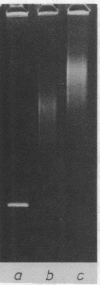
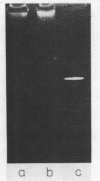
The hypothesis about the role of partial denaturation in DNA retardation during its electrophoresis in denaturing gel /1,2/ was tested. We used partially melted DNA molecules in which the size of the melted regions and their location were known. They were obtained through glyoxal treatment of the melted regions by a procedure allowing the denatured state to be fixed at any point within the melting range. The approach and the availability of the melting maps of DNAs made it possible to investigate DNA molecules differing in length and in the size of the melted regions. The presence of a denatured region at the end of the molecule or inside of it was shown to decrease its electrophoretic mobility, the effect depending on the size of the melted region and on the DNA length. On the basis of the experimental results an explanation is proposed for the cause of retardation in the case of partially denatured DNA.
Full text
PDF


Images in this article




Selected References
These references are in PubMed. This may not be the complete list of references from this article.
- Amirikyan B. R., Vologodskii A. V., Lyubchenko YuL Determination of DNA cooperativity factor. Nucleic Acids Res. 1981 Oct 24;9(20):5469–5482. doi: 10.1093/nar/9.20.5469. [DOI] [PMC free article] [PubMed] [Google Scholar]
- Borovik A. S., Kalambet Y. A., Lyubchenko Y. L., Shitov V. T., Golovanov E. I. Equilibrium melting of plasmid ColE1 DNA: electron-microscopic visualization. Nucleic Acids Res. 1980 Sep 25;8(18):4165–4184. doi: 10.1093/nar/8.18.4165. [DOI] [PMC free article] [PubMed] [Google Scholar]
- Broude N. E., Budowsky E. I. The reaction of glyoxal with nucleic acid components. V. Denaturation of DNA under the action of glyoxal. Biochim Biophys Acta. 1973 Feb 4;294(1):378–384. doi: 10.1016/0005-2787(73)90092-0. [DOI] [PubMed] [Google Scholar]
- Fischer S. G., Lerman L. S. Length-independent separation of DNA restriction fragments in two-dimensional gel electrophoresis. Cell. 1979 Jan;16(1):191–200. doi: 10.1016/0092-8674(79)90200-9. [DOI] [PubMed] [Google Scholar]
- Fischer S. G., Lerman L. S. Separation of random fragments of DNA according to properties of their sequences. Proc Natl Acad Sci U S A. 1980 Aug;77(8):4420–4424. doi: 10.1073/pnas.77.8.4420. [DOI] [PMC free article] [PubMed] [Google Scholar]
- Müller W., Hattesohl I., Schuetz H. J., Meyer G. Polyethylene glycol derivatives of base and sequence specific DNA ligands: DNA interaction and application for base specific separation of DNA fragments by gel electrophoresis. Nucleic Acids Res. 1981 Jan 10;9(1):95–119. doi: 10.1093/nar/9.1.95. [DOI] [PMC free article] [PubMed] [Google Scholar]
- Oka A., Nomura N., Morita M., Sugisaki H., Sugimoto K., Takanami M. Nucleotide sequence of small ColE1 derivatives: structure of the regions essential for autonomous replication and colicin E1 immunity. Mol Gen Genet. 1979 May 4;172(2):151–159. doi: 10.1007/BF00268276. [DOI] [PubMed] [Google Scholar]
- Pavlov V. M., Lyubchenko Y. L., Borovik A. S., Lazurkin Y. S. Specific fragmentation of T7 phage DNA at low-melting sites. Nucleic Acids Res. 1977 Nov;4(11):4053–4062. doi: 10.1093/nar/4.11.4053. [DOI] [PMC free article] [PubMed] [Google Scholar]
- Studier F. W., Rosenberg A. H., Simon M. N., Dunn J. J. Genetic and physical mapping in the early region of bacteriophage T7 DNA. J Mol Biol. 1979 Dec 25;135(4):917–937. doi: 10.1016/0022-2836(79)90520-5. [DOI] [PubMed] [Google Scholar]