



Abstract
The latent capacity of human platelets for oxidizing several important energy-yielding substrates has been revealed by hypoosmolaric incubation conditions.
The data show that the human platelet has a considerable capacity to oxidize both glucose and long-chain fatty acids. Long-chain fatty acids appear to rank favorably with glucose as a potential energy substrate. In a number of mammalian tissues, (—)-carnitine serves to regulate the rate at which long-chain fatty acids are oxidized. Evidence was obtained which suggests that (—)-carnitine functions in a similar role in the platelet.
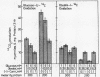
After storage of human platelets at 4°C for 24 hr, the oxidative capacity for glucose was reduced by approximately 25% and for long-chain fatty acids by almost 50%. Investigation of the component parts of the metabolic pathways indicated that a marked decrease in the capacity of the Krebs cycle could be responsible for the decrement in energy substrate oxidation.
Full text
PDF


Images in this article

Selected References
These references are in PubMed. This may not be the complete list of references from this article.
- BALDINI M., COSTEA N., DAMESHEK W. The viability of stored human platelets. Blood. 1960 Dec;16:1669–1692. [PubMed] [Google Scholar]
- BENDALL D. S., DE DUVE C. Tissue-fractionation studies. 14. The activation of latent dehydrogenases in mitochondria from rat liver. Biochem J. 1960 Mar;74:444–450. doi: 10.1042/bj0740444. [DOI] [PMC free article] [PubMed] [Google Scholar]
- BLIGH E. G., DYER W. J. A rapid method of total lipid extraction and purification. Can J Biochem Physiol. 1959 Aug;37(8):911–917. doi: 10.1139/o59-099. [DOI] [PubMed] [Google Scholar]
- BODE C., KLINGENBERG M. DIE VERATMUNG VON FETTSAEUREN IN ISOLIERTEN MITOCHONDRIEN. Biochem Z. 1965 Feb 24;341:271–299. [PubMed] [Google Scholar]
- BRECHER G., CRONKITE E. P. Morphology and enumeration of human blood platelets. J Appl Physiol. 1950 Dec;3(6):365–377. doi: 10.1152/jappl.1950.3.6.365. [DOI] [PubMed] [Google Scholar]
- BREMER J. Carnitine in intermediary metabolism. The metabolism of fatty acid esters of carnitine by mitochondria. J Biol Chem. 1962 Dec;237:3628–3632. [PubMed] [Google Scholar]
- Born G. V. Uptake of adenosine and of adenosine diphosphate by human blood platelets. Nature. 1965 Jun 12;206(989):1121–1122. doi: 10.1038/2061121a0. [DOI] [PubMed] [Google Scholar]
- CAMPBELL E. W., SMALL W. J., DAMESHEK W. Metabolic activity of human blood platelets. I. J Lab Clin Med. 1956 Jun;47(6):835–843. [PubMed] [Google Scholar]
- Cohen P., Cooley M. H., Gardner F. H. Platelet preservation. 3. Comparison of radioactivity yields of platelet concentrates derived from blood anticoagulated with EDTA and ACD. N Engl J Med. 1965 Oct 14;273(16):845–850. doi: 10.1056/NEJM196510142731603. [DOI] [PubMed] [Google Scholar]
- DOLE V. P., MEINERTZ H. Microdetermination of long-chain fatty acids in plasma and tissues. J Biol Chem. 1960 Sep;235:2595–2599. [PubMed] [Google Scholar]
- Deykin D., Desser R. K. The incorporation of acetate and palmitate into lipids by human platelets. J Clin Invest. 1968 Jul;47(7):1590–1602. doi: 10.1172/JCI105851. [DOI] [PMC free article] [PubMed] [Google Scholar]
- ESTES J. W., McGOVERN J. J., GOLDSTEIN R., ROTA M. Stability of certain coagulation factors and metabolic activities of platelets in stored blood. J Lab Clin Med. 1962 Mar;59:436–444. [PubMed] [Google Scholar]
- FRAENKEL G., FRIEDMAN S. Carnitine. Vitam Horm. 1957;15:73–118. doi: 10.1016/s0083-6729(08)60508-7. [DOI] [PubMed] [Google Scholar]
- FRITZ I. B. Factors influencing the rates of long-chain fatty acid oxidation and synthesis in mammalian systems. Physiol Rev. 1961 Jan;41:52–129. doi: 10.1152/physrev.1961.41.1.52. [DOI] [PubMed] [Google Scholar]
- FRITZ I. B., YUE K. T. LONG-CHAIN CARNITINE ACYLTRANSFERASE AND THE ROLE OF ACYLCARNITINE DERIVATIVES IN THE CATALYTIC INCREASE OF FATTY ACID OXIDATION INDUCED BY CARNITINE. J Lipid Res. 1963 Jul;4:279–288. [PubMed] [Google Scholar]
- GUREVITCH J., NELKEN D. Osmotic fragility of human blood platelets. Blood. 1956 Oct;11(10):924–928. [PubMed] [Google Scholar]
- HOFFMAN J. F. The active transport of sodium by ghosts of human red blood cells. J Gen Physiol. 1962 May;45:837–859. doi: 10.1085/jgp.45.5.837. [DOI] [PMC free article] [PubMed] [Google Scholar]
- HOGEBOOM G. H., SCHNEIDER W. C. Intracellular distribution of enzymes. XI. Glutamic dehydrogenase. J Biol Chem. 1953 Sep;204(1):233–238. [PubMed] [Google Scholar]
- Haldar D., Freeman K. B. Importance of the osmolarity of the incubation medium on amino acid incorporation into protein by isolated rat liver mitochondria. Biochem J. 1969 Mar;111(5):653–661. doi: 10.1042/bj1110653. [DOI] [PMC free article] [PubMed] [Google Scholar]
- KORNBERG A., PRICER W. E., Jr Enzymatic synthesis of the coenzyme A derivatives of long chain fatty acids. J Biol Chem. 1953 Sep;204(1):329–343. [PubMed] [Google Scholar]
- Karpatkin S. Studies on human platelet glycolysis. Effect of glucose, cyanide, insulin, citrate, and agglutination and contraction on platelet glycolysis. J Clin Invest. 1967 Mar;46(3):409–417. doi: 10.1172/JCI105542. [DOI] [PMC free article] [PubMed] [Google Scholar]
- Kerby G. P., Taylor S. M. The effect of added ATP on the pathways of glucose utilization by human washed platelets in vitro. J Lab Clin Med. 1967 Feb;69(2):194–203. [PubMed] [Google Scholar]
- LEHNINGER A. L. Phosphorylation coupled to oxidation of dihydrodiphosphopyridine nucleotide. J Biol Chem. 1951 May;190(1):345–359. [PubMed] [Google Scholar]
- LOEHR G. W., WALLER H. D. [Cellular metabolism and cellular aging]. Klin Wochenschr. 1959 Aug 15;37:833–843. doi: 10.1007/BF01479896. [DOI] [PubMed] [Google Scholar]
- MARQUIS N. R., FRITZ I. B. ENZYMOLOGICAL DETERMINATION OF FREE CARNITINE CONCENTRATIONS IN RAT TISSUES. J Lipid Res. 1964 Apr;5:184–187. [PubMed] [Google Scholar]
- RANDLE P. J. THE INTERRELATIONSHIPS OF HORMONES, FATTY ACID AND GLUCOSE IN THE PROVISION OF ENERGY. Postgrad Med J. 1964 Aug;40:457–463. doi: 10.1136/pgmj.40.466.457. [DOI] [PMC free article] [PubMed] [Google Scholar]
- Rosenzweig A., Ways P. The oxidation of long-chain fatty acids by the formed elements of human blood. Blood. 1966 Jan;27(1):57–64. [PubMed] [Google Scholar]
- Rossi E. C. Effects of ethylenediaminetetraacetate (EDTA) and citrate upon platelet glycolysis. J Lab Clin Med. 1967 Feb;69(2):204–216. [PubMed] [Google Scholar]
- STRACK E., LORENZ I. [The preparation of L-carnitine and its isomers]. Hoppe Seylers Z Physiol Chem. 1960 May 31;318:129–137. doi: 10.1515/bchm2.1960.318.1.129. [DOI] [PubMed] [Google Scholar]
- TEDESCHI H., HARRIS D. L. The osmotic behavior and permeability to non-electrolytes of mitochondria. Arch Biochem Biophys. 1955 Sep;58(1):52–67. doi: 10.1016/0003-9861(55)90092-8. [DOI] [PubMed] [Google Scholar]
- TROUT D. L., ESTES E. H., Jr, FRIEDBERG S. J. Titration of free fatty acids of plasma: a study of current methods and a new modification. J Lipid Res. 1960 Apr;1:199–202. [PubMed] [Google Scholar]
- Warshaw A. L., Laster L., Shulman N. R. The stimulation by thrombin of glucose oxidation in human platelets. J Clin Invest. 1966 Dec;45(12):1923–1934. doi: 10.1172/JCI105497. [DOI] [PMC free article] [PubMed] [Google Scholar]
- Wittels B., Hochstein P. The identification of carnitine palmityltransferase in erythrocyte membranes. J Biol Chem. 1967 Jan 10;242(1):126–130. [PubMed] [Google Scholar]