



Abstract
The function of carbonic anhydrase in H+ secretion by the turtle bladder was studied in vitro. Dose response curves were obtained for the carbonic anhydrase inhibitors, acetazolamide and ethoxzolamide, with and without addition of CO2 to the system. In addition, carbonic anhydrase was assayed in homogenates of mucosal cells. The activity in the homogenates was 155±16 U/g dry wt, of which only 11 U represented contamination from erythrocytes; after addition of 5 × 10⁻⁶m acetazolamide, no enzyme activity was detectable.
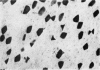
In the intact preparation free of exogenous CO2, the dose response curve for acetazolamide showed two plateaus of inhibition, one at 50% and one at more than 80% inhibition. At 50% inhibition (from 5 × 10⁻⁶ to 5 × 10⁻⁵m acetazolamide), H+ secretion was restored or enhanced by CO2 addition to the same extent as bladders not exposed to acetazolamide. At concentrations of more than 1 × 10⁻⁴m, H+ secretion was no longer restorable by CO2. Unlike acetazolamide, ethoxzolamide caused progressive inhibition of H+ secretion in the CO2-free system. The maximal extent of inhibition with ethoxzolamide and the behavior of inhibition in the presence of 2.5% CO2 were the same as for acetazolamide. Evidence is presented that all surface epithelial cells secrete H+ and generate OH− within the cell interior. The capacity of cells to dispose of OH− by CO2 hydroxylation varies with the availability of cytoplasmic carbonic anhydrase. A small population of cells contains abundant carbonic anhydrase and secretes at high rates even when CO2 is in short supply.
On the basis of these results and histochemical data on the distribution of carbonic anhydrase within the mucosa, an analysis is presented of the epithelial organization of acidification by the turtle bladder.
Full text
PDF


Images in this article

Selected References
These references are in PubMed. This may not be the complete list of references from this article.
- Adrian C., Hogben M. The chloride effect of carbonic anhydrase inhibitors. Mol Pharmacol. 1967 Jul;3(4):318–326. [PubMed] [Google Scholar]
- CROSBY W. H., FURTH F. W. A modification of the benzidine method for measurement of hemoglobin in plasma and urine. Blood. 1956 Apr;11(4):380–383. [PubMed] [Google Scholar]
- Carter M. J., Parsons D. S. The isoenzymes of carbonic anhydrase: tissue, subcellular distribution and functional significance, with particular reference to the intestinal tract. J Physiol. 1971 May;215(1):71–94. doi: 10.1113/jphysiol.1971.sp009458. [DOI] [PMC free article] [PubMed] [Google Scholar]
- DURBIN R. P., HEINZ E. Electromotive chloride transport and gastric acid secretion in the frog. J Gen Physiol. 1958 May 20;41(5):1035–1047. doi: 10.1085/jgp.41.5.1035. [DOI] [PMC free article] [PubMed] [Google Scholar]
- Gonzalez C. F., Schilb T. P. Acetazolamide-sensitive short-circuited current versus mucosal HCO3- concentration in turtle bladders. Biochim Biophys Acta. 1969;193(2):419–429. doi: 10.1016/0005-2736(69)90201-6. [DOI] [PubMed] [Google Scholar]
- Green H. H., Steinmetz P. R., Frazier H. S. Evidence for proton transport by turtle bladder in presence of ambient bicarbonate. Am J Physiol. 1970 Mar;218(3):845–850. doi: 10.1152/ajplegacy.1970.218.3.845. [DOI] [PubMed] [Google Scholar]
- Hansson H. P. Histochemical demonstration of carbonic anhydrase activity in some epithelia noted for active transport. Acta Physiol Scand. 1968 Aug;73(4):427–434. doi: 10.1111/j.1365-201x.1968.tb10882.x. [DOI] [PubMed] [Google Scholar]
- Hirschhorn N., Frazier H. S. Intracellular electrical potential of the epithelium of turtle bladder. Am J Physiol. 1971 May;220(5):1158–1161. doi: 10.1152/ajplegacy.1971.220.5.1158. [DOI] [PubMed] [Google Scholar]
- MAREN T. H. A simplified micromethod for the determination of carbonic anhydrase and its inhibitors. J Pharmacol Exp Ther. 1960 Sep;130:26–29. [PubMed] [Google Scholar]
- MAREN T. H., ASH V. I., BAILEY E. M., Jr Carbonic anhydrase inhibition. II. A method for determination of carbonic anhydrase inhibitors, particularly of diamox. Bull Johns Hopkins Hosp. 1954 Nov;95(5):244–255. [PubMed] [Google Scholar]
- Maffly R. H. A conductometric method for measuring micromolar quantities of carbon dioxide. Anal Biochem. 1968 May;23(2):252–262. doi: 10.1016/0003-2697(68)90357-6. [DOI] [PubMed] [Google Scholar]
- Maren T. H. Carbonic anhydrase: chemistry, physiology, and inhibition. Physiol Rev. 1967 Oct;47(4):595–781. doi: 10.1152/physrev.1967.47.4.595. [DOI] [PubMed] [Google Scholar]
- Maren T. H., Ellison A. C. A study of renal carbonic anhydrase. Mol Pharmacol. 1967 Nov;3(6):503–508. [PubMed] [Google Scholar]
- Maren T. H., Wiley C. W. Kinetics of carbonic anhydrase in whole red cells as measured by transfer of carbon dioxide and ammonia. Mol Pharmacol. 1970 Jul;6(4):430–440. [PubMed] [Google Scholar]
- Philpot F. J., Philpot J. S. A modified colorimetric estimation of carbonic anhydrase. Biochem J. 1936 Dec;30(12):2191–2193. doi: 10.1042/bj0302191. [DOI] [PMC free article] [PubMed] [Google Scholar]
- RADTKE H. W., Rumrich G., Kinne-saffran E., Ulrich K. J. Dual action of acetazolamide and furosemide on proximal volume absorption in the rat kidney. Kidney Int. 1972 Feb;1(2):100–105. doi: 10.1038/ki.1972.13. [DOI] [PubMed] [Google Scholar]
- Rosen S. Localization of carbonic anhydrase acitivity in transporting urinary epithelia. J Histochem Cytochem. 1970 Sep;18(9):668–670. doi: 10.1177/18.9.668. [DOI] [PubMed] [Google Scholar]
- Rosen S. Localization of carbonic anhydrase activity in the vertebrate nephron. Histochem J. 1972 Jan;4(1):35–48. doi: 10.1007/BF01005267. [DOI] [PubMed] [Google Scholar]
- Rosen S. The turtle bladder. I. Morphological studies under varying conditions of fixation. Exp Mol Pathol. 1970 Jun;12(3):286–296. doi: 10.1016/0014-4800(70)90060-2. [DOI] [PubMed] [Google Scholar]
- Schilb T. P., Brodsky W. A. Acidification of mucosal fluid by transport of bicarbonate ion in turtle bladders. Am J Physiol. 1966 May;210(5):997–1008. doi: 10.1152/ajplegacy.1966.210.5.997. [DOI] [PubMed] [Google Scholar]
- Schwartz J. H., Steinmetz P. R. CO2 requirements for H+ secretion by the isolated turtle bladder. Am J Physiol. 1971 Jun;220(6):2051–2057. doi: 10.1152/ajplegacy.1971.220.6.2051. [DOI] [PubMed] [Google Scholar]
- Scott W. N., Shamoo Y. E., Brodsky W. A. Carbonic anhydrase content of turtle urinary bladder mucosal cells. Biochim Biophys Acta. 1970;219(1):248–250. doi: 10.1016/0005-2736(70)90084-2. [DOI] [PubMed] [Google Scholar]
- Steinmetz P. R. Acid-base relations in epithelium of turtle bladder: site of active step in acidification and role of metabolic CO2. J Clin Invest. 1969 Jul;48(7):1258–1265. doi: 10.1172/JCI106091. [DOI] [PMC free article] [PubMed] [Google Scholar]
- Steinmetz P. R. Characteristics of hydrogen ion transport in urinary bladder of water turtle. J Clin Invest. 1967 Oct;46(10):1531–1540. doi: 10.1172/JCI105644. [DOI] [PMC free article] [PubMed] [Google Scholar]
- Steinmetz P. R., Lawson L. R. Effect of luminal pH on ion permeability and flows of Na+and H+ in turtle bladder. Am J Physiol. 1971 Jun;220(6):1573–1580. doi: 10.1152/ajplegacy.1971.220.6.1573. [DOI] [PubMed] [Google Scholar]
- Struyvenberg A., Morrison R. B., Relman A. S. Acid-base behavior of separated canine renal tubule cells. Am J Physiol. 1968 May;214(5):1155–1162. doi: 10.1152/ajplegacy.1968.214.5.1155. [DOI] [PubMed] [Google Scholar]
- Surface topography and electron probe analysis of carbonic anhydrase-containing cells in the turtle bladder mucosa. J Histochem Cytochem. 1972 Jul;20(7):548–551. doi: 10.1177/20.7.548. [DOI] [PubMed] [Google Scholar]
- Wheeler H. O., Ross E. D., King K. K. Effect of carbonic anhydrase inhibitors on isolated rabbit gallbladders. Am J Physiol. 1969 Jan;216(1):175–178. doi: 10.1152/ajplegacy.1969.216.1.175. [DOI] [PubMed] [Google Scholar]
- Wistrand P. J., Båthe P. Inhibition of carbonic anhydrase activity of whole erythrocytes. Acta Pharmacol Toxicol (Copenh) 1968;26(2):145–168. doi: 10.1111/j.1600-0773.1968.tb00434.x. [DOI] [PubMed] [Google Scholar]