


Abstract
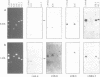
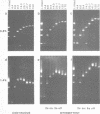
Under certain conditions of agarose gel electrophoresis, larger DNA molecules migrate faster than smaller ones. This anomalous mobility of DNA, which can lead to serious errors in the measurement of DNA fragment lengths, is related to near-zero velocity conformations which can trap DNA chains during electrophoresis. Intermittent electric fields can be used to alter the chain conformations so as to restore the monotonic mobility-size relationship which is necessary for a correct interpretation of the gel. These data are in agreement with the results of a computer simulation based on a theoretical model of electrophoresis.
Full text
PDF


Images in this article
Selected References
These references are in PubMed. This may not be the complete list of references from this article.
- Carle G. F., Frank M., Olson M. V. Electrophoretic separations of large DNA molecules by periodic inversion of the electric field. Science. 1986 Apr 4;232(4746):65–68. doi: 10.1126/science.3952500. [DOI] [PubMed] [Google Scholar]
- Carle G. F., Olson M. V. An electrophoretic karyotype for yeast. Proc Natl Acad Sci U S A. 1985 Jun;82(11):3756–3760. doi: 10.1073/pnas.82.11.3756. [DOI] [PMC free article] [PubMed] [Google Scholar]
- Chu G., Vollrath D., Davis R. W. Separation of large DNA molecules by contour-clamped homogeneous electric fields. Science. 1986 Dec 19;234(4783):1582–1585. doi: 10.1126/science.3538420. [DOI] [PubMed] [Google Scholar]
- Edmondson S. P., Gray D. M. Analysis of the electrophoretic properties of double-stranded DNA and RNA in agarose gels at a finite voltage gradient. Biopolymers. 1984 Dec;23(12):2725–2742. doi: 10.1002/bip.360231204. [DOI] [PubMed] [Google Scholar]
- Elder J. K., Amos A., Southern E. M., Shippey G. A. Measurement of DNA length by gel electrophoresis. I. Improved accuracy of mobility measurements using a digital microdensitometer and computer processing. Anal Biochem. 1983 Jan;128(1):223–226. doi: 10.1016/0003-2697(83)90368-8. [DOI] [PubMed] [Google Scholar]
- Fangman W. L. Separation of very large DNA molecules by gel electrophoresis. Nucleic Acids Res. 1978 Mar;5(3):653–665. doi: 10.1093/nar/5.3.653. [DOI] [PMC free article] [PubMed] [Google Scholar]
- Jamil T., Lerman L. S. Dependence of the electrophoretic mobility of DNA in gels on field intermittency. J Biomol Struct Dyn. 1985 Feb;2(5):963–966. doi: 10.1080/07391102.1985.10507612. [DOI] [PubMed] [Google Scholar]
- Lalande M., Noolandi J., Turmel C., Rousseau J., Slater G. W. Pulsed-field electrophoresis: application of a computer model to the separation of large DNA molecules. Proc Natl Acad Sci U S A. 1987 Nov;84(22):8011–8015. doi: 10.1073/pnas.84.22.8011. [DOI] [PMC free article] [PubMed] [Google Scholar]
- Lerman L. S., Frisch H. L. Why does the electrophoretic mobility of DNA in gels vary with the length of the molecule? Biopolymers. 1982 May;21(5):995–997. doi: 10.1002/bip.360210511. [DOI] [PubMed] [Google Scholar]
- Lumpkin O. J., Déjardin P., Zimm B. H. Theory of gel electrophoresis of DNA. Biopolymers. 1985 Aug;24(8):1573–1593. doi: 10.1002/bip.360240812. [DOI] [PubMed] [Google Scholar]
- Meinkoth J., Wahl G. Hybridization of nucleic acids immobilized on solid supports. Anal Biochem. 1984 May 1;138(2):267–284. doi: 10.1016/0003-2697(84)90808-x. [DOI] [PubMed] [Google Scholar]
- Noolandi J, Rousseau J, Slater GW, Turmel C, Lalande M. Self-trapping and anomalous dispersion of DNA in electrophoresis. Phys Rev Lett. 1987 Jun 8;58(23):2428–2431. doi: 10.1103/PhysRevLett.58.2428. [DOI] [PubMed] [Google Scholar]
- Robinson L. H., Landy A. HindII, HindIII, and HpaI restriction fragment maps of bacteriophage lambda DNA. Gene. 1977 Sep;2(1):1–31. doi: 10.1016/0378-1119(77)90019-1. [DOI] [PubMed] [Google Scholar]
- Sanger F., Coulson A. R., Hong G. F., Hill D. F., Petersen G. B. Nucleotide sequence of bacteriophage lambda DNA. J Mol Biol. 1982 Dec 25;162(4):729–773. doi: 10.1016/0022-2836(82)90546-0. [DOI] [PubMed] [Google Scholar]
- Schwartz D. C., Cantor C. R. Separation of yeast chromosome-sized DNAs by pulsed field gradient gel electrophoresis. Cell. 1984 May;37(1):67–75. doi: 10.1016/0092-8674(84)90301-5. [DOI] [PubMed] [Google Scholar]
- Slater G. W., Rousseau J., Noolandi J., Turmel C., Lalande M. Quantitative analysis of the three regimes of DNA electrophoresis in agarose gels. Biopolymers. 1988 Mar;27(3):509–524. doi: 10.1002/bip.360270311. [DOI] [PubMed] [Google Scholar]
- Sodroski J. G., Goh W. C., Haseltine W. A. Transforming potential of a human protooncogene (c-fps/fes) locus. Proc Natl Acad Sci U S A. 1984 May;81(10):3039–3043. doi: 10.1073/pnas.81.10.3039. [DOI] [PMC free article] [PubMed] [Google Scholar]
- Trus M. D., Sodroski J. G., Haseltine W. A. Isolation and characterization of a human locus homologous to the transforming gene (v-fes) of feline sarcoma virus. J Biol Chem. 1982 Mar 25;257(6):2730–2733. [PubMed] [Google Scholar]