



Abstract
A systematic review of risk factors for intimate partner violence was conducted. Inclusion criteria included publication in a peer-reviewed journal, a representative community sample or a clinical sample with a control-group comparison, a response rate of at least 50%, use of a physical or sexual violence outcome measure, and control of confounding factors in the analyses. A total of 228 articles were included (170 articles with adult and 58 with adolescent samples). Organized by levels of a dynamic developmental systems perspective, risk factors included: (a) contextual characteristics of partners (demographic, neighborhood, community and school factors), (b) developmental characteristics and behaviors of the partners (e.g., family, peer, psychological/behavioral, and cognitive factors), and (c) relationship influences and interactional patterns. Comparisons to a prior review highlight developments in the field in the past 10 years. Recommendations for intervention and policy along with future directions for intimate partner violence (IPV) risk factor research are presented.
Keywords: future research, intervention, intimate partner violence, perpetration, policy, risk factors, men, systematic review, women, victimization
Issues related to intimate partner violence (IPV) in married, cohabiting, and dating couples have generated a great deal of interest from scholars, social activists, and the public. Reports based on national surveys indicate that the rate of physical IPV toward a partner in the prior year for United States couples ranges from 17% to 39% (Elliot, Huizinga, & Morse, 1985; Plichta, 1996; Schafer, Caetano, & Clark, 1998; Straus & Gelles, 1990), with rates from a meta-analysis being relatively similar for men and women within studies, although usually slightly higher for women (Archer, 2000). Prevalence rates from the recent National Intimate Partner and Sexual Violence Survey remain high for both men and women, estimated at more than 4.2 million intimate-partner-related physical assaults, rapes, and stalking perpetrated against women annually and 3.2 million physical assaults, rapes, and stalking against men (Black et al., 2011).
The purpose of this study was to provide a comprehensive compilation and systematic review of studies involving risk factors for IPV, including the perpetration of physical, psychological, and sexual abuse. IPV can be best understood from a dynamic developmental systems perspective (DDS) in which couple aggression is conceptualized as an interactional pattern that is responsive to the conjoint developmental characteristics and behaviors of each partner, as well as contextual factors and relationship influences and processes (Capaldi, Kim, & Shortt, 2004; Capaldi, Shortt, & Kim, 2005). Using a DDS perspective as an organizing conceptual framework, risk factors in (a) contextual characteristics (e.g., age, gender, race/ethnicity), (b) developmental characteristics (e.g., family relationships, developmental psychopathology), and (c) relationship influences such as relationship satisfaction were reviewed to determine the extent to which each of these factors predicted IPV in adult and adolescent relationships. Note that although different types of aggression or abuse (e.g., physical, psychological, and sexual abuse) may be interrelated (Hamby & Sugarman, 1999; Murphy & O’Leary, 1989; O’Leary, 1999), it is not within the scope of the current review to examine them as risk factors for each other.
IPV encompasses physical, psychological, and sexual abuse by men and by women toward romantic partners of the same or opposite sex. Physical violence involves forceful physical contact that may vary from light pushes and slaps to severe beatings and lethal violence. Sexual abuse includes coercive and physical behaviors varying from trying to persuade someone to perform a sexual act against their will, ignoring “no” responses, to physically forced sex acts (Teten, Hall, & Capaldi, 2009; Tjaden & Thoennes, 2000). The term psychological aggression (or emotional abuse) refers to acting in an offensive or degrading manner toward another, usually verbally, and may include threats, ridicule, withholding affection, and restrictions (e.g., social isolation, financial control) (O’Leary & Maiuro, 2001). Some degree of psychological abuse, at least at a minor or occasional level, is very common (Shortt et al., 2011). Further, psychological abuse tends to be associated with physical abuse. For example, Capaldi and Crosby (1997) found that at age 18 years the two types of abuse perpetration were significantly associated for young men and young women (r = .60 for men, r = .55 for women, both p < .001), and psychological abuse has been found predictive of physical abuse and to have severe impacts (O’Leary & Maiuro, 2001).
Method: Systematic Review
Prior literature reviews of risk factors for IPV were published 10 years ago. For example, Schumacher, Feldbau-Kohn, Smith Slep, and Heyman (2001) reviewed risk factors for male-to-female physical violence, and their study was informative in establishing inclusions and exclusion criteria for the current study. Meta analyses that were conducted in the past decade focused on specific risk factors, such as intergenerational transmission of violence, relationship satisfaction, and substance use (Foran & O’Leary, 2008; Stith, Green, Smith, & Ward, 2008; Stith et al., 2000). Several same studies examined in these prior reviews are included in the current study. However, high research productivity in this field during the past decade enabled us to use greater study selectivity in our inclusion criteria and increase the overall study quality.
Literature Search
Parallel literature searches were conducted in PsycINFO, Web of Science, MEDLINE, and CSA Illumina’s Social Services Abstracts Indexes and Limits. These databases were selected for their quality and depth of coverage of social science literature (Norris & Oppenheim, 2007; Taylor, Wylie, Dempster, & Donnelly, 2007). Search terms and strategies were selected through team collaboration as well as terms used in other reviews (e.g., Schumacher et al., 2001; Stith et al., 2008). Search terms included indexed terms unique to each database (e.g., MeSH terms, PsycINFO index), as well as selected text words to increase search effectiveness and to account for normal errors with database interindexer consistency (Leininger, 2000). Search terms included relationships (dating, couple, intimate partner, marital, spouse, husband, wife, same-sex partner), partner aggression (abuse, aggression, domestic violence, batter, maltreatment, violence), risk analysis (risk marker, risk factor, resilience, predictor, pathway, correlate), and specific risk factors (academic achievement, adolescent, age, alcohol, anger, antisocial, attitude, criminal behavior, delinquency, development, drug use, employment status, gender, intergenerational transmission, jealousy, marijuana, racial identity, relationship satisfaction, relationship status, pregnancy, religion, sexual coercion, substance use).
Journals identified for hand searching included Violence and Victims, Journal of Family Violence, and Journal of Interpersonal Violence because of the high volume of studies retrieved from these journals in database searches. Hand searching is an additional method to minimize indexing errors (Petticrew & Roberts, 2006). Reference lists from previous partner aggression literature reviews were searched for additional studies that were possibly not captured in database searches (Archer, 2002; Foran & O’Leary, 2008; Schumacher et al., 2001; Stith et al., 2000; Stith et al., 2008; Stith, Smith, Penn, Ward, & Tritt, 2004; Vives-Cases, Gil-Gonzalez, & Carrasco-Portino, 2009; Williams, Ghandour, & Kub, 2008). When methodological aspects of a study were unclear (e.g., missing reporting of response rate), lead authors were contacted for additional information. We were able to retrieve all studies selected for review.
Inclusion-Exclusion Criteria
Studies examined in this review were empirical studies that included one or more risk factors and a designated partner violence outcome. Studies were published in peer-reviewed journals and originated from the United States, Canada, United Kingdom, New Zealand, or Australia. To provide an adequate test of the association of the risk factor and partner violence outcome, studies had to include (a) a range or continuum of aggressive behavior ranging from mild to more severe and (b) participants who were nonaggressive as well as those who were aggressive to allow for judging the association of involvement in aggression with the risk factors. In addition, the studies involved (a) a community sample representative of some specified population (e.g., normative, at-risk) or (b) a clinical sample with a representative comparison group (i.e., involving matching on some criteria, not a sample of convenience). For inclusion, risk factors needed to be adequately described to provide definition and operationalization of the risk factors. In addition, the statistical association (or lack thereof) between the risk factor and abuse outcome had to be clear.
The most desirable design for examining the association of risk factors and outcomes was a longitudinal study where the risk factors were measured prior to the abuse outcome, controlling for competing risk factors. However, cross-sectional studies were included because relatively few longitudinal studies on IPV and risk factors exist. Studies that included only reports by one participant about the risk characteristics of their partner as predictors of that partner’s IPV were excluded as being a weak design. These studies chiefly involved women’s retrospective reports of their male partners’ risk factors, which are likely to be biased for those who experienced IPV.
Studies were selected for inclusion in three stages (see Figure 1). An initial screening of titles and abstracts was conducted followed by appraisal using a quality assessment checklist (Centre for Reviews and Dissemination, 2009). Inclusion criteria for the initial screening of titles and abstracts were (a) articles published in a peer-reviewed journal that (b) empirically evaluated one or more risk factor with a physical aggression outcome for partner aggression in adolescence or adulthood and (c) used either a representative community sample or reasonable control group comparison. Titles and abstracts that did not clearly state this information were retrieved for quality appraisal to reduce review bias. After duplicate articles were removed, study quality was assessed using a modification of the Downs and Black (1998) checklist, a well-validated appraisal tool with high inter-rater reliability approved for use in systematic reviews (Centre for Reviews and Dissemination, 2009; Deeks et al., 2003; Higgins & Green, 2011). Modifications to the Downs and Black checklist included the additional assessment criteria of (a) controlling for possible co-occurring risk factors and (b) response rate of 50% or greater, whereas (c) questions that pertained to randomized clinical trials were omitted. Fifteen percent of all articles were reviewed for checklist reliability with 89% agreement (kappa = .75). Discrepancies between reviewers were resolved through discussion and consensus.
Figure 1.
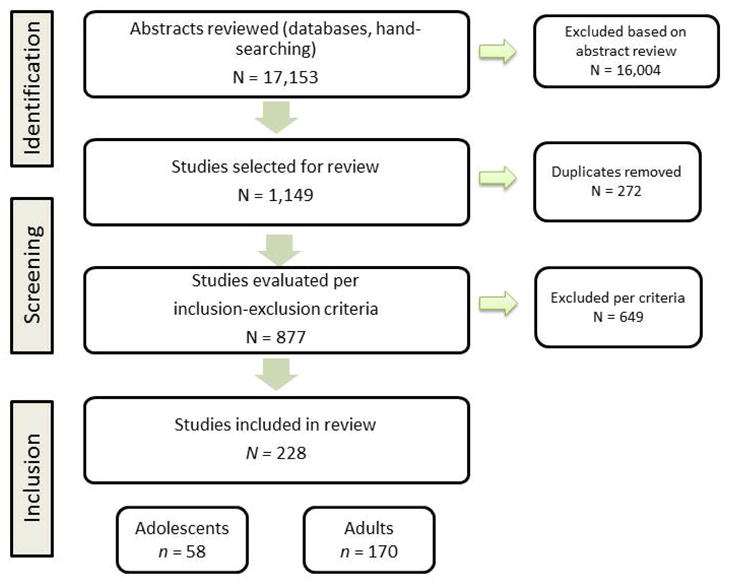
Flowchart of article identification, screening, and inclusion.
A total of 877 articles were reviewed with the appraisal checklist. Of the 649 excluded articles, sampling methodology accounted for 45.91% (20.49% convenience, 8.94% college students, 8.47% clinical sample with no control-group comparison, 8.01% nonrepresentative comparison sample); articles without an IPV outcome variable accounted for 18%, response rate below 50% (e.g., Smith Slep & O’Leary 2005 whose study used random digit dialing procedures) or where response rate was not reported accounted for 15.12% and prevalence studies accounted for 6.63%. Studies where the victim’s reported the perpetrator’s characteristics accounted for 1.54%, and studies with a maltreatment cluster variable or similar composite accounted for 1.85%. Studies that did not control for potentially confounding factors accounted for 3.7% of excluded articles. The remaining 7% were excluded because of other criteria (e.g., literature review, methodology article, qualitative, geographic reasons). The total number of studies included in the summary tables and systematic review was 228. None of the studies involving same-sex couples met criteria for inclusion. Hence, the studies summarized all involved heterosexual couples.
Study Type
As shown in Table 1, studies that met the selection criteria were first separated into studies with adult samples (age 18 years or older, n = 170) and studies with adolescent (dating) samples (n = 58), and then within each of these two larger subgroupings were ordered according to longitudinal versus cross-sectional design, and sample size. Some longitudinal studies still involved retrospective reporting of risk factors for IPV and therefore were categorized as longitudinal and retrospective. Very few studies with clinical samples (e.g., women in a shelter, emergency room samples) involved a representative comparison group who had not experienced IPV; only studies included with the community samples were examined in the current study. Studies were not separated by perpetration and victimization, especially as many studies examined both. Severity of violence measured ranged from mild to severe; however, violence severity was not used as an organizational category in the summary table due to few studies that compared more mild forms of violence with more severe violence (e.g., Foshee et al., 2009; Newby et al., 2003). In summary, summarized studies are presented in nested subsections as follows: Level 1: Adult versus Adolescent; Level 2: Longitudinal versus Cross-Sectional; and Level 3: Large sample (N = 500 or more) versus Smaller sample. There were considerably more adult studies than adolescent studies. Several of the longitudinal adult studies, however, involved predictors measured in adolescence, and a number assessed IPV in young adulthood. Note also that the longitudinal studies were more likely to be smaller samples, whereas the cross-sectional studies were considerably more likely to be large national or community samples.
Table 1.
Design Characteristics of Included Studies
| Sample Size | Adults (n= 170) | Adolescents (n = 58) | ||
|---|---|---|---|---|
| Frequency | Percentage | Frequency | Percentage | |
|
|
|
|||
| Sample > 950 | 102 | 60 | 29 | 50 |
| Sample < 950 – 75 | 68 | 40 | 29 | 50 |
| Methods | ||||
| Cross-sectional | 103 | 61 | 32 | 55 |
| Longitudinal | 67 | 39 | 26 | 45 |
| IPV Directionality | ||||
| MFPV, FMPV | 104 | 61 | 53 | 91 |
| MFPV | 62 | 36 | 5 | 9 |
| FMPV | 1 | 1 | 0 | 0 |
| MFPV, FFPV | 3 | 2 | 0 | 0 |
| Unit of Analysis | ||||
| Couple | 37 | 22 | 3 | 5 |
| Individual | 133 | 78 | 55 | 95 |
Finally, it should be noted that these 228 publications represent approximately 95 unique samples. Multiple studies were published on the same sample in order to address different research questions regarding predictors of IPV and also because longitudinal studies with different data availability over time leads to the possibility of addressing new questions. Multiple studies with five or more articles in the review included the following longitudinal studies: National Alcohol Survey and National Couples Survey (n = 19 articles), National Survey of Families and Households (n = 16 articles), Add Health Survey (n = 14 articles), National Family Violence Survey (n = 12 articles), Oregon Youth Study and OYS-Couples Study (n = 10 articles), Christchurch Study (n = 6 articles), Safe Dates Study (n = 6 articles), General Social Survey of Canada (n = 8 articles), Youth Risk Behavior Survey (n = 7 articles), National Violence Against Women Survey (n = 5 articles), and National Alcohol and Family Violence Survey (n = 5 articles).
Dynamic Developmental Systems Perspective
Within a dynamic developmental systems (DDS) perspective, the importance of considering risk factors in (a) contextual and demographic characteristics of both partners, (b) the characteristics and behaviors of both partners as products of each partners’ developmental history including socialization experiences, and (c) the couple’s relationship and interaction patterns within the dyad is emphasized (Capaldi et al., 2005). Each level of risk factors can be involved in the emergence as well as the course of IPV. The review summary first discusses IPV directionality (i.e., one partner versus both partners involved) found in the adult and adolescent studies and measurement of IPV. Risk factors in the contextual characteristics of the partners included demographic factors (age, gender, socioeconomic status [SES], race/ethnicity, acculturation, and stress), neighborhood and community-level factors, and school context factors. For the level of developmental characteristics and behaviors that male and female partners bring to the relationship, the following risk factors are discussed: family factors (exposure to IPV in family or origin, experience of child abuse, and parenting), peer associations and influences (association with deviant peers, social and emotional support), psychological and behavioral factors (conduct problems/antisocial behavior, personality disorder, depression, suicide attempts, alcohol and drug use, self-esteem), and cognitive factors (hostile attributes, attitudes, and beliefs). In the review, no studies meeting criteria were found on assertiveness, authoritarianism, and Axis I disorders other than antisocial behavior/personality. The risk factors discussed at the level of the couples’ relationship and interaction patterns included relationship status, relationship satisfaction, attachment, and negative emotionality and jealousy. No studies meeting criteria were found on dominance and empathy.
Within each section of risk factors, we focus on summarizing findings from the longitudinal studies, and then findings from the cross-sectional studies that were not in the longitudinal studies and any cross-sectional findings that add additional important information. In cases where a large number of studies focused on a specific risk factor were available, we only discuss some of the studies, trying to focus on studies with representative findings or counter findings and studies that focused on the risk factor as the main study questions. Many studies focused on one or two questions and predictor variables, and frequently included other risk factors as control variables. We tried to include reports of these associations where possible. In some cases, they were not reported separately in the article. Even in the longitudinal studies, it was sometimes the case that retrospective reporting was used for at least some risk factors, particularly for issues related to experience in earlier childhood such as child abuse and witnessing domestic violence, and in some cases proximal predictors (e.g., early adult substance use) were assessed at the same time as the IPV outcome. For simplicity, all of these findings are discussed within the longitudinal section.
Prior to describing sections of the main review tables, factors related to design of the reviewed studies (e.g., the proportion of studies examining bidirectional violence, the proportion of longitudinal versus cross-sectional studies) are summarized. As there were a large number of studies reviewed, not all studies were discussed in the Results section, but rather studies representative of findings or a body of findings or noteworthy for other reasons were discussed.
Results
Intimate Partner Violence Directionality
Of significance, particularly given the history of this field, is that most studies involved examination of both male-to-female IPV (MFPV) and female-to-male IPV (FMPV). Of the adult studies included, 61% examined bidirectional violence, whereas almost all of the adolescent studies examined bidirectional violence. Although most studies looked at men’s and women’s IPV, relatively few of the studies included and interviewed both members of the dyad, with 78% of the adult studies and 95% of the adolescent studies interviewing individuals only (however, note that many of those studies involved men and women).
Most studies (61% of adult studies and 55% of adolescent studies) were cross-sectional. The limitation of such a design is that it is impossible to determine directionality and establish if the risk factor (e.g., depressive symptoms) was present prior to the IPV or whether the risk factor might have been an outcome of the IPV.
It is informative to examine trends in whether the studies included MFPV, FMPV, or both for adult and adolescent studies by year of publication. Figure 2 shows that relatively few studies that met inclusion criteria were published prior to 1996 due primarily to sampling methodology (e.g., convenience samples, clinical samples with no control-group comparison) and not controlling for confounding factors (e.g., economic status). The number of studies that met criteria has increased substantially since the 1990s, with almost four times as many studies being published between 2005 and July 2011 as between 1996 and 2000. The adolescent studies almost all include bidirectional violence or both MFPV and FMPV, and the relative proportion of adult studies including both partner’s violence also appears to increase in 2006 to July 2011 compared with 2001 to 2005.
Figure 2.

Number of articles by intimate partner violence directionality and year of publication.
Measurement of Intimate Partner Violence
Studies on psychological and physical IPV relied predominantly on the Conflict Tactics Scale (CTS; Straus, Hamby, Boney-McCoy & Sugarman, 1996) in some form, either Form R or selected questions from the measure, and was used by 62% of the adult studies and 40% of the adolescent studies (see Table 2). Self-report measurement with one to three items among both adult and adolescent samples was a common strategy (adult sample 19%, adolescent samples 24%). Adolescent samples in this review did not include multimodal measurement encompassing observational data or multi-informant data, and only 5% of the adult studies included multimodal IPV measures. In part, the studies that incorporated observational data were often based on samples of convenience with limited sample sizes. See Schumacher et al. (2001) for further discussion of these studies. Among the studies that involved adolescent samples, the most frequent measures used after the CTS were the Safe Dates Scales (14%; Foshee et al., 1996), Conflict in Relationships Scale (9%; Wolfe et al., 1994), and the Conflict in Adolescent Dating Relationships Inventory (5%; Wolfe, et al. 2001). Many studies involved combined measures of psychological abuse and physical violence. Few studies addressed sexual victimization among adolescents. Subsequently, we discuss findings from the 228 studies by areas of risk factors ( reviewed in more detail in the online tables available at http://ww.springerpub.com/pa) Study abbreviations are shown in Table 3.
Table 2.
Measurement of Physical IPV within Adult and Adolescent Studies
| Measures | Frequency | Percentage |
|---|---|---|
| Adults | ||
| CTS (e.g., CTS Form R, various items) | 105 | 62 |
| 1-item self-report | 15 | 9 |
| 2-items self-report | 9 | 5 |
| 3-items self-report | 9 | 5 |
| 4 to 5-items self-report | 3 | 2 |
| 7 to 9-items self-report | 8 | 5 |
| 15 to 16-items self-report | 2 | 1 |
| 33-items self-report | 1 | 1 |
| Multimodal (e.g. observational, multi-informant report) | 9 | 5 |
| Official records only | 2 | 1 |
| Canadian General Social Survey items | 2 | 1 |
| Other | 5 | 3 |
| Adolescents | ||
| CTS (e.g., CTS Form R, various items) | 23 | 40 |
| 1-item self-report | 9 | 15 |
| 2 to 3-items self-report | 5 | 9 |
| 4 to 5-items self-report | 2 | 3 |
| 7 to 9-items self-report | 2 | 3 |
| 17-items self-report | 1 | 2 |
| Conflict in Relationships Scale | 5 | 9 |
| Conflict in Adolescent Dating Relationships Inventory | 3 | 5 |
| Safe Dates Scales (e.g., brief version, 18-item version) | 8 | 14 |
Table 3.
Study Abbreviations
| BRFSS | Behavioral Risk Factor Surveillance System |
| CCLS | Columbia County Longitudinal Study |
| CCS | Children in the Community Study |
| CHDS | Christchurch Health and Development Study |
| CSDD | Cambridge Study in Delinquent Development |
| CGSS | Canadian General Social Survey |
| CHYS | Canadian Healthy Youth Survey |
| FFCWS | Fragile Families and Child Wellbeing Study |
| IYFP | Iowa Youth and Families Project |
| MLS | Minnesota Longitudinal Study |
| NAS | National Alcohol Survey |
| NAFVS | National Alcohol and Family Violence Survey |
| NCS | National Comorbidity Survey |
| NESARC | National Epidemiologic Survey on Alcohol and Related Conditions |
| NFVS | National Family Violence Survey |
| NHSDA | National Household Survey on Drug Abuse |
| NSFH | National Survey of Families and Households |
| NVAWS | National Violence Against Women Survey |
| NYS | National Youth Survey |
| OYS | Oregon Youth Study |
| OYS-CS | Oregon Youth Study-Couples Study |
| PHDCN | Project on Human Development in Chicago Neighborhoods |
| RAYAPS | RAND Adolescent/Young Adult Panel Study |
| RHCP | Raising Healthy Children Project |
| RHHDP | Rutgers Health and Human Development Project |
| SCYRS | South Carolina Youth Risk Behavior Survey |
| SSDP | Seattle Social Development Project |
| TAP | Teen Assessment Project |
| TCDP | Tennessee Child Development Project |
| YRBS | Youth Risk Behavior Survey |
| YVS | Youth Violence Survey |
| WCFP | Welfare, Children, and Families Project |
Contextual and Developmental Characteristics and Behaviors of Partners
I. Contextual Characteristics of Partners: Demographic Risk Factors
Many studies included demographic variables as descriptors or as controls, but fewer focused on them as predictors. These latter studies in particular are described in the subsequent summary that includes sections on age, gender, SES, race/ethnicity, and acculturation. Note that some of samples have restriction of range on demographics (e.g., low-income unmarried young mothers; e.g., Huang, Son, & Wang, 2010), which is likely to have affected findings.
Age
Findings are relatively consistent that age is protective against IPV in adulthood. For example, Rodriguez, Lasch, Chandra, and Lee (2001) in a study with the NSFH found a negative association of age and IPV. This is consistent with findings from multiwave prospective longitudinal studies that found that IPV declines with age (Kim, Laurent, Capaldi, & Feingold, 2008).
Gender
The reviewed studies generally indicate that men and women are relatively equally likely to perpetrate IPV (Woodward, Fergusson, & Horwood, 2002) or that women show somewhat higher rates than men (Herrera, Wiersma, & Cleveland, 2008; Schluter, Abbott, & Bellringer, 2008). Thus, findings are consistent with the meta-analysis conducted by Archer (2000), which indicated that for IPV perpetration women are slightly more likely than men to use one or more acts of physical aggression and to use such acts more frequently. Findings of Ehrensaft, Moffitt, and Caspi (2004) typify the bigger picture, taking into account factors including severity and injury. Ehrensaft et al. compared individuals in abusive relationships causing injury and/or official intervention (9% prevalence, clinically abusive), with participants reporting physical abuse without such clinical consequences (14% prevalence, nonclinically abusive) and with control participants who reported no abuse. After controlling for family of origin characteristics, parenting, child behavior problems, adolescent psychiatric disorders, and adolescent personality traits, the study indicated that, in the nonclinically abusive relationships, perpetrators were primarily women. In clinically abusive relationships, men and women used physical abuse, although more women needed medical treatment for injury. This finding is in line with the meta-analysis by Archer (2000), which indicated that men were more likely to inflict injury and that, overall, 62% of those injured by a partner were women. There are indications of interactions between gender and age in predicting IPV. Capaldi, Kim, and Shortt (2007) found that women were observed to use more physical aggression than men in late adolescence, but the prevalence was similar by around age 26 years.
Socioeconomic Status
Findings for education overall indicate some association (e.g., Cunradi, Caetano, & Schafer, 2002; Sorenson, Upchurch, & Haikang, 1996), which often dissipates when other more proximal factors, such as relationship conflict, are controlled (DeMaris, Benson, Fox, Hill, & Van Wyk, 2003; Lanier & Maume, 2009). A study by Cunradi et al. (2002) focused on prediction from SES factors while controlling for other risk factors such as exposure to parental IPV, alcohol use, and impulsivity. They found that education appeared to be a more significant predictor than employment status. Income was found to be a relatively strong predictor of IPV for each of the three main ethnic groups (Euro American, African American, and Hispanic) in the United States (Cunradi et al., 2002). Related to educational capacity, Lussier, Farrington, and Moffitt (2009) found in a long-term study that, after controlling for antisocial behavior, the only developmental risk factor predictive of IPV in adulthood for men was low verbal IQ. Rodriguez et al. (2001) found that nonemployed respondents were not at higher risk for family violence, in comparison with employed respondents. However, employed persons receiving welfare benefits were four times more likely to report violence.
Cross-sectional work appears to support a significant association between unemployment and IPV (e.g., Brownridge & Halli, 2002; Caetano, Vaeth, & Ramisetty-Mikler, 2008; Ellison, Trinitapoli, Anderson, & Johnson, 2007). O’Donnell, Smith, and Madison (2002) found that lower income was associated with greater MFPV. Pan, Neidig, and O’Leary (1994) found that any MFPV was associated with lower income, and that severe MFPV was associated with lower income than mild MFPV. Cunradi et al. (2002) found that, after controlling for alcohol use/abuse, childhood parent-perpetrated violence, approval of IPV, impulsivity, age, and relationship factors, annual household income was the most important predictor of IPV for Euro American, African American, and Hispanic couples. Cunradi (2009) also found that, after controlling for SES, low income was associated with FMPV but not MFPV for a Hispanic sample. Howell and Pugliesi (1988) found in analyses that – after controlling for age, exposure to parental aggression, low SES, and occupational and employment status – risk factors for MFPV included employment status and blue-collar occupation. Overall, these studies suggest that unemployment and low income are stronger and more robust demographic risk factors for IPV than education level.
Race/Ethnicity
Several studies have examined the association of race/ethnicity with IPV, although similar to other demographic factors it is rarely the main focus of a study. The weight of findings indicate that being a member of a minority group is a risk factor for IPV, with findings of greater risk being most consistent for African Americans. For example, in the FFCWS, Huang et al. (2010) found in multiple regressions controlling for prior IPV (Year 1) and 10 other factors, that African American ethnicity was associated with higher levels of IPV in Year 3. Similarly, Caetano, Field, Ramisetty-Mikler, and McGrath (2005) found for the NAS that the prevalence of IPV was higher among African American and Hispanic couples than Euro American couples, and the incidence rate was approximately two times higher. After controlling for household income, findings indicated that the recurrence of IPV was more common for African American couples. In a cross-sectional study with the NSFH dataset, Ellison et al. (2007) found that African American women were 43% more likely to experience MFPV but that there was little difference in prevalent rates between Hispanic and Euro American women. Ramisetty-Mikler, Caetano, and McGrath (2007) found that IPV perpetration was about twice as frequent in African American men and women. Effects of ethnicity may be mediated by other factors. For the BRFSS, Vest, Catlin, Chen, and Brownson (2002) found that after controlling for age, marital status, and income, race was no longer a risk factor.
The association of ethnicity with IPV has been examined in some non United States studies. In a New Zealand study, Marie, Fergusson, and Boden (2008) found that – after controlling for socioeconomic status, family functioning factors, and individual factors – men and women reporting Maori ethnicity were at higher risk of both IPV victimization and perpetration, as well as higher risk of injuries related to IPV than were non Maori participants. Risk of IPV did not vary with the degree of Maori identity. Note that not all of the above studies considered acculturation, which is a consideration particularly for Hispanic populations and is discussed below.
Acculturation
Caetano, Ramisetty-Mikler, and McGrath (2004) examined the association of acculturation and IPV among Hispanic couples in the NAS. Acculturation was assessed from a scale with items regarding language use, ethnicity of people they spent time with, and Hispanic values. Group cut offs were based on those developed to produce three groups (representing one third of respondents each) from a national survey of Hispanics. Prevalence rates of MFPV and FMPV incidence and recurrence did not vary significantly across acculturation groups. Couples with mixed acculturation levels (high-medium) were less at risk for MFPV. Further, acculturation level at Time 1 was not associated with MFPV and FMPV status 5 years later. In a cross-sectional study, Kantor, Jasinski, and Aldarondo (1994) found that – after controlling for cultural norms regarding violence approval, age, and economic stressors – Hispanics/Latino Americans did not differ from Euro Americans in their risk for MFPV. Being born in the United States was a significant risk for perpetration of IPV by Mexican and Puerto Rican American husbands. Jasinski (1998) found for the NAFVS that third-generation Hispanic American husbands were three times more likely to assault their wives than first-generation husbands, and younger age of immigration to United Sates increased risk of wife assault. Thus, the relatively sparse evidence in this area suggests that for Hispanics being born in the United States versus foreign born is a risk factor for IPV, whereas degree of acculturation per se is not.
Stress
In cross-sectional work, Smith Slep, Foran, Heyman, and Snarr (2010) examined financial and community stress among several other factors in predicting to men’s and women’s IPV perpetration and victimization for an Air Force sample. They found that – after controlling for many other factors at the relationship, individual, family, organization, and community levels – financial stress predicted men’s and women’s IPV perpetration. Neff, Holamon, and Schluter (1995) found for a Texas sample of men and women that financial stress was associated with increased likelihood of perpetrating IPV for men and women. Probst et al. (2008) found for the National Survey of Children’s Health that parenting stress was related to violent parental arguments. In a study of MFPV victimization in married couples, Jasinski and Kantor (2001) found for the NAFVS sample that life stressors reported for both partners were associated with MFPV for Hispanic but not Anglo couples. Jasinski. Asdigian and Kantor (1997) found for the NAFVS that Hispanic husbands’ work-related stress was associated with increased levels of alcohol use and MFPV; for Euro American husbands, work-related stress was associated with increased levels of alcohol use. Examining IPV perpetration by men and women, Caetano, Ramisetty-Mikler, Vaeth, and Harris (2007) found for Hispanic couples in the NAS sample that, after controlling for SES, a low level of acculturation with a high level of acculturation stress predicted a greater risk for IPV. For men and women, high acculturation stress was directly related to IPV. Thus, there is evidence that stress, which has received relatively little attention, is predictive of IPV. Findings also appear to suggest that the effects of stress on IPV are likely to be moderated by other factors such as ethnicity.
II. Contextual Characteristics of Partners: Neighborhood and Community-Level Risk Factors
Neighborhood and community
Within the past decade, neighborhood and community-level variables have been an emerging focus in the literature for risk factors for partner violence. In a prospective longitudinal study, Jain, Buka, Subramanian, and Molnar (2010) paired data from the PHDCN with 1990 U.S. Census data to assess the contribution of collective efficacy (e.g., community cohesiveness, willingness to intervene with a neighbor) as a risk factor for young-adult dating violence. After controlling for confounding variables (gender, age, parent education, race, neighborhood poverty, and perceived neighborhood violence), higher levels of collective efficacy significantly reduced the risk of dating violence victimization for males only; it was not a significant risk factor for male or female perpetration or female victimization.
Results from cross-sectional studies on the association of collective efficacy, social cohesion, and social control with IPV are mixed. Rothman et al. (2011) found that lower collective efficacy, lower social control, and increased neighborhood disorder was associated with dating violence perpetration within an adolescent sample but not with an adult sample. Browning (2002) found that collective efficacy mediated the association between neighborhood disadvantage and lethal IPV after controlling for confounding variables (e.g., disadvantage, immigrant concentration, nonintervention norms). In contrast, a study by Caetano, Ramisetty-Mikler, and Harris (2010) found that perceived social cohesion and perceived social control did not mediate the effect of poverty on IPV perpetration after controlling for age and alcohol use. Other neighborhood-level variables examined in cross-sectional studies included neighborhood disadvantage (e.g., Benson, Wooldredge, Thistlethwaite, & Fox, 2004; Van Wky, Benson, Fox, & DeMaris, 2003) as well as neighborhood connectedness and support (e.g., Banyard, Cross, Modecki, 2006; Champion, Foley, Sigmon-Smith, Sutfin, & DuRant, 2008; Smith Slep et al., 2010).
III. Contextual Characteristics of Partners: School Context Risk Factors
School context
The influence of the school context (e.g., perceived school safety, school attachment, school bonding, and school economic disadvantage) as a risk factor for adolescent relationship aggression is an emerging area of research. In a longitudinal study with the first two waves of the Add Health sample, Spriggs, Halpern, Herring, and Schoenbach (2009) found that, after controlling for race/ethnicity and age, the effect of school economic disadvantage (based on the SES levels of family participants at the school) differed by gender such that school disadvantage was not significantly related to males’ IPV victimization. For females, family disadvantage had a greater effect in more economically advantaged schools and was greater for psychological than physical victimization. Foshee et al. (2011) found an association between school bonding (i.e., degree of endorsement of “my school is like a family”) and IPV perpetration in a longitudinal study of a school-based sample of adolescents. After controlling for demographic variables, school bonding was associated with decreased odds of perpetrating both peer violence and dating violence for girls; however, for boys, it was associated with increased odds of perpetrating peer and dating violence compared to peer violence only. Schnurr and Lohman (2008) found that, after controlling for individual and family characteristics (ethnicity, SES, income, family structure, adolescent externalizing, internalizing and substance use, and multiple measures of parenting), certain school-level factors were significant moderating factors for dating violence perpetration in the longitudinal WCFP. They found that perceptions of an unsafe school together with experiencing family violence were risk factors for dating violence perpetration for African American males, whereas high levels of school involvement during early adolescence together with family violence exposure were risk factors for Hispanic females’ perpetration of dating violence. These studies suggest that the effect of school context may differ by gender and may also interact with other factors to work as a moderator.
IV. Developmental Characteristics and Behaviors of Partners: Family Risk Factors
Exposure to intimate partner violence in family of origin
Because of theories based in social learning and intergenerational transmission, a frequently studied risk factor for IPV is exposure to IPV in the family of origin or witnessing IPV of parents in childhood. This issue is rarely addressed with a fully prospective design due mainly to the length of study time required for such an approach (which is also true of other childhood risk factors). In the fully prospective MLS, Linder and Collins (2005) found that, after controlling for early familial violence, individuals who experienced early childhood abuse, witnessed parental IPV, and experienced parental boundary violations (i.e., parental seductiveness or role reversal) reported higher levels of MFPV/FMPV in their romantic relationships. Similarly, Ehrensaft et al. (2003), after controlling for demographic factors and other predictors, found that exposure to violence between parents was a risk factor, but not as strong a predictor as conduct disorder. In a fully prospective study on MFPV in late adolescence, Capaldi and Clark (1998) found that parental antisocial behavior predicted both parental IPV and a developmental pathway via the adolescents’ development of antisocial behavior to MFPV perpetration. Parental IPV was not a significant predictor after controlling for the intergenerational antisocial behavior pathway.
Using retrospective reporting of childhood factors and the NESARC sample, Roberts, Gilman, Fitzmaurice, Decker, and Koenen (2010) found that – after controlling for childhood circumstances, adverse events, and demographic variables – witnessing IPV as a child was positively associated with IPV perpetration in adulthood. Again, using adult-retrospective reports, Aldarondo and Sugarman (1996) found that men who witnessed family/spousal violence were at greater risk for perpetrating IPV over both short and long time periods. Using a similar retrospective design, Renner and Slack (2006) found that – after controlling for age when first child was born, race/ethnicity, marital status, age when first employed, childhood history, and SES variables – childhood physical abuse, sexual abuse, and witnessing IPV were predictive of IPV victimization. All in all, there is evidence of a low to moderate significant association of witnessing parental IPV and later perpetration or victimization for IPV. However, much of the evidence was based on retrospective reporting, and limited findings have suggested that more proximal factors, including the individual’s antisocial behavior and adult adjustment, may mediate the association.
Experience of child abuse
Experience of child abuse is the other frequently studied childhood risk factor, as related to theories of intergenerational family violence. In the Toledo Adolescent Relationship Study, Swinford, DeMaris, Cernkovich, and Giordano (2000) found in multivariate analyses that childhood abuse assessed by harsh physical discipline significantly predicted perpetration of IPV. Linder and Collins (2005) found in the MLS, after controlling for early familial violence, that individuals who experienced early childhood abuse reported higher levels of MFPV/FMPV in their romantic relationships. Ehrensaft et al. (2003), after controlling for demographic factors, found that power assertive punishment was a risk factor for IPV and that conduct disorder mediated the effect of child abuse on IPV. Similarly, Renner and Slack (2006) found in the Illinois Families Study involving adult retrospective reports and controlling for several demographic and childhood history factors, that childhood physical abuse and sexual abuse were predictive of IPV victimization. For a sample with documented childhood abuse and matched controls, after controlling for age and ethnicity, White and Widom (2003) found that childhood abuse and neglect was a signi cant predictor of IPV perpetration for men and women. For men, child abuse and neglect predicted antisocial personality disorder but not early aggression, alcohol problems, or hostility. For women, child abuse and neglect predicted antisocial personality disorder, alcohol problems, and hostility, but not aggression. Antisocial personality disorder mediated the effects of child abuse and neglect on later IPV for men. Antisocial personality disorder, alcohol problems, and hostility mediated the effects of child abuse and neglect on later IPV for women but early aggression did not. Controlling for other factors (e.g., aggression at age 10 years, adolescent violence), Herrenkohl et al. (2004) for the SSDP study found that childhood abuse was a direct predictor of IPV for men, but the association was moderated by quality of relationship to partner for women. For the NYS, Lackey (2003) found in analyses – including witnessing interparental aggression, family size, and family-of-origin income – that, for men, the proximal factors of commitments to the partner and to work significantly mediated the effect of victimization by parents as an adolescent on later IPV. Thus, victimization by parents decreased commitment to the partner and work, both of which subsequently increased IPV later in life. In the same study, it was found that, for women, victimization by parents during adolescence did not appear to significantly affect later IPV. Also, decreases in attachment to the partner and commitments to the partner or work did not subsequently increase IPV. Only weakening work beliefs significantly increased later IPV for women.
Similar to the findings for witnessing IPV, these findings indicate a low to moderate significant association of child abuse and neglect with later IPV. Again, these findings are generally over reliant on retrospective reports. The White and Widom (2003) study indicated that, similar to other early risk factors, the effects seem to be mediated by subsequent problematic development, including antisocial behavior and substance use problems. There is no indication of major gender differences in these associations.
Parenting
Examination of parenting factors other than those directly involved in the intergenerational transmission of violence (i.e., parental IPV and child abuse) is generally confined to adolescent studies. Parental monitoring has been found to be protective against a variety of problem behaviors at adolescence (e.g., Dishion, Nelson, & Kavanagh, 2003) and has been examined in several studies in relation to dating violence. Similarly, family conflict is considered a risk factor for problem behaviors at adolescence, and again has been examined in several studies.
Linder and Collins (2005) found for the MLS that parent-child boundary violations (seductive behaviors, peer-like relationship, or child as parental caretaker) at age 13 years were, after controlling for other factors (e.g., gender, child physical abuse, witnessing domestic violence), predictive of IPV perpetration and victimization for men and women at ages 21–23 years. Foshee et al. (2011) examined two aspects of family context, namely family conflict and parental monitoring, in relation to perpetration of violence against peers and dating partners versus neither. They found that these types of violence were associated with family conflict and parental monitoring. The associations were found to be stronger for boys. In a study involving parent and youth reports for a high-risk Chicago sample, Gorman-Smith, Tolan, Sheidow, and Henry (2001) found that adolescent boys who engaged in violence toward a partner also were likely to be engaged in other kinds of violence, and boys engaged in both kinds of violence were likely to be from less cohesive, less organized families, with less effective discipline and lower levels of parental monitoring (tracking, involvement). Monitoring appeared to show the most robust association (although not necessarily significantly so). For a study of adolescent males in Canada, Lavoie et al. (2002) examined the contribution of parental monitoring, witnessing parental IPV, and parent-to-child aggression in multivariate analyses and found that poor monitoring in late childhood was predictive of MFPV. For the WCFP, Schnurr & Lohman (2008) examined MFPV, FMPV, perpetration, and victimization for adolescents who were predominantly African American or Hispanic. Among other predictors, they examined mother-and father-child relationships and parental monitoring. They found that mother-child hostility was predictive of perpetration for Hispanic females, whereas father-child hostility was protective for females.
In cross-sectional work, Chapple (2003) examined the contribution of parental monitoring in multivariate analyses and found that low parental monitoring predicted perpetration of IPV for boys and girls. For the TAP, Banyard et al. (2006) examined MFPV and FMPV perpetration and the association to several predictors including parental monitoring and maternal and paternal support. Whereas these parenting variables showed significant bivariate associations with IPV perpetration, they were not significantly associated in multivariate analyses. For a large multisite United States study, Miller, Gorman-Smith, Sullivan, Orpinas, and Simon (2009) examined IPV perpetration for male and female adolescents and found that IPV was negatively associated with parental involvement and parental support of nonaggressive solutions. They also found that higher parental monitoring was related to lower levels of physical dating violence perpetration for boys; girls reporting parental support for nonaggressive solutions reported lower levels of dating violence. For the CHYS, Leadbetter, Banister, Ellis, and Yeung (2008) examined IPV victimization for boys and girls and found that, after controlling for age, gender, and physical dating violence victimization, there were no effects of parental psychological control or parental monitoring on adolescent relational dating victimization. After controlling for relational dating victimization, higher levels of parental monitoring were significantly related to less physical dating victimization. Overall, findings suggest that parenting factors, particularly positive involvement in the adolescent’s life (monitoring, support) and encouragement of nonviolent behavior, are relatively robust low to moderate predictors of dating violence. As with most less proximal predictors, effects may be mediated by more proximal factors, such as youth characteristics.
V. Developmental Characteristics and Behaviors of Partners: Peer Associations and Influences
Association with deviant peers
A strong predictor of problem behaviors, including aggressive and violent behaviors in general in adolescence, is association with deviant peers (e.g., Dishion, Véronneau, & Myers, in press). Therefore, it would be expected that similar negative influences from peers may affect engagement in IPV.
In adolescent work, Foshee et al. (2011) compared adolescents who had engaged in perpetration of violence toward both peers and dating partners and found that friends’ peer violence was predictive of IPV perpetration for boys and girls. Again in longitudinal work with the Safe Dates Study, Arriaga and Foshee (2004) found that, after controlling for interparental violence, having friends who were perpetrators or victims of dating violence was strongly associated with an adolescent’s own experiences as both a perpetrator and a victim of dating violence. Schad, Szwedo, Antonishak, Hare, and Allen (2008) found that, after controlling for gender and minority status, both teens’ relational aggression and romantic partners’ victimization were predicted from levels of best friends’ pressuring behaviors toward teens in an observed interaction as well as from best friends’ ratings of how much pressure teens experienced from their peer group. Romantic partner relational aggression and teen victimization were predicted by pressure from teens’ peer group only. For a longitudinal Canadian sample of adolescents, Williams et al. (2008) found that, after controlling for other factors, whereas acceptance of aggression was associated with IPV perpetration only, negative relationship characteristics and aggressive peer contexts were related to perpetration and victimization. For the WCFP, Schnurr and Lohman (2008) found for male and female adolescents that early involvement and an increase in involvement with antisocial peers were linked to perpetrating dating IPV. With the MLS, Linder and Collins (2005) found that, after controlling for other factors (e.g., child physical abuse, witnessing domestic violence, parent-child boundary violations), a composite measure of friendship quality at age 16 years was associated with lower likelihood of IPV victimization and perpetration at age 21 years, and this did not vary by gender.
In cross-sectional work, Espelage and Holt (2007) for a Midwestern sample divided the sample into four groups related to bullying and victimization within the peer group (bullies, victims, bully victims, and uninvolved) and examined the association to dating violence victimization. Each group contained boys and girls (although there were some gender differences in group membership). They found that bully victims showed the highest levels of dating violence victimization, with bully and victim groups showing intermediate levels and the uninvolved group the lowest levels. Miller et al. (2009) for a multisite study of boys and girls in Grade 6 found, after controlling for several factors, that IPV perpetration was positively associated with peer deviancy. Gagné, Lavoie, and Hébert (2005) examined MFPV victimization only for a Canadian sample of 10th and 11th-grade girls and found that, after controlling for number of years dating and intra-familial IPV experiences, involvement with peers who were also IPV perpetrators or victims was predictive of continued MFPV victimization. Kinsfogel and Grych (2004) for a Midwestern sample of adolescent boys and girls found that perceptions of peer dating aggression were related to engagement in IPV.
Overall, there is evidence that involvement with aggressive peers is a relatively robust and strong predictor of involvement in dating aggression at adolescence, whereas higher friendship quality is a protective factor. These findings are in keeping with the fact that behavior of peers is a relatively strong and proximal predictor of behavior in adolescence. Youth tend to select friends with similar interests and behavior and become more like them over time (Dishion & Patterson, 2006; Kupersmidt, DeRosier, & Patterson, 1995). Further, dating partners are usually selected from the peer group, leading to assortative partnering patterns (with relatively like individuals) that are similar to peer-association processes (Kim & Capaldi, 2004; Yamaguchi & Kandel, 1993).
Social and emotional support
Aspects of support have usually been examined for women and are usually hypothesized to be protective against IPV victimization – thus risk would be viewed as because of lack of support. In recent years, however, some studies have examined support as protective against perpetration. Huang et al. (2010) examined MFPV victimization using the FFCWS and found that social support reduced the odds of victimization for women. Lanier and Maume (2009) examined social isolation/support in four domains (received help, social interaction, church involvement, participation in events and activities) in rural and urban areas for the NSFH and found that the only type of support for women related to a lower probability of MFPV victimization was received help. In cross-sectional work, Van Wyk et al. (2003) examined MFPV victimization for the NSFH sample and found that women with less assistance and living in disadvantaged neighborhoods were more likely to be victims of IPV. Golinelli, Longshore, and Wenzel (2009) examined MFPV and victimization for a California sample of women and found that greater social support moderated the effect of risk factors on MFPV among nonsubstance using women only.
Two longitudinal studies reviewed and examined whether support is protective against IPV perpetration. Roberts et al. (2010) examined men’s perpetration of IPV using the NESARC study and found that emotional support was not protective against MFPV. Herrera et al. (2008) examined MFPV and FMPV perpetration for the Add Health sample and found in bivariate analyses that parental support and school support reduced the probability of IPV. In cross-sectional work, Smith Slep et al. (2010) examined predictors of IPV perpetration for an Air Force sample of men and women and found associations between several aspects of support, including spouse deployment support and support from neighbors, with lower perpetration of IPV; although findings differed among groups of men and women in differing circumstances (e.g., with or without children). Rosen, Kaminski, Parmley, Knudson, and Fancher (2003) examined MFPV perpetration also for a military (Army) sample. They found that lower leadership support and lower support for spouses were associated with MFPV.
In adolescent work, Foshee et al. (2011) examined predictors of dating violence perpetration for boys and girls and found that higher levels of social bonding were associated with decreased odds of perpetrating dating violence. For girls, school bonding was associated with decreased odds of perpetrating dating violence; whereas for boys, school bonding was associated with increased odds. Maas, Fleming, Herrenkohl, and Catalano (2010) for the RHCP examined dating violence victimization for boys and girls and found that, after controlling for several variables (e.g., poverty, maltreatment, parental IPV, social skills, externalizing, internalizing, and alcohol consumption), higher bonding to parents had a protective effect on the risk of IPV victimization for girls and boys. Cleveland, Herrera, and Stuewig (2003) found for the Add Health sample that school attachment was protective of MFPV victimization for girls but not related to perpetration for boys. Barnyard et al. (2006) for 7th through 12th graders in the TAP found that factors related to lower likelihood of IPV perpetration included maternal and paternal support, neighborhood monitoring, neighborhood support, and school attachment.
In sum, support is not always found to be a protective factor for IPV perpetration or victimization, but the weight of evidence from the relatively limited number of studies suggests that social support and tangible help are protective for perpetration and victimization, and that parental support (also discussed in the section on parenting) is protective for adolescents. It may be that higher-risk groups, such as those with individual risk characteristics such as substance use problems, are less likely to benefit from such support. Further studies are needed that compare the protective value of different aspects of support within populations with differing characteristics.
VI. Developmental Characteristics and Behaviors of Partners: Psychological and Behavioral Risk Factors
Conduct problems/antisocial behavior, anger, and hostility
The cluster of problem behaviors related to the childhood diagnoses of conduct disorder and the adult diagnosis of antisocial personality disorder (e.g., impulsive and societal rule-breaking behaviors, including delinquent and aggressive behaviors) have been studied as developmental risk factors for IPV, particularly in the past 10–15 years. On this topic, there have been a relatively large number of prospective longitudinal studies.
In a prospective study with the Dunedin sample including men and women, Magdol, Moffitt, Caspi, and Silva (1998a) found that antecedents of IPV perpetration included risk factors from the four domains of family relations, educational achievements, and problem behavior, but with the presence of early problem behaviors being the most consistent predictor. In a second study with the same sample, Moffitt, Krueger, Caspi, and Fagan (2000) found that IPV and general crime shared a strong risk from a trait of negative emotionality (e.g., anxiety, anger, hostility). For the CCS, Ehrensaft et al. (2003) found that, after controlling for several factors such as interparental IPV and parent power assertive punishment, conduct disorder was the strongest risk factor for IPV perpetration. For the Dunedin study, again, Ehrensaft et al. (2004) found that women in clinically abusive relationships (resulting in injury or police contact) had childhood family adversity, adolescent conduct problems, and aggressive personality, and that men had disinhibitory psychopathology since childhood and extensive personality deviance. Capaldi and Clark (1998) found for the OYS-CS that boys’ antisocial behavior (ages 15–16 years) was significantly associated with MFPV (at age 18 years); for the same sample, Capaldi, Dishion, Stoolmiller, and Yoerger (2001) found that antisocial behavior at ages 17–18 years was predictive of MFPV at ages 20–23 years. Kim and Capaldi (2004) found for the OYS sample that, after controlling for depressive symptoms, young men and women showed significant associations between antisocial behavior and perpetration of physical and psychological IPV. In a study involving boys, the CSDD, Lussier et al. (2009) found that late and early adolescent antisocial behavior onset were significant predictors of MFPV in adulthood. After controlling for antisocial behavior in late adolescence, only one developmental risk factor remained a significant predictor of MFPV in adulthood, namely low verbal IQ. In a study including young men and women, Andrews, Foster, Capaldi, and Hops (2000) found, after controlling for all variables (e.g., marital status, gender, parent-adolescent conflict, youth depressive symptoms) and their interactions, that family aversive communication and participant antisocial behavior predicted IPV in couples. Again, in a study involving young men and women (the CHDS), Woodward et al. (2002) found that individuals with younger onset antisocial behavior were more likely than those with later or no onset antisocial behavior to be perpetrators or victims of IPV, and there was no gender difference in IPV perpetration. For the SSDP, Herrenkohl, Kosterman, Mason, and Hawkins (2007) found for young men and women that the odds of moderately severe IPV perpetration were double for chronic youth offenders compared to nonoffenders. After controlling for gender and proximal characteristics (e.g., substance use), chronic and late increaser youth offenders were more likely to be involved in severe IPV perpetration. Partner characteristics (substance use, antisocial behavior) also had a unique effect on severe IPV whereas controlling for gender, other proximal characteristics, and youth violence trajectories. White and Widom (2003) found for men and women that early aggression, antisocial personality disorder, and hostility all signi cantly predicted IPV perpetration. In a study including men and women, Huesmann, Dubow, and Boxer (2009) found for the CCLS that life-course persistent antisocial behavior and adult-onset antisocial behavior (versus childhood or adolescence only) were predictive of MFPV and FMPV. Simons, Wu, Johnson, and Conger (1995) found for the parent generation in IYFP that – after controlling for the effects of grandparent harsh discipline, antisocial behavior (parents), aggression toward children, and aggression toward spouse – antisocial behavior of mothers and fathers predicted marital violence. White and Widom (2003) found that hostility was associated with IPV perpetration for men and women. Findings from these predominantly fully prospective longitudinal studies, taken together with earlier studies, indicate that conduct problems or antisocial behavior is consistently found to be a substantial risk factor for later IPV involvement (as it is for other kinds of adult violence), is implicated in the developmental histories of both men and women who perpetrate IPV, and is frequently found to be a mediator for earlier risk factors such as harsh parental treatment.
Personality disorders (other than antisocial behavior)
The associations of personality disorders, other than antisocial personality disorder, with IPV have been little examined. In the only longitudinal study found, for the CCS sample, Ehrensaft, Cohen, and Johnson (2006) examined the association of DSM-IV diagnosed disorders including Cluster A (paranoid, schizoid, and schizotypal), Cluster B (histrionic, narcissistic, and borderline disorders), and Cluster C (avoidant, dependent, and obsessive compulsive disorder) with IPV. After controlling for SES, race, sex, age, and other personality disorder symptoms, Cluster A and B symptoms in the early 20s predicted later perpetration of IPV. Cluster C symptoms decreased risk of IPV in participants who experienced childhood abuse and adolescent conduct disorder. Individuals with Cluster A, B, and C symptoms had a slower age-based decline of symptoms in those who perpetrated IPV compared to their nonviolent peers.
Depression
The association of depressive symptoms with IPV has been studied mainly in samples of early adults. Andrews et al. (2000) did not find that depressive symptoms were predictive of IPV for young adults (aged 23 years). In a study examining only victimization of women, Lehrer, Buka, Gortmaker, and Shrier (2006) for the Add Health Study found that 28% of women with severe depression symptoms experienced IPV or injury, whereas 17.5% with lower depression symptoms experienced IPV or injury. The association of depressive symptoms to perpetration by these young women was not examined. Again, in examining IPV victimization for the Add Health sample but in a study including men and women, Halpern, Spriggs, Martin, and Kupper (2009) found that men and women who were low on depressive symptoms were less likely to be involved in IPV victimization, whereas those with persistent victimization were more likely to show higher depressive symptoms. However, in multivariate analyses, depressive symptoms were no longer a significant predictor.
A series of studies have been conducted on the topic of depressive symptoms and IPV using the prospective longitudinal OYS-CS. Capaldi and Crosby (1997) found that young women’s depressive symptoms predicted their psychological and physical FMPV but that young men’s depressive symptoms did not predict MFPV. In a later study with the OYS-CS examining physical and psychological IPV, Kim and Capaldi (2004) found that men’s depressive symptoms were concurrently related to psychological IPV perpetration at Time 2 and to physical and psychological aggression at Time 3. Women’s depressive symptoms were related to FMPV (both physical and psychological) concurrently (Time 2) as well as longitudinally (Time 3). In addition, women’s depressive symptoms were predictive of men’s psychological aggression, whereas men’s risk factors were not significantly associated with FMPV. In a later study with the OYS-CS sample, Kim et al. (2008) again found that, while controlling for antisocial behavior, women’s depressive symptoms were predictive of their male partner’s MFPV, but the men’s own depressive symptoms were not predictive of MFPV. Overall, the findings for depressive symptoms indicate that they are associated with IPV perpetration and victimization, but that this association is not robust in multivariate analyses and may be stronger for women than for men.
Suicide attempts
Suicide attempts, a violent behavior associated with severe depression and with undercontrolled and antisocial behavior, has received less attention as a risk factor for IPV. In a prospective longitudinal study of the OYS men, Kerr and Capaldi (2011) found that suicide-attempt history was a significant predictor of injuring a partner, after controlling for confounding factors. Results from cross-sectional studies are mixed. Seedat, Stein, and Forde (2005) did not find a significant association between suicide-attempt history and IPV victimization among a sample of adult women from a Memphis survey. Using cross-sectional data from the 1997 SCYRS, Coker et al. (2000) found that suicide-attempt history was a significant predictor of IPV perpetration for boys and girls, as well as a predictor of victimization for girls but not for boys. Howard, Wang, and Yan (2007, 2008) did not find a statistically significant association between suicide-attempt behavior and physical dating violence in multiple regression analyses for adolescent boys and girls using data from the 2005 YRBS. Overall, findings are mixed regarding the association of suicide attempts and IPV. The Kerr and Capaldi (2011) study involved prospective yearly reports of attempts, and such frequent measurement may be needed to capture adequately this low base-rate risk factor.
Alcohol and drug use
Alcohol is widely considered to be a key proximal predictor of IPV, because of its hypothesized disinhibitory effect on aggression (Flanzer, 2005). Drug use has been less frequently examined as a predictor. For the RHHDP, White and Chen (2002) found that for men and women, after controlling for other risk factors (e.g., age, education, marital status, parental fighting), current problem drinking was significantly associated with IPV victimization and perpetration, although the magnitude of associations was small. Caetano et al. (2005) examined predictors of the recurrence and incidence of IPV perpetration across a 5-year period for couples, and in a multivariate prediction model – including several other risk factors (e.g., age, relationship status, race, employment) and alcohol use predictors (problems, five or more drinks per occasion in the past year, and average volume of use – each assessed for men and women) – found that none of the alcohol measures were significantly predictive of MFPV but that the women’s volume of alcohol use predicted recurrence of FMPV and the men’s volume of use predicted the incidence of FMPV. In an Australian study, Schluter et al. (2008) found that problem drinking in couples was related to IPV victimization for men and women. For the NSFH, Rodriguez et al. (2001) found that the frequency of drinking alcohol was not related to mutual IPV for employed adults, but for the nonemployed relative to full-time workers, more alcoholic drinks significantly increased the risk of violence.
Testa, Livingston, and Leonard (2003) examined women’s victimization and found that women’s heavy episodic drinking did not predict subsequent experiences of MFPV in ongoing or new relationships, but that marijuana and hard drug use were associated with increased likelihood of victimization in new relationships. For the RAYAPS, Martino, Collins, and Ellickson (2005) found that – after controlling for educational attainment, income level, and race – substance use including alcohol, marijuana, and other drug use did not increase women’s long-term risk of perpetrating or being a victim of IPV. However, each type of substance use was assessed by only one item. For the OYS-CS, Feingold, Kerr, and Capaldi (2008) found for men’s perpetration that, after controlling for SES variables and antisocial behavior, men using substances – especially cannabis, hallucinogens, and nicotine – committed more IPV than did men with no substance use. Alcohol dependence was a significant predictor of IPV, however, after controlling for problems with cannabis and other hard drugs, the association was nonsignificant. Co-occurrence of alcohol with cannabis and hard drugs predicted higher IPV incidence. In a study involving men and women for the SSDP, Herrenkohl et al. (2007) found in bivariate analyses of proximal characteristics and IPV that the individual’s getting drunk from alcohol and arrests due to drinking and use of other drugs were not related to IPV perpetration, but that partner’s heavy alcohol use, use of marijuana, use of other drugs, and selling drugs were predictive. The fact that partner rather than individual characteristics were predictive could have been partly because the study participant reported on their own and on their partner’s risk characteristics. For the CCS in New York, Ehrensaft et al. (2003) found that a combined measure of alcohol abuse and marijuana abuse in early adulthood did not show independent prediction to either perpetration or victimization controlling for other factors. White and Widom (2003) found for a sample of adults, who had been abused in childhood and matched controls, that total lifetime symptoms of alcohol abuse/dependence predicted IPV perpetration for men and women. For the NAS sample, Field and Caetano (2005) found that MFPV was associated with history of childhood abuse and alcohol abuse; alcohol use by males and females was significantly associated with FMPV. For CHDS, Fergusson, Boden, and Horwood (2008) found that – controlling for risk factors such as childhood conduct problems – alcohol abuse/dependence predicted IPV perpetration but not victimization; no gender differences were found for IPV perpetration or victimization or for alcohol use/dependence in adolescence and later IPV perpetration. For the Add Health sample, Whitaker, Le, and Niolon (2010) found that drug use but not problem drinking was significantly predictive of persistence in IPV, although it was no longer significant after controlling for frequency of violence in the prior relationship.
In cross-sectional work, Slashinski, Coker, and Davis (2003) examined MFPV and FMPV perpetration and found for the NVAWS that dating physical aggression was associated with use of antidepressants, tranquilizers, pain medication, and recreational drug use for women only. In a national study of couples that adjusted for confounding factors, including women’s alcohol use, race/ethnicity, age, income, and illicit drug use, McKinney, Caetano, Rodriguez, and Okoro (2010) found no significant association between men’s alcohol involvement and severe (versus mild only) MFPV or FMPV. Women’s alcohol involvement was associated with more than a 3-three-fold increased risk of severe (versus mild only) MFPV and a 2.5-fold increased risk of FMPV. Using the NHSDA, Stalans and Ritchie (2008) found that marijuana use/abuse was associated with MFPV and FMPV for ethnic minorities and those with low SES but not for Euro American couples and higher SES. For low SES and minority-status couples, emotional abuse was also associated with marijuana use/abuse, and emotional abuse mediated the effect of marijuana use/abuse on physical violence. Emotional abuse was the strongest predictor of physical violence. After controlling for psychological abuse, findings indicated that stimulant use, sedative use, and alcohol abuse or dependence were associated with physical violence.
In longitudinal adolescent work, Reyes, Foshee, Bauer, and Ennett (2010) found for a rural school-based sample, after controlling for demographic and psychosocial covariates, that the results of the between-person effects of heavy alcohol use suggested that heavy alcohol use was significantly positively associated with the overall cohort trajectory of physical dating aggression perpetration with no evidence of sex differences. Adolescents with heavy alcohol use at baseline reported relatively high levels of dating aggression perpetration during early and middle adolescence; yet by late adolescence, there were no differences in perpetration levels between heavy alcohol users and nonusers. After controlling for demographic and psychosocial covariates, the results of the within-person effects of heavy alcohol use suggested a negative interaction between heavy alcohol use and grade, such that the effect of heavy alcohol use on dating violence perpetration diminished as grade level increased. In an urban sample of high school girls, Buzy et al. (2004) found that, after controlling for any alcohol use and demographic variables, greater alcohol use was concurrently associated with greater risk for physical violence victimization for the girls and longitudinally associated with physical and sexual victimization 4 months later. For the WCFP, Schnurr and Lohman (2008) examined MFPV and FMPV perpetration and victimization for a predominantly African American and Hispanic sample. They found, controlling for other factors, that drug and alcohol use were predictive of perpetration of dating violence for girls but not for boys. Maas et al. (2010) examined dating violence victimization for the RHCP sample and found that externalizing behavioral problems predicted IPV victimization for boys and that internalizing, externalizing, and alcohol consumption predicted IPV victimization for girls.
In cross-sectional work, Temple and Freeman (2011) examined dating violence victimization for a Texas high school sample and found that, after controlling for demographic variables and alcohol use, lifetime use of any controlled substance significantly increased the likelihood of reporting dating violence victimization. O’Keefe (1997) found that for a school-based Los Angeles sample comprised (composed) of students in Grades 11 and 12, controlling for other factors (e.g., SES, race, family-of-origin violence, relationship characteristics), alcohol and drug use were associated with dating violence perpetration for boys and girls. Eaton, Davis, Barrios, Brener, and Noonan (2007) found for a national sample of 9th to 12th graders in the YRBS that dating violence victimization was associated with alcohol use and marijuana use for girls but not for boys. For the YVS, Swahn, Simon, Arias, and Bossarte (2008) found that – after controlling for age, race/ethnicity, gender, heavy episodic drinking, other drug use, peer drinking, depression, impulsivity, and monitoring – early alcohol initiation was associated with dating violence victimization and perpetration, relative to nondrinking.
Overall, these findings indicate that although there is evidence for an association of indicators of alcohol use with IPV perpetration and victimization, it is not as strong or as consistent as has generally been supposed. This is likely partly because of the strong association of problematic substance use with other risk factors, particularly with conduct problems/antisocial behavior. It also appears that the association may be stronger for girls and women than for boys and men. There are fewer studies on the use of drugs and IPV, but those that are there suggest that there could be a stronger association between such use and IPV.
Self-esteem
The association of self-esteem with IPV has been predominantly examined in cross-sectional work – no longitudinal studies of this association were found. In a study with the first wave of the OYS-CS sample, Capaldi and Crosby (1997) found that depressive symptoms and low self-esteem predicted psychological and physical aggression perpetration by young-adult women, whereas depressive symptoms and self-esteem were not predictive for men. In cross-sectional work with the NSFH, Ellison and Anderson (2001) found that, controlling for other factors, low self-esteem was predictive of FMPV but not of MFPV. Hazen, Connelly, Soriano, and Landsverk (2008) examined victimization by MFPV for a Latina sample and found no association between low self-esteem and victimization. Sugarman and Hotaling (1989) similarly reported no association between husbands’ and wives’ low self-esteem and MFPV in the NFVS On the other hand, Whiting, Simmons, Havens, Smith, and Oka (2009) examined the association of low self-esteem and mutual IPV (because most respondents reported mutual IPV) for men and women in the NCS and found a significant association. Overall, findings from the limited number of studies indicated that there is some evidence of an association between low self-esteem and IPV perpetration in women but little evidence for men. Low self-esteem is also associated with other internalizing factors such as depressive symptoms (Brown, Bifulco, & Andrews, 1990).
VII. Developmental Characteristics and Behaviors of Partners: Cognition
Hostile attributions, attitudes, and beliefs
Specific aspects of hostile cognitions or attributions have been examined in relation to IPV. Fite et al. (2008) examined the association of social information processing in adolescence (ages 13 and 16 years) with later IPV (measured on four occasions from ages 18 to 21 years) for the TCDP. IPV was predicted by hostile attributions, generation of aggressive responses, and positive evaluation of aggressive responses. No gender differences were found in the models. Capaldi et al. (2001) found for the OYS sample that hostile talk about women (observed during male peer interactions at ages 17–18 years) was significantly predictive of later MFPV (at ages 20–23 years) in a path model controlling for other factors. Hostility was related to aggression and antisocial behavior more generally, but it seems that hostile thinking may add to prediction of IPV over and above conduct problems, which could involve, for some, undercontrolled or impulsive behaviors without necessarily hostile thinking. Results from a longitudinal study of a high school-based sample by Connolly et al. (2010) suggested that aggression-tolerant attitudes and hostile couple relationships were significantly related to dating aggression involvement after controlling for gender and overall risk. White, Merrill, and Koss (2001) found for a Navy sample, including men and women, that hostility toward women accounted for a small amount of variance in MFPV (1%) in the presence of other factors (e.g., demographics, child abuse, anger/impulsivity), but hostility toward men did not account for variance in FMPV.
No longitudinal studies of adults that met criteria addressed risk factors related to attitudes per se. In cross-sectional work, McKinney, Caetano, Ramisetty-Mikler, and Nelson (2009) found for the NAS that reciprocal IPV, in particular, was likely to be associated with attitudes approving of IPV. Markowitz (2001) found for a sample of ex-offenders and community members that approval of violence against spouses and children were related to the frequency of perpetrating IPV. Also, the association between childhood violence and perpetrating IPV in adulthood was explained by accepting attitudes toward violence. Sugarman, Aldarondo, and Boney-McCoy (1996) examined MFPV (reports of perpetration by men and victimization by women) for the NFVS and found that attitudes approving of marital violence were a correlate for the men’s and women’s reports of MFPV. Browning (2002) drew on several sources of data in Chicago for a sample of women and found that neighborhood attitudes supportive of nonintervention for IPV were associated with higher levels of nonlethal IPV. Thus, as been found in many areas (Pleck, Sonenstein, & Ku, 1990), there is some association of attitudes supportive of violence and IPV perpetration and victimization, but given the cross-sectional nature of the evidence, it is hard to determine if attitudes precede or follow the IPV behavior.
Attitudes and beliefs justifying the use of physical aggression in relationships were examined in several cross-sectional studies with adolescent samples included in this review (e.g., Grych & Kinsfogel, 2010; Johnson, 2001; Josephson & Proulx, 2008; O’Keefe, 1997); however, our inclusion criteria captured only one longitudinal study (Connolly et al., 2010, reviewed earlier). Among the adult samples, only cross-sectional studies investigated the association of attitudes (e.g., approval of violence, patriarchal dominance) with IPV (e.g., Brownridge et al., 2008; Johnson, 2001; Markowitz, 2001), and results suggested a positive association. Overall, hostility toward women by men, and attitudes approving of or justifying IPV by either men or women, are low to moderate proximal predictors of IPV.
Relationship Risk Factors
I. Relationship Risk Factors: Relationship Influences and Interactional Patterns
Marital/relationship status
Aspects of relationship status that have been examined in association with risk for IPV include married, cohabiting, divorced, and dating or single (including never married and formerly married), with some studies focusing on official status and thus not distinguishing dating or in some cases cohabiting from not being in a relationship. Cui, Durtschi, Donnellan, Lorenz, and Conger (2010) found for an Iowa study that cohabiting couples were more likely to engage in IPV than were married couples. Similarly, Magdol, Moffitt, Caspi, and Silva (1998b) found for the Dunedin sample that IPV was more likely in cohabitating relationships than in dating or married. Caetano et al. (2005) also found negative effects of cohabitation for the incidence of MFPV in a longitudinal survey of couples. Herrera et al. (2008) found for MFPV and FMPV perpetration for the Add Health sample that, after controlling for effects of family and school correlates, dating couples were less likely to perpetrate IPV than cohabitating couples. In contrast, using data from the longitudinal FFCWS, Huang et al. (2010) found that married or cohabitating mothers were less likely to be victims of IPV compared to mothers who did not live with their child’s father.
In cross-sectional work, O’Donnell et al. (2002) found higher risk for MFPV victimization among separated and divorced women versus married women. Hyman, Forte, Mont, Romans, and Cohen (2006) found for the CGSS examining MFPV and victimization that the strongest risk factor for IPV was marital status, with women who were single, divorced, separated, or widowed being 10 times more likely to report IPV as compared to women who were married or living with a common-law partner. Sorenson and Telles (1991) for a Los Angeles area study examined MFPV and FMPV and found that marital status was related to IPV, such that divorced or separated had the highest incidence and never married had the lowest rates. Neff et al. (1995) for a Texas sample of regular drinkers and nondrinkers who were married, divorced, or separated (combined into formerly married) found that formerly married men and women had higher rates of IPV perpetration and victimization than did currently married individuals, and this was the case for Euro American, African Americans, and Hispanic adults at close to or over double the prevalence of violence among the formerly married in most cases.
Brownridge and Halli (2002) conducted a study specifically focused on understanding MFPV against cohabitating and married women for the NVAWS. After controlling for relationship (e.g., jealousy, alcohol use, social isolation) and selection variables (e.g., age, education, employment, income, exposure to parental IPV), the results indicated that women who cohabited showed higher MFPV victimization than those who had never cohabited. For cohabiting women, MFPV victimization was associated with younger age, women’s unemployment, past partner violence, childlessness, and depressive symptoms. Slashinski et al. (2003), again for the NVAWS, examined MFPV and FMPV and found that married individuals were less likely to report IPV than divorced or separated couples. Hazen and Soriano (2007) examined victimization by MFPV for a San Diego sample of Latina women and found that those who were divorced, separated, or never married were at higher risk for victimization. Kershner, Long, and Anderson (1998), for a sample of women in the Midwest predominantly enrolled in the WIC supplemental food program and examining MFPV (physical, emotional/verbal, and sexual) and victimization, found that proportional increases in risk relative to married women were 2.1 for single, 2.5 for divorced, and 6.5 for separated women, after adjusting for other variables. Single women who recently changed their relationship status were at higher risk for MFPV than women with other types of status change. Vest et al. (2002) examined victimization by MFPV for a sample of women in the BRFSS and found that single, divorced, and separated marital states were risk factors. In sum, there is clear evidence of associations of types of relationship status with IPV perpetration and victimization, with separated women being particularly vulnerable.
Relationship discord
Relationship or marital discord is considered a proximal risk factor to IPV and is theoretically and practically akin to psychological aggression toward a partner. Aldarondo and Sugarman (1996) examined persistence in MFPV perpetration/victimization over time for the NFVS and found that that low levels of marital agreement increased the risk. DeMaris et al. (2003) examined prediction to MFPV and FMPV for the NSFH and found in multivariate analyses that couples who had more frequent disagreements or exhibited a more hostile disagreement style showed higher levels of IPV.
In cross-sectional work, Coleman and Strauss (1986) found for MFPV and FMPV in the NFVS, controlling for power norm consensus, that equalitarian couples had the lowest rates of conflict and violence and male-dominant and female-dominant couples had the highest rates. Equalitarian couples experienced little increase in the violence rate when conflict increased, especially for MFPV. Male-dominant couples were most likely to have experienced a high degree of conflict, almost twice as likely as couples with an equalitarian relationship. Aldarondo, Kantor, and Jasinski (2002) examined MFPV victimization for various Latino family ethnic groups (e.g., Mexican, Mexican American, and Puerto Rican) for the NFVS After controlling for age, violence approval, alcohol consumption, verbal aggression, violence in family of origin, family income, employment, occupation, and marital status, the study found that level of conflict was the strongest and most stable risk factor across Latino ethnic groups and gender. Bookwala, Sobin, and Zdaniuk (2005) examined perpetration and victimization for MFPV and FMPV using the NSFH. They found that younger participants used more maladaptive (higher confrontation) conflict resolution strategies, engaged in more physical arguments, and sustained more injuries than older participants; thus, marital discord was associated with IPV. Regarding gender effects, after controlling for marital history (number of marriages) and duration of current marriage, women compared to men used calm discussions less (the least reported by women who were young) and heated arguments more. Choice, Lamke, and Pittman (1995) examined conflict resolution strategies and marital distress as mediating factors in the link between witnessing interparental violence and MFPV for the NFVS After controlling for SES, ethnicity, and age, men who witnessed parental MFPV were more likely to be verbally aggressive during marital conflicts that were associated with greater likelihood of marital distress, and high levels of marital distress were associated with MFPV. Sugarman and Hotaling (1989) examined MFPV for the NFVS and found that, after controlling for all variables, higher levels of marital conflict increased the likelihood of MFPV. Pan et al. (1994) examined MFPV perpetration for an Army sample and found that mild and severe MFPV were associated with marital discord. Sugarman et al. (1996) examined MFPV for the NFVS and found that low levels of marital agreement were associated with MFPV. In sum, marital or relationship conflict is a robust proximal predictor of IPV for men and women.
Relationship satisfaction
Relationship or marital satisfaction (or conversely dissatisfaction) is most often assessed by the Dyadic Adjustment Scale (Spanier, 1976). White and Chen (2002) examined MFPV and FMPV, including reports of perpetration and victimization, for the RHHDP and examined whether relationship dissatisfaction mediated the association of problem drinking and IPV. They found that relationship dissatisfaction fully mediated the effects of problem drinking on IPV perpetration for women and men; however, it only partially mediated the effects of problem drinking for men’s IPV victimization but did not play a meditational role for women’s victimization. Kerr and Capaldi (2011) found for MFPV perpetration for the OYS-CS that the indirect association of adolescent aggression on MFPV via low relationship satisfaction was significant.
In cross-sectional work, Smith Slep et al. (2010) examined MFPV and FMPV for an Air Force sample and found that low relationship satisfaction was associated with IPV for men and women. In a cross-sectional study with a school-based adolescent sample, O’Keefe (1997) found that relationship satisfaction was not associated with dating violence perpetration for boys and that greater conflict in the dating relationship was a predictor of perpetration for boys and girls. In sum, low relationship satisfaction is a risk factor for IPV for men and women, but it is likely due in large part to an association with relationship conflict.
Attachment
The role of attachment between adult partners was examined in three studies. For the NYS, Lackey (2003) examined the association of attachment to partner and MFPV and FMPV perpetration and found – after controlling for other factors (e.g., family size, income, witnessing parental IPV) – that for men commitments to the partner and to work significantly mediated the effect of victimization by parents as an adolescent on later IPV. Victimization by parents decreased commitment to the partner and work, both of which subsequently increased IPV later in life. For women, victimization by parents during adolescence did not appear to significantly affect later FMPV. Also, decreases in attachment to the partner and commitments to the partner or work did not subsequently increase FMPV.
In cross-sectional work, Lafontaine and Lussier (2005) examined the link between romantic attachment and IPV using a Quebec sample interviewed by telephone. After controlling for anger in couples, findings indicated that state anger and trait anger in men mediated the association between avoidant attachment and use of psychological IPV. For women, anger out mediated the association of anxious attachment and psychological IPV. For men and women, trait anger and anger out mediated the association between female anxiety and use of physical IPV. Men who had low anxiety of abandonment with high trait anger or low anger control were more likely to use physical IPV. Feerick, Haugaard, and Hien (2002) used data from a study of women in New York receiving treatment for cocaine use and a control sample to examine the contributions of attachment and drug abuse to the association of child maltreatment and adulthood violence. Insecure working models of attachment were associated with partner violence victimization for control-group women only, independent of the effect of sexual abuse.
In adolescent work, the association of attachment and dating violence has been examined in studies by Allen and colleagues. Miga, Hare, Allen, and Manning (2010) examined the relation of insecure attachment states of mind and romantic attachment styles to adolescent aggression in romantic relationships. After controlling for gender and race/ethnicity, the romantic partner’s attachment anxiety significantly and positively predicted verbal and physical aggression victimization of youth, the romantic partner’s male gender was a moderator, the youth’s attachment anxiety significantly and positively predicted physical aggression perpetration but not verbal aggression or victimization, and the youth’s avoidant attachment was not a significant predictor of aggression. After controlling for gender and income, the results for age-18-years perpetration indicated an effect of early adolescent paternal aggression and attachment security, as well as an interaction between paternal aggression and adolescents’ attachment security – the relation of paternal aggression to perpetration of IPV 5 years later was positive for less secure adolescents and was nonsigni cant for secure adolescents. In predicting to victimization, there was a similar significant effect of paternal aggression but not of attachment security or an interaction effect. In a similar line of research, Maas et al., (2010) found that higher bonding to parents was protective against the risk of IPV victimization for boys and girls, using data from the longitudinal RHCP.
In cross-sectional work, Chapple (2003) examined parental attachment in relation to the intergenerational transmission of IPV for an Arkansas high school sample. Findings indicated that, after controlling for gender, welfare status, and race, participants who had ever witnessed parental IPV were below the mean for parental attachment and involvement and above the mean for hours of dating, dating IPV, and the perceived likelihood of dating IPV. The significant risk factors for perpetration of dating IPV in multivariate analyses were witnessed parental IPV, gender (girls higher), race (non Euro American higher), low parental monitoring, and greater dating frequency. Wekerle and Wolfe (1998) examined MFPV and FMPV perpetration and victimization and found that avoidant attachment style increased risk of violence perpetration for both genders. Predictors of victimization included childhood maltreatment for boys and girls; insecure and avoidant attachment style predicted victimization for girls but not boys. Overall, the findings for the association of attachment problems and IPV are mixed.
Negative emotionality and jealousy
When examining MFPV perpetration in the OYS-CS, Kerr and Capaldi (2011) found in bivariate associations that the men’s jealousy was associated with MFPV as reported and observed, with men’s arrests for IPV and women’s injuries from IPV, and also was predictive of aggression toward partner in multivariate models controlling for several other factors (e.g., aggression more generally and relationship satisfaction). For the Dunedin Study including males and females, Moffitt et al. (2000) found that negative emotion was strongly related to IPV perpetration and crime more generally. For the SSDP, Herrenkohl et al. (2004) found that negative emotionality at age 21 years was predictive of IPV perpetration (at age 24 years) for women but not for men.
In cross-sectional work, Brownridge (2004) examined predictors of women’s victimization in the CGSS and found that sexual jealousy or possessiveness was related to MFPV victimization for women in both biological and stepfamilies. In a cross-sectional study with an adolescent sample, Giordano, Soto, Manning, and Longmore (2010) found that jealousy was a predictor of experiencing relationship violence after controlling for demographic and family variables (e.g., demographic factors, parenting, parent-to-teen violence).
Discussion
Study Findings
This study represents the first extensive systematic search of findings of studies on risk factors for IPV – since Schumacher et al.’s (2001) comprehensive review of studies on risk for male-to-female partner physical abuse. The current review examined both male-to-female and female-to-male physical, psychological, and sexual aggression. It was chiefly limited to examining risk factors for acts of IPV, rather than examining prediction to outcomes of IPV such as injury. Few studies involving sexual violence were found that met criteria. Two hundred and twenty eight were found meeting quality control criteria, representing approximately 95 unique samples.
Male-to-male and female-to-female IPV was not excluded, but unfortunately no studies that exclusively examined same-sex relationships met the inclusion criteria, and only two studies (Golinelli et al., 2009; Moracco, Runyan, Bowling, & Earp, 2007) included both heterosexual and same-sex relationships in their analyses. A lack of representative sampling methodology was the primary reason for the exclusion of same-sex IPV studies, and where representative samples were used (e.g., Bartholomew, Regan, Oram & White, 2008, random digit dialing), studies did not meet the response rate criterion. The present study underscores the need for high-quality same-sex IPV research and its persisting underrepresentation in the literature (Burke & Follingstad, 1999), which is likely because of a combination of factors such as public policy (e.g., research funding), challenges with sampling strategies, and socially desirable responding (Murray & Mobley, 2009).
Interestingly, although the studies were searched from the 1970s to the present, relatively few studies were found that met criteria and were published prior to 1996. One hundred and eighty two of the included studies were published between 2001 and 2011. Thus, considerable progress has been made in examining risk factors for IPV in the past 10 years. This progress includes a greater focus on IPV or dating violence in adolescence and examination of FMPV as well as MFPV. A substantial proportion of studies were longitudinal, a much superior design for identification of risk factors compared to cross-sectional studies. In addition, many studies controlled for additional or confounding factors, and several studies were based on developmental models whereby effects of more distal predictors (e.g., demographic factors, witnessing parental violence) were hypothesized to be mediated by more proximal risk factors (e.g., conduct problems, substance use).
Overall, findings for the risk factors for IPV showed many similarities to findings for risk factors for other problems that involve risky behavior in adolescence and adulthood, such as crime, substance use, and sexual risk behaviors, suggesting that IPV is theoretically and intraindividually akin to these behaviors. One factor that is implicit in this review, although not directly addressed, is that risk factors for IPV tend to be associated to one another. For instance, Capaldi, DeGarmo, Patterson, and Forgatch (2002) examined the association of contextual risk factors for antisocial behavior across the early life span. They demonstrated that family income, parental antisocial behavior, depressive symptoms, transitions (separations, repartnerings), SES, stress, and unemployment were significantly associated for the OYS sample and loaded significantly on a forced one-factor solution. Most notable areas of findings for risk factors in the current review are summarized subsequently.
Risk Factor Summary
In the area of demographic risk factors, older age is associated with decreased risk for IPV, with the peak seeming to occur quite early – in late adolescence and young adulthood. This is contrary to earlier views that IPV was related to entrapment in marriage (Stets & Straus, 1989) and inevitably got worse over time (Walker, 1989). This shows similarity to the pattern for crime and violence more generally, which peaks in adolescence and then declines (Blumstein, Cohen, Roth, & Visher, 1986; Wiesner, Capaldi, & Kim, 2007). Deprivation, including unemployment and low income, was predictive of IPV. Minority group membership was also predictive of IPV, with evidence of mediation by income. For Hispanics, being born in the U.S. versus foreign born is a risk factor, but degree of acculturation was not predictive and therefore does not explain this association. High levels of acculturation stress are predictive of IPV, as well as other kinds of stress such as financial and work related.
More attention has been paid to the possible contribution of larger community contextual factors to IPV in recent years, with studies of neighborhood/community and school context. Findings regarding these risk factors, however, were mixed; thus, no clear risk factors emerged at these community levels.
Exposure to violence between parents in the family of origin and experience of child abuse are still much researched risk factors. All in all, there is evidence of a low to moderate significant association of these two childhood experiences of violence and later perpetration or victimization for IPV. However, much of the evidence was based on retrospective reporting, and limited findings have suggested that more proximal factors, including the individual’s antisocial behavior and adult adjustment, may mediate the association. For example, the White and Widom (2003) study indicated that, similar to other early risk factors, the effects of child abuse seem to be mediated by subsequent problematic development, including antisocial behavior and substance use problems. There is no indication of major gender differences in these associations.
Studies of protective family-of-origin factors were also included in the review. Notably, parenting factors – particularly positive involvement in the adolescent’s life (monitoring, support) and encouragement of nonviolent behavior – were relatively robust low to moderate predictors of dating violence.
As we progress into the realm of social and behavioral risk factors evident in adolescence, which are often examined in relation to dating or young adult IPV and are thus more proximal both chronologically and conceptually to the outcome of IPV, stronger findings emerge for some key predictors. Again, similar to findings for crime and violence more generally, there is evidence that involvement with aggressive peers is a relatively robust and strong predictor of involvement in dating aggression at adolescence, whereas higher friendship quality is a protective factor. Likely, this risk is related to both selection and influence factors (i.e. that youth with higher levels of problem behavior select friends with similar characteristics and that the friends’ behaviors influence their behaviors) (Dishion & Patterson, 2006; Kupersmidt et al., 1995) and to the fact that dating partners are often met through or with friends. The mechanisms of influence within the peer group and friendship relations have been less examined.
A factor that has been hypothesized as an important protective factor for IPV victimization, in particular, is social support; because social isolation is considered a risk factor (Dutton & Goodman, 2005). The relatively limited number of studies that have examined this issue indicates that social support and tangible help are protective for perpetration and victimization, and that parental support is protective for adolescents. Studies are needed that compare the protective value of different aspects of support within populations with differing characteristics.
Areas of psychopathology that have received attention as risk factors for IPV, particularly in developmental studies conducted in the past decade, include the externalizing and internalizing domains. From this work, conduct problems or antisocial behavior has emerged consistently as a substantial risk factor for later IPV involvement for men and women who perpetrate IPV and are frequently found to be a mediator for earlier risk factors such as harsh parental treatment. In contrast, in the internalizing domain where fewer studies were identified, the findings for depressive symptoms indicate that they are associated with IPV perpetration and victimization, but that this association is not robust in multivariate analyses. A particularly interesting indication here was that depressive symptoms may be a stronger risk factor for IPV perpetration for women than for men. The association between depressive symptoms and IPV for women is usually viewed as due to a causal association from the latter to the former. However, these findings indicate that depressive symptoms may be a risk factor, perhaps because of the effects of symptoms such as irritability and negative affect. Associations between depressive symptoms and IPV may be reciprocal. Further study is needed to increase understanding of this association.
Findings in the area of substance use were particularly interesting. Conventional wisdom is that alcohol use is a major risk factor for IPV. Whereas some evidence was found for an association, it was of a low magnitude and not found consistently, especially when controlling for other factors. On the other hand, there was evidence that there could be a stronger association between drug use and IPV. These findings – along with the indication that alcohol use could be a stronger risk factor for women’s than for men’s perpetration – indicate that more studies with designs that account for factors such as the co-occurrence of substance use with antisocial behavior and among types of substance use (e.g., alcohol and marijuana) are needed – along with studies of moderators of associations – to understand the association of substance use and IPV. Studies examining intraindividual changes over time in use, and associations with intraindividual change in IPV, are also needed. In addition, creative experimental designs to examine these associations are needed (e.g., Leonard & Roberts, 1998).
Regarding relationship factors – which overall are understudied compared to contextual and developmental characteristics and behaviors of partners – relationship status (e.g., married, cohabiting, separated) is related to IPV, with married individuals being at lowest risk and separated women being particularly vulnerable. Low relationship satisfaction and high discord or conflict are proximal predictors of IPV, with high discord in particular being a robust predictor.
Gender Issues
One notable finding of this review is that regardless of any differences in frequency and/or severity of engagement in IPV by girls/women and boys/men, overall there are more similarities than differences in risk factors. The main area where there was relatively robust evidence of gender differences was in internalizing problem behaviors, including depressive symptoms and low self-esteem, where there was relatively consistent evidence that internalizing behaviors are risk factors for women but not for men. The second area where there seemed to be emerging evidence for gender differences, somewhat surprisingly and counter to conventional wisdom, was in alcohol use as a greater risk factor for IPV for girls/women than for men. This could be due to several possible factors, such as alcohol having more of a disinhibitory effect on aggression for women than for men, the association of alcohol use to other psychopathology in women including antisocial behavior, men’s reactions to women’s drinking, or the characteristics of male partners selected by women who are higher users of alcohol. Further study of this issue with longitudinal designs that can test possible alternative explanations is needed.
Methodological Issues
It is interesting to note some differences between the findings of the present review and the Schumacher et al. (2001) review of male-to-female partner physical abuse. These differences are likely due to several factors, in addition to the fact that the present review also included female-to-male physical violence as well as psychological and sexual abuse. First, inclusion/exclusion criteria differed between the two reviews. Notably, the Schumacher et al. review did not exclude samples of convenience, and many studies were excluded in the current review due to this criterion. This resulted in the loss, for example, of several studies using observational approaches (e.g., Cordova, Jacobson, Gottman, Rushe, & Cox, 1993), and this points to the need for studying risk factors for IPV using both a community or clinical/control sample and strong multimethod, multiagent approaches. In recent years, there has been an increase in studies with a longitudinal developmental design that began in childhood or adolescence. This has led to an increase in examination of developmental history including individual characteristics. For example, conduct problems/antisocial behavior were not mentioned in the Schumacher et al. review, but numerous studies were found that examined this risk factor in the current review. There has been a considerable increase in the number of studies examining alcohol and drug problems as risk factors while controlling for other risk factors, with substance use risk representing a major section of the current review. Risk factors related to intergenerational violence, notably childhood victimization and exposure to interparental violence, were areas of considerable research activity in both the Schumacher et al. and current reviews.
Implications for Intervention and Policy
We draw the following eight implications for intervention and policy from this work.
Prevention and intervention programs should work on amelioration of proven risk factors (particularly malleable factors) – as identified in this review – rather than untested or less robust factors, to prevent and reduce IPV.
Efforts to increase public awareness that risk factors apply to men and women and that reducing risk for both sexes may ultimately reduce IPV
More awareness for women that internalizing and alcohol use may be risk factors for them.
More awareness is needed of risk contexts (e.g., higher risk related to relationship separation).
More awareness of drug use as a risk factor to address in prevention and treatment.
As IPV is associated with deviant peer association, conduct problems, and substance use, prevention and treatment programs addressing these issues for adolescents and young adults should consider adding an IPV prevention component. This would be a cost effective way of addressing IPV prevention.
As couple conflict and dissatisfaction are very predictive proximal risk factors, increasing problem-solving and interaction skills and reducing negative behaviors are important targets of prevention and intervention.
As IPV emerges in dating couples, prevention programs should start early, and both prevention and intervention programs be targeted particularly to the higher-risk ages of the teens and twenties.
Recommendations for Future Research
Following we list 12 recommendations for future research.
Many of the reviewed studies involve single individuals rather than couples; thus, our understanding of both how this behavior emerges in couples and its course within couples is inadequate. Few studies have examined risk factors from both partners – for example, the interaction of levels of a risk factor for each partner.
In relation, there are relatively few multimethod, multiagent studies, including such important approaches as observing couples’ interactions that are on community or clinical/controlled samples.
More well designed (representative) studies of same-sex couples are needed.
The effect of changing partners and the similarities and differences in these differing partners’ characteristics on IPV is generally overlooked as an important study design that could increase our understanding about the effect of risk factors on IPV. Further, not taking into account partner (or relationship) changes can lead to biased results because couples with higher levels of conflict, who break up tend to have higher levels of IPV yet may be dropped out of the study.
We know surprisingly little about occasions of IPV, including how conflicts escalate to IPV.
Although many studies control for possible confounding risk factors, the interfaces of the risk factors are not well understood.
Many studies do not involve an adequate larger theoretical model that accounts for the association among risk factors – for example, that is grounded in theory related to individual development or romantic relationship development and is related to meditational associations. Any occasion of IPV involves at least two individuals. Further, there is much evidence that men and women (and in many cases both partners) are involved. However, with some notable exceptions (e.g., Bradbury & Lawrence, 1999; Capaldi et al., 2005; O’Leary & Smith Slep, 2003) most work on couples’ aggression and associated risk factors does not involve a dyadic or interactive conceptual model.
Substance use is emerging as a more complex risk factor than realized, especially given evidence of an association of drug use with IPV. Future research should focus on addressing the associations while accounting for the fact that many individuals are involved in polysubstance use. Further, examining intraindividual variations in substance use and IPV involvement for both men and women and within couples is needed to understand this association.
Deviant peer association in adolescence is emerging as an important risk factor. We need to understand more about social influence processes within deviant friendships and interactions that present risk for IPV.
We now know many of the risk factors for IPV and that it is a complex issue with multiple determinants. We know much less however about the effects of moderators on these risk factors – for example, gender, race, age, SES level, level of social support, and the role that the presence of children in the relationship plays.
We know more about risk factors than about protective factors; particularly, as these may provide important leverage for prevention, further attention should be paid to protective factors.
There are several potentially important risk factors, such as stress, that have been little examined given their potential influence. Relatedly, we know little about the association of risk factors with physiology, such as individual differences in stress reactivity and physiological arousal, which may be mediators between stressful experiences and IPV.
Acknowledgments
The project described was supported by awards from National Institutes of Health, U.S. Public Health Service (NIH) to Dr. Capaldi: Award Number HD 46364 (Risk for Dysfunctional Relationships in Young Adults) from the National Institute of Child Health and Development (NICHD); 1R01AA018669 (Understanding Alcohol Use over Time in Early Mid-Adulthood for At-Risk Men) from the National Institute on Alcohol Abuse and Alcoholism (NIAAA); and R01 DA 015485 (Adjustment Problems and Substance Use in Three Generations) from the National Institute of Drug Abuse (NIDA). The content is solely the responsibility of the authors and does not necessarily represent the official views of the NIH, NIDA, NIAAA, or NICHD. We wish to thank to Sally Schwader for editorial assistance and Danielle Hirsch, Hannah Lakehomer, Marlene Monette-Showker, and Melissa Pistono for their assistance summarizing articles.
Footnotes
ONLINE TABLES: Detailed summaries of the 228 studies reviewed in this article can be found in 6 tables available online at www.springerpub.com/pa. Click on the link to the Partner Abuse State of Knowledge Project, and go to Topic #3 in the online document.
References
- Aldarondo E, Kantor GK, Jasinski JL. A risk marker analysis of wife assault in Latino families. Violence Against Women. 2002;8(4):429–454. [Google Scholar]
- Aldarondo E, Sugarman DB. Risk marker analysis of the cessation and persistence of wife assault. Journal of Consulting and Clinical Psychology. 1996;64(5):1010–1019. doi: 10.1037//0022-006x.64.5.1010. [DOI] [PubMed] [Google Scholar]
- Andrews JA, Foster SL, Capaldi D, Hops H. Adolescent and family predictors of physical aggression, communication, and satisfaction in young adult couples: A prospective analysis. Journal of Consulting and Clinical Psychology. 2000;68(2):195–208. doi: 10.1037//0022-006x.68.2.195. [DOI] [PMC free article] [PubMed] [Google Scholar]
- Archer J. Sex differences in aggression between heterosexual partners: A meta-analytic review. Psychological Bulletin. 2000;126:651–680. doi: 10.1037/0033-2909.126.5.651. [DOI] [PubMed] [Google Scholar]
- Archer J. Sex differences in physically aggressive acts between heterosexual partners: A meta-analytic review. Aggression and Violent Behavior. 2002;7(4):313–351. [Google Scholar]
- Arriaga XB, Foshee VA. Adolescent dating violence: Do adolescents follow in their friends’, or their parents’, footsteps? Journal of Interpersonal Violence. 2004;19(2):162–184. doi: 10.1177/0886260503260247. [DOI] [PubMed] [Google Scholar]
- Bartholomew K, Regan KV, Oram D, White MA. Correlates of partner abuse in male same-sex relationship. Violence and Victims. 2008;23(3):344–360. doi: 10.1891/0886-6708.23.3.344. [DOI] [PubMed] [Google Scholar]
- Banyard VL, Cross C, Modecki KL. Interpersonal violence in adolescence: Ecological correlates of self-reported perpetration. Journal of Interpersonal Violence. 2006;2110:1314–1332. doi: 10.1177/0886260506291657. [DOI] [PubMed] [Google Scholar]
- Benson ML, Wooldredge J, Thistlethwaite AB, Fox GL. The correlation between race and domestic violence is confounded with community context. Social Problems. 2004;51(3):326–342. [Google Scholar]
- Black MC, Basile KC, Breiding MJ, Smith SG, Walters ML, Merrick MT, Chen J, Stevens MR. National intimate partner and sexual violence survey (NISVS): 2010 summary report. Atlanta, GA: National Center for Injury Prevention and Control, Centers for Disease Control and Prevention; 2011. [Google Scholar]
- Blumstein A, Cohen J, Roth JA, Visher CA. Criminal careers and career criminals. Vol. 1. Washington, DC: National Academy Press; 1986. [Google Scholar]
- Bookwala J, Sobin J, Zdaniuk B. Gender and aggression in marital relationships: A life-span perspective. Sex Roles. 2005;52(11–12):797–806. [Google Scholar]
- Bradbury TN, Lawrence E. Physical aggression and the longitudinal course of newlywed marriage. In: Arriaga XB, Oskamp S, editors. Violence in intimate relationships. Thousand Oaks, CA: Sage; 1999. pp. 181–202. [Google Scholar]
- Brown GW, Bifulco A, Andrews B. Self-esteem and depression: III. Aetiological issues. Social Psychiatry and Psychiatric Epidemiology. 1990;25:235–243. doi: 10.1007/BF00788644. [DOI] [PubMed] [Google Scholar]
- Browning CR. The span of collective efficacy: Extending social disorganization theory to partner violence. Journal of Marriage and the Family. 2002;64(4):833–850. [Google Scholar]
- Brownridge DA. Understanding women’s heightened risk of violence in common-law unions: Revisiting the selection and relationship hypotheses. Violence against Women. 2004;10(6):626–651. [Google Scholar]
- Brownridge DA, Chan KL, Hiebert-Murphy D, Ristock J, Tiwari A, Leung WC, Santos SC. The elevated risk for non-lethal post-separation violence in Canada: A comparison of separated, divorced, and married women. Journal of Interpersonal Violence. 2008;23(1):117–135. doi: 10.1177/0886260507307914. [DOI] [PubMed] [Google Scholar]
- Brownridge DA, Halli SS. Double jeopardy?: Violence against immigrant women in Canada. Violence and Victims. 2002;17(4):455–471. doi: 10.1891/vivi.17.4.455.33680. [DOI] [PubMed] [Google Scholar]
- Burke LK, Follingstad DR. Violence in lesbian and gay relationships: Theory, prevalence, and correlational factors. Clinical Psychology Review. 1999;19:487–512. doi: 10.1016/s0272-7358(98)00054-3. [DOI] [PubMed] [Google Scholar]
- Buzy WM, McDonald R, Jouriles EN, Swank PR, Rosenfield D, Shimek JS, Corbett-Shindler D. Adolescent girls’ alcohol use as a risk factor for relationship violence. Journal of Research on Adolescence. 2004;14(4):449–470. [Google Scholar]
- Caetano R, Field CA, Ramisetty-Mikler S, McGrath C. The 5-year course of intimate partner violence among White, Black, and Hispanic couples in the United States. Journal of Interpersonal Violence. 2005;20(9):1039–1057. doi: 10.1177/0886260505277783. [DOI] [PubMed] [Google Scholar]
- Caetano R, Ramisetty-Mikler S, Harris TR. Neighborhood characteristics as predictors of male to female and female to male partner violence. Journal of Interpersonal Violence. 2010;25(11):1986–2009. doi: 10.1177/0886260509354497. [DOI] [PMC free article] [PubMed] [Google Scholar]
- Caetano R, Ramisetty-Mikler S, McGrath C. Acculturation, drinking, and intimate partner violence among Hispanic couples in the United States: A longitudinal study. Hispanic Journal of Behavioral Sciences. 2004;26(1):60–78. [Google Scholar]
- Caetano R, Ramisetty-Mikler S, Vaeth PAC, Harris TR. Acculturation stress, drinking, and intimate partner violence among Hispanic couples in the U.S. Journal of Interpersonal Violence. 2007;22(11):1431–1447. doi: 10.1177/0886260507305568. [DOI] [PubMed] [Google Scholar]
- Caetano R, Vaeth PAC, Ramisetty-Mikler S. Intimate partner violence victim and perpetrator characteristics among couples in the United States. Journal of Family Violence. 2008;23(6):507–518. [Google Scholar]
- Capaldi DM, Clark S. Prospective family predictors of aggression toward female partners for at-risk young men. Developmental Psychology. 1998;34(6):1175–1188. doi: 10.1037//0012-1649.34.6.1175. [DOI] [PubMed] [Google Scholar]
- Capaldi DM, Crosby L. Observed and reported psychological and physical aggression in young, at-risk couples. Social Development. 1997;6:184–206. [Google Scholar]
- Capaldi DM, DeGarmo DS, Patterson GR, Forgatch MS. Contextual risk across the early life span and association with antisocial behavior. In: Reid JB, Patterson GR, Snyder J, editors. Antisocial behavior in children and adolescents: A developmental analysis and model for intervention. Washington DC: American Psychological Association; 2002. pp. 123–145. [Google Scholar]
- Capaldi DM, Dishion TJ, Stoolmiller M, Yoerger K. Aggression toward female partners by at-risk young men: the contribution of male adolescent friendships. Developmental Psychology. 2001;37(1):61–73. [PubMed] [Google Scholar]
- Capaldi DM, Kim HK, Shortt JW. Women’s involvement in aggression in young adult romantic relationships: A developmental systems model. In: Putallez M, Bierman KL, editors. Aggression, antisocial behavior, and violence among girls: A developmental perspective. New York: Guilford Press; 2004. pp. 223–241. [Google Scholar]
- Capaldi DM, Kim HK, Shortt JW. Observed initiation and reciprocity of physical aggression in young, at-risk couples. Journal of Family Violence. 2007;22(2):101–111. doi: 10.1007/s10896-007-9067-1. [DOI] [PMC free article] [PubMed] [Google Scholar]
- Capaldi DM, Shortt JW, Kim HK. A life span developmental systems perspective on aggression toward a partner. In: Pinsof WM, Lebow J, editors. Family psychology: The art of the science. New York: Oxford University Press; 2005. pp. 141–167. [Google Scholar]
- Centre for Reviews and Dissemination. Systematic reviews: CRD’s guidance for undertaking reviews in health care. York: University of York; 2009. [Google Scholar]
- Champion H, Foley KL, Sigmon-Smith K, Sutfin EL, DuRant RH. Contextual factors and health risk behaviors associated with date fighting among high school students. Women and Health. 2008;47(3):1–22. doi: 10.1080/03630240802132286. [DOI] [PubMed] [Google Scholar]
- Chapple CL. Examining intergenerational violence: Violent role modeling or weak parental controls? Violence and Victims. 2003;18(2):143–162. doi: 10.1891/vivi.2003.18.2.143. [DOI] [PubMed] [Google Scholar]
- Choice P, Lamke LK, Pittman JF. Conflict resolution strategies and marital distress as mediating factors in the link between witnessing interparental violence and wife battering. Violence and Victims. 1995;10(2):107–119. [PubMed] [Google Scholar]
- Cleveland HH, Herrera VM, Stuewig J. Abusive males and abused females in adolescent relationships: Risk factor similarity and dissimilarity and the role of relationship seriousness. Journal of Family Violence. 2003;18(6):325–339. [Google Scholar]
- Coker AL, McKeown RE, Sanderson M, Davis KE, Valois RF, Huebner ES. Severe dating violence and quality of life among South Carolina high school students. American Journal of Preventive Medicine. 2000;19(4):220–227. doi: 10.1016/s0749-3797(00)00227-0. [DOI] [PubMed] [Google Scholar]
- Coleman DH, Straus MA. Marital power, conflict, and violence in a nationally representative sample of American couples. Violence and Victims. 1986;1(2):141–157. [PubMed] [Google Scholar]
- Connolly J, Nocentini A, Menesini E, Pepler D, Craig W, Williams TS. Adolescent dating aggression in Canada and Italy: A cross-national comparison. International Journal of Behavioral Development. 2010;34(2):98–105. [Google Scholar]
- Cordova JV, Jacobson NS, Gottman JM, Rushe R, Cox G. Negative reciprocity and communication in couples with a violent husband. Journal of Abnormal Psychology. 1993;104:559–564. doi: 10.1037//0021-843x.102.4.559. [DOI] [PubMed] [Google Scholar]
- Cui M, Durtschi JA, Donnellan MB, Lorenz FO, Conger RD. Intergenerational transmission of relationship aggression: A prospective longitudinal study. Journal of Family Psychology. 2010;24(6):688– 697. doi: 10.1037/a0021675. [DOI] [PMC free article] [PubMed] [Google Scholar]
- Cunradi CB. Intimate partner violence among Hispanic men and women: The role of drinking, neighborhood disorder, and acculturation-related factors. Violence and Victims. 2009;24(1):83–97. doi: 10.1891/0886-6708.24.1.83. [DOI] [PubMed] [Google Scholar]
- Cunradi CB, Caetano R, Schafer J. Socioeconomic predictors of intimate partner violence among White, Black, and Hispanic couples in the United States. Journal of Family Violence. 2002;17(4):377–389. [Google Scholar]
- Deeks JJ, Dinnes J, D’Amico R, Sowden AJ, Sakarovitch C, Song F, et al. Evaluating non-randomized intervention studies. Health Technology Assessment. 2003;7(27):1–186. doi: 10.3310/hta7270. [DOI] [PubMed] [Google Scholar]
- DeMaris A, Benson ML, Fox GL, Hill T, Van Wyk J. Distal and proximal factors in domestic violence: A test of an integrated model. Journal of Marriage and Family. 2003;65(3):652–667. [Google Scholar]
- Dishion TJ, Nelson SE, Kavanagh K. The Family Check-Up with high-risk young adolescents: Preventing early-onset substance use by parent monitoring. Behavior Therapy. 2003;34:553–571. [Google Scholar]
- Dishion TJ, Patterson GR. The development and ecology of antisocial behavior in children and adolescents. In: Cicchetti D, Cohen DJ, editors. Developmental psychopathology: Risk, disorder, and adaptation. Vol. 3. New York: Wiley; 2006. pp. 503–541. [Google Scholar]
- Dishion TJ, Véronneau M-H, Myers MW. Cascading peer dynamics underlying the progression to violence from early to late adolescence. Development and Psychopathology. doi: 10.1017/S0954579410000313. (in press) [DOI] [PubMed] [Google Scholar]
- Downs SH, Black N. The feasibility of creating a checklist for the assessment of the methodological quality both of randomized and non-randomized studies of health care interventions. Journal of Epidemiology and Community Health. 1998;52:377–384. doi: 10.1136/jech.52.6.377. [DOI] [PMC free article] [PubMed] [Google Scholar]
- Dutton MA, Goodman LA. Coercion is intimate partner violence: Toward a new conceptualization. Sex Roles. 2005;11/12:743–756. [Google Scholar]
- Eaton DK, Davis KS, Barrios L, Brener ND, Noonan RK. Associations of dating violence victimization with lifetime participation, co-occurrence, and early initiation of risk behaviors among U.S. high school students. Journal of Interpersonal Violence. 2007;22(5):585–602. doi: 10.1177/0886260506298831. [DOI] [PubMed] [Google Scholar]
- Ehrensaft MK, Cohen P, Brown J, Smailes E, Chen HN, Johnson JG. Intergenerational transmission of partner violence: A 20-year prospective study. Journal of Consulting and Clinical Psychology. 2003;71(4):741–753. doi: 10.1037/0022-006x.71.4.741. [DOI] [PubMed] [Google Scholar]
- Ehrensaft MK, Cohen P, Johnson JG. Development of personality disorder symptoms and the risk for partner violence. Journal of Abnormal Psychology. 2006;115(3):474–483. doi: 10.1037/0021-843X.115.3.474. [DOI] [PubMed] [Google Scholar]
- Ehrensaft MK, Moffitt TE, Caspi A. Clinically abusive relationships in an unselected birth cohort: Men’s and women’s participation and developmental antecedents. Journal of Abnormal Psychology. 2004;113(2):258–270. doi: 10.1037/0021-843X.113.2.258. [DOI] [PubMed] [Google Scholar]
- Ellison CG, Anderson KL. Religious involvement and domestic violence among US couples. Journal for the Scientific Study of Religion. 2001;40(2):269–286. [Google Scholar]
- Ellison CG, Trinitapoli JA, Anderson KL, Johnson BR. Race/ethnicity, religious involvement, and domestic violence. Violence against Women. 2007;13(11):1094–1112. doi: 10.1177/1077801207308259. [DOI] [PubMed] [Google Scholar]
- Elliott DS, Huizinga D, Morse BJ. The dynamics of delinquent behavior: A National Survey Progress Report. Boulder, CO: Institute of Behavioral Sciences, University of Colorado; 1985. [Google Scholar]
- Espelage DL, Holt MK. Dating violence and sexual harassment across the bully-victim continuum among middle and high school students. Journal of Youth and Adolescence. 2007;36(6):799–811. [Google Scholar]
- Feerick MM, Haugaard JJ, Hien DA. Child maltreatment and adulthood violence: the contribution of attachment and drug abuse. Child Maltreatment. 2002;7(3):226–240. doi: 10.1177/1077559502007003005. [DOI] [PubMed] [Google Scholar]
- Feingold A, Kerr DCR, Capaldi DM. Associations of substance use problems with intimate partner violence for at-risk men in long-term relationships. Journal of Family Psychology. 2008;22(3):429–438. doi: 10.1037/0893-3200.22.3.429. [DOI] [PMC free article] [PubMed] [Google Scholar]
- Fergusson DM, Boden JM, Horwood LJ. Developmental antecedents of interpartner violence in a New Zealand birth cohort. Journal of Family Violence. 2008;23(8):737–753. [Google Scholar]
- Field CA, Caetano R. Longitudinal model predicting mutual partner violence among White, Black, and Hispanic couples in the United States general population. Violence and Victims. 2005;20(5):499–511. [PubMed] [Google Scholar]
- Fite JE, Bates JE, Holtzworth-Munroe A, Dodge KA, Nay SY, Pettit GS. Social information processing mediates the intergenerational transmission of aggressiveness in romantic relationships. Journal of Family Psychology. 2008;22(3):367–376. doi: 10.1037/0893-3200.22.3.367. [DOI] [PMC free article] [PubMed] [Google Scholar]
- Flanzer JP. Alcohol and other drugs are key causal agents of violence. In: Loseke DR, Gelles RJ, Cavanaugh MM, editors. Current controversies on family violence. Thousand Oaks, CA: Sage; 2005. pp. 163–189. [Google Scholar]
- Foran HM, O’Leary KD. Alcohol and intimate partner violence: A meta-analytic review. Clinical Psychology Review. 2008;28(7):1222–1234. doi: 10.1016/j.cpr.2008.05.001. [DOI] [PubMed] [Google Scholar]
- Foshee VA, Benefield T, Suchindran C, Ennett ST, Bauman KE, Karriker-Jaffe KJ, et al. The development of four types of adolescent dating abuse and selected demographic correlates. Journal of Research on Adolescence. 2009;19(3):380–400. doi: 10.1111/j.1532-7795.2009.00593.x. [DOI] [PMC free article] [PubMed] [Google Scholar]
- Foshee VA, Linder GF, Bauman KE, Langwick SA, Arriaga XB, Heath JL, et al. The Safe Dates Project: Theoretical basis, evaluation design, and selected baseline findings. American Journal of Preventive Medicine. 1996;12(Suppl 5):39–47. [PubMed] [Google Scholar]
- Foshee VA, Reyes HLM, Ennett ST, Suchindran C, Mathias JP, Karriker-Jaffe KJ, Bauman KE, Benefield TS. Risk and protective factors distinguishing profiles of adolescent peer and dating violence perpetration. Journal of Adolescent Health. 2011;48(4):344–350. doi: 10.1016/j.jadohealth.2010.07.030. [DOI] [PMC free article] [PubMed] [Google Scholar]
- Gagné MH, Lavoie F, Hébert M. Victimization during childhood and revictimization in dating relationships in adolescent girls. Child Abuse & Neglect. 2005;29(10):1155–1172. doi: 10.1016/j.chiabu.2004.11.009. [DOI] [PubMed] [Google Scholar]
- Giordano PC, Soto DA, Manning WD, Longmore MA. The characteristics of romantic relationships associated with teen dating violence. Social Science Research. 2010;39(6):863–874. doi: 10.1016/j.ssresearch.2010.03.009. [DOI] [PMC free article] [PubMed] [Google Scholar]
- Golinelli D, Longshore D, Wenzel SL. Substance use and intimate partner violence: Clarifying the relevance of women’s use and partners’ use. The Journal of Behavioral Health Services & Research. 2009;36(2):199–211. doi: 10.1007/s11414-008-9114-6. [DOI] [PMC free article] [PubMed] [Google Scholar]
- Gorman-Smith D, Tolan PH, Sheidow AJ, Henry DB. Partner violence and street violence among urban adolescents: Do the same family factors relate? Journal of Research on Adolescence. 2001;22:273–295. [Google Scholar]
- Grych JH, Kinsfogel KM. Exploring the role of attachment style in the relation between family aggression and abuse in adolescent dating relationships. Journal of Aggression, Maltreatment and Trauma. 2010;19(6):624–640. [Google Scholar]
- Halpern CT, Spriggs AL, Martin SL, Kupper LL. Patterns of intimate partner violence victimization from adolescence to young adulthood in a nationally representative sample. Journal of Adolescent Health. 2009;45(5):508–516. doi: 10.1016/j.jadohealth.2009.03.011. [DOI] [PMC free article] [PubMed] [Google Scholar]
- Hamby SL, Sugarman DB. Acts of psychological aggression against a partner and their relation to physical assault and gender. Journal of Marriage and the Family. 1999;61:959–970. [Google Scholar]
- Hazen AL, Connelly CD, Soriano FI, Landsverk JA. Intimate partner violence and psychological functioning in Latina women. Health Care for Women International. 2008;29(3):282–299. doi: 10.1080/07399330701738358. [DOI] [PubMed] [Google Scholar]
- Hazen AL, Soriano FI. Experiences with intimate partner violence among Latina women. Violence against Women. 2007;13(6):562–582. doi: 10.1177/1077801207301558. [DOI] [PubMed] [Google Scholar]
- Herrenkohl TI, Kosterman R, Mason WA, Hawkins JD. Youth violence trajectories and proximal characteristics of intimate partner violence. Violence and Victims. 2007;22(3):259–274. doi: 10.1891/088667007780842793. [DOI] [PubMed] [Google Scholar]
- Herrenkohl TI, Mason WA, Kosterman R, Lengua LJ, Hawkins JD, Abbott RD. Pathways from physical childhood abuse to partner violence in young adulthood. Violence and Victims. 2004;19(2):123–136. doi: 10.1891/vivi.19.2.123.64099. [DOI] [PubMed] [Google Scholar]
- Herrera VM, Wiersma JD, Cleveland HH. The influence of individual and partner characteristics on the perpetration of intimate partner violence in young adult relationships. Journal of Youth and Adolescence. 2008;37(3):284–296. [Google Scholar]
- Higgins JPT, Green S, editors. Cochrane Handbook for Systematic Reviews of Interventions Version 5.1.0. The Cochrane Collaboration; 2011. Retrieved from www.cochrane-handbook.org. [Google Scholar]
- Howard DE, Wang MQ, Yan F. Psychological factors associated with reports of physical dating violence among U.S. adolescent females. Adolescence. 2007;42(166):311–324. [PubMed] [Google Scholar]
- Howard DE, Wang MQ, Yan F. Psychosocial factors associated with reports of physical dating violence victimization among U.S. adolescent males. Adolescence. 2008;43(171):449–460. [PubMed] [Google Scholar]
- Howell MJ, Pugliesi KL. Husbands who harm: Predicting spousal violence by men. Journal of Family Violence. 1988;3(1):15–27. [Google Scholar]
- Huang CC, Son E, Wang LR. Prevalence and factors of domestic violence among unmarried mothers with a young child. Families in Society. 2010;91(2):171–177. [Google Scholar]
- Huesmann LR, Dubow EF, Boxer P. Continuity of aggression from childhood to early adulthood as a predictor of life outcomes: Implications for the adolescent-limited and life-course-persistent models. Aggressive Behavior. 2009;35(2):136–149. doi: 10.1002/ab.20300. [DOI] [PMC free article] [PubMed] [Google Scholar]
- Hyman l, Forte T, Mont JD, Romans S, Cohen MM. The association between length of stay in Canada and intimate partner violence among immigrant women. American Journal of Public Health. 2006;96(4):654–659. doi: 10.2105/AJPH.2004.046409. [DOI] [PMC free article] [PubMed] [Google Scholar]
- Jain S, Buka SL, Subramanian SV, Molnar BE. Neighborhood predictors of dating violence victimization and perpetration in young adulthood: A multilevel study. American Journal of Public Health. 2010;100(9):1737–44. doi: 10.2105/AJPH.2009.169730. [DOI] [PMC free article] [PubMed] [Google Scholar]
- Jasinski JL. The role of acculturation in wife assault. Hispanic Journal of Behavioral Sciences. 1998;20(2):175–191. [Google Scholar]
- Jasinski JL, Asdigian NL, Kantor GK. Ethnic adaptations to occupational strain. Journal of Interpersonal Violence. 1997;12(6):814–831. [Google Scholar]
- Jasinski JL, Kantor GK. Pregnancy, stress and wife assault: Ethnic differences in prevalence, severity, and onset in a national sample. Violence and Victims. 2001;16(3):219–232. [PubMed] [Google Scholar]
- Johnson H. Contrasting views of the role of alcohol in cases of wife assault. Journal of Interpersonal Violence. 2001;16(1):54–72. [Google Scholar]
- Josephson WL, Proulx JB. Violence in young adolescents’ relationships: A path model. Journal of Interpersonal Violence. 2008;23(2):189–208. doi: 10.1177/0886260507309340. [DOI] [PubMed] [Google Scholar]
- Kantor GK, Jasinski JL, Aldarondo E. Sociocultural status and incidence of marital violence in Hispanic families. Violence and Victims. 1994;9(3):207–222. [PubMed] [Google Scholar]
- Kerr DCR, Capaldi DM. Young men’s intimate partner violence and relationship functioning: Long-term outcomes associated with suicide attempt and aggression in adolescence. Psychological Medicine. 2011;40:759–769. doi: 10.1017/S0033291710001182. [DOI] [PMC free article] [PubMed] [Google Scholar]
- Kershner M, Long D, Anderson JE. Abuse against women in rural Minnesota. Public Health Nursing. 1998;15(6):422–431. doi: 10.1111/j.1525-1446.1998.tb00369.x. [DOI] [PubMed] [Google Scholar]
- Kim HK, Capaldi DM. The association of antisocial behavior and depressive symptoms between partners and risk for aggression in romantic relationships. Journal of Family Psychology. 2004;18(1):82–96. doi: 10.1037/0893-3200.18.1.82. [DOI] [PubMed] [Google Scholar]
- Kim HK, Laurent HK, Capaldi DM, Feingold A. Men’s aggression toward women: A 10-year panel study. Journal of Marriage and Family. 2008;70(5):1169–1187. doi: 10.1111/j.1741-3737.2008.00558.x. [DOI] [PMC free article] [PubMed] [Google Scholar]
- Kinsfogel KM, Grych JH. Interparental conflict and adolescent dating relationships: integrating cognitive, emotional, and peer influences. Journal of Family Psychology. 2004;18:505–515. doi: 10.1037/0893-3200.18.3.505. [DOI] [PubMed] [Google Scholar]
- Kupersmidt JB, DeRosier ME, Patterson CP. Similarity as the basis of children’s friendships: The roles of sociometric status, aggressive and withdrawn behavior, academic achievement, and demographic characteristics. Journal of Social and Personal Relationships. 1995;12(3):439–457. [Google Scholar]
- Lackey C. Violent family heritage, the transition to adulthood, and later partner violence. Journal of Family Issues. 2003;24(1):74–98. [Google Scholar]
- Lafontaine M-F, Lussier Y. Does anger towards the partner mediate and moderate the link between romantic attachment and intimate violence? Journal of Family Violence. 2005;20(6):349–361. [Google Scholar]
- Lanier C, Maume MO. Intimate partner violence and social isolation across the rural/urban divide. Violence against Women. 2009;15(11):1311–1330. doi: 10.1177/1077801209346711. [DOI] [PubMed] [Google Scholar]
- Lavoie F, Hebert M, Tremblay R, Vitaro F, Vezina L, McDuff P. History of family dysfunction and perpetration of dating violence by adolescent boys: A longitudinal study. Journal of Adolescent Health. 2002;30(5):375–383. doi: 10.1016/s1054-139x(02)00347-6. [DOI] [PubMed] [Google Scholar]
- Leadbeater BJ, Banister EM, Ellis WE, Yeung R. Victimization and relational aggression in adolescent romantic relationships: The influence of parental and peer behaviors, and individual adjustment. Journal of Youth and Adolescence. 2008;37(3):359–372. doi: 10.1007/s10964-007-9269-0. [DOI] [PMC free article] [PubMed] [Google Scholar]
- Lehrer JA, Buka S, Gortmaker S, Shrier LA. Depressive symptomatology as a predictor of exposure to intimate partner violence among US female adolescents and young adults. Archives of Pediatrics & Adolescent Medicine. 2006;160(3):270–276. doi: 10.1001/archpedi.160.3.270. [DOI] [PubMed] [Google Scholar]
- Leininger K. Interindexer consistency in PsycINFO. Journal of Librarianship and Information Science. 2000;32:4–8. [Google Scholar]
- Leonard KE, Roberts LJ. The effects of alcohol on the marital interactions of aggressive and nonaggressive husbands and their wives. Journal of Abnormal Psychology. 1998;107:602–615. doi: 10.1037//0021-843x.107.4.602. [DOI] [PubMed] [Google Scholar]
- Linder JR, Collins WA. Parent and peer predictors of physical aggression and conflict management in romantic relationships in early adulthood. Journal of Family Psychology. 2005;19(2):252–262. doi: 10.1037/0893-3200.19.2.252. [DOI] [PubMed] [Google Scholar]
- Lussier P, Farrington DP, Moffitt TE. Is the antisocial child father of the abusive man? A 40-year prospective longitudinal study on the developmental antecedents of intimate partner violence. Criminology. 2009;47(3):741–780. [Google Scholar]
- Maas CD, Fleming CB, Herrenkohl TI, Catalano RF. Childhood predictors of teen dating violence victimization. Violence and Victims. 2010;25(2):131–149. doi: 10.1891/0886-6708.25.2.131. [DOI] [PMC free article] [PubMed] [Google Scholar]
- Magdol L, Moffitt TE, Caspi A, Silva PA. Developmental antecedents of partner abuse: a prospective-longitudinal study. Journal of Abnormal Psychology. 1998a;107(3):375–389. doi: 10.1037//0021-843x.107.3.375. [DOI] [PubMed] [Google Scholar]
- Magdol L, Moffitt TE, Caspi A, Silva PA. Hitting without a license: Testing explanations for differences in partner abuse between young adult daters and cohabiters. Journal of Marriage and the Family. 1998b;60(1):41–55. [Google Scholar]
- Marie D, Fergusson DM, Boden JM. Ethnic identity and intimate partner violence in a New Zealand birth cohort. Social Policy Journal of New Zealand/Te Puna Whakaaro. 2008;33(33):126–145. [Google Scholar]
- Markowitz FE. Attitudes and family violence: Linking intergenerational and cultural theories. Journal of Family Violence. 2001;16(2):205–218. [Google Scholar]
- Martino SC, Collins RL, Ellickson PL. Cross-lagged relationships between substance use and intimate partner violence among a sample of young adult women. Journal of Studies on Alcohol. 2005;66(1):139–148. doi: 10.15288/jsa.2005.66.139. [DOI] [PubMed] [Google Scholar]
- McKinney CM, Caetano R, Ramisetty-Mikler S, Nelson S. Childhood family violence and perpetration and victimization of intimate partner violence: findings from a national population-based study of couples. Annals of Epidemiology. 2009;19(1):25–32. doi: 10.1016/j.annepidem.2008.08.008. [DOI] [PMC free article] [PubMed] [Google Scholar]
- McKinney CM, Caetano R, Rodriguez LA, Okoro N. Does alcohol involvement increase the severity of intimate partner violence? Alcoholism: Clinical and Experimental Research. 2010;34(4):655–658. doi: 10.1111/j.1530-0277.2009.01134.x. [DOI] [PMC free article] [PubMed] [Google Scholar]
- Miga EM, Hare A, Allen JP, Manning N. The relation of insecure attachment states of mind and romantic attachment styles to adolescent aggression in romantic relationships. Attachment and Human Development. 2010;12(5):463–481. doi: 10.1080/14616734.2010.501971. [DOI] [PMC free article] [PubMed] [Google Scholar]
- Miller S, Gorman-Smith D, Sullivan T, Orpinas P, Simon TR. Parent and peer predictors of physical dating violence perpetration in early adolescence: Tests of moderation and gender differences. Journal of Clinical and Child Adolescent Psychology. 2009;38(4):538–550. doi: 10.1080/15374410902976270. [DOI] [PMC free article] [PubMed] [Google Scholar]
- Moffitt TE, Krueger RF, Caspi A, Fagan J. Partner abuse and general crime: How are they the same? How are they different? Criminology. 2000;38(1):199–232. [Google Scholar]
- Moracco KE, Runyan CW, Bowling JM, Earp JA. Women’s experiences with violence: A national study. Women’s Health Issues. 2007;17(1):3–12. doi: 10.1016/j.whi.2006.03.007. [DOI] [PubMed] [Google Scholar]
- Murphy CM, O’Leary KD. Psychological aggression predicts physical aggression in early marriage. Journal of Consulting and Clinical Psychology. 1989;57:579–582. doi: 10.1037//0022-006x.57.5.579. [DOI] [PubMed] [Google Scholar]
- Murray CE, Mobley AK. Empirical research about same-sex intimate partner violence: A methodological review. Journal of Homosexuality. 2009;56(3):361–386. doi: 10.1080/00918360902728848. [DOI] [PubMed] [Google Scholar]
- Neff JA, Holamon B, Schluter TD. Spousal violence among Anglos, Blacks, and Mexican Americans: The role of demographic variables, psychosocial predictors, and alcohol consumption. Journal of Family Violence. 1995;10(1):1–21. [Google Scholar]
- Newby JH, Ursano RJ, McCarroll JE, Martin LT, Norwood AE, Fullerton CS. Spousal aggression by U.S Army female soldiers toward employed and unemployed civilian husbands. American Journal of Orthopsychiatry. 2003;73(3):288–293. doi: 10.1037/0002-9432.73.3.288. [DOI] [PubMed] [Google Scholar]
- Norris M, Oppenheim C. Comparing alternatives to the Web of Science for coverage of the social sciences’ literature. Journal of Informetrics. 2007;1(2):161–169. [Google Scholar]
- O’Donnell CJ, Smith A, Madison JR. Using demographic risk factors to explain variations in the incidence of violence against women. Journal of Interpersonal Violence. 2002;17:1239–1262. [Google Scholar]
- O’Keefe M. Predictors of dating violence among high school students. Journal of Interpersonal Violence. 1997;12:546–568. [Google Scholar]
- O’Leary KD. Psychological abuse: A variable deserving critical attention in domestic violence. Violence and Victims. 1999;14:3–23. [PubMed] [Google Scholar]
- O’ Leary KD, Maiuro RD, editors. Psychological abuse in violent domestic relations. New York: Springer; 2001. [Google Scholar]
- O’Leary KD, Smith Slep AMS. A dyadic longitudinal model of adolescent dating aggression. Journal of Clinical Child and Adolescent Psychology. 2003;32:314–327. doi: 10.1207/S15374424JCCP3203_01. [DOI] [PubMed] [Google Scholar]
- Pan HS, Neidig PH, O’Leary KD. Predicting mild and severe husband-to-wife physical aggression. Journal of Consulting and Clinical Psychology. 1994;62:975–981. doi: 10.1037//0022-006x.62.5.975. [DOI] [PubMed] [Google Scholar]
- Petticrew M, Roberts H. Systematic reviews in the social sciences: A practical guide. Malden, MA: Blackwell Publishing; 2006. [Google Scholar]
- Pleck JH, Sonenstein FL, Ku LC. Contraceptive attitudes and intention to use condoms in sexual experiences and inexperienced adolescent males. Journal of Family Issues. 1990;11(3):294–312. doi: 10.1177/019251390011003004. [DOI] [PubMed] [Google Scholar]
- Plichta SB. Violence and abuse: Implications for women’s health. In: Falik MF, Collins KS, editors. Women’s health: The Commonwealth Fund Survey. Baltimore: John Hopkins University Press; 1996. [Google Scholar]
- Probst JC, Wang J-Y, Martin AB, Moore CG, Paul BM, Samuels ME. Potentially violent disagreements and parenting stress among American Indian/Alaska native families: Analysis across seven states. Maternal and Child Health Journal. 2008;12(Suppl1):S91–S102. doi: 10.1007/s10995-008-0370-0. [DOI] [PubMed] [Google Scholar]
- Ramisetty-Mikler S, Caetano R, McGrath C. Sexual aggression among White, Black, and Hispanic couples in the U.S.: Alcohol use, physical assault and psychological aggression as its correlates. The American Journal of Drug and Alcohol Abuse. 2007;33:31–43. doi: 10.1080/00952990601082639. [DOI] [PubMed] [Google Scholar]
- Renner LM, Slack KS. Intimate partner violence and child maltreatment: Understanding intra- and intergenerational connections. Child Abuse and Neglect. 2006;30:599–617. doi: 10.1016/j.chiabu.2005.12.005. [DOI] [PubMed] [Google Scholar]
- Reyes HLM, Foshee VA, Bauer DJ, Ennett ST. The role of heavy alcohol use in the developmental process of desistance in dating aggression during adolescence. Journal of Abnormal Child Psychology. 2011;39:239–250. doi: 10.1007/s10802-010-9456-4. [DOI] [PMC free article] [PubMed] [Google Scholar]
- Roberts AL, Gilman SE, Fitzmaurice G, Decker MR, Koenen KC. Witness of intimate partner violence in childhood and perpetration of intimate partner violence in adulthood. Epidemiology. 2010;21(6):809–818. doi: 10.1097/EDE.0b013e3181f39f03. [DOI] [PMC free article] [PubMed] [Google Scholar]
- Rodriguez E, Lasch KE, Chandra P, Lee J. Family violence, employment status, welfare benefits, and alcohol drinking in the United States: what is the relation? Journal of Epidemiology and Community Health. 2001;55(3):172–178. doi: 10.1136/jech.55.3.172. [DOI] [PMC free article] [PubMed] [Google Scholar]
- Rosen LN, Kaminski RJ, Parmley AM, Knudson KH, Fancher P. The effects of peer group climate on intimate partner violence among married male U.S. Army soldiers. Violence against Women. 2003;9:1045–1071. [Google Scholar]
- Rothman EF, Johnson RM, Young R, Weinberg J, Azrael D, Molnar BE. Neighborhood-level factors associated with physical dating violence perpetration: Results of a representative survey conducted in Boston, MA. Journal of Urban Health. 2011;88(2):201–13. doi: 10.1007/s11524-011-9543-z. [DOI] [PMC free article] [PubMed] [Google Scholar]
- Schad MM, Szwedo DE, Antonishak J, Hare A, Allen JP. The broader context of relational aggression in adolescent romantic relationships: Predictions from peer pressure and links to psychosocial functioning. Journal of Youth and Adolescence. 2008;37(3):346–358. doi: 10.1007/s10964-007-9226-y. [DOI] [PMC free article] [PubMed] [Google Scholar]
- Schafer J, Caetano R, Clark C. Rates of intimate partner violence in the United States. American Journal of Public Health. 1998;88:1702–1704. doi: 10.2105/ajph.88.11.1702. [DOI] [PMC free article] [PubMed] [Google Scholar]
- Schluter PJ, Abbott MW, Bellringer ME. Problem gambling related to intimate partner violence: Findings from the Pacific Islands families study. International Gambling Studies. 2008;8(1):49–61. [Google Scholar]
- Schnurr MP, Lohman BJ. How much does school matter? An examination of adolescent dating violence perpetration. Journal of Youth and Adolescence. 2008;37(3):266–283. [Google Scholar]
- Schumacher JA, Feldbau-Kohn S, Smith Slep AMS, Heyman RE. Risk factors for male-to-female partner physical abuse. Aggression and Violent Behavior. 2001;6:281–352. [Google Scholar]
- Seedat S, Stein MB, Forde DR. Association between physical partner violence, posttraumatic stress, childhood trauma, and suicide attempts in a community sample of women. Violence and Victims. 2005;20(1):87–98. [PubMed] [Google Scholar]
- Shortt JW, Capaldi DM, Kim HK, Kerr DCR, Owen LD, Feingold A. Stability of intimate partner violence by men across 12 years in young adulthood: Effects of relationship transitions. Prevention Science. 2011 doi: 10.1007/s11121-011-0202-0. Online. [DOI] [PMC free article] [PubMed] [Google Scholar]
- Simons RL, Wu CI, Johnson C, Conger RD. A test of various perspectives on the intergenerational transmission of domestic violence. Criminology. 1995;33(1):141–172. [Google Scholar]
- Slashinski MJ, Coker AL, Davis KE. Physical aggression, forced sex, and stalking victimization by a dating partner: An analysis of the National Violence against Women Survey. Violence and Victims. 2003;18(6):595–617. doi: 10.1891/vivi.2003.18.6.595. [DOI] [PubMed] [Google Scholar]
- Smith Slep AMS, Foran HM, Heyman RE, Snarr JD. Unique risk and protective factors for partner aggression in a large scale Air Force survey. Journal of Community Health. 2010;35(4):375–83. doi: 10.1007/s10900-010-9264-3. [DOI] [PubMed] [Google Scholar]
- Smith Slep AMS, O’Leary SG. Parent and partner violence in families with young children: Rates, patterns, and connections. Journal of Consulting and Clinical Psychology. 2005;73:435–444. doi: 10.1037/0022-006X.73.3.435. [DOI] [PubMed] [Google Scholar]
- Sorenson SB, Telles CA. Self-reports of spousal violence in a Mexican-American and non-Hispanic White population. Violence and Victims. 1991;6(1):3–15. [PubMed] [Google Scholar]
- Sorenson SB, Upchurch DM, Haikang S. Violence and injury in marital arguments: Risk patterns and gender differences. American Journal of Public Health. 1996;86(1):35–35. doi: 10.2105/ajph.86.1.35. [DOI] [PMC free article] [PubMed] [Google Scholar]
- Spanier GB. Measuring dyadic adjustment: New scales for assessing the quality of marriage and similar dyads. Journal of Marriage and the Family. 1976;38:15–28. [Google Scholar]
- Spriggs AL, Halpern CT, Herring AH, Schoenbach VJ. Family and school socioeconomic disadvantage: Interactive influences on adolescent dating violence victimization. Social Science & Medicine. 2009;68(11):1956–1965. doi: 10.1016/j.socscimed.2009.03.015. [DOI] [PMC free article] [PubMed] [Google Scholar]
- Stalans LJ, Ritchie J. Relationship of substance use/abuse with psychological and physical intimate partner violence: Variations across living situations. Journal of Family Violence. 2008;23(1):9–24. [Google Scholar]
- Stets JE, Straus M. The marriage license as a hitting license: A comparison of assaults in dating, cohabiting and married couples. Journal of Family Violence. 1989;4:161–180. [Google Scholar]
- Stith SM, Green NM, Smith DB, Ward DB. Marital satisfaction and marital discord as risk markers for intimate partner violence: A meta-analytic review. Journal of Family Violence. 2008;23(3):149–160. [Google Scholar]
- Stith SM, Rosen KH, Middleton KA, Busch AL, Lundeberg K, Carlton RP. The intergenerational transmission of spouse abuse: A meta-analysis. Journal of Marriage & the Family. 2000;62(3):640–654. [Google Scholar]
- Stith SM, Smith DB, Penn CE, Ward DB, Tritt D. Intimate partner physical abuse perpetration and victimization risk factors: A meta-analytic review. Aggression and Violent Behavior. 2004;10(1):65–98. [Google Scholar]
- Straus MA, Gelles RJ, editors. Physical violence in American families: Risk factors and adaptations to violence in 8,145 families. New Brunswick, NJ: Transaction; 1990. [Google Scholar]
- Straus MA, Hamby SL, Boney-McCoy S, Sugarman DB. The revised conflict tactics scales (CTS2): Development and preliminary psychometric data. Journal of Family Issues. 1996;17:283–316. [Google Scholar]
- Sugarman DB, Aldarondo E, Boney-McCoy S. Risk marker analysis of husband-to-wife violence: A continuum of aggression. Journal of Applied Social Psychology. 1996;26(4):313–337. [Google Scholar]
- Sugarman DB, Hotaling GT. Violent men in intimate relationships: An analysis of risk markers. Journal of Applied Social Psychology. 1989;19(12 Pt 1):1034–1048. [Google Scholar]
- Swahn MH, Simon TR, Arias I, Bossarte RM. Measuring sex differences in violence victimization and perpetration within date and same-sex peer relationships. Journal of Interpersonal Violence. 2008;23:1120–1138. doi: 10.1177/0886260508314086. [DOI] [PubMed] [Google Scholar]
- Swinford SP, DeMaris A, Cernkovich SA, Giordano PC. Harsh physical discipline in childhood and violence in later romantic involvements: The mediating role of problem behaviors. Journal of Marriage and the Family. 2000;62(2):508–519. [Google Scholar]
- Taylor B, Wylie E, Dempster M, Donnelly M. Systematically retrieving research: A case study evaluating seven databases. Research on Social Work Practice. 2007;17(6):697–706. [Google Scholar]
- Temple JR, Freeman DH. Dating violence and substance use among ethnically diverse adolescents. Journal of Interpersonal Violence. 2011;26:701–18. doi: 10.1177/0886260510365858. [DOI] [PubMed] [Google Scholar]
- Testa M, Livingston JA, Leonard KE. Women’s substance use and experiences of intimate partner violence: A longitudinal investigation among a community sample. Addictive Behaviors. 2003;28(9):1649–1664. doi: 10.1016/j.addbeh.2003.08.040. [DOI] [PubMed] [Google Scholar]
- Teten AL, Hall GCN, Capaldi DM. Use of coercive sexual tactics across 10 years in at-risk young men: Developmental patterns and co-occurring problematic dating behaviors. [DOI 10.1007/s10508-007-9309-6] Archives of Sexual Behavior. 2009;38:574–582. doi: 10.1007/s10508-007-9309-6. [DOI] [PMC free article] [PubMed] [Google Scholar]
- Tjaden P, Thoennes N. Publication No NCT 181867. Washington, DC: Department of Justice; 2000. Extent, nature, and consequences of intimate partner violence: findings from the National Violence against Women Survey. [Google Scholar]
- Van Wyk JA, Benson ML, Fox GL, DeMaris A. Detangling individual-, partner-, and community-level correlates of partner violence. Crime & Delinquency. 2003;49(3):412–438. [Google Scholar]
- Vest JR, Catlin TK, Chen JJ, Brownson RC. Multistate analysis of factors associated with intimate partner violence. American Journal of Preventive Medicine. 2002;22:156–164. doi: 10.1016/s0749-3797(01)00431-7. [DOI] [PubMed] [Google Scholar]
- Vives-Cases C, Gil-Gonzalez D, Carrasco-Portino M. Verbal marital conflict and male domination in the family as risk factors of intimate partner violence. Trauma Violence and Abuse. 2009;10(2):171–180. doi: 10.1177/1524838008331193. [DOI] [PubMed] [Google Scholar]
- Walker LE. Psychology and violence against women. American Psychologist. 1989;44(4):695–702. doi: 10.1037//0003-066x.44.4.695. [DOI] [PubMed] [Google Scholar]
- Wekerle C, Wolfe DA. The role of child maltreatment and attachment style in adolescent relationship violence. Development and Psychopathology. 1998;10:571–586. doi: 10.1017/s0954579498001758. [DOI] [PubMed] [Google Scholar]
- Whitaker DJ, Le B, Niolon PH. Persistence and desistance of the perpetration of physical aggression across relationships: Findings from a national study of adolescents. Journal of Interpersonal Violence. 2010;25(4):591–609. doi: 10.1177/0886260509334402. [DOI] [PubMed] [Google Scholar]
- White HR, Chen PH. Problem drinking and intimate partner violence. Journal of Studies on Alcohol. 2002;63:205–214. doi: 10.15288/jsa.2002.63.205. [DOI] [PubMed] [Google Scholar]
- White HR, Widom CS. Intimate partner violence among abused and neglected children in young adulthood: The mediating effects of early aggression, antisocial personality, hostility and alcohol problems. Aggressive Behavior. 2003;29:332–345. [Google Scholar]
- White JW, Merrill LL, Koss MP. Predictors of premilitary courtship violence in a Navy recruit sample. Journal of Interpersonal Violence. 2001;16(9):910–927. [Google Scholar]
- Whiting JB, Simmons LA, Havens JR, Smith DB, Oka M. Intergenerational transmission of violence: The influence of self-appraisals, mental disorders and substance abuse. Journal of Family Violence. 2009;24(8):639–648. [Google Scholar]
- Wiesner M, Capaldi DM, Kim HK. Arrest trajectories across a 17-year span for young men: Relation to dual taxonomies and self-reported offense trajectories. Criminology. 2007;45:835–863. doi: 10.1111/j.1745-9125.2007.00099.x. [DOI] [PMC free article] [PubMed] [Google Scholar]
- Williams JR, Ghandour RM, Kub JE. Female perpetration of violence in heterosexual intimate relationships: Adolescence through adulthood. Trauma Violence and Abuse. 2008;9:227–249. doi: 10.1177/1524838008324418. [DOI] [PMC free article] [PubMed] [Google Scholar]
- Wolfe DA, Reitzel-Jaffe D, Gough R, Wekerle C. Unpublished manuscript. Ontario Canada: University of Western Ontario; 1994. Conflicts in relationships: Measuring physical and sexual coercion among youth. [Google Scholar]
- Wolfe DA, Scott KC, Reitzel-Jaffe D, Wekerle C, Grasley C, Straatman A. Development and validation of the conflict in adolescent dating relationships inventory. Psychological Assessment. 2001;13:277–293. [PubMed] [Google Scholar]
- Woodward LJ, Fergusson DM, Horwood LJ. Romantic relationships of young people with childhood and adolescent onset antisocial behavior problems. Journal of Abnormal Child Psychology. 2002;30:231–243. doi: 10.1023/a:1015150728887. [DOI] [PubMed] [Google Scholar]
- Yamaguchi K, Kandel DB. Marital homophily on illicit drug use among young adults: Assortative mating or marital influence? Social Forces. 1993;72:505–528. [Google Scholar]