


Abstract
The promoter of mouse DNA polymerase beta gene was analyzed by combining 5'-upstream region of this gene with chloramphenicol acetyltransferase (CAT) gene and by introduction of the recombinant plasmid DNA into mouse NIH/3T3 cells. Serial deletion of the mouse DNA sequence revealed that the promoter function resides within a 33 base pair region from the nucleotide position -48 to -15 with respect to the transcription initiation site, and is highly active without enhancer sequence. The promoter region was separated into two subregions: one (-48 to -35) contains a GC-box and the other contains a 10 base pair palindrome, whose sequence is similar to one of promoter consensus sequences found in a number of promoters including adenovirus promoters. The DNA polymerase beta promoter-directed CAT expression was competitively inhibited by the simultaneous transfection of plasmid DNA containing SV40 early promoter sequence. The viral sequences which are competitive to the GC-box of DNA polymerase beta gene promoter were the GC-boxes of SV40 promoter. Therefore, it is concluded that transcription of mouse DNA polymerase beta gene is regulated by mouse trans-acting factors equivalent to human Sp1 which is known to be trans-acting protein factor acting on SV40 GC-box sequences.
Full text
PDF


Images in this article
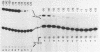
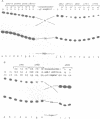
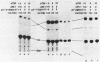
Selected References
These references are in PubMed. This may not be the complete list of references from this article.
- Banerji J., Olson L., Schaffner W. A lymphocyte-specific cellular enhancer is located downstream of the joining region in immunoglobulin heavy chain genes. Cell. 1983 Jul;33(3):729–740. doi: 10.1016/0092-8674(83)90015-6. [DOI] [PubMed] [Google Scholar]
- Benoist C., Chambon P. In vivo sequence requirements of the SV40 early promotor region. Nature. 1981 Mar 26;290(5804):304–310. doi: 10.1038/290304a0. [DOI] [PubMed] [Google Scholar]
- Berk A. J. Adenovirus promoters and E1A transactivation. Annu Rev Genet. 1986;20:45–79. doi: 10.1146/annurev.ge.20.120186.000401. [DOI] [PubMed] [Google Scholar]
- Carthew R. W., Chodosh L. A., Sharp P. A. An RNA polymerase II transcription factor binds to an upstream element in the adenovirus major late promoter. Cell. 1985 Dec;43(2 Pt 1):439–448. doi: 10.1016/0092-8674(85)90174-6. [DOI] [PubMed] [Google Scholar]
- Chevaillier P. H., Philippe M. Acitivé DNA-polymérase nucléaire dans les spermatozoides de souris et évolution de cette activité au cours de la spermatogenèse. Exp Cell Res. 1976 May;99(2):237–244. doi: 10.1016/0014-4827(76)90579-6. [DOI] [PubMed] [Google Scholar]
- Chiu R. W., Baril E. F. Nuclear DNA polymerases and the HeLa cell cycle. J Biol Chem. 1975 Oct 10;250(19):7951–7957. [PubMed] [Google Scholar]
- Darnell R. B., Boime I. Differential expression of the human gonadotropin alpha gene in ectopic and eutopic cells. Mol Cell Biol. 1985 Nov;5(11):3157–3167. doi: 10.1128/mcb.5.11.3157. [DOI] [PMC free article] [PubMed] [Google Scholar]
- Dynan W. S., Sazer S., Tjian R., Schimke R. T. Transcription factor Sp1 recognizes a DNA sequence in the mouse dihydrofolate reductase promoter. Nature. 1986 Jan 16;319(6050):246–248. doi: 10.1038/319246a0. [DOI] [PubMed] [Google Scholar]
- Dynan W. S., Tjian R. Control of eukaryotic messenger RNA synthesis by sequence-specific DNA-binding proteins. 1985 Aug 29-Sep 4Nature. 316(6031):774–778. doi: 10.1038/316774a0. [DOI] [PubMed] [Google Scholar]
- Dynan W. S., Tjian R. The promoter-specific transcription factor Sp1 binds to upstream sequences in the SV40 early promoter. Cell. 1983 Nov;35(1):79–87. doi: 10.1016/0092-8674(83)90210-6. [DOI] [PubMed] [Google Scholar]
- Fromm M., Berg P. Deletion mapping of DNA regions required for SV40 early region promoter function in vivo. J Mol Appl Genet. 1982;1(5):457–481. [PubMed] [Google Scholar]
- Fry M., Loeb L. A., Martin G. M. On the activity and fidelity of chromatin-associated hepatic DNA polymerase-beta in aging murine species of different life spans. J Cell Physiol. 1981 Mar;106(3):435–444. doi: 10.1002/jcp.1041060313. [DOI] [PubMed] [Google Scholar]
- Gorman C. M., Moffat L. F., Howard B. H. Recombinant genomes which express chloramphenicol acetyltransferase in mammalian cells. Mol Cell Biol. 1982 Sep;2(9):1044–1051. doi: 10.1128/mcb.2.9.1044. [DOI] [PMC free article] [PubMed] [Google Scholar]
- Hanaka S., Nishigaki T., Sharp P. A., Handa H. Regulation of in vitro and in vivo transcription of early-region IV of adenovirus type 5 by multiple cis-acting elements. Mol Cell Biol. 1987 Jul;7(7):2578–2587. doi: 10.1128/mcb.7.7.2578. [DOI] [PMC free article] [PubMed] [Google Scholar]
- Hansen U., Sharp P. A. Sequences controlling in vitro transcription of SV40 promoters. EMBO J. 1983;2(12):2293–2303. doi: 10.1002/j.1460-2075.1983.tb01737.x. [DOI] [PMC free article] [PubMed] [Google Scholar]
- Hayashi S., Kondoh H. In vivo competition of delta-crystallin gene expression by DNA fragments containing a GC box. Mol Cell Biol. 1986 Nov;6(11):4130–4132. doi: 10.1128/mcb.6.11.4130. [DOI] [PMC free article] [PubMed] [Google Scholar]
- Hecht N. B., Farrell D., Davidson D. Changing DNA polymerase activities during the development of the testis in the mouse. Dev Biol. 1976 Jan;48(1):56–66. doi: 10.1016/0012-1606(76)90045-2. [DOI] [PubMed] [Google Scholar]
- Henikoff S. Unidirectional digestion with exonuclease III creates targeted breakpoints for DNA sequencing. Gene. 1984 Jun;28(3):351–359. doi: 10.1016/0378-1119(84)90153-7. [DOI] [PubMed] [Google Scholar]
- Hurst H. C., Jones N. C. Identification of factors that interact with the E1A-inducible adenovirus E3 promoter. Genes Dev. 1987 Dec;1(10):1132–1146. doi: 10.1101/gad.1.10.1132. [DOI] [PubMed] [Google Scholar]
- Hübscher U., Kuenzle C. C., Spadari S. Functional roles of DNA polymerases beta and gamma. Proc Natl Acad Sci U S A. 1979 May;76(5):2316–2320. doi: 10.1073/pnas.76.5.2316. [DOI] [PMC free article] [PubMed] [Google Scholar]
- Jones N. C., Rigby P. W., Ziff E. B. Trans-acting protein factors and the regulation of eukaryotic transcription: lessons from studies on DNA tumor viruses. Genes Dev. 1988 Mar;2(3):267–281. doi: 10.1101/gad.2.3.267. [DOI] [PubMed] [Google Scholar]
- Lee W., Haslinger A., Karin M., Tjian R. Activation of transcription by two factors that bind promoter and enhancer sequences of the human metallothionein gene and SV40. Nature. 1987 Jan 22;325(6102):368–372. doi: 10.1038/325368a0. [DOI] [PubMed] [Google Scholar]
- Lee W., Haslinger A., Karin M., Tjian R. Activation of transcription by two factors that bind promoter and enhancer sequences of the human metallothionein gene and SV40. Nature. 1987 Jan 22;325(6102):368–372. doi: 10.1038/325368a0. [DOI] [PubMed] [Google Scholar]
- Lusky M., Botchan M. Inhibition of SV40 replication in simian cells by specific pBR322 DNA sequences. Nature. 1981 Sep 3;293(5827):79–81. doi: 10.1038/293079a0. [DOI] [PubMed] [Google Scholar]
- Matsukage A., Kitani H., Yamaguchi M., Kusakabe M., Morita T., Koshida Y. Differentiation of lens and neural cells in chicken embryos is accompanied by simultaneous decay of DNA replication machinery. Dev Biol. 1986 Sep;117(1):226–232. doi: 10.1016/0012-1606(86)90365-9. [DOI] [PubMed] [Google Scholar]
- Matsukage A., Yamamoto S., Yamaguchi M., Kusakabe M., Takahashi T. Immunocytochemical localization of chick DNA polymerases alpha and beta +. J Cell Physiol. 1983 Nov;117(2):266–271. doi: 10.1002/jcp.1041170219. [DOI] [PubMed] [Google Scholar]
- Montminy M. R., Bilezikjian L. M. Binding of a nuclear protein to the cyclic-AMP response element of the somatostatin gene. Nature. 1987 Jul 9;328(6126):175–178. doi: 10.1038/328175a0. [DOI] [PubMed] [Google Scholar]
- Sawadogo M., Roeder R. G. Interaction of a gene-specific transcription factor with the adenovirus major late promoter upstream of the TATA box region. Cell. 1985 Nov;43(1):165–175. doi: 10.1016/0092-8674(85)90021-2. [DOI] [PubMed] [Google Scholar]
- Spadari S., Weissbach A. The interrelation between DNA synthesis and various DNA polymerase activities in synchronized HeLa cells. J Mol Biol. 1974 Jun 15;86(1):11–20. doi: 10.1016/s0022-2836(74)80003-3. [DOI] [PubMed] [Google Scholar]
- Tavianini M. A., Hayes T. E., Magazin M. D., Minth C. D., Dixon J. E. Isolation, characterization, and DNA sequence of the rat somatostatin gene. J Biol Chem. 1984 Oct 10;259(19):11798–11803. [PubMed] [Google Scholar]
- Van Beveren C., van Straaten F., Curran T., Müller R., Verma I. M. Analysis of FBJ-MuSV provirus and c-fos (mouse) gene reveals that viral and cellular fos gene products have different carboxy termini. Cell. 1983 Apr;32(4):1241–1255. doi: 10.1016/0092-8674(83)90306-9. [DOI] [PubMed] [Google Scholar]
- Wang T. S., Korn D. Reactivity of KB cell deoxyribonucleic acid polymerases alpha and beta with nicked and gapped deoxyribonucleic acid. Biochemistry. 1980 Apr 29;19(9):1782–1790. doi: 10.1021/bi00550a009. [DOI] [PubMed] [Google Scholar]
- Wawra E., Dolejs I. Evidences for the function of DNA polymerase-beta in unscheduled DNA synthesis. Nucleic Acids Res. 1979 Nov 24;7(6):1675–1686. doi: 10.1093/nar/7.6.1675. [DOI] [PMC free article] [PubMed] [Google Scholar]
- Yamaguchi M., Hirose F., Hayashi Y., Nishimoto Y., Matsukage A. Murine DNA polymerase beta gene: mapping of transcription initiation sites and the nucleotide sequence of the putative promoter region. Mol Cell Biol. 1987 May;7(5):2012–2018. doi: 10.1128/mcb.7.5.2012. [DOI] [PMC free article] [PubMed] [Google Scholar]
- Yamaguchi M., Takahashi T., Yasuda K., Shimura Y., Matsukage A. Characterization of messenger RNA for chick-embryo DNA polymerase beta and its translation product in vitro. Eur J Biochem. 1983 Jun 15;133(2):277–282. doi: 10.1111/j.1432-1033.1983.tb07459.x. [DOI] [PubMed] [Google Scholar]