



Abstract
China faces the challenge of dual epidemics of drug use and HIV/AIDS. Despite the high relapse rate among heroin addicts released from compulsory rehabilitation facilities, there are few programs available in China to assist these addicts in the community. We pilot-tested in China a Recovery Management Intervention (RMI) program designed to facilitate early detection of relapse and prompt linkage from compulsory rehabilitation to the community and, if participants relapse, to community-based methadone maintenance treatment (MMT) programs. One hundred heroin addicts were randomly assigned to either the Standard Care group (n=50) or the RMI group (n=50). At the end of the 3-month trial, participants in the RMI group, relative to the standard care group, demonstrated positive outcomes in recidivism due to relapse (0 vs. 6%, p=0.08; d=0.354), MMT participation (8% vs. 0, p=0.6; d=0.417), and employment (33% vs. 2%, p<.001; d=0.876), although no difference was found in urine testing results (8.5% vs. 8.7%; d=0.013) among interviewed participants. These pilot study results were based on a small sample size and short-term observation, suggesting the need for more research to further improve and test RMI effectiveness with larger samples over a longer period of time in order to provide evidence in support of RMI as an effective strategy for community reintegration among addicts released from rehabilitation facilities in China.
Keywords: Recovery management, compulsory rehabilitation, China
1. Introduction
China faces the challenge of dual epidemics of drug use and HIV/AIDS (Sullivan & Wu, 2007). China has traditionally taken punitive measures toward drug addicts, and drug detoxification and rehabilitation facilities operate under the auspices of the public security system. Relapse rates after release are high (estimated to be 80 to 95%), but few programs are available to assist addicts while they are in the community after being released from the compulsory facilities. Addiction is associated with a high risk of HIV, hepatitis B and C infections, overdose death, criminal activities, and re-incarceration (Hser et al., 2001, 2004). In responding to concerns of high rates of HIV/AIDS and other medical consequences among heroin users, the Chinese government recently authorized establishment of methadone maintenance treatment (MMT) programs nationwide. In contrast to the rehabilitation facilities, MMT programs are led by the China Ministry of Health and administered by the Chinese Center for Diseases Control (CDC). MMT is relatively new in China and the participation rate by addicts released from the compulsory rehabilitation facilities has been low.
Studies conducted in the United States and other countries have shown that MMT is effective in reducing drug use and HIV risks among heroin addicts (Marsch, 1998; Ball & Ross, 1991; Mattick et al., 2003; Sorenen & Copeland, 2000). Strengthening the linkage between the correctional system and the community, including the MMT system, is likely to reduce relapse and the negative consequences associated with relapse, including HIV risk behaviors. In order to develop recovery management options that facilitate successful transition into the community for those heroin addicts released from compulsory rehabilitation facilities, we pilot-tested a Recovery Management Intervention (RMI) program to compare its outcomes relative to the current practices.
Compulsory Drug Rehabilitation and Methadone Maintenance Treatment in China
Drug use is illegal in China, and if discovered by the public security system, addicts are registered and sent to (1) compulsory detoxification centers on a first-time offense (for one- to six-month stay), or (2) compulsory rehabilitation facilities on repeat offenses (for one to three years). The law changed in 2010 to allow community rehabilitation, but detection of relapse results in compulsory rehabilitation in lock-up residential stays for two years. The compulsory rehabilitation is housed within secure facilities and controlled by the correctional agencies that are in charge of running prison systems. Most rehabilitation facilities involve some form of physical exercise, education, and farming activity (Wang, 1999) and few offer psychosocial counseling or therapies. Information on rehabilitation activities at these facilities is scarce. However, there are indications that the relapse rate upon release is as high as 80% to 95% (McCoy et al., 2001; Yang et al., 1998; Wu et al., 2002; Wang et al., 1998), and many continue in a cycle of substance abuse and compulsory rehabilitation.
Recognizing increased drug abuse, HIV, and other related problems in China, the Chinese government recently authorized the rapid establishment of MMT sites throughout the country (Sullivan & Wu, 2007; Hser et al., 2011). The first eight MMT clinics were set up in early 2004, and by the end of 2009 China had opened more than 680 MMT clinics (Yin et al., 2010). The program signals that the Chinese government understands the critical link between drug use and control of HIV/AIDS. However, the illegality of drug use in China makes it very difficult to recruit heroin addicts to participate in MMT.
Methadone is the most widely used pharmacological treatment for opiate dependence. A large body of international research has shown the efficacy of MMT for the treatment of opiate addiction and subsequent reduction in HIV risk behaviors (NIDA, 2006). While MMT can be effective in reducing drug use and related problems, few addicts released from compulsory treatment in China participate in MMT despite their high rates of relapse. Long periods of forced abstinence in rehabilitation facilities do not inhibit relapse to heroin use after release. Recently released addicts are at particularly high risk for overdose and disease transmission (Binswanger et al., 2007). Linkage to MMT after release from the compulsory treatment is a promising opportunity to combat disease transmission, facilitate reentry into the community, and reduce recidivism and relapse (Rich et al., 2005; Kinlock et al., 2007). Thus, connecting addicts with MMT programs can help to break the cycle of substance abuse, health risks, criminal behavior, and re-incarceration among heroin-dependent drug users.
Evidence-based Recovery Management Interventions
Several recovery management interventions have been developed in the U.S. and can be adapted for application in China. Below we briefly describe these interventions.
Transitional Case Management
There are several case management models (e.g., brokerage, assertive case management, intensive case management), and case management interventions have been found to be effective with substance-abusing and criminal populations in addressing substance abuse (Siegal et al., 1996), employment (Martin & Inciardi, 1993; Siegal et al., 1996), and criminality (Siegal, Li, & Rapp, 2002). Adaptation of the “strengths” case management approach for transitioning clients to treatment has been effective in increasing treatment utilization among individuals with substance use disorders (Siegal, Li, & Rapp, 2002) and with mental disorders (Brun & Rapp, 2001), and has been modified and tested in a parole population (Prendergast & Cartier, 2004) within the NIDA-funded Criminal Justice Drug Abuse Treatment Studies. This Transitional Case Management (TCM) protocol includes (1) a strengths assessment of inmates to identify the “strengths” of the client and to promote engagement between client and case manager, (2) a case conference call with the client about 1 month prior to release, and (3) weekly sessions of case management in the community post-parole for 3 months. The TCM intervention begins with pre-release planning for post-discharge aftercare and support, continuing with post-release community-based case management. The TCM case managers assist parolees in achieving goals and accessing needed services during early months in the community.
Recovery Management Checkups
Based on a chronic care model of addiction designed to manage addiction over time (e.g., see White & Kelly, 2011), Scott and Dennis developed and tested a Recovery Management Checkup Model (RMC). The approach includes quarterly checkups with assessments and personalized feedback for each participant on the status of their condition, linkage to treatment, and enhancing treatment retention and completion. RMC has been applied to individuals treated for substance abuse disorders and has demonstrated effectiveness in terms of treatment reentry (Dennis et al., 2003; Scott et al., 2005; Dennis & Scott, 2012).
Immediate Access to MMT upon Release
A recent study conducted by Kinlock et al. (2007) compared heroin-dependent inmates released from prison who were randomly assigned to three conditions: (1) counseling only: counseling in prison with passive referral to treatment upon release; (2) counseling plus transfer: counseling in prison with immediate access to MMT upon release; and (3) counseling-plus-methadone: methadone maintenance and counseling in prison, continued in community-based MMT upon release. Relevant to the study described in this article, Kinlock et al. found that participants in the counseling-plus-transfer group demonstrated significantly higher rates of entering community-based treatment than the counseling-only group (50% vs. 7.8%), and slightly lower rates of positive urine test for opioids (41.0% vs. 62.5%) at 1-month post-release. The Kinlock study provides evidence that immediate access to MMT after release from prison can have beneficial impacts on community treatment entry and heroin use.
The Present Study
The literature confirms that early detection of relapse and prompt access to treatment are essential, and that linkage to community and treatment should occur upon release to increase treatment participation and reduce relapse. We adapted and developed a Recovery Management Intervention program incorporating these evidence-based components, making the program appropriate for use in China, to optimize the likelihood of successful transition for addicts released from rehabilitation facilities to reenter the community and, in the cases of relapse, participate in community-based MMT. The present study pilot-tested the Recovery Management Intervention program to obtain preliminary outcome data on its effectiveness in facilitating early detection of relapse and prompting linkage from compulsory rehabilitation to the community and, if participants relapse, to community-based methadone maintenance treatment (MMT) programs in China. Based on existing research, we hypothesized that the RMI condition would be effective and would produce improvements in drug abstinence and transition rates from the rehabilitation treatment to the community and to MMT. We also anticipated improvement in other key life domains (recidivism, employment, mental health) as secondary outcomes of the intervention.
2. Materials and Methods
Study Design and Procedures
A two-group random assignment design was utilized. Eligible and consenting addicts were randomly assigned to the following two conditions: (1) Standard Care group, and (2) Recovery Management Intervention (RMI) group. The intervention lasted 12 weeks, and participants were assessed at baseline and at 3 months after release.
Standard Care Group
The current practice is as follows. Upon discharge, the social worker and the local police meet with the addict to lay out post-release reporting requirements, which include monthly contact with the social worker and random urine testing in the local checking hospital (approximately every month in the first year post-release). As “Standard Care,” the current practice was enhanced by adding and completing a Strengths Assessment that identifies strengths, accomplishments, resources, and goals, and then develops plans for immediate needs upon release.
Recovery Management Intervention Program
The Recovery Management Intervention (RMI) Program includes Strengths Assessment and post-release recovery management in the community (including weekly sessions and urine testing). The strengths-based case management RMI is designed to promote reentry into the community, and frequent contacts allow early detection of relapse and prompt linkage to MMT upon relapse. The development of RMI was informed by several evidence-based transitional programs (described earlier) that have shown improved rates of transition from confined environments (e.g., jail/prison, residential stay) to community treatment in the United States, and they are excellent candidates for adaptation and application in China. To adapt the RMI program for Chinese settings, we conducted formative research to solicit feedback and suggestions from social workers and participants on the feasibility and acceptability of the research protocols. Participants and social workers expressed enthusiasm for the study and provided constructive suggestions for finalizing protocols. The senior investigators provided training before trial implementation.
At the release, those assigned to the RMI group followed similar procedures as described for those in the Standard Care Group (e.g., Strengths Assessment). However, during the 3-month post-release period, the social worker maintained weekly contacts with the participant to monitor their progress and to conduct on-site urine testing. Participants in the RMI condition were tested weekly on-site to allow early detection and immediate feedback. Results of the weekly urine test were used only for the intervention research and were not shared with the police. At each contact, the social worker reviewed the major life areas and status of the participant (e.g., drug use, alcohol use) and worked with the participant to obtain needed services such as temporary subsidy, job information, skill training information, etc. The social worker provided support and encouragement to increase the participant’s motivation to stay away from heroin. Not all participants can participate in MMT, however, as the current policy in China requires that only those currently dependent on opiates are eligible for MMT. Upon detection of relapse (self-report or urine positive), social workers provided immediate linkage to MMT (e.g., making appointment, arranging transportation, escorting clients to MMT) to expedite the recovery process.
Setting: Social Work Consortium in Shanghai
Shanghai is the largest and most developed city in China, with approximately 17 million residents and 28,000 registered drug addicts. Currently there are three compulsory rehabilitation facilities (two for men and one for women) and seven MMT clinics in Shanghai. Unique to Shanghai, a non-governmental social services organization exists to help drug users recover in the community following release from compulsory drug treatment centers (Xu, 2007). Established in 2003 as the first social worker consortium in China, Shanghai’s Zi-Qiang consortium (Zi-Qiang means getting strong by self-help) is a community-based social service network with about 500 social workers hired from eligible individuals from the community to help people living within the same community. All illicit drug users are monitored and contacted weekly by a social worker and are tested regularly for drug use for three years. The RMI program was designed to be incorporated into this existing support network.
Study Participants
A total of 100 participants were recruited from three rehabilitation facilities located in Shanghai. Consecutive releases during 2009-2010 were invited to participate. Eligibility criteria include (1) meeting Diagnostic and Statistical Manual of Mental Disorders (DSM-IV; American Psychiatric Association, 1994) criteria for heroin dependence at the time of incarceration; (2) willingness to enroll in a MMT program upon relapse; and (3) permanent Shanghai resident in two districts where the study were conducted. Of 435 participants screened, 300 were not eligible (mostly because their residence was outside the two study districts, but 15 were unwilling to enroll in MMT), 35 refused to participate, and 100 agreed to participate and provided signed informed consent. Using a computer-generated randomization sheet, participants were randomly assigned to the RMI group (n=50) or the Standard Care group (n=50). A Social Worker Coordinator conducted randomization, informed the social worker who then enrolled and assigned the specific case accordingly. The study was approved by institutional review boards in Shanghai and UCLA, and was overseen by a Data Safety Monitoring Board.
Study Measures
Baseline data were collected with the Addiction Severity Index (ASI) which has been validated in Chinese settings (Zhao et al., 2004). Case records included urine testing results and referral services. The ASI was repeated at the 3-month post-release follow-up interview.
The Addiction Severity Index (ASI)
(McLellan, et al., 1980; 1992) is a structured interview that assesses problem severity in seven areas: alcohol use, drug use, employment, family and social relationships, legal, psychological, and medical status. The ASI is the most widely used instrument in the substance abuse field both in the U.S. and internationally. The ASI has been examined among Chinese clients (Yeh et al., 1998; Zhao et al., 2001; 2004). Dr. Zhao’s study (2004) based on heroin addicts in a Chinese rehabilitation center indicates that ASI has reliability and validity for Chinese drug-dependent clients. The ASI data were collected at baseline and follow-up.
Client Evaluation of Self at Intake (CESI)
This instrument, developed by researchers at the Texas Christian University (Simpson & Joe, 1993; Garner et al., 2007), is a self-rating form. It includes short scales for treatment motivation (problem recognition, desire for help, treatment readiness, external pressure), psychological functioning (self-esteem, depression, anxiety, and decision-making), social functioning (childhood problems, hostility, risk-taking, and social conformity), and criminal thinking. The three treatment motivation scales represent the Stages of Change model as delineated by Prochaska & DiClemente (1986). Each scale uses a 5-point Likert response set. The Cronbach alpha reliability coefficient for the different scales ranges from .63 to .91.
HIV Risk Behavior Survey
The Risk Behavior Survey (RBS), an abbreviated version of the Risk Behavior Assessment developed by NIDA, was used to measure risk behaviors related to HIV. Risk behaviors in the areas of drug use and sex in the previous 30 days are measured. Reliability and validity assessments of the RBS support its adequacy as a research tool for populations of drug users, including intravenous drug users (Darke et al., 1991; Weatherby et al., 1994; Needle et al., 1995).
Planned Analyses
Baseline differences across the intervention groups were analyzed using chi-square tests for categorical measures and ANOVAs for continuous measures. To assess the intervention effect at the follow-up, ANCOVAs were conducted controlling for baseline measures. Opiate-negative rates across time by the two intervention groups were tested using generalized estimating equations.
3. Results
Baseline Characteristics
Baseline client characteristics are provided in Table 1. No differences were observed in background characteristics (23% female, mean age of 39 years, 10 years of education, and about 30% employed in the past 3 years), arrest history (34%), and opiate use (age of first heroin use around 28, use for about 11 years). Similarly, no differences were observed across conditions in terms of the ASI severity scores in the seven domains and the evaluation of self.
Table 1.
Demographics and background characteristics at baseline*
| RMI (N = 50) | Standard (n = 50) | Total (n=100) | |
|---|---|---|---|
| Female, % | 22.0 | 24.0 | 23.0 |
| Mean age (SD) | 38.6 (12.3) | 38.7 (10) | 38.7 (11.2) |
| Mean year of education (SD) | 9.8 (1.7) | 9.6 (1.9) | 9.7 (1.8) |
| Marital status, % | |||
| Married | 18.0 | 32.0 | 25.0 |
| Previously married | 20.0 | 30.0 | 25.0 |
| Never married | 62.0 | 38.0 | 50.0 |
| Dependent living situation, % | 87.8 | 84.0 | 83.9 |
| Employed (past 3 yrs), % | 34.0 | 28.0 | 31.0 |
| Arrest besides drug offense, % | 32.0 | 36.0 | 34.0 |
| Drug use history | |||
| Age of first use (SD) | 28.0 (8.1) | 27.8 (7.0) | 27.9 (7.5) |
| Years of use (SD) | 10.5 (8.6) | 10.7 (9.7) | 10.6 (9.1) |
No group difference was found significant in variables on this table
Drug Use during the Trial
Figure 1 shows the percentage of opiate-negative samples during the 12-week protocol; only 3 urine testing results were available for the control group as they received monthly testing (which can be any week of the month, but plotted in the third for simplicity). In both groups, the percentage of negative urine results decreased over time, but there were no differences between the two conditions across time.
Figure 1.
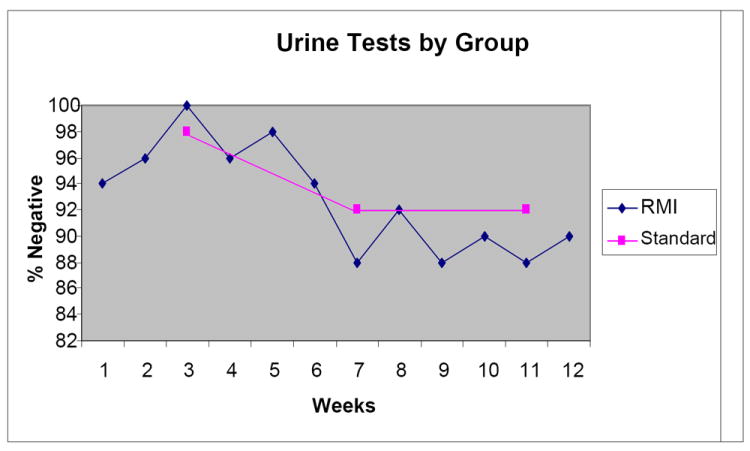
Urine testing results (% negative)
Addiction Severity and Self-Evaluation
No differences were found across groups at the 3-month follow-up in all domains measured by ASI and by self-evaluation. The only exception is that RMI participants reported greater emotional distress including depression (32.6 vs. 29.3) and anxiety (34.9 vs. 31.7). Both groups, however, improved at the follow-up in terms of drug use, family relationship, and legal problem severity from those at the baseline.
HIV Risk Behavior at the Follow-up
HIV risk behaviors including injection and risky sex behaviors at 3-month follow-up are provided in Table 4. In general, few participants reported injection and none reported needle-sharing in the past month. About one-fifth had sex in the past month, and among those who reported having sex, few used condoms (e.g., none used condoms among those who had been paid for sex). The two groups did not differ in these risk behaviors.
Table 4.
HIV risk behavior at 3-month follow-up
| RMI (N = 48) | Standard (n = 46) | |
|---|---|---|
| Injection in the past month, % | ||
| Yes | 6.3 | 0.0 |
| Not answered | 10.4 | 19.6 |
| Among those reported injection, %: | ||
| Shared needle in the past month | 0.0 | 0.0 |
| Informed to be HIV-positive, % | 8.3 | 10.9 |
| Had sex in the past month, % | 16.7 | 21.7 |
| Among those who had sex, %: | ||
| Had sex with regular partners | 87.5 | 88.9 |
| Used condoms with regular partners | 12.5 | 0.0 |
| Had sex with casual partners | 37.5 | 50.0 |
| Used condoms with casual partners | 12.5 | 0.0 |
| Had been paid for sex | 25.0 | 20.0 |
| Used condoms in commercial sex | 0.0 | 0.0 |
None of the measures were significantly different between the two groups
Treatment Participation and Other Outcomes at the Follow-up
At the 3-month follow-up, 3 of the control group participants and none of the RMI group participants were arrested due to relapse and were sent back to the compulsory facilities. Among those who participated in the follow-up, significantly more in the RMI group than the control group were employed (33% vs. 2%, p< 0.001). Although methadone maintenance enrollment rates were not statistically significant (8% vs. 0, p=0.06), the group difference was of a medium effect size (0.417). The two groups did not differ in urine testing results.
4. Discussion
The present study pilot-testing the Recovery Management Intervention has demonstrated its feasibility and provided preliminary evidence of its effectiveness in selected outcome measures. The lower rate of recidivism and higher rates of employment and treatment participation among the RMI group are promising findings. On the other hand, no differences were found in drug abstinence and HIV risk behaviors. It should be noted that the current practice by social workers in Shanghai follows a basic case management model, which may explain the overall low relapse rates among the study participants (less than 15%) regardless of study conditions. Because these pilot findings were based on a small sample size and short-term observation, future studies are needed to further improve and test RMI effectiveness with larger samples over a longer period of time in order to provide evidence in support of RMI as an effective strategy to promote community reintegration among addicts released from compulsory rehabilitation facilities in China.
In addition to the Strengths Assessment conducted in both study conditions, the enhancements of RMI over the current practice in Shanghai basically included more frequent contacts (weekly, as opposed to monthly) and urine testing (with immediate results) by the social worker. These enhancements allowed more opportunities for education/counseling/intervention, more rapid detection of relapse, and immediate access to MMT— thus shifting social workers’ function and role more to the linking of addicts to the community resources to meet participants’ needs, as opposed to focusing on monitoring. The greater frequency of contacts and support may explain the positive findings of MMT participation and employment rates among the RMI group. Particularly, the employment rate in the RMI group was unexpectedly much higher than that in the Standard Care group. Note that both groups received the Strengths Assessment, which was designed to assist them to identify positive areas for further development, but the referral services and support provided by the social workers for the RMI group were more intense and apparently produced a significantly better outcome for achieving participants’ goals, at least in the employment area.
It is not clear why greater emotional distress (depression, anxiety) were reported by the RMI participants than the control group. Furthermore, self-esteem and self-efficacy did not differ by the two groups. Future studies with larger sample sizes should provide better understanding of the relationships among these constructs as related to the intervention. Most social workers’ training and efforts have been on case management services (e.g., referral, linkage). Provision of training on therapeutic skills may further improve both the service delivery as well as psychological well-being of individuals in recovery.
Few study participants reported HIV risk behaviors including injection and risky sex, and no group differences were found. It is possible that these behaviors were underreported, although some did choose to refuse to answer these sensitive questions (e.g., 10% of RMI and 20% of Standard Care group did not answer the injection question). Condom use was alarmingly low among those who reported having sex with casual partners or engaged in commercial sex, which indicates an important area for future HIV education and prevention efforts.
The study has several limitations. The study sample size is small because it is a pilot study. Small sizes not only provide low statistical power, but also inhibit further explorations of factors underlying the improved outcomes associated with the intervention. For example, floor effects have been observed in some outcomes (e.g., none of the control group entered MMT and none of the RMI clients were arrested, although statistical test results of these outcome measures were not significant), resulting in conservative estimates of intervention effects. Nevertheless, we provided effect sizes for these major outcomes. Future studies with larger sample sizes will allow formal testing of the RMI. The environment in Shanghai may be unique, particularly in terms of the existing social worker network. Replications of the study in other regions or provinces can shed light of whether the study findings are generalizable. Finally, some of the motivation scales have relatively low reliability coefficient (e.g., 0.63). Future psychometric research is needed either to improve this scale for its adaption in the Chinese settings or develop a new scale that is more reliable or appropriate for the Chinese population.
MMT in China is at an early stage of diffusion. The low rates of MMT participation suggest that there are barriers that need to be overcome (Hser et al., 2011). In the present study, among the 50 eligible individuals who refused to participate in the study, 15 did so because they were unwilling to enroll in MMT. As is the case in other countries new to MMT, MMT is stigmatized as “just another drug.” However, methadone usage within a maintenance program is well documented as an effective pharmacotherapy (Rich et al., 2005), and has been shown as effective prevention of HIV infection (Gowing et al., 2006). More education on MMT may improve the knowledge about MMT and its effectiveness. Because the law in China only allows current opiate users to participate in MMT, our RMI only engaged participants in MMT when they relapsed. Based on the early detection and early intervention and continued support post-release, the present study has demonstrated that RMI is a promising strategy that can improve the linkage of addicts to needed services and reintegration into the community. In the event that the restriction on MMT participation becomes relaxed in the future, RMI can be easily expanded to engage all participants in need of MMT. Furthermore, as China develops more treatment options, continuing care should be an important component to be included in order to support sustained recovery in the community (McKay 2009, Lash et al., 2011). Given some positive outcomes demonstrated in the present study, it is reasonable to consider RMI as part of a continuing care approach. McKay (2009) has suggested that continuing care monitoring and care for at least one year or more results in better outcomes for those with chronic substance use disorders in U.S. studies. Future studies should investigate if extending the RMI for longer periods of time as part of the continuing care can maximize its potential benefit in supporting stable recovery among these addicts.
Table 2.
ASI scores at intake and 3 month follow-up
| Baseline (n=100) | 3 month FU (n=94) | |||
|---|---|---|---|---|
|
| ||||
| RMI (N = 50) | Standard (n = 50) | RMI (N = 48) | Standard (n = 46) | |
| Alcohol, Mean (SD) | .05 (.10) | .03 (.07) | .07 (.10) | .05 (.09) |
| Drug, Mean (SD)* | .12 (.09) | .12 (.10) | .02 (.05) | .02 (.04) |
| Employment, Mean (SD) | .57 (.26) | .61 (.29) | .55 (.27) | .63 (.20) |
| Family, Mean (SD) * | .17 (.12) | .17 (.11) | .13 (.11) | .11 (.09) |
| Legal, Mean (SD)* | .09 (.13) | .11 (.14) | .03 (.09) | .02 (.06) |
| Medical, Mean (SD) | .06 (.14) | .11 (.21) | .11 (.23) | .09 (.17) |
| Psychiatric, Mean (SD) | .10 (.15) | .08 (.14) | .06 (.13) | .05 (.12) |
Significant main effect of time (p<.05)
No significant effects were found on the main effect of the treatment group or the interaction of group and time (p<.05)
Table 3.
Client evaluation of self and treatment at baseline and 3 month follow-up
| Baseline (n=100) | 3 month FU (n=94) | |||
|---|---|---|---|---|
|
| ||||
| RMI (N = 50) | Standard (n = 50) | RMI (N = 48) | Standard (n = 46) | |
| Problem recognition, Mean (SD) | 24.8 (5.2) | 24.7 (5.3) | 25.4 (5.6) | 25.0 (6.9) |
| Desire for help, Mean (SD) | 25.7 (5.5) | 25.4 (4.3) | 26.2 (5.4) | 25.2 (5.2) |
| Treatment readiness, Mean (SD) | 30.5 (4.2) | 29.4 (4.5) | 30.9 (4.5) | 30.0 (5.2) |
| Pressure for treatment, Mean (SD) | 30.9 (5.2) | 31.5 (4.5) | 31.5 (6.9) | 30.7 (6.3) |
| Self-esteem, Mean (SD) | 28.0 (5.4) | 27.4 (3.7) | 28.8 (5.0) | 27.8 (4.4) |
| Depression, Mean (SD) | 30.6 (6.4) | 30.2 (5.1) | 32.6 (7.1) | 29.3 (7.3) |
| Anxiety, Mean (SD) * | 34.2 (6.4) | 33.3 (5.8) | 34.9 (7.1) | 31.7 (7.0) |
| Decision making, Mean (SD) | 28.1 (4.3) | 28.0 (3.7) | 30.0 (5.3) | 27.8 (4.5) |
| Self-efficacy, Mean (SD) | 27.0 (5.5) | 26.9 (4.6) | 28.4 (6.2) | 26.3 (5.9) |
| Childhood problems | 31.1 (6.2) | 31.2 (5.3) | 31.1 (6.3) | 30.4 (6.4) |
| Hostility, Mean (SD) | 35.6 (6.3) | 35.4 (6.0) | 37.1 (6.8) | 34.8 (7.1) |
| Risk taking, Mean (SD) | 29.1 (5.3) | 29.4 (3.8) | 29.7 (6.5) | 29.5 (5.8) |
| Social consciousness, Mean (SD) | 29.5 (4.0) | 27.4 (4.6) | 28.5 (4.0) | 27.4 (4.6) |
Significant main effect of the treatment group (p<.05)
No significant effects were found on the main effect of time or the interaction of group and time
Table 5.
Arrest, Urine Positive, MMT enrollment, and Employment at 3-month follow-up
| RMI (N = 50) | Standard (n = 50) | Total (n = 100) | Effect Size | |
|---|---|---|---|---|
| Arrested, % | 0 | 6.0 | 3.0 | 0.354 |
|
| ||||
| Not arrested and Interviewed, % | (n = 48) | (n = 46) | (n = 94) | |
| Urine positive | 8.5 | 8.7 | 8.6 | 0.013 |
| MMT enrollment | 8.3 | 0 | 4.3 | 0.417 |
| Employmenta | 33.3 | 2.2 | 18.1 | 0.876 |
Significant main effect of the treatment group (p<.001).
Acknowledgments
The authors thank the support of social workers and the participation of clients in China.
Declaration of Interest: This work was supported in part by Grant # R21DA025385, P30DA016383 & K05DA017648 (PI: Hser) from the National Institute on Drug Abuse (NIDA). NIDA played no direct role in the design or conduct of the study or in the collection, management, analysis, and interpretation of the data and did not review or approve this manuscript. Dr. Hser had full access to all of the data in the study and takes responsibility for the integrity of the data and the accuracy of the data analysis.
Footnotes
Publisher's Disclaimer: This is a PDF file of an unedited manuscript that has been accepted for publication. As a service to our customers we are providing this early version of the manuscript. The manuscript will undergo copyediting, typesetting, and review of the resulting proof before it is published in its final citable form. Please note that during the production process errors may be discovered which could affect the content, and all legal disclaimers that apply to the journal pertain.
References
- American Psychiatric Association. Diagnostic and statistical manual of mental disorders. 4. Washington, D.C.: Author; 1994. [Google Scholar]
- Ball JC, Ross A. The effectiveness of methadone maintenance treatment : patients, programs, services, and outcome. New York: Springer-Verlag; 1991. [Google Scholar]
- Binswanger JA, Stern MF, Deyo RA, Heagerty PJ, Cheadle A, Elmore JG, Koepsell TD. Release from prison — A high risk of death for former inmates. N Engl J Med. 2007;356:157–165. doi: 10.1056/NEJMsa064115. [DOI] [PMC free article] [PubMed] [Google Scholar]
- Brun C, Rapp R. Strengths-based case management: Individuals perspectives on strengths and the case manager relationship. Social Work. 2001;46(3):278–288. doi: 10.1093/sw/46.3.278. [DOI] [PubMed] [Google Scholar]
- Darke S, Hall W, Heather N, Ward J, Wodak A. The reliability and validity of a scale to measure HIV risk taking behavior among intravenous drug users. AIDS. 1991;5:181–185. doi: 10.1097/00002030-199102000-00008. [DOI] [PubMed] [Google Scholar]
- Dennis ML, Scott CK, Funk R. An experimental evaluation of Recovery Management Checkups (RMC) for people with chronic substance use disorders. Evaluation & Program Planning. 2003;26:339–52. doi: 10.1016/S0149-7189(03)00037-5. [DOI] [PMC free article] [PubMed] [Google Scholar]
- Derogatis LR, Melisaratos N. The Brief Symptom Inventory: An introductory report. Psychological Medicine. 1983;13(3):595–605. [PubMed] [Google Scholar]
- Gowing LR, Farrell M, Bornemann R, Sullivan LE, Ali RL. Methadone treatment of injecting opioid users for prevention of HIV infection. Journal of General Internal Medicine. 2006;21(2):193–195. doi: 10.1111/j.1525-1497.2005.00287.x. [DOI] [PMC free article] [PubMed] [Google Scholar]
- Hser Y, Gelberg L, Hoffman V, Grella CE, McCarthy W, Anglin MD. Health conditions among aging narcotics addicts: Medical examination results. Journal of Behavioral Medicine. 2004;27(6):607–622. doi: 10.1007/s10865-004-0005-x. [DOI] [PubMed] [Google Scholar]
- Hser Y, Hoffman V, Grella CE, Anglin MD. A 33-year follow-up of narcotics addicts. Archives of General Psychiatry. 2001;58:503–508. doi: 10.1001/archpsyc.58.5.503. [DOI] [PubMed] [Google Scholar]
- Hser Y, Li J, Jiang H, Zhang R, Du J, Zhang C, Zhang B, Evans E, Wu F, Chang Y-J, Peng C, Huang D, Stitzer ML, Roll J, Zhao M. Effects of a randomized contingency management intervention on opiate abstinence and retention in methadone maintenance treatment in China. Addiction. 2011 doi: 10.1111/j.1360-0443.2011.03490.x. [DOI] [PMC free article] [PubMed] [Google Scholar]
- Huang H, Wu X, Lin M, Wen D, Zheng C. An investigation on the mental health of heroin addicts. Chinese Journal of Clinical Psychology. 2001;9(1):58–59. in Chinese. [Google Scholar]
- Kinlock TW, Gordon MS, Schwartz RP, O’Grady K, Fitzgerald TT, Wilson M. A randomized clinical trial of methadone maintenance for prisoners: Results at 1-month post-release. Drug and alcohol dependence. 2007;91(2-3):220–227. doi: 10.1016/j.drugalcdep.2007.05.022. [DOI] [PMC free article] [PubMed] [Google Scholar]
- Lash SJ, Timko C, Curran GM, McKay JR, Burden JL. Implementation of evidence-based substance use disorder continuing care interventions. Psychol Addict Behav. 2011;25(2):238–51. doi: 10.1037/a0022608. [DOI] [PMC free article] [PubMed] [Google Scholar]
- Marsch LA. The efficacy of methadone maintenance interventions in reducing illicit opiate use, HIV risk behavior and criminality: a meta-analysis. Addiction. 1998;93(4):515–32. doi: 10.1046/j.1360-0443.1998.9345157.x. [DOI] [PubMed] [Google Scholar]
- Martin S, Inciardi J. Case management approaches for the criminal justice client. In: Inciardi J, editor. Drug treatment and criminal justice. Thousand Oaks, CA: Sage Publications; 1993. pp. 84–86. [Google Scholar]
- Mattick RP, Breen C, Kimber J, et al. Methadone maintenance therapy versus no opioid replacement therapy for opioid dependence. Cochrane Database Syst Rev. 2003(2) doi: 10.1002/14651858.CD002209. CD002209. [DOI] [PubMed] [Google Scholar]
- McCoy CB, McCoy HV, Lai S, Yu Z, Wang X, Meng J. Reawakening the dragon: Changing patterns of opiate use in Asia, with particular emphasis on China’s Yunnan province. Substance Use & Misuse. 2001;36(1-2):49–69. doi: 10.1081/ja-100000228. [DOI] [PubMed] [Google Scholar]
- McKay JR. Continuing care research: what we have learned and where we are going. J Subst Abuse Treat. 2009;36:131–45. doi: 10.1016/j.jsat.2008.10.004. [DOI] [PMC free article] [PubMed] [Google Scholar]
- McLellan AT, Luborsky L, Woody GE, O’Brien CP. An improved diagnostic evaluation instrument for substance abuse patients: The Addiction Severity Index. Journal of Nervous and Mental Disease. 1980;168:26–33. doi: 10.1097/00005053-198001000-00006. [DOI] [PubMed] [Google Scholar]
- McLellan AT, Kushner H, Metzger D. The fifth edition of the Addiction Severity Index. Journal of Substance Abuse Treatment. 1992;9:199–213. doi: 10.1016/0740-5472(92)90062-s. [DOI] [PubMed] [Google Scholar]
- Dennis ML, Scott CK. Four-year outcomes from the Early Re-Intervention (ERI) experiment using Recovery Management Checkups (RMCs) Drug and Alcohol Dependence. 2012;121(1–2):10–17. doi: 10.1016/j.drugalcdep.2011.07.026. [DOI] [PMC free article] [PubMed] [Google Scholar]
- National Institute on Drug Abuse (NIDA) Methadone Research Web Guide Tutorial. 2006 Retrieved from http://international.drugabuse.gov/educational-opportunities/certificate-programs/methadone-research-web-guide. Retrieved 2010.
- Needle R, Fisher DG, Weatherby N, Chitwood D, Brown B, Cesari H, et al. Reliability of self-reported HIV risk behaviors of drug users. Psychology of Addictive Behaviors. 1995;9(4):242–250. [Google Scholar]
- Prendergast M, Cartier J. Criminal Justice Drug Abuse Treatment Research Studies (CJ-DATS): Transitional case management study: Intervention Manual. Los Angeles: UCLA Integrated Substance Abuse Programs; 2004. [Google Scholar]
- Rich JD, McKenzie M, Shield DC, Wolf FA, Key RG, Poshkus M, et al. Linkage with methadone treatment upon release from incarceration: A promising opportunity. Journal of Addictive Diseases. 2005;24(3):49–60. doi: 10.1300/J069v24n03_04. [DOI] [PubMed] [Google Scholar]
- Scott CK, Foss MA, Dennis ML. Utilizing Recovery Management Checkups to shorten the cycle of relapse, treatment reentry, and recovery. Drug & Alcohol Dependence. 2005;78:325–38. doi: 10.1016/j.drugalcdep.2004.12.005. [DOI] [PMC free article] [PubMed] [Google Scholar]
- Siegal H, Fisher J, Rapp R, Kelliher C, Wagner J, O’Brien W, Cole P. Enhancing substance abuse treatment with case management: Its impact on employment. Journal of Substance Abuse Treatment. 1996;13(2):93–98. doi: 10.1016/0740-5472(96)00029-3. [DOI] [PubMed] [Google Scholar]
- Siegal H, Li L, Rapp R. Case management as a therapeutic enhancement: Impact on post-treatment criminality. Journal of Addictive Diseases. 2002;21(4):37–47. doi: 10.1300/J069v21n04_04. [DOI] [PubMed] [Google Scholar]
- Sorensen JL, Copeland AL. Drug abuse treatment as an HIV prevention strategy: a review. Drug Alcohol Depend. 2000;59(1):17–31. doi: 10.1016/s0376-8716(99)00104-0. [DOI] [PubMed] [Google Scholar]
- Sullivan SG, Wu Z. Rapid scale up of harm reduction in China. International Journal of Drug Policy. 2007;18(2):118–128. doi: 10.1016/j.drugpo.2006.11.014. [DOI] [PubMed] [Google Scholar]
- Wang W. Illegal drug abuse and the community camp strategy in China. Journal of Drug Education. 1999;29(2):97–114. doi: 10.2190/J28R-FH8R-68A9-L288. [DOI] [PubMed] [Google Scholar]
- Wang Z, Gerald B, Cheng M, Chen S. Drug treatment and public security in the People’s Republic of China. In: Klingeman H, Hunt G, editors. Drug treatment systems in an international perspective: Drugs demons, and delinquents. Thousand Oaks, CA: Sage; 1998. pp. 253–262. [Google Scholar]
- Weatherby N, Needle R, Cesari H, Booth R, McCoy CB, Watters JK, Chitwood DD, et al. Validity of self-reported drug use among injection drug users and crack cocaine users recruited through street outreach. Evaluation and Program Planning. 1994;17(4):347–355. [Google Scholar]
- White W, Kelly JF. Introduction: The theory, science, and practice of recovery management. In: Kelly, White, editors. Addiction Recovery Management: Theory, Research and Practice. Humana Press; 2011. pp. 1–6. [Google Scholar]
- Wu Z, Detels R, Zhang J, Li V, Li J. Community-based trial to prevent drug use among youths in Yunnan, China. American Journal of Public Health. 2002;92(12):1952–1956. doi: 10.2105/ajph.92.12.1952. [DOI] [PMC free article] [PubMed] [Google Scholar]
- Xu L. Shanghai social work development. China Social Welfare. 2007;1:15–17. [Google Scholar]
- Yang R, Wang J, He W. One-year follow-up of heroin addicts after a detoxification treatment. Chinese Journal of Clinical Psychology. 1998;6(1):53–54. [Google Scholar]
- Yeh HS, Lee Y-C, Wan S-R, Lin S-F, Liu K-M, Sun H-J, et al. Reliability of a Chinese version of the Addiction Severity Index. Chinese Psychiatry. 1998;12(3):228–234. in Chinese. [Google Scholar]
- Yin L, Qin G, Qian HZ, Zhu Y, Hu W, Zhang L, Yiming S, et al. Continued spread of HIV among injecting drug users in southern Sichuan Province, China. Harm Reduction Journal. 2007;4:6. doi: 10.1186/1477-7517-4-6. [DOI] [PMC free article] [PubMed] [Google Scholar]
- Zhao M, Hao W, Yang D, Zhang Y, Li L. A prospective study of factors related to relapse in heroin addicts. Chinese Journal of Clinical Psychology. 2001;9(2):81–83. in Chinese. [Google Scholar]
- Zhao M, Li X, Hao W, Wang Z, Zhang M, Xu D, et al. A preliminary study of the reliability and validity of the Addiction Severity Index. Journal of Chinese Medical Research. 2004;4(8):679–680. in Chinese. [Google Scholar]