



Abstract
Modulation of translation initiation efficiency on classical swine fever virus (CSFV) RNA can be achieved by targeted mutations within the internal ribosome entry site (IRES). In this study, cDNAs corresponding to the wild-type (wt) or mutant forms of the IRES of CSFV strain Paderborn were amplified and inserted into dicistronic reporter plasmids encoding Fluc and Rluc under the control of a T7 promoter. The mutations were within domains II, IIId1, and IIIf of the IRES. The plasmids were transfected into baby hamster kidney (BHK) cells infected with recombinant vaccinia virus vTF7-3, which expresses the T7 RNA polymerase. IRES mutants with different levels of IRES activity were identified and then introduced by homologous recombination into bacterial artificial chromosomes (BACs) containing CSFV Paderborn cDNA downstream of a T7 promoter. From the wt and mutant BACs, full-length CSFV RNA transcripts were produced in vitro and electroporated into porcine PK15 cells. Rescued mutant viruses were obtained from RNAs that contained mutations within domain IIIf which retained more than 75% of the wt translation efficiency. Sequencing of cDNA generated from these rescued viruses verified the maintenance of the introduced changes within the IRES. The growth characteristics of each rescued mutant virus were compared to those of the wt virus. It was shown that viable mutant viruses with reduced translation initiation efficiency can be designed and generated and that viruses containing mutations within domain IIIf of the IRES have reduced growth in cell culture compared to the wt virus.
INTRODUCTION
Classical swine fever virus (CSFV), the causative agent of the highly contagious pig disease classical swine fever (CSF), belongs to the pestivirus genus within the family Flaviviridae. Its positive-sense single-stranded RNA genome (ca. 12.3 kb) contains one long open reading frame (ORF) encoding structural and nonstructural proteins within a single polyprotein (33). The CSFV RNA is infectious, as it functions as an mRNA to produce the structural and nonstructural proteins necessary for virus replication and formation. The ORF is flanked by untranslated regions (UTRs) termed the 5′ UTR (373 nucleotides [nt]) and 3′ UTR (ca. 228 nt) (9). The UTRs within the CSFV RNA are distinct from those of most eukaryotic mRNAs. There is no 5′-terminal cap structure; instead, the 5′ UTR harbors an internal ribosome entry site (IRES) (40, 47), while the 3′ UTR lacks a poly(A) tail but contains a variable AU-rich region and a conserved region (9, 54). Previous studies (6, 9, 11) have shown that the CSFV 5′ UTR contains a number of structural elements, including two small stem-loops (domains Ia and Ib) plus the IRES, which comprises a single large stem-loop (domain II) and a complex, domain III, which contains the subdomains IIIa, IIIb, IIIc, IIId1, IIId2, and IIIe plus IIIf (the pseudoknot structure). The organization of motifs and domains within the IRES is conserved among some groups of viruses belonging to the Flaviviridae family, including hepatitis C virus (HCV) (18, 57) and the pestiviruses (including CSFV and bovine viral diarrhea virus [BVDV]) (8, 11, 40). In addition, some members of the picornavirus family, such as porcine teschovirus (PTV) (39), porcine sapelovirus 1 (formerly porcine enterovirus-8), and simian sapeloviruses (7), also have this type of IRES and it has been classified as a type 4 IRES within this virus family (2, 16).
The HCV IRES displays a domain configuration similar to that of the CSFV IRES, with the exception of an extra domain IV and the lack of a IIId2 domain within domain III. It is generally accepted that the boundaries of the IRES are nt 65 to 427 for CSFV (11) and nt 42 to 372 for HCV (46), although observations that domains Ia and Ib can affect IRES translation efficiency have been previously reported (47).
Structural and functional analyses of domains II and III of the HCV and HCV-like IRESs have been performed (reviewed in references 17 and 27). Partial deletion of domain II or mutational disruption of the stem structures within domain II leads to a significant reduction in IRES function (to ca. 20% of the wild-type [wt] level), whereas the complete deletion of domain II largely abrogates (to less than 10% of wt) IRES activity (11, 18, 24, 47). Deletion of domain II does not prevent binding of the 40S subunit or eukaryotic initiation factor 3 (eIF3) to the IRES, and the recruitment of eIF2 and Met-tRNA to the initiation complex is unaffected in mutants lacking domain II (20, 22, 24, 25, 37, 50). However, efficient assembly of the 80S ribosome does not occur with these mutants (20, 26). Domain II is known to adopt an L shape, which induces a conformational change in the 40S ribosomal subunit (26, 52) that seems to be needed for eIF5-mediated hydrolysis of eIF2-bound GTP and the subsequent eIF5B-dependent joining of subunits to form translation-competent 80S ribosomes (26, 37).
Domain III of the CSFV IRES corresponds to the region of the genome from nt 143 to 307. The apical part of domain III consists of three subdomains, IIIa to IIIc, in both HCV and CSFV (6) which form a four-way junction (23, 24). It has been shown for both CSFV and HCV that the junction formed by domains IIIa to IIIc together with the loops of domain IIIa and IIIb supports the binding of eIF3 (22–25, 38, 50). The other part of domain III harbors the subdomains IIId1-2 and IIIe. Together with domain IIIf, the loop of domain IIId (or IIId1), plus the sequence surrounding the initiation codon, facilitates the binding and positioning of the 40S ribosomal subunit (4, 5, 22, 24, 25, 30), forming the 43S scaffold for the subsequent 80S ribosome formation and translation initiation. The role of loop IIIa in 40S subunit binding is controversial. Kieft et al. (22) found a close interaction between the loop of domain IIIa and the 40S ribosomal subunit by measurements of footprinting and adenosine modification interference as well as assays of binding to domain IIIa mutants, whereas others have seen no effect of the loop of IIIa on 40S subunit binding or IRES activity (11, 24, 37, 38). However, removal of the entire IIIa domain does affect translation (11), presumably due to its role in forming the four-way junction supporting the binding of eIF3 (see above).
Most studies on the CSFV IRES function have used mono- and dicistronic reporter RNAs. Characterization of the IRES by detection of expressed reporter proteins such as luciferase defines domain II and several subdomains of domain III as being important for virus translation (8, 11, 29, 40, 47). Although these approaches efficiently characterize the function of each structure for IRES-mediated translation, such studies have not directly determined the importance of the sequence within the IRES for other virus functions such as RNA replication. However, it can be difficult to disentangle effects on virus replication from effects on translation within the context of the whole virus; thus, few reports have investigated the effect of changes in the 5′ UTR of pestiviruses on viral RNA replication and on virus production, which also includes other processes such as virus assembly, virus release, and entry into cells. The importance of domains Ia and Ib for virus replication was demonstrated by mutagenesis of a full-length BVDV cDNA clone (1, 31). In addition, it has been shown that a nonviral marker sequence (44 nt) could be inserted within the loop of subdomain IIId2 (nt 294) in the IRES of CSFV strain Alfort with no major changes in virus growth characteristics (35).
The aim of the present study was to develop a strategy to produce attenuated CSFVs. We have constructed a set of mutant IRES elements and characterized them in the context of a reporter gene system. Based on these results, a range of mutant IRES elements, with a broad range of levels of IRES activity, were transferred into a full-length CSFV cDNA and the effect of these quite subtle mutations on virus RNA replication and infectivity was examined.
MATERIALS AND METHODS
Cells.
Porcine kidney cells (PK15 and SK6) and baby hamster kidney (BHK) cells were grown in Dulbecco's modified Eagle's medium (DMEM) supplemented with 5% fetal calf serum (FCS).
Dicistronic reporter plasmids.
All DNA preparations and manipulations were performed using standard methods (49) or according to manufacturer's instructions. The plasmid pRBRluc has been described previously (3) and contains the Renilla luciferase (Rluc) gene under the control of a T7 promoter. Mutations and deletions within the CSFV IRES were generated by overlap extension PCR or standard PCR using primers listed in Table 1. EcoRI and BamHI restriction sites were incorporated into the primers, and the PCR products were cloned into pCR-XL-TOPO or pCR-II-TOPO (Invitrogen). Derivatives of the pRBRluc plasmid containing the wt or mutant forms of the CSFV IRES cDNA were generated by insertion of EcoRI-BamHI fragments into the similarly digested pRBRLuc. Dicistronic derivatives of these plasmids were obtained by the introduction of EcoRI-SalI fragments from the monocistronic constructs containing the IRES-Rluc sequences downstream of the firefly luciferase (Fluc) coding region in pFluc vector (3) (Fig. 1).
Table 1.
List of primers used to generate inserts for the dicistronic and full-genome constructs
| Primer | Sequencea |
|---|---|
| Pader46F-EcoRI | 5′-CCGAATTCCGATTTGGCCTAGGGTACCCCT-3′ |
| Pader 427R-BamHI | 5′-CCGGATCCCATTGGTTTTTGTTTGTTTGTTTTGTATAATAGTTC-3′ |
| Pader1-EcoRI | 5′-CCGAATTCCTATACGAGGTTAGCTCGTCCTCG-3′ |
| -dII-EcoRI | 5′-CCGAATTCGACTAGCCGTAGTGGCGA-3′ |
| Δ1F-EcoRI | 5′-CCGAATTCCCCTCCAGCGACGGCCGA-3′ |
| Δ2F-EcoRI | 5′-CCGAATTCGGCCGAACTGGGCTAGCCA-3′ |
| Δ3F-EcoRI | 5′-CCGAATTCTGGGCTAGCCATGCCCACAGTA-3′ |
| Δ4F-EcoRI | 5′-CCGAATTCGCTAGCAAACGGAGGGACTAGC-3′ |
| Δ5F-EcoRI | 5′-CCGAATTCCCCTCCCTTCGGGGAGGGACTAGCCGTAGTG-3′ |
| Δ6F-EcoRI | 5′-CCGAATTCGGGAGGGTTCGCCCTCCCACTAGCCGTAGTGGCGAGC-3′ |
| IIID1F | 5′-TTAACCCTGGCSSSSSTCGCCAGGGT-3′ |
| IIID1R | 5′-ACCCTGGCGASSSSSGCCAGGGTTAA-3′ |
| S1mut1F | 5′-GCAAACGGAGGGACATCGCGTAGTGGCGAGCTCCCTG-3′ |
| S1mut1R | 5′-CGCGATGTCCCTCCGTTTGCTAGTCCT-3′ |
| S2mut1F | 5′-ACCTGATAGGGTGCTGCTATAGCCCACTAACAGGCTAGT-3′ |
| S2mut1R | 5′-ACTAGCCTGTTAGTGGGCGAGAGCAGCACCCTATCAGGT-3′ |
| S2mut2-6F | 5′-ACCTGATAGGGTGCTGCKCKCGCCCACTAACAGGCTAGT-3′ |
| S2mut2-6R | 5′-ACTAGCCTGTTAGTGGGCGMGMGCAGCACCCTATCAGGT-3′ |
| S2mut4F | 5′-ACCTGATAGGGTGCTGCTCGCGCCCACTAACAGGCTAGT-3′ |
| S2mut4R | 5′-ACT AGCCTGTTAGTGGGCGCGAGCAGCACCCTATCAGGT-3′ |
| S2mut5-6F | 5′-GGCTAGTATAAAAATGTGGGCTGTACATGGCACATGG-3′ |
| S2mut5-6R | 5′-CCATGTGCCATGTACAGCCCACATTTTTATACTAGCC-3′ |
| S2mut7F | 5′-GGCTAGTATAAAAATGAGAGCTGTACATGGCACATGG-3′ |
| S2mut7R | 5′-CCATGTGCCATGTACAGCTCTCATTTTTATACTAGCC-3′ |
| paderrpsLNeoF | 5′-ATTCCGATTTGGCCTAGGGTACCCCTCCAGCGACGGCCGAACTGGGCTAGCCGGCCTGGTGATGATGGCGGGATCG-3′ |
| PaderrpsLNeoR | 5′-TCCCATTGGTTTTTGTTTGTTTGTTTTGTATAATAGTTCAAAATGATTCAACTCAGAAGAACTCGTCAAGAAGGCG-3′ |
| Pader47F | 5′-CGATTTGGCCTAGGGTACCCC-3′ |
| Pader427R | 5′-GTTTTTGTTTGTTTGTTTTGTATAATAGTTC-3′ |
| PaderΔ2F | 5′-TCCTCGTGTACAACATTGGACAAACTAAAATTCCGATTTGGCCTAGGGTACGGCCGAACTGGGCTAGCCATGCCCACAGTAGGACTAGCAAACGGAGGG-3′ |
| PaderΔ5F | 5′-TCCTCGTGTACAACATTGGACAAACTAAAATTCCGATTTGGCCTAGGGTACCCCTCCCTTCGGGGAGGGACTAGCCGTAGTGGCGAGCTCCCTGGGTGG-3′ |
| PaderΔ6F | 5′-TCCTCGTGTACAACATTGGACAAACTAAAATTCCGATTTGGCCTAGGGTACGGGAGGGTTCGCCCTCCCACTAGCCGTAGTGGCGAGCTCCCTGGGTGG-3′ |
| pBelo69R | 5′-CGGATGAATGGCAGAAATTCGATGATAAGCTGTCA-3′ |
| pBeloPaderSeq | 5′-GCAGTTTTAGTGTTGATTGTGGGTGTACC-3′ |
Italic underlined regions represent randomized nucleotides: S = 80% G plus 20% C; K = 50% G plus 50% T; M = 50% C plus 50% A. Bold sequences represent homology arms used for recombination.
Fig 1.

Structure of the dicistronic reporter plasmids. The wt (nt 47 to 427) IRES or mutant derivatives from the CSFV Paderborn strain were inserted downstream from the coding region of firefly luciferase sequence (Fluc) and upstream from the Renilla luciferase (Rluc) sequence. Both coding regions were placed under the transcriptional control of a T7 promoter. The configuration of the reporter plasmids allows the translation of Fluc by a cap-dependent mechanism, whereas the translation of Rluc is governed by the CSFV IRES or the mutant derivatives.
Transient-expression assays.
The various reporter plasmids (2 μg) were transfected, using FuGene6 (Roche) (3 μl), into BHK cells (35-mm-diameter dishes) which had been infected with a recombinant vaccinia virus (vTF7-3) that expresses the T7 RNA polymerase (14) as described previously (3). Cell lysates were prepared 20 h after transfection. The activities of Rluc and Fluc present within the cell lysates were quantified using separate Renilla and firefly luciferase assay kits (Promega) with a luminometer. The results were normalized to the Fluc luminescence and are presented as the means (± standard deviations [SD]) of the results of three or four independent transfection experiments.
Full-length CSFV cDNAs containing mutations in the IRES element.
Insertion of the modified IRES elements into the full-length CSFV cDNA was accomplished using PCR and targeted recombination (36). The bacterial artificial chromosome (BAC) containing the full-length CSFV Paderborn cDNA, pBeloPader10 (41), was used as a backbone in which the IRES sequence (nt 124 to 401) was replaced with a counterselection cassette (rpsL/neo cassette; Gene Bridges) conferring streptomycin sensitivity and neomycin resistance. A PCR fragment containing the rpsL/neo cassette flanked on each side by ca. 50 nt (corresponding to nt 73 to 123 and nt 402 to 455 of the CSFV genome) was generated using primers PaderrpsLNeoF and PaderrpsLNeoR (Table 1). This fragment was subsequently used as a megaprimer (modified from reference 59) to introduce the rpsL/neo cassette into the Paderborn cDNA sequence in place of nt 124 to 401 by the use of a Phusion High-Fidelity (HF) DNA polymerase and Phusion HF reaction buffer (Fermentas/Thermo Scientific) in accordance with the manufacturer's instructions. Thermal cycler conditions were set to 94°C for 15 s followed by 45 cycles of 94°C for 15 s, 65°C for 30 s, and 68°C for 20 min and, finally, an elongation step of 68°C for 12 min. The product (pBeloPader_rpsL) was electroporated into electrocompetent Escherichia coli DH10B (Invitrogen) together with pRed/ET (Gene Bridges), a plasmid encoding the phage lambda proteins redα and redβ which are required for recombination. Cells were grown on plates at 30°C containing kanamycin at 15 μg/ml, chloramphenicol at 15 μg/ml, and tetracycline at 3 μg/ml. Colonies were selected and inoculated into 5 ml of LB medium containing the same antibiotics, and plasmids were purified using a miniPrep kit (Qiagen). Correct insertion of the rpsL cassette sequence into the full-length CSFV cDNA was verified by nucleotide sequencing of the entire CSFV IRES region and the flanking areas (nt −69 to 540). Sequencing was performed using a BigDye Terminator v1.1 cycle sequencing kit (Applied Biosystems) essentially in accordance with the manufacturer's instructions. Briefly, cycle sequencing was performed in 10-μl reaction mixtures (2 μl of Ready Reaction Premix, 2 μl of BigDye sequencing buffer, 5 pmol of primer, 10 ng of template) under the following conditions: 96°C for 1 min followed by 25 cycles of 96°C for 10 s, 50°C for 5 s, and 60°C for 4 min. Electrophoresis was carried out on a model 3500 Genetic Analyzer (Applied Biosystems). E. coli cells grown at 30°C containing the rpsL/neo cassette within the CSFV genome (pBeloPaderrpsL) plus pRed/ET were electroporated with PCR fragments corresponding to the various mutant IRES elements which were generated using the primers listed in Table 1. Recombination was induced by incubation with 0.3% to 0.4% l-arabinose at 37°C for 1 h prior to electroporation and for 2 h without l-arabinose postelectroporation. Cells were then grown on plates containing chloramphenicol (15 μg/ml) at 37°C. This procedure resulted in the loss of pRedET. Colonies were then picked and grown overnight at 37°C in 5 ml of LB medium containing chloramphenicol at 15 μg/ml, and BAC DNA was purified and sequenced as described above. Cells with the expected derivatives of the IRES were inoculated into 500 ml of LB medium containing chloramphenicol at 15 μg/ml and grown for 20 h. BAC DNA was purified using a Large-Construct kit (Qiagen). The presence of the full-length CSFV cDNA was verified by NotI digestion and sequencing. The structures of these modified BACs are shown in Fig. 2.
Fig 2.

Generation of full-length CSFV cDNAs containing mutations in the IRES element. Construction of pBeloPader10 was described previously (41). (A) Nucleotides 99 to 377 of the CSFV full-length cDNA were replaced by a cassette conferring streptomycin sensitivity and neomycin resistance (rpsL/neo cassette), giving rise to a new construct, pBeloPader_rpsL. (B) Fragments corresponding to nt 47 to 427, containing the mutated IRES element, were recombined within E. coli into pBeloPader_rpsL, replacing the rpsL/neo cassette, thus restoring streptomycin resistance and neomycin sensitivity to the cells.
Recovery of infectious virus.
Selected BAC DNAs (0.5 to 1 μg) were linearized with NotI digestion and transcribed in vitro within 15-μl reaction mixtures using a T7 RiboMAX large-scale RNA production system (Promega). The transcribed full-length RNAs were verified by gel electrophoresis. These RNAs were then introduced into PK15 cells by electroporation. Briefly, for each transcript, a PK15 cell suspension (1 ml of 2 × 10⁶ cells per ml) was centrifuged at 1,500 rpm for 15 min, washed, and resuspended in phosphate-buffered saline (PBS) (1 ml). The cell suspension (800 μl) was mixed with 7 μl of in vitro-synthesized RNA and electroporated at 240 V with a single-pulse length of 25 ms on a Gene Pulser XCell (Bio-Rad). The cells were then transferred in duplicate to 24-well culture plates, supplemented with 400 μl of DMEM containing 10% FCS, and incubated at 37°C in 5% CO2 for 3 days. Cells in one plate were fixed and stained for the presence of CSFV antigens by the use of pan-pestivirus polyclonal antisera as previously described (55). The other plate was frozen at −80°C and used for further propagation. Virus was amplified by inoculating, in duplicate, 1 ml of PK15 cells in suspension (3 × 10⁵ per ml) with 150 μl of the harvested virus stock. The infected cells were incubated at 37°C for 3 days before the samples were frozen at −80°C. To determine the specific infectivity of the transcripts which generated viable virus (quantified as 50% tissue culture infective dose [TCID50]/50 μl/2 μg of RNA), the electroporations were repeated with 2 μg of RNA and then, at 12 and 24 h later, the cells were frozen at −80°C. From these harvests, the virus present within samples (50 μl) was titrated using 50 μl of a PK15 cell suspension (3 × 10⁵ cells/ml) in 96-well plates and grown for 72 h. Cells were fixed and stained as described above.
Growth curves.
Virus titers (quantified as TCID50/50 μl) after the third passage were determined (43). PK15 cells (1 × 10⁵ cells/ml in DMEM–5% FCS) were seeded in duplicate in 24-well plates using 1 ml/well. Cells were infected with virus (at a multiplicity of infection [MOI] of 0.01) immediately after seeding. At 3 h postinfection, the medium was removed from the cells and fresh DMEM–5% FCS (1 ml) was added. At 3, 12, 24, 48, and 72 h postinfection, the cells were frozen at −80°C. From these virus harvests, samples (50 μl) were titrated (as described above) to determine the virus yield for each virus at each time point. In addition, viral RNA was purified from samples (140 μl) harvested at 3, 12, 24, 48, and 72 h postinfection using a QIAamp Viral RNA minikit (Qiagen). The purified RNA was subsequently treated with DNase I (Fermentas) at 37°C for 15 min and assayed by quantitative reverse transcriptase PCR (RT-PCR) as described previously (42). In addition, the RNA extracted at 72 h postinfection was used in RT-PCRs to amplify the IRES cDNA, which was then sequenced as described above to confirm the maintenance of the introduced mutations within the IRES sequence. Furthermore, the 3′ UTR was sequenced in a similar way to determine if adaptive mutations had accumulated in this region during virus passage. To rule out the presence of any cDNAs carried over from the electroporation, samples were assayed as described above but in the absence of reverse transcriptase. No products were detected under these conditions. As a positive control for the assay, RNA was isolated from PK15 cells infected with the CSFV Alfort strain.
Detection of CSFV NS3 protein by immunofluorescence.
Staining of infected PK15 cells with monoclonal antibodies against the nonstructural protein NS3 (WB103 and WB105; Animal Health and Veterinary Laboratories Agency [AHVLA], Weybridge, United Kingdom) was previously described (44). The presence of NS3 and the cell nuclei were visualized using a goat anti-mouse Alexa Fluor 488-conjugated secondary antibody (Molecular Probes [Invitrogen]) and DAPI (4′,6′diamidino-2-phenylindole) (VectaShield; Vector Laboratories), respectively. Images were taken at ×10 magnification using an Olympus BX63 fluorescence microscope.
Statistical analysis.
Statistical analysis was performed using Student's t test. Confidence levels are indicated in the figures as follows: N.S., not significant; *, P < 0.05; **, P < 0.01; ***, P < 0.001.
RESULTS
Analysis of CSFV IRES activity within reporter gene mRNAs.
A cDNA fragment corresponding to the IRES (nt 47 to 427 [referred to as the IRES wt]) from the Paderborn strain of CSFV was generated by PCR and inserted into plasmids expressing dicistronic reporter mRNAs. The PCR fragment was inserted upstream of Rluc but downstream from Fluc (in pFluc/IRES/Rluc). Mutant forms of the CSFV IRES were also prepared and inserted into the reporter plasmid in the same way. The plasmids were transfected into vTF7-3-infected BHK cells, and dicistronic mRNAs were transcribed from the T7 promoter. After 20 h, cell extracts were prepared and the expression of the Fluc and Rluc proteins was assayed in a quantitative manner. The cap-dependent synthesis of the Fluc protein, which is independent of the IRES-mediated translation, was used to normalize data for variations in transfection efficiency. The different IRES mutations constructed can be subdivided into three groups as follows: group a, deletions in IRES domain II; group b, mutations in IRES subdomain IIId1; and group c, mutations in stem 1a and stem 2, which are within subdomain IIIf (the pseudoknot) (Table 2; Fig. 3).
Table 2.
List of dicistronic constructs used in this study
| Mutant | Domain | IRES modification |
|---|---|---|
| -dII | II | ΔA47-G127 |
| IIΔ1 | II | ΔA47-C70 |
| IIΔ2 | II | ΔA47-C78 |
| IIΔ3 | II | ΔA47-C89 |
| IIΔ4 | II | ΔA47-G112 |
| IIΔ5 | II | ΔA47-C70, A76-C122; linker, 5′-CTTCGG-3′ |
| IIΔ6 | II | ΔA47-C70, A76-C122, CCUCC71-75GGAGG; GGAGG123–127CCUCC; linker, 5′-GTTCGC-3′ |
| IIId1m1 | IIId1 | GGGGGUC266–272CGGCCUC |
| IIId1m2 | IIId1 | GGGGGUC266–272CCCCCUC |
| IIId1m3 | IIId1 | GGGGGUC266–272CCCGCUC |
| S1am1 | IIIf | UA343–344AU |
| S2m1 | IIIf | AGAG325–328UCUC |
| S2m2 | IIIf | AGAG325–328GCUC |
| S2m3 | IIIf | AGAG325–328GCGC |
| S2m4 | IIIf | AGAG325–328UCGC; UCUC355–358CGGG |
| S2m5 | IIIf | AGAG325–328UCUC; UCUC355–358GUGG |
| S2m6 | IIIf | AGAG325–328UCGC; UCUC355–358GUGG |
| S2m7 | IIIf | AGAG325–328UCUC; UCUC355–358GAGA |
Fig 3.

Secondary structure of the CSFV strain Paderborn IRES. The model is based on a previous published model of the CSFV strain Alfort IRES (11). The names of the different domains are indicated. Ovals mark the domains that were targeted for mutagenesis in this study. The initiation codon is indicated in bold and underlined.
Deletion of domains Ia and Ib does not affect IRES function.
To verify the dispensability of the first 47 nt (domains Ia and Ib) of the 5′ UTR for CSFV IRES function within the assay system used here, we compared the Rluc expression from mRNAs containing either the full-length 5′ UTR (nt 1 to 427) or just nt 47 to 427 (IRES wt) (Fig. 3). No significant difference between them in IRES activity was observed (Fig. 4A).
Fig 4.

The role of the CSFV domain II in IRES activity. The full-length 5′ UTR or IRES elements were introduced into dicistronic plasmids that express Fluc and Rluc. The Fluc activity was used to normalize the data for differences in transfection efficiency. Data are presented as normalized Rluc activities relative to those of the wt IRES (nt 47 to 427) (% wt). (A) Comparison of translation efficiencies of the full-length 5′ UTR and nt 47 to 427 (wt IRES) from dicistronic reporter plasmids in vTF7-3-infected BHK cells. (B) Secondary structures of the wt and truncated mutants within domain II. (C) Comparison of translation efficiencies of the wt IRES element and the mutants containing truncated domain II sequences within the IRES. Data in panels A and C are presented as means ± SD (n ≥ 3). N.S, not significant; *, P < 0.05; **, P < 0.01.
Group a: partial deletions in domain II reduce only modestly the CSFV IRES activity.
To test the necessity of domain II for translation in this system, a mutant lacking all of domain II was created (-dII [deletion of nt 1 to 127]). This mutant showed ca. 10-fold-reduced IRES activity (11% ± 7%) compared to the wt IRES activity (Fig. 4C). Some six different mutant forms of the CSFV IRES which are modified within domain II (group a mutants) were generated (Fig. 4B). Deletion of nt 1 to 69 (IIΔ1), which removed the initial part of domain II upstream of the internal loop that introduces a bend into domain II (26), had no significant effect on the activity of the IRES (117% ± 14%) (Fig. 4C). Deletion of nt 1 to 78 (IIΔ2) from the 5′ UTR, which included the partial removal of the first internal loop, led to an almost 40% reduction in IRES activity (to 62% ± 9% of wt) (Fig. 4C). Further deletion within domain II, up to nt 110 (IIΔ3 and IIΔ4), did not abrogate the IRES activity further (for IIΔ3, 74% ± 7%; for IIΔ4, 78% ± 15%) (Fig. 4C). To characterize the importance of domain II further, the apical part (nt 75 to 122) of domain II was removed, leaving only a small stem-loop corresponding to nt 70 to 75 and nt 123 to 127 of the original domain II linked by the sequence 5′-CTTCGG-3′ (IIΔ5; Fig. 4B). Furthermore, in the Δ6 mutant, the sequence of the IIΔ5 stem was reversed and linked by the loop sequence 5′-GTTCGC-3′. Surprisingly, removing the apical part of domain II did not decrease IRES activity beyond that of IIΔ2, IIΔ3, or IIΔ4 (IIΔ5 IRES activity, 78% ± 6%) and even reversal of the stem sequence (IIΔ6) had only a rather modest detrimental effect on the IRES activity (IIΔ6 IRES activity, 75% ± 10%) (Fig. 4C). Thus, although complete removal of the domain II had a large effect on IRES activity, the sequence of this structure could be drastically modified without greatly affecting IRES activity.
Group b: mutations within domain IIId1 impair CSFV IRES function.
Previous studies have shown that domain IIId is important for the function of the IRES in pestiviruses (8, 25) and HCV (21, 29), since it interacts with the 40S ribosomal subunit (24, 25, 29). Mutations within CSFV subdomain IIId1 (group b mutants) were generated by modifying the apical sequence of subdomain IIId1 from GGGGGUC (IRES wt) to CGGCCUC (IIId1m1), CCCCCUC (IIId1m2), and CCCGCUC (IIId1m3), as shown in Fig. 5A. The changes in mutants IIId1m1, IIId1m2, and IIId1m3 all abrogate one base pair formation in the apical part of the stem and result in a modified loop. The IRES activity of the group b mutants, expressed within BHK cells, is shown in Fig. 5B. Substituting guanine with cytosine at nt 266, 269, and 270 (IIId1m1) led to a 45% reduction in IRES activity (54% ± 5%) compared to the wt IRES activity. Further G-C substitutions at nt positions 266 to 268 and nt 270 (IIId1m3) led to an 85% reduction in IRES activity (11% ± 2% of wt). When all guanines were substituted for cytosines at nt positions 266 to 270 (IIId1m2), no further decrease in activity was observed (11% ± 1%).
Fig 5.
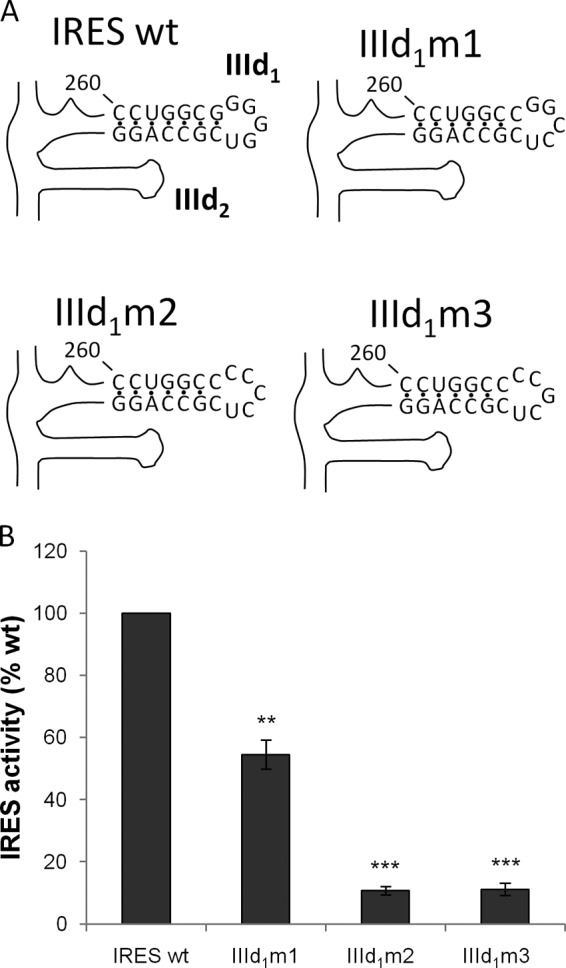
The role of domain IIId1 in CSFV IRES activity. (A) Predicted secondary structures of the wt and mutant domain IIId1 elements. (B) Comparison of translation efficiencies of the wt IRES and mutant IRES elements with modifications within domain IIId1. The IRES elements were inserted into a dicistronic reporter plasmid and assayed as described for Fig. 4. Data are represented as means ± SD (n ≥ 3). **, P < 0.01; ***, P < 0.001.
Group c: role of domain IIIf in CSFV IRES function.
The pseudoknot structure of both the CSFV and HCV IRES elements (domain IIIf) consists of two stems, stem 1 and stem 2 (Fig. 3), connected by 2 loops. HCV IRES stem 1 consists of a continuous stem, whereas stem 1 in the CSFV IRES is interrupted and hence is divided into stem 1a and stem 1b (11, 18). Domain IIIf is indispensable for IRES function in HCV, BVDV, and CSFV (11, 34, 47, 56, 58) and has a pivotal role in the binding and correct positioning of the initiation codon on the 40S ribosomal subunit (4, 22, 24, 30, 38). Several mutants were created in this region of the CSFV IRES (see Fig. 6A). The mutants were divided into two groups: mutants in stem 1a and mutants in stem 2. In one mutant (S1m1), the UA at nt 343 to 344 was modified to inhibit base pairing in this region. Mutations in stem 2 were designed to prevent base pair formation between nt 325 to 328 and nt 355 to 358 (mutants S2m1 to S2m5) at either multiple positions (S2m1 to S2m4) or single positions (S2m5 to S2m6). Compensatory mutations (compared to S2m1) were introduced in mutants S2m2 to S2m7 to recreate base pairing, either as U-G base pairs or by reintroducing G-C base pairs, but with the two bases on opposite strands compared to the wt pseudoknot. This design allowed the evaluation of the importance of specific secondary structure elements as opposed to just that of the sequence of nucleotides involved in the pseudoknot formation. The IRES activities of the various mutant forms of domain IIIf stems 1a and 2 are shown in Fig. 6B. Preventing base pair formation at nt 343 to 344 in stem 1a led to an almost 50% reduction in IRES activity (S1m1), whereas preventing base pairing at nt 325 to 328 in stem 2 (S2m1) of domain IIIf led to a larger reduction in IRES activity (just 20% ± 3% of wt). Single or multiple (G-U [wobble base pair]) or Watson-Crick base-pair-forming (G-C and A-U) compensatory mutations were also introduced on both strands of stem 2 (S2m2 to S2m7) for comparison with the four nucleotide substitutions in S2m1. Reintroducing base pairing at nt 325/258 (S2mut2) and at 325/258 and 327/356 (S2m3) led to slight increases in IRES activity to 33% ± 9% and 37% ± 10%, respectively, compared to the IRES wt. The IRES activity increased further with the reintroduction of additional G-C and G-U base pairs (S2m4; 51% ± 19%) and reached 76% ± 7% compared to the IRES wt with the introduction of two G-C base pairs and an A-U base pair (S2m5). The S2m6 and S2m7 mutants were designed to restore IRES activity, albeit with S2m6 having two G-U pairs in place of the two A-U pairs of the IRES wt and S2m7 having the same base pairs as the IRES wt but with nt 325 to 328 and nt 355 to 358 changed to the opposite strand. Both mutants had IRES activity which was not significantly different from that of the wt IRES (for S2m6, 87% ± 3%; for S2m7, 98% ± 8%), although reintroducing base pairing in the form of two G-U base pairs (S2m6) did appear to be less effective than restoring four Watson-Crick base pairs in the opposite configuration within stem 2 of domain IIIf.
Fig 6.

The roles of stem 1a and stem2 of domain IIIf in IRES activity. (A) Secondary structure of the wt and mutant domain IIIf (pseudoknot) elements. (B) Comparison of translation efficiencies of the wt IRES element and IRES elements mutated within stem 1a and stem 2 within domain IIIf. The IRES elements were inserted into a dicistronic reporter plasmid and assayed as described for Fig. 4. Data are represented as means ± SD (n ≥ 3). N.S, not significant; *, P < 0.05; **, P < 0.01; ***, P < 0.001.
Rescue of mutant viruses with mutated IRES elements.
To evaluate the effect of the various IRES mutations on virus replication and infectivity, some 10 IRES modifications were chosen for introduction into a full-length cDNA of CSFV strain Paderborn (Table 3) by targeted recombination (T. B. Rasmussen, M. B. Friis, P. C. Risager, G. J. Belsham, I. Reimann, and M. Beer, unpublished data). These IRES mutants were selected on the basis of the Rluc activity expressed within the reporter gene assays and had produced a broad range of IRES activities (from 11% to 98% of wt activity—see Table 3), and the mutations were within different domains of the IRES. From each mutant full-length cDNA, positive-sense RNA transcripts were generated in vitro and introduced into PK15 cells by the use of electroporation. RNA transcribed from the parental pBeloPader10 cDNA clone was used as a positive control. Of the 10 mutants introduced into the CSFV genome, only 4 gave rise to viable viruses (Table 3). Most of the tolerated mutations were point mutations within domain IIIf, whereas the mutations in domain II and domain IIId1 mainly resulted in nonviable viruses. A single exception was a derivative of the full-length mutant PaderS2m5 which was generated adventitiously and found to have a mutation at nt 263 (G263A) located in the stem of IIId1 (PaderS2m5_IIId1m4). This double mutant has not been extensively analyzed, but viability was demonstrated in assays for the production of the NS3 protein by the use of immunofluorescence assays (Fig. 7A). This indicates that a mutation in the stem of domain IIId1 does not block infectivity, in contrast to the mutations within the loop of this domain (Table 3).
Table 3.
List of mutated full-length CSFV cDNAs
| Clone | IRES modification | % IRES activitya | Virus replication | Specific infectivity (TCID50/50 μl/2 μg of RNA) at indicated time (h) |
RNA accumulation (fold increase/2 μg of RNA) at indicated time (h) |
Titer (TCID50/50 μl) after indicated no. of passagesb |
||||
|---|---|---|---|---|---|---|---|---|---|---|
| 12 | 24 | 12 | 24 | 1 | 2 | 3 | ||||
| wt Pader10 | 100 | + | 1.8 × 101 | 1.78 × 10³ | 64 | 128 | 4.2 × 10⁵ | 6.8 × 10⁶ | 3.2 × 10⁵ | |
| PaderIIΔ2 | ΔNt70–78 | 62 ± 10 | − | N.D.c | N.D. | N.D. | N.D. | <10 | <10 | <10 |
| PaderIIΔ5 | ΔNt76–122; loop, 5′-CTTCGG-3′ | 78 ± 6 | − | N.D. | N.D. | N.D. | N.D. | <10 | <10 | <10 |
| PaderIIΔ6 | ΔNt76–122; loop, 5′-GTTCGC-3′ | 75 ± 10 | − | N.D. | N.D. | N.D. | N.D. | <10 | <10 | <10 |
| PaderIIId1m1 | GGGGG266–270CGGCC | 55 ± 5 | − | N.D. | N.D. | N.D. | N.D. | <10 | <10 | <10 |
| PaderIIId1m2 | GGGGG266–270CCCCC | 11 ± 1 | − | N.D. | N.D. | N.D. | N.D. | <10 | <10 | <10 |
| PaderS1m1 | UA343–344AU | 58 ± 13 | − | N.D. | N.D. | N.D. | N.D. | <10 | <10 | <10 |
| PaderS2m1 | AGAG325–328UCUC | 20 ± 4 | − | N.D. | N.D. | N.D. | N.D. | <10 | <10 | <10 |
| PaderS2m5 | AGAG325–328UCUC; UCUC355–358GUGG | 76 ± 7 | + | 3 × 100 | 3.16 × 10² | 6 | 6.8 | 5.6 × 10² | 6.8 × 10⁴ | 5.6 × 10⁴ |
| PaderS2m6 | AGAG325–328UCGC; UCUC355–358GUGG | 87 ± 17 | + | 0 | 1.8 × 101 | 0 | 1.9 | 5.6 × 101 | 3.2 × 10³ | 4.6 × 10³ |
| PaderS2m7 | AGAG325–328UCUC; UCUC355–358GAGA | 98 ± 8 | + | 0 | 3.2 × 101 | 1.3 | 2.1 | 4.6 × 101 | 4.6 × 10⁴ | 3.2 × 10³ |
Data represent the means ± standard deviations of the results of at least three independent experiments performed with the dicistronic reporter assay.
Values < 10 were not measurable.
N.D., not determined.
Fig 7.

Growth characteristics of wt and mutant CSFVs in cells. (A) wt Pader10- and PaderS2m5_IIId14-infected PK15 cells stained with NS3-specific antibody (green) and DAPI (blue) 72 h postinfection. Pictures were taken at ×10 magnification. (B) The growth of the rescued viruses wt Pader10, PaderS2m5, PaderS2m6, and PaderS2m7 in PK15 cells was evaluated using one-step growth curves. Virus titers were determined from harvests prepared at 3, 12, 24, 48, and 72 h postinfection. (C) Viral RNA accumulation from PK15 extracts infected with the rescued viruses wt Pader10, PaderS2m5, PaderS2m6 and paderS2m7 was determined by quantitative RT-PCR at 3, 12, 24, 48, and 72 h postinfection. Data in panels B and C are represented as means + SD (n = 3).
The maintenance of the IRES mutations within the rescued viruses was demonstrated by sequencing of RT-PCR-generated products made from DNase I-treated RNA extracts from viruses subjected to three passages (data not shown). No PCR products were generated from the same RNA preparations when the reverse transcriptase was omitted from the reaction mixture, showing that the PCR products were generated from the viral RNA and not from contaminating CSFV cDNAs carried over from the electroporation.
Domain IIIf mutant viruses showed reduced growth characteristics in cell culture.
To examine the growth characteristics of the viable mutant viruses, PK15 cells were infected with third-passage virus at an MOI = 0.01 and, following incubation for 3, 12, 24, 48, and 72 h, the virus yield was determined. Figure 7B shows that all three mutant viruses with changes in domain IIIf grew less well than the wt Pader10 rescued virus. The PaderS2m5 mutant virus was only moderately defective, while the PaderS2m6 and PaderS2m7 mutant viruses grew significantly less well. To support the data obtained from the virus yield assays, RNA was isolated from each virus harvest at the same time points and the level of viral RNA was determined using quantitative RT-PCR assays. Figure 7C shows the accumulation of viral RNA during the first 72 h of infection. The profile of accumulation of viral RNA followed the same pattern as observed for the virus growth curves, except that the amount of viral RNA generated in cells infected with the PaderS2m5 mutant virus was markedly lower (>100-fold) than that seen with the wt and almost indistinguishable from that generated by the PaderS2m6 and PaderS2m7 mutants. Virus yield and RNA production were also analyzed in SK6 cells and showed a pattern similar to that observed in PK15 cells; thus, wt Pader10 > PaderS2m5 > PaderS2m6 = PaderS2m7 (data not shown). As with the experiment in PK15 cells, the magnitude of RNA accumulation in SK6 cells seen with the PaderS2m5 mutant in relation to the wt Pader10 was lower than expected in comparison to the small difference between the virus yield assays for these viruses.
To confirm these results, we also determined the specific infectivity of the wt and mutant RNA transcripts in cells. The transcripts were introduced into PK15 cells by electroporation, and then the cells were incubated for 12 h and 24 h, which should have allowed all viruses to go through at least one replicative cycle. At each time point, the cells were harvested and the viruses that had been generated were titrated and RNA was isolated. The results showed that only the wt Pader10 transcript and the PaderS2m5 RNA yielded detectable infectious virus following 12 h of incubation, whereas a longer incubation time was needed to obtain infectious virus from the PaderS2m6 and PaderS2m7 transcripts (Table 3). To determine the production of viral RNA within electroporated PK15 cells, quantitative RT-PCR was performed in the presence or absence of reverse transcriptase. A substantial increase in RNA was detectable only using the wt Pader10 and PaderS2m5 transcripts after 12 h of incubation. However, after 24 h, an increase in RNA was observed for all viruses, but all of the mutants were highly defective compared to wt Pader10 (Table 3). For comparison, we determined virus yield and measured RNA accumulation within PK 15 cells infected with third-passage virus (Fig. 7B and C). We were able to detect infectious virus and viral RNA accumulation after 12 h (except for PaderS2m7) and 24 h of incubation. As expected, the yield of mutant virus RNA was much less than that of wt RNA at both time points To investigate if any adaptive mutations occurred within either the 5′ UTR or 3′ UTR, sequencing was performed on RT-PCR products generated from both the 5′ and 3′ UTRs from RNA extracted directly from electroporated cells and from third-passage virus-infected cells. In both cases, all viruses had maintained the original mutations in the 5′ UTR and no adaptive mutations were observed in the 3′ UTR.
DISCUSSION
Domain II.
The importance of the different secondary RNA structures within the CSFV strain Paderborn 5′ UTR has been evaluated. The focus has been on the role of these structures in IRES activity as determined using reporter gene systems and also on virus replication within the context of the complete virus genome. As in previous studies on the pestivirus IRES, we created different deletion mutants to determine the 5′ border of the IRES. Data presented previously have been inconsistent; Rijnbrand et al. (47) found that a deletion of the initial 26 nt increased the IRES activity significantly, whereas further deletion up to nt 66 led to a reduction in IRES activity, placing the IRES boundary between nt 26 and 66. However, Fletcher and Jackson (11) found that deleting the initial 2, 14, 38, or 65 nt did not have any significant impact on IRES activity. We found that deletion of the initial 47 nt of the 5′ UTR did not have any impact on IRES-directed translation (Fig. 4A) and that further deletion to nt 71 (IIΔ1) also had no significant effect on IRES activity. These results are consistent with those of Fletcher and Jackson (11) and place the IRES boundary close to the 5′ end of domain II. Additional 5′ end deletions extending beyond nt 79 resulted in a 20% to 40% reduction in IRES activity (Fig. 4C), which is also consistent with earlier studies on the CSFV IRES (11). It is known that HCV and CSFV IRES domain II is not necessary for binding to either the 40S ribosomal unit or the initiation factors eIF2 and eIF3 (23, 38), although the stability of the interaction between the IRES and the 40S subunit can be influenced by domain II (24, 25). Furthermore, the CSFV and HCV IRES domain II elements have been shown to adopt an L-shaped conformation (26, 28, 52) whereby the apical part (subdomain IIb) partially overlaps the E-site of the 40S subunit at the same position at which the deacylated tRNA exits the ribosome (52). The domain II interaction introduces a conformational change in the 40S subunit, which has been proposed to hold the coding RNA in position until the translation machinery has been successfully assembled (52). Finally, the eIF5-induced hydrolysis of GTP and the subsequent release of eIF2/GDP from the initiation complex were shown to be promoted by domain II of both the CSFV and HCV IRES elements, as deletions in the subdomains dIIa and dIIb or loop E led to a 50% reduction in GTP hydrolysis (26). In accord with these results, almost the same reduced level of translation was observed with mutants IIΔ2 to IIΔ4 (Fig. 4C), in which these same elements of the IRES were deleted. However, surprisingly, keeping just the lower part of domain II and adding an unrelated loop sequence was sufficient to maintain 70% of wt IRES function (IIΔ5) and even switching the base pairing within the residual stem-loop structure (IIΔ6) maintained a high level of IRES activity, whereas the complete removal of domain II (-dII) inhibited IRES activity by about 90% (Fig. 4C) as observed previously (see, e.g., reference 26). These data together showed that although the complete loss of domain II is detrimental for IRES activity, partial deletion and extensive modifications of this domain are remarkably well tolerated.
We and others have noted that a basal activity of 10% to 20% of the wt level is observed in the absence of an intact domain II (11, 26, 37) (Fig. 5). It seems that partial deletion of domain II or even a restructuring of the basal stem of domain II is sufficient to introduce a conformational change in the 43S ribosomal subunit and hence allow eIF5-mediated GTP hydrolysis, albeit at a lower level than seen with the intact domain II. This would correlate well with initiation of translation in an eIF2-independent manner as observed by others (37, 53). It appears that there is little sequence specificity about the nature of the stem-loop structure which is present upstream of domain III.
To analyze the function of domain II of the IRES for the virus, selected deletions (IIΔ2, IIΔ5, and IIΔ6) were introduced into a full-length CSFV cDNA in an attempt to rescue viable viruses. The full-length CSFV cDNA contained nt 1 to 69 of the Paderborn sequence as opposed to the dicistronic reporter plasmids. Thus, domains Ia and Ib remained intact in these mutant cDNAs. Not very surprisingly, none of these deletion mutants proved viable (Table 2). Studies using HCV replicons showed that domain II of the HCV IRES plays a crucial role in RNA replication. It was found that substitution of the apical loop of HCV domain II with that of CSFV led to a nearly complete reduction in replication, while translation from these RNAs was almost unaffected (45). On the other hand, similar studies using a replicon based upon another pestivirus, BVDV, showed that domain II is completely dispensable for virus replication (15). Our results suggest that the CSFV domain II does have an impact on replication, but it remains to be shown whether the domain II mutants are capable of initiating translation efficiently within the context of the full-length viral RNA.
Domain IIId1.
The IIId1 domain is involved in the initial interaction between the 40S ribosomal subunit and the IRES. Deletion or mutation of the apical loop of domain IIId1 in the CSFV IRES leads to a reduction in 40S-IRES binary complex formation (25). Similar observations have been obtained with the HCV IRES domain IIId (22). Our data showed that mutations located in the apical loop of IIId1 indeed affect the activity of the IRES. However, even substituting the wt guanines (G) for cytosine (C) at positions 266, 269, and 270 together lowered the activity to only ca. 50% of the wt level (Fig. 5). Additional G-C substitutions at positions 267 and 268 decreased the IRES activity further to 15% of wt, whereas restoring G267 did not elevate IRES activity (Fig. 5). It could be argued that the reintroduction of G267 alone does not produce a strong enough interaction between IIId1 and the 40S subunit to produce an effect on IRES activity. Alternatively, nt 266 might not be involved in the interaction with 40S, although this seems unlikely, since our data and that of others (24, 25) show that the nucleotides flanking G267 have an impact on IRES activity.
Our attempts to rescue live viruses containing mutations in the loop of domain IIId1 were unsuccessful, whereas a derivative of PaderS2m5 (PaderS2m5_IIId14) which also contained a point mutation in the stem of IIId1 at nt G263 (G263A) was successfully rescued into infectious virus (Fig. 7A). It is well established that both the 5′ and 3′ UTRs of many positive-strand viruses, including members of the Flaviviridae, interact with each other during both RNA replication and translation (13, 19, 51; reviewed in reference 32). Romero-López and Berzal-Herranz (48) have recently shown that domain 5BSL3.2 located in the cre within the 3′ UTR of the HCV genome has the capacity to form a kissing-loop interaction with the IIId domain which is initiated between the CCC on the internal loop of 5BSL3.2 and the GGG located on the apical loop of domain IIId. Moreover, the same domain forms a kissing-loop interaction through a motif located at the apical loop with the downstream X-tail SL2 domain, which is crucial for replication (10, 12). A region in the 3′ UTR located in the stem of domain IV (9) of some CSFV strains, including the Paderborn strain, at nt 12081 to 12085 could potentially form a similar kissing-loop interaction with the IIId1 domain within the IRES. However, no such interaction has been described for CSFV to our knowledge. If such an interaction does exist in the CSFV genome, changing the Gs of G266 to G270 to Cs in the RNA transcripts may have prevented this interaction and thus prevented RNA replication. This requires further investigation. Although the loop of IIId1 does appear important for both CSFV translation and replication, it is apparent that a modification within the stem of IIId1 can be accepted by the virus (Fig. 7A).
It has previously been shown that insertion of a 44-nt sequence into domain IIId2 is tolerated within the genome of CSFV (35). The insertion was found to be reduced by 29 nt in length following passage of the virus (35). This indicates that the intact IIId2 structure is not critical for virus replication, and indeed, there is not an analogous structure in the HCV IRES (18).
Domain IIIf.
The involvement of domain IIIf in viral translation has been well established by many groups, not only for the pestiviruses but also for other members of the Flaviviridae (4, 11, 22, 24, 25, 30, 38, 56, 58). Our study clearly confirmed that the pseudoknot is an important structure for the IRES function (Fig. 6B). The efficiency of translation seemed to reflect the number of Watson-Crick and G-U wobble base pairs stabilizing the pseudoknot, whereas the sequence or position of nucleotides forming the base pairs seemed less important. Similar results were previously obtained by others (11, 34, 47). However, at this point, we cannot exclude the possibility that the introduction of modifications within domain IIIf may lead to changes in the RNA structure different from those that are predicted and that such changes may also affect the interaction between the 5′ UTR and other regions of the 12.3-kb CSFV RNA genome.
Viable viruses were rescued with the mutants PaderS2m5, PaderS2m6, and PaderS2m7, showing that mutations in stem2 of the pseudoknot are tolerated. After passage of virus three times in PK15 cells, virus RNA was extracted and sequenced, and the results confirmed the maintenance of the introduced mutations in the rescued viruses.
In single-step growth curve analysis of third-passage virus, each mutant displayed reduced growth characteristics compared to the wt virus in two different porcine cell lines. Interestingly, all three mutants had a more than 100-fold reduction in RNA accumulation compared to the wt virus. Moreover, the yield of PaderS2m5 virus was about 100 times higher than that of PaderS2m6 and PaderS2m7 after 72 h, whereas the levels of viral RNA accumulation were almost the same for the three mutants. It is interesting that it had seemed from the reporter gene assay that the PaderS2m5 mutant IRES may be less active than the PaderS2m6 and PaderS2m7 elements. The reporter gene assays, along with the data obtained for the accumulation of viral RNA and generation of infectious virus, suggest that the behavior characteristics of the different mutants do not solely reflect differences in the capacity of the viral RNA to be translated or replicated. Several other factors could have an impact on virus growth; for example, reduced packaging of viral RNA would result in fewer infectious particles and hence lower growth rates. To further investigate the growth properties of the mutant viruses, we examined the specific infectivity of mutant viruses compared to wt Pader10. Our data showed that, following 12 h and 24 h of incubation, when the viruses would be expected to have gone through at least one replication cycle, the mutant viruses were clearly defective compared to wt Pader10 with regard to virus yield and viral RNA accumulation. Furthermore, as for the later time points, PaderS2m5 showed a higher virus yield than both PaderS2m6 and PaderS2m7, whereas the increases in viral RNA accumulation remained almost the same for all three mutants. These data indicate that each of the mutant viruses is defective with regard to replication compared to the wt Pader10 and that PaderS2m5 shows a higher growth rate compared to the two other mutants. However, the similar increase in RNA accumulation of PaderS2m5 compared to PaderS2m6 and PaderS2m7 still indicates that other factors that affect virus growth differ between the three mutants. It could be postulated that adaptive mutations may have occurred, but none have been identified within the 5′- and 3′-UTR sequences which have been analyzed, and in comparing virus yield and RNA accumulation from freshly electroporated cells with those of third-passage virus, the pattern remained the same.
Generation of viable viruses containing mutations within the IRES.
In this work, we used an efficient method for introducing mutations into full-length viral cDNAs to achieve the rescue of mutant CSF viruses. Although the IRES was targeted for modification in this study, potentially any region of the viral genome could be modified using the recombination system (Rasmussen et al., unpublished). Furthermore, we have demonstrated that mutations within the IRES can be tolerated by the virus, although the mutant viruses displayed reduced growth in cell culture in comparison with the wt virus. This approach facilitates the analysis of translation and replication in CSFV and potentially allows an improved system for the design and production of live attenuated vaccines.
ACKNOWLEDGMENTS
We thank Preben Normann, Inge Nielsen, and Lone Nielsen for their technical assistance.
We thank the Danish Research Council for Technology and Production Sciences for financial support (DRCTPS grant no. 274-08-0305).
Footnotes
Published ahead of print 6 June 2012
REFERENCES
- 1. Becher P, Orlich M, Thiel HJ. 2000. Mutations in the 5′ nontranslated region of bovine viral diarrhea virus result in altered growth characteristics. J. Virol. 74:7884–7894 [DOI] [PMC free article] [PubMed] [Google Scholar]
- 2. Belsham GJ. 2009. Divergent picornavirus IRES elements. Virus Res. 139:183–192 doi:10.1016/j.virusres.2008.07.001 [DOI] [PubMed] [Google Scholar]
- 3. Belsham GJ, Nielsen I, Normann P, Royall E, Roberts LO. 2008. Monocistronic mRNAs containing defective hepatitis C virus-like picornavirus internal ribosome entry site elements in their 5′ untranslated regions are efficiently translated in cells by a cap-dependent mechanism. RNA 14:1671–1680 doi:10.1261/rna.1039708 [DOI] [PMC free article] [PubMed] [Google Scholar]
- 4. Berry KE, Waghray S, Doudna JA. 2010. The HCV IRES pseudoknot positions the initiation codon on the 40S ribosomal subunit. RNA 16:1559–1569 doi:10.1261/rna.2197210 [DOI] [PMC free article] [PubMed] [Google Scholar]
- 5. Berry KE, Waghray S, Mortimer SA, Bai Y, Doudna JA. 2011. Crystal structure of the HCV IRES central domain reveals strategy for start-codon positioning. Structure 19:1456–1466 doi:10.1016/j.str.2011.08.002 [DOI] [PMC free article] [PubMed] [Google Scholar]
- 6. Brown EA, Zhang H, Ping LH, Lemon SM. 1992. Secondary structure of the 5′ nontranslated regions of hepatitis C virus and pestivirus genomic RNAs. Nucleic Acids Res. 20:5041–5045 [DOI] [PMC free article] [PubMed] [Google Scholar]
- 7. Chard LS, Kaku Y, Jones B, Nayak A, Belsham GJ. 2006. Functional analyses of RNA structures shared between the internal ribosome entry sites of hepatitis C virus and the picornavirus porcine teschovirus 1 Talfan. J. Virol. 80:1271–1279 doi:10.1128/JVI.80.3.1271-1279.2006 [DOI] [PMC free article] [PubMed] [Google Scholar]
- 8. Chon SK, Perez DR, Donis RO. 1998. Genetic analysis of the internal ribosome entry segment of bovine viral diarrhea virus. Virology 251:370–382 doi:10.1006/viro.1998.9425 [DOI] [PubMed] [Google Scholar]
- 9. Deng R, Brock KV. 1993. 5′ and 3′ untranslated regions of pestivirus genome: primary and secondary structure analyses. Nucleic Acids Res. 21:1949–1957 [DOI] [PMC free article] [PubMed] [Google Scholar]
- 10. Diviney S, et al. 2008. A hepatitis C virus cis-acting replication element forms a long-range RNA-RNA interaction with upstream RNA sequences in NS5B. J. Virol. 82:9008–9022 doi:10.1128/JVI.02326-07 [DOI] [PMC free article] [PubMed] [Google Scholar]
- 11. Fletcher SP, Jackson RJ. 2002. Pestivirus internal ribosome entry site (IRES) structure and function: elements in the 5′ untranslated region important for IRES function. J. Virol. 76:5024–5033 [DOI] [PMC free article] [PubMed] [Google Scholar]
- 12. Friebe P, Boudet J, Simorre JP, Bartenschlager R. 2005. Kissing-loop interaction in the 3′ end of the hepatitis C virus genome essential for RNA replication. J. Virol. 79:380–392 doi:10.1128/JVI.79.1.380-392.2005 [DOI] [PMC free article] [PubMed] [Google Scholar]
- 13. Frolov I, McBride MS, Rice CM. 1998. cis-acting RNA elements required for replication of bovine viral diarrhea virus-hepatitis C virus 5′ nontranslated region chimeras. RNA 4:1418–1435 [DOI] [PMC free article] [PubMed] [Google Scholar]
- 14. Fuerst TR, Niles EG, Studier FW, Moss B. 1986. Eukaryotic transient-expression system based on recombinant vaccinia virus that synthesizes bacteriophage T7 RNA polymerase. Proc. Natl. Acad. Sci. U. S. A. 83:8122–8126 [DOI] [PMC free article] [PubMed] [Google Scholar]
- 15. Grassmann CW, Yu H, Isken O, Behrens SE. 2005. Hepatitis C virus and the related bovine viral diarrhea virus considerably differ in the functional organization of the 5′ non-translated region: implications for the viral life cycle. Virology 333:349–366 doi:10.1016/j.virol.2005.01.007 [DOI] [PubMed] [Google Scholar]
- 16. Hellen CU, de Breyne S. 2007. A distinct group of hepacivirus/pestivirus-like internal ribosomal entry sites in members of diverse picornavirus genera: evidence for modular exchange of functional noncoding RNA elements by recombination. J. Virol. 81:5850–5863 doi:10.1128/JVI.02403-06 [DOI] [PMC free article] [PubMed] [Google Scholar]
- 17. Hoffman B, Liu Q. 2011. Hepatitis C viral protein translation: mechanisms and implications in developing antivirals. Liver Int. 31:1449–1467 doi:10.1111/j.1478-3231.2011.02543.x [DOI] [PubMed] [Google Scholar]
- 18. Honda M, Beard MR, Ping LH, Lemon SM. 1999. A phylogenetically conserved stem-loop structure at the 5′ border of the internal ribosome entry site of hepatitis C virus is required for cap-independent viral translation. J. Virol. 73:1165–1174 [DOI] [PMC free article] [PubMed] [Google Scholar]
- 19. Isken O, Grassmann CW, Yu H, Behrens SE. 2004. Complex signals in the genomic 3′ nontranslated region of bovine viral diarrhea virus coordinate translation and replication of the viral RNA. RNA 10:1637–1652 doi:10.1261/rna.7290904 [DOI] [PMC free article] [PubMed] [Google Scholar]
- 20. Ji H, Fraser CS, Yu Y, Leary J, Doudna JA. 2004. Coordinated assembly of human translation initiation complexes by the hepatitis C virus internal ribosome entry site RNA. Proc. Natl. Acad. Sci. U. S. A. 101:16990–16995 doi:10.1073/pnas.0407402101 [DOI] [PMC free article] [PubMed] [Google Scholar]
- 21. Jubin R, et al. 2000. Hepatitis C virus internal ribosome entry site (IRES) stem loop IIId contains a phylogenetically conserved GGG triplet essential for translation and IRES folding. J. Virol. 74:10430–10437 [DOI] [PMC free article] [PubMed] [Google Scholar]
- 22. Kieft JS, Zhou K, Jubin R, Doudna JA. 2001. Mechanism of ribosome recruitment by hepatitis C IRES RNA. RNA 7:194–206 [DOI] [PMC free article] [PubMed] [Google Scholar]
- 23. Kieft JS, et al. 1999. The hepatitis C virus internal ribosome entry site adopts an ion-dependent tertiary fold. J. Mol. Biol. 292:513–529 doi:10.1006/jmbi.1999.3095 [DOI] [PubMed] [Google Scholar]
- 24. Kolupaeva VG, Pestova TV, Hellen CU. 2000. An enzymatic footprinting analysis of the interaction of 40S ribosomal subunits with the internal ribosomal entry site of hepatitis C virus. J. Virol. 74:6242–6250 [DOI] [PMC free article] [PubMed] [Google Scholar]
- 25. Kolupaeva VG, Pestova TV, Hellen CU. 2000. Ribosomal binding to the internal ribosomal entry site of classical swine fever virus. RNA 6:1791–1807 [DOI] [PMC free article] [PubMed] [Google Scholar]
- 26. Locker N, Easton LE, Lukavsky PJ. 2007. HCV and CSFV IRES domain II mediate eIF2 release during 80S ribosome assembly. EMBO J. 26:795–805 doi:10.1038/sj.emboj.7601549 [DOI] [PMC free article] [PubMed] [Google Scholar]
- 27. Lukavsky PJ. 2009. Structure and function of HCV IRES domains. Virus Res. 139:166–171 doi:10.1016/j.virusres.2008.06.004 [DOI] [PMC free article] [PubMed] [Google Scholar]
- 28. Lukavsky PJ, Kim I, Otto GA, Puglisi JD. 2003. Structure of HCV IRES domain II determined by NMR. Nat. Struct. Biol. 10:1033–1038 doi:10.1038/nsb1004 [DOI] [PubMed] [Google Scholar]
- 29. Lukavsky PJ, Otto GA, Lancaster AM, Sarnow P, Puglisi JD. 2000. Structures of two RNA domains essential for hepatitis C virus internal ribosome entry site function. Nat. Struct. Biol. 7:1105–1110 doi:10.1038/81951 [DOI] [PubMed] [Google Scholar]
- 30. Lytle JR, Wu L, Robertson HD. 2002. Domains on the hepatitis C virus internal ribosome entry site for 40s subunit binding. RNA 8:1045–1055 [DOI] [PMC free article] [PubMed] [Google Scholar]
- 31. Makoschey B, et al. 2004. Bovine viral diarrhea virus with deletions in the 5′-nontranslated region: reduction of replication in calves and induction of protective immunity. Vaccine 22:3285–3294 doi:10.1016/j.vaccine.2004.03.003 [DOI] [PubMed] [Google Scholar]
- 32. Martínez-Salas E, Pacheco A, Serrano P, Fernandez N. 2008. New insights into internal ribosome entry site elements relevant for viral gene expression. J. Gen. Virol. 89:611–626 doi:10.1099/vir.0.83426-0 [DOI] [PubMed] [Google Scholar]
- 33. Meyers G, Rumenapf T, Thiel HJ. 1989. Molecular cloning and nucleotide sequence of the genome of hog cholera virus. Virology 171:555–567 [DOI] [PubMed] [Google Scholar]
- 34. Moes L, Wirth M. 2007. The internal initiation of translation in bovine viral diarrhea virus RNA depends on the presence of an RNA pseudoknot upstream of the initiation codon. Virol. J. 4:124 doi:10.1186/1743-422X-4-124 [DOI] [PMC free article] [PubMed] [Google Scholar]
- 35. Moser C, Bosshart A, Tratschin JD, Hofmann MA. 2001. A recombinant classical swine fever virus with a marker insertion in the internal ribosome entry site. Virus Genes 23:63–68 [DOI] [PubMed] [Google Scholar]
- 36. Muyrers JP, Zhang Y, Testa G, Stewart AF. 1999. Rapid modification of bacterial artificial chromosomes by ET-recombination. Nucleic Acids Res. 27:1555–1557 [DOI] [PMC free article] [PubMed] [Google Scholar]
- 37. Pestova TV, de Breyne S, Pisarev AV, Abaeva IS, Hellen CU. 2008. eIF2-dependent and eIF2-independent modes of initiation on the CSFV IRES: a common role of domain II. EMBO J. 27:1060–1072 doi:10.1038/emboj.2008.49 [DOI] [PMC free article] [PubMed] [Google Scholar]
- 38. Pestova TV, Shatsky IN, Fletcher SP, Jackson RJ, Hellen CU. 1998. A prokaryotic-like mode of cytoplasmic eukaryotic ribosome binding to the initiation codon during internal translation initiation of hepatitis C and classical swine fever virus RNAs. Genes Dev. 12:67–83 [DOI] [PMC free article] [PubMed] [Google Scholar]
- 39. Pisarev AV, et al. 2004. Functional and structural similarities between the internal ribosome entry sites of hepatitis C virus and porcine teschovirus, a picornavirus. J. Virol. 78:4487–4497 [DOI] [PMC free article] [PubMed] [Google Scholar]
- 40. Poole TL, et al. 1995. Pestivirus translation initiation occurs by internal ribosome entry. Virology 206:750–754 [DOI] [PubMed] [Google Scholar]
- 41. Rasmussen TB, et al. 2010. Generation of recombinant pestiviruses using a full-genome amplification strategy. Vet. Microbiol. 142:13–17 doi:10.1016/j.vetmic.2009.09.037 [DOI] [PubMed] [Google Scholar]
- 42. Rasmussen TB, et al. 2007. Virulence, immunogenicity and vaccine properties of a novel chimeric pestivirus. J. Gen. Virol. 88:481–486 doi:10.1099/vir.0.82453-0 [DOI] [PubMed] [Google Scholar]
- 43. Reed LJ, Muench H. 1938. A simple method of estimating fifty per cent endpoints. Am. J. Hyg. (Lond.) 27:493–497 [Google Scholar]
- 44. Reimann I, Meyers G, Beer M. 2003. Trans-complementation of autonomously replicating Bovine viral diarrhea virus replicons with deletions in the E2 coding region. Virology 307:213–227 [DOI] [PubMed] [Google Scholar]
- 45. Reusken CB, Dalebout TJ, Eerligh P, Bredenbeek PJ, Spaan WJ. 2003. Analysis of hepatitis C virus/classical swine fever virus chimeric 5′NTRs: sequences within the hepatitis C virus IRES are required for viral RNA replication. J. Gen. Virol. 84:1761–1769 [DOI] [PubMed] [Google Scholar]
- 46. Reynolds JE, et al. 1996. Internal initiation of translation of hepatitis C virus RNA: the ribosome entry site is at the authentic initiation codon. RNA 2:867–878 [PMC free article] [PubMed] [Google Scholar]
- 47. Rijnbrand R, van der Straaten T, van Rijn PA, Spaan WJ, Bredenbeek PJ. 1997. Internal entry of ribosomes is directed by the 5′ noncoding region of classical swine fever virus and is dependent on the presence of an RNA pseudoknot upstream of the initiation codon. J. Virol. 71:451–457 [DOI] [PMC free article] [PubMed] [Google Scholar]
- 48. Romero-López C, Berzal-Herranz A. 2009. A long-range RNA-RNA interaction between the 5′ and 3′ ends of the HCV genome. RNA 15:1740–1752 doi:10.1261/rna.1680809 [DOI] [PMC free article] [PubMed] [Google Scholar]
- 49. Sambrook J, Russell DW. 2001. The condensed protocols from molecular cloning: a laboratory manual. Cold Spring Harbor Laboratory Press, Cold Spring Harbor, NY [Google Scholar]
- 50. Sizova DV, Kolupaeva VG, Pestova TV, Shatsky IN, Hellen CU. 1998. Specific interaction of eukaryotic translation initiation factor 3 with the 5′ nontranslated regions of hepatitis C virus and classical swine fever virus RNAs. J. Virol. 72:4775–4782 [DOI] [PMC free article] [PubMed] [Google Scholar]
- 51. Song Y, et al. 2006. The hepatitis C virus RNA 3′-untranslated region strongly enhances translation directed by the internal ribosome entry site. J. Virol. 80:11579–11588 doi:10.1128/JVI.00675-06 [DOI] [PMC free article] [PubMed] [Google Scholar]
- 52. Spahn CM, et al. 2001. Hepatitis C virus IRES RNA-induced changes in the conformation of the 40s ribosomal subunit. Science 291:1959–1962 doi:10.1126/science.1058409 [DOI] [PubMed] [Google Scholar]
- 53. Terenin IM, Dmitriev SE, Andreev DE, Shatsky IN. 2008. Eukaryotic translation initiation machinery can operate in a bacterial-like mode without eIF2. Nat. Struct. Mol. Biol. 15:836–841 doi:10.1038/nsmb.1445 [DOI] [PubMed] [Google Scholar]
- 54. Thurner C, Witwer C, Hofacker IL, Stadler PF. 2004. Conserved RNA secondary structures in Flaviviridae genomes. J. Gen. Virol. 85:1113–1124 [DOI] [PubMed] [Google Scholar]
- 55. Uttenthal A, Storgaard T, Oleksiewicz MB, de Stricker K. 2003. Experimental infection with the Paderborn isolate of classical swine fever virus in 10-week-old pigs: determination of viral replication kinetics by quantitative RT-PCR, virus isolation and antigen ELISA. Vet. Microbiol. 92:197–212 [DOI] [PubMed] [Google Scholar]
- 56. Wang C, Le SY, Ali N, Siddiqui A. 1995. An RNA pseudoknot is an essential structural element of the internal ribosome entry site located within the hepatitis C virus 5′ noncoding region. RNA 1:526–537 [PMC free article] [PubMed] [Google Scholar]
- 57. Wang C, Sarnow P, Siddiqui A. 1993. Translation of human hepatitis C virus RNA in cultured cells is mediated by an internal ribosome-binding mechanism. J. Virol. 67:3338–3344 [DOI] [PMC free article] [PubMed] [Google Scholar]
- 58. Wang C, Sarnow P, Siddiqui A. 1994. A conserved helical element is essential for internal initiation of translation of hepatitis C virus RNA. J. Virol. 68:7301–7307 [DOI] [PMC free article] [PubMed] [Google Scholar]
- 59. Wei D, Li M, Zhang X, Xing L. 2004. An improvement of the site-directed mutagenesis method by combination of megaprimer, one-side PCR and DpnI treatment. Anal. Biochem. 331:401–403 doi:10.1016/j.ab.2004.04.019 [DOI] [PubMed] [Google Scholar]