



Abstract
Background
Biopsy Gleason score (bGS) remains an important prognostic indicator for adverse outcomes in Prostate Cancer (PCA). In the light of recent studies purporting difference in prognostic outcomes for the subgroups of GS7 group (primary Gleason pattern 4 vs. 3), upgrading of a bGS of 6 to a GS≥7 has serious implications. We sought to identify pre-operative factors associated with upgrading in a cohort of GS6 patients who underwent prostatectomy.
Design
We identified 281 cases of GS6 PCA on biopsy with subsequent prostatectomies. Using data on pre-operative variables (age, PSA, biopsy pathology parameters), logistic regression models (LRM) were developed to identify factors that could be used to predict upgrading to GS≥7 on subsequent prostatectomy. A decision tree (DT) was constructed.
Results
92 of 281 cases (32.7%) were upgraded on subsequent prostatectomy. LRM identified a model with two variables with statistically significant ability to predict upgrading, including pre-biopsy PSA (Odds Ratio 8.66; 2.03-37.49, 95% CI) and highest percentage of cancer at any single biopsy site (Odds Ratio 1.03, 1.01-1.05, 95% CI). This two-parameter model yielded an area under curve of 0.67. The decision tree was constructed using only 3 leave nodes; with a test set classification accuracy of 70%.
Conclusions
A simplistic model using clinical and biopsy data is able to predict the likelihood of upgrading of GS with an acceptable level of certainty. External validation of these findings along with development of a nomogram will aid in better stratifying the cohort of low risk patients as based on the GS.
Keywords: Carcinoma, prostate/pathology/predictive modeling, statistical techniques/logistic regression, binary recursive partitioning
Introduction
Many recent studies have shown that the prostate cancers with Gleason score (GS) =7 have an adverse and varied prognosis depending on the primary Gleason pattern. Understandably, upgrading of a GS6 on a biopsy to a GS7 or more on prostatectomy may translate into potential adverse outcomes for the patient. King et al defined “clinically significant” upgrading of the biopsy as any of the following: (i) a biopsy Gleason score (bGS) of 6 to a prostatectomy GS (pGS) of 7 or higher, (ii) a bGS 3 + 4 to a pGS of 4 + 3 or higher, and (iii) a bGS of 7 to a pGS of 8 or higher [1]. The reported rates of clinically significant upgrading in recent studies are widely varying, ranging from 14% [2] to up to 71.7% [3]. Factors affecting upgrading rates have been influenced by the type of biopsy (sextant vs. Extended biopsy scheme) [4,5], stage [6,7], PSA [6-8], number of core biopsies [9] and biopsy GS [6,7]. The goal of this study is to provide more clarification to this important discussion by identifying the clinical variables that correlated with upgrading from bGS of 6 to a pGS of 7 or more in this patient cohort at a tertiary care institution in the PSA era.
Material and methods
Case selection
The study population consisted of a cohort of patients who had a biopsy diagnosis of prostate cancer between 1998 and 2002 based on either digital rectal examination (DRE) or elevated PSA at screening. The study was conducted after full approval of the Loyola University Medical Center Institutional Review Board (LU 108763). The department of pathology database was searched for all radical prostatectomies conducted at the institution between 1998 and 2002 for a biopsy diagnosis of PCa from this group of patients. A total of 647 PCa patients diagnosed with concurrent prostatectomy data and biopsy data available were identified from this database. From this dataset, we selected a cohort of 281 patients with a biopsy GS6 that were diagnosed between 1998-2002. Most of these biopsies were from a pre-extended biopsy era and the median number of core biopsies was 8 (range = 6-12). The radical prostatectomy specimen was submitted entirely if the specimen weighed less than 50grams and every other section in case of specimens weighing more than 50 grams. Clinical data including age, pre-biopsy PSA, and biopsy variables including percentage of positive biopsy sites (PPBS), highest percentage of cancer at any single site with cancer (hPCA), and presence of high-grade prostatic intra-epithelial neoplasia (HGPIN) or perineural invasion (PNI) were extracted.
Statistical analyses
Cases with missing values on any of the aforementioned variables were deleted from the analyses. After appropriate transformation, Kolmogorov-Smirnov test for all scale data were not significant anymore. For univariate analyses, either Student’s t-test or the non-parametric two independent sample test (Mann-Whitney’s U test) was used for comparing differences in age, hPCA, PPBS and pre-biopsy PSA between the two outcome groups (upgraded vs. not upgraded). Multivariate logistic regression models (LRM) using a forward Wald method were constructed in Stata 10 (Statacorp, College Station, TX) to identify factors predictive of upgrading to GS>6. Odds Ratio (OR) and 95% confidence intervals (CI) of the OR were estimated and reported after exponentiation of the beta estimates. Receiver Operator Characteristic (ROC) curves were constructed and the area under curve (AUC) for the models was evaluated using the “c” statistic. Additionally, a decision tree (DT) was constructed using the Weka workbench using significant predictors from the LRM analyses to estimate cut-points and classification accuracy [10,11].
Results
The baseline demographic information of the patients selected for the study is depicted in Table 1. There was no significant difference in age between the two groups of patients. Among 281 patients with GS=6, ninety-two (92) were upgraded to GS>6 (32.7%). Among the upgraded cases, 90 (97.8%) were upgraded to GS 7, and 1 each (1.1%) was upgraded to GS 8 and GS 9. Baseline univariate analyses revealed only pre-biopsy PSA and highest percentage of cancer at any single biopsy site to be statistically higher in cases that were upgraded (see Table 2).
Table 1.
Baseline characteristics of this cohort of 281 patients with GS=6. Cochran-Armitage test was used to test the significance of linear trend of proportion of upgraded cases across the progressive quintiles of PSA.
| Characteristics | Not upgraded (n=189) | Upgraded (n=92) | Significance |
|---|---|---|---|
| Age at testing median (range), y | 58 (42-73) | 58.5 (48-77) | 0.21 |
| Pre-biopsy PSA | 0.0001 | ||
| Quintile 1 (0.6-4.1 ng/mL) | 47 (24.9%) | 9 (9.8%) | |
| Quintile 2 (4.2-5 ng/mL) | 41 (21.7%) | 19 (20.7%) | |
| Quintile 3 (5.1-5.9 ng/mL) | 39 (20.6%) | 14 (15.2%) | |
| Quintile 4 (6-8.4 ng/mL) | 35 (18.5%) | 21 (22.8%) | |
| Quintile 5 (8.5-63.8 ng/mL) | 27 (14.3%) | 29 (31.5%) | |
| hPSA, median (range) | 10 (1-80) | 20 (2-10) | 0.001 |
| PPBS, median (range) | 50 (17-100) | 42.9 (17-100) | 0.69 |
| HGPIN in biopsy | 21 (11.7%) | 16 (19.3%) | 0.09 |
| PNI in biopsy | 8 (4.4%) | 3 (3.6%) | 0.75 |
Table 2.
Results of uni- and multi-variable analyses. Only log (PSA) and hPCA at a single biopsy site had the best ability to predict upgrading to a significant extent.
| Predictor | Univariate Statistics | Multivariable Statistics | ||
|---|---|---|---|---|
|
| ||||
| OR (95% CI) | p-value | OR (95% CI) | p-value | |
| Age | 1.02 (0.99, 1.06) | 0.15 | 1.02 (0.97, 1.06) | 0.319 |
| PSA | 12.36 (4.32, 39.24) | 0.0001 | 8.04 (2.18, 21.65) | 0.002 |
| hpCA | 1.02 (1.01, 1.03) | 0.001 | 1.02 (1.01, 1.04) | 0.001 |
| PPBS | 1.00 (0.99, 1.01) | 0.533 | 0.99 (0.98, 1.01) | 0.897 |
| HGPIN | 0.55 (0.27, 1.12) | 0.102 | 0.47 (0.22, 1.02) | 0.057 |
| PNI | 1.24 (0.32, 4.8) | 0.755 | 3.6 (0.53, 24.33) | 0.188 |
LRM identified a model including both the significant variables from univariate analyses that had a statistically significant ability to predict upgrading, including pre-biopsy PSA (Odds Ratio 8.66; 2.03-37.49, 95% CI) and hPCA (Odds Ratio 1.03, 1.01-1.05, 95% CI). This two-parameter model yielded a predictive accuracy of 62.2% (AUC=0.67). None of the other variables (age, PPBS, or presence of HGPIN) were included in the final model. (Table 2) PNI was not included for modeling in the multivariable analyses owing to very few cases that had PNI in both outcome groups.
DT analysis (Figure 1) showed that the root node first splits on the PSA attribute, followed by a subsequent split on hPCA in the right branch. The tree was constructed using 66% of the data for training and the remaining 34% for testing. Using only 3 leave nodes, the tree obtained a test set classification accuracy of 70%. The corresponding ROC area was 60% (0.6). Hence, using only a few leave nodes, the tree was able to give satisfactory classification performance.
Figure 1.
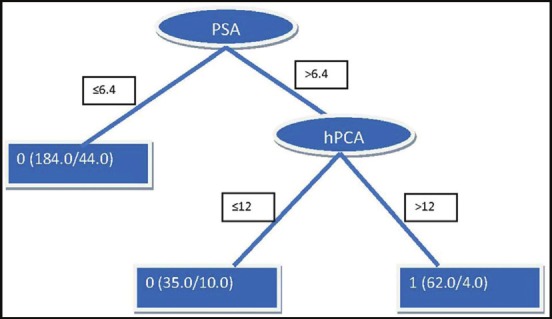
Decision tree analyses using prebiopsy PSA and hPCA. Binary cutpoints derived using this analyses are illustrated. The tree was constructed using 66% of the data for training and the remaining 34% for testing. Using only 3 leave nodes, the tree obtained a test set classification accuracy of 70%.
Discussion
While the incidence of PCA has been increasing over the past decade, a substantial downward trend in clinical stage and median PSA levels at diagnosis are being observed. Furthermore, there has also been a 3 fold decrease in the incidence of clinical stage T3 to T4 with increasing detection of low-volume cancer due to increased numbers of biopsies being performed [12]. Therefore, clinical stage and PSA level are becoming less relevant when classifying patients as low, intermediate, or high risk for treatment failure and disease progression. Gleason score, on the other hand, has been found to directly correlate with PSA failure, time to metastases and cancer specific mortality [13-15].
Although, prostatectomy Gleason score (pGS) is more accurate at predicting biochemical failure than biopsy Gleason score (bGS) [16]. However, it is the bGS that is available to the clinician and patient before a definitive treatment strategy is decided upon. Many studies have clearly shown significant discrepancies between bGS and pGS of the radical prostatectomy (RP) specimen. Furthermore, since low Volume/Low risk PCA is best served by RP, accurate identification of this subset on biopsy as GS6 or less is important since upgrading of a GS6 to a GS7 on RP may adversely change the risk levels and outcomes for this so called low-risk group as determined on a biopsy.
The reported incidence of upgrading is very varied in literature depending on the definition used and the type of biopsy schema (extended vs. sextant) [1,4,5]. The term “clinically significant upgrade” was coined by King et al, and refers to either a bGS of 6 upgraded to a pGS of 7 or higher, a bGS of 3+4 upgraded to a pGS of 4+3 or higher, or a bGS of 7 upgraded to pGS of 8 or higher [2]. This upgrading is important due to the implications on treatment options indicated for a Gleason score of ≤6, 7, or ≥8. Of note, cancers with a bGS of 6 that were upgraded to pGS of 7 matched the pathologic characteristics of cancers with a bGS of 7 and pGS of 7. These characteristics included cancer volume, margin and seminal vesicle status, capsular involvement, and extraprostatic extension. Patients who had a bGS of 6 and remained pGS of 6 had significantly better pathologic characteristics. These three scenarios demonstrate the overall significance of the final pathologic GS compared to the bGS.
Many recent studies have investigated the factors that predict upgrading. A summary of the major recent studies is depicted in Table 3. One of the early studies by D’Amico et al identified that higher baseline PSA and clinical stage are significantly associated with upgrading [6]. The predictive value of PSA for upgrading has been reaffirmed in many subsequent studies [3,4,17]. However the utility of clinical stage was questionable in other subsequent studies [1,5,18]. Recent studies have determined that the prostate specific antigen density or percentage free PSA are significant independent predictors of Gleason upgrading even when accounting for prostate specific antigen [19-21]. Men with a higher PSA level, perineural invasion and high-volume cancer at biopsy are most likely to be upgraded, while men with a large prostate volume and low-volume cancer at biopsy are more likely to be downgraded [22]. The reported rates of upgrading are varied in literature ranging from 14% in the cohort of King et al [2] to 71.1% in the study by Cam et al [3]. We included the cohort of GS6 patients in our study and PSA remained an independent predictor of Gleason upgrading in our study too, in agreement with most previous studies. In addition, the highest percentage of cancer was an additional significant predictor in our study. Interestingly, the import of tumor volume on Gleason upgrading has been conflicting in past literature with some reporting significant utility [18], while other studies have failed to demonstrate its utility [13,23]. Notably, the latter study concluded that histologic grading from small amounts of cancer in prostate biopsies is reliable and not more prone to grading errors. These authors advocate that a repeat biopsy for these patients may not be indicated.
Table 3.
Summary of major studies till date investigating the factors associated with upgrading.
| Authors | Year | Biopsy Cohort Characteristics | Upgrading Rate (Criteria) | Predictive Factors | Notable Results |
|---|---|---|---|---|---|
| Dong et al | 2008 | 268 GS6 patients | 50% | PSA, prostate volume and biopsy cancer volume | Pts. With upgrading with shorter RFS |
| Kulkarni et al | 2007 | 175 low-risk Pca | 34% | PSA, Path Expertise | Nomogram with c=0.71 BCA*=0.65) |
| Pinthus et al. | 2006 | Subset of 205 with GS6 | ~50% | PSA, Tumor volume on Biopsy | |
| Mian et al | 2006 | 426 patients (225 Sextant; 206 EB**) | 44% | Type of Biopsy (EB vs.Sextant) | Extended Biopsy scheme with less upgrading |
| King et al | 2006 | 371 patients | 40.70% | None | Independent of Tumor volume or clinical indices |
| Chun et al | 2006 | 4789 patients with GS 6 and GS7 | 28.2% (King et al’s criteria) | PSA, Clin. stage, bGS | BCA=0.75 |
| Chun et al | 2006 | 2880 patients with GS≤6 | 36.7% (King et al’s criteria) | PSA, Clinical stage, bGS | Nomogram with BCA=0.804 |
| King et al | 2005 | Subset of 72 patients with GS=6 | 32% | None | Volume indices do not predict upgrading |
| D’Amico et al | 1999 | 420 Clinical T1c with bGS≤6 | 40% | PSA, prostate volume, Clin. stage 2b, 2c |
BCA = Bootstrap Corrected Accuracy;
EB = Extended Biopsy.
For studies since 2008 please see discussion.
There are two proposed reasons for the varied incidence of clinically significant upgrading, one involving interpretational bias and the other citing sampling effects due to tumor heterogeneity. However, there is disagreement within the literature as to whether an extended biopsy scheme could lower the incidence of significant upgrading compared to the standard sextant biopsy pattern. Capitanio and coworkers found that in men assessed with 10-12 cores, the rate of GSU was 47.9% compared with 23.5% if >18 cores were taken [9]. Currently, the focus has moved towards using clinical factors to predict the probability of significant GS upgrading between biopsy and RP. The accuracy of the models from recent major studies have ranged between 65 [24]-81% [7]. Notably, Kulkarni et al [16] developed a nomogram with an accuracy of 0.71 and their nomogram included PSA, which was a significant predictive factor. Similarly Moussa et al [25] developed a nomogram that had a concordance index of 0.68. Their cohort is similar to ours in that both included GS6 patients.
Nonetheless, there are some limitations to our study that merit addressing: first, we included solely patients with subsequent RP data available. Hence, it is not possible for us to estimate with certainty if the similar low-risk patients who do not undergo RP would have potential high-risk disease. Second, most patients underwent RP around a median duration of 2 months after biopsy and so it is unclear how much the disease characteristics may change in this interval. Thirdly the number of core biopsies taken in our cohort of patients is less (range 6-12) compared to more recent prostate biopsy protocols where up to 18 cores are submitted for pathological evaluation. However, at the same time there are studies in the literature that have shown that the number of core biopsies obtained is significantly lower in Gleason score upgraded patients in comparison to unchanged/downgraded Gleason score group. Also the prostate biopsy protocols are still heterogeneous and reflecting current daily urological practice with usage of nomograms based on six- and eight-core biopsy schemes [26]. Nonetheless, the efficacy of our model is comparable to the model developed by Kulkarni et al [24] with similar rates of upgrading. An important caveat for potential investigators regarding our study is that the applicability of our model may only be valid in cohorts with similar proportions of upgraded cases. Lastly, our sample size was insufficient to lend itself to a split-sample validation; keeping this in mind, we have performed a bootstrap validation to confirm our findings (not shown).
Since the variance in upgrading status is only partly explained by model, other factors may still contribute to upgrading including clinical stage, which we have not included in our study. Nonetheless, we have a chosen a surrogate of tumor volume (hPCA) that is fast easily reproducible, and accurate for pathologists to estimate at the time of report sign out, instead of cumbersome indices as millimeter lengths of cancer, overall percentage of cancer etc. Hence, our aim was also to develop a model that could easily be used in a nomogram at the time of sign-out. If our data is validated in an external cohort from a western population, then such nomogram information may even be incorporated as an addendum in pathology reports of all patients with a bGS of 6.
In conclusion, we report an upgrading rate of 32.7% in the GS6 cohort of patients who underwent subsequent RP. Pre-biopsy PSA and highest percentage of cancer in the biopsy are significant predictors of upgrading in the uni- as well as multivariable models. This information can be used as an adjunctive piece of informed clinical decision making when deciding potential treatment options for patients afflicted with low-risk prostate cancer, especially in patients seeking less invasive therapies such as active surveillance.
Conflict of interest statement
The authors declare that they have no conflict of interest
References
- 1.King CR, McNeal JE, Gill H, Presti JC Jr. Extended prostate biopsy scheme improves reliability of Gleason grading: implications for radiotherapy patients. International journal of radiation oncology, biology, physics. 2004;59:386–391. doi: 10.1016/j.ijrobp.2003.10.014. [DOI] [PubMed] [Google Scholar]
- 2.King CR. Patterns of prostate cancer biopsy grading: trends and clinical implications. International journal of cancer. Journal international du cancer. 2000;90:305–311. doi: 10.1002/1097-0215(20001220)90:6<305::aid-ijc1>3.0.co;2-u. [DOI] [PubMed] [Google Scholar]
- 3.Cam K, Yucel S, Turkeri L, Akdas A. Accuracy of transrectal ultrasound guided prostate biopsy: histopathological correlation to matched prostatectomy specimens. International journal of urology : official journal of the Japanese Urological Association. 2002;9:257–260. doi: 10.1046/j.1442-2042.2002.00456.x. [DOI] [PubMed] [Google Scholar]
- 4.King CR, Long JP. Prostate biopsy grading errors: a sampling problem? International journal of cancer. Journal international du cancer. 2000;90:326–330. doi: 10.1002/1097-0215(20001220)90:6<326::aid-ijc3>3.0.co;2-j. [DOI] [PubMed] [Google Scholar]
- 5.Mian BM, Lehr DJ, Moore CK, Fisher HA, Kaufman RP Jr, Ross JS, Jennings TA, Nazeer T. Role of prostate biopsy schemes in accurate prediction of Gleason scores. Urology. 2006;67:379–383. doi: 10.1016/j.urology.2005.08.018. [DOI] [PubMed] [Google Scholar]
- 6.Chun FK, Briganti A, Shariat SF, Graefen M, Montorsi F, Erbersdobler A, Steuber T, Salonia A, Currlin E, Scattoni V, Friedrich MG, Schlomm T, Haese A, Michl U, Colombo R, Heinzer H, Valiquette L, Rigatti P, Roehrborn CG, Huland H, Karakiewicz PI. Significant upgrading affects a third of men diagnosed with prostate cancer: predictive nomogram and internal validation. BJU international. 2006;98:329–334. doi: 10.1111/j.1464-410X.2006.06262.x. [DOI] [PubMed] [Google Scholar]
- 7.Chun FK, Steuber T, Erbersdobler A, Currlin E, Walz J, Schlomm T, Haese A, Heinzer H, Mc-Cormack M, Huland H, Graefen M, Karakiewicz PI. Development and internal validation of a nomogram predicting the probability of prostate cancer Gleason sum upgrading between biopsy and radical prostatectomy pathology. European urology. 2006;49:820–826. doi: 10.1016/j.eururo.2005.11.007. [DOI] [PubMed] [Google Scholar]
- 8.D’Amico AV, Renshaw AA, Arsenault L, Schultz D, Richie JP. Clinical predictors of upgrading to Gleason grade 4 or 5 disease at radical prostatectomy: potential implications for patient selection for radiation and androgen suppression therapy. International journal of radiation oncology, biology, physics. 1999;45:841–846. doi: 10.1016/s0360-3016(99)00260-6. [DOI] [PubMed] [Google Scholar]
- 9.Capitanio U, Karakiewicz PI, Valiquette L, Perrotte P, Jeldres C, Briganti A, Gallina A, Suardi N, Cestari A, Guazzoni G, Salonia A, Montorsi F. Biopsy core number represents one of foremost predictors of clinically significant gleason sum upgrading in patients with low-risk prostate cancer. Urology. 2009;73:1087–1091. doi: 10.1016/j.urology.2008.10.048. [DOI] [PubMed] [Google Scholar]
- 10.Ian H, Witten EF. Data Mining: Practical Machine Learning Tools and Techniques. San Fransisco: Morgan Kaufmann; 2005. [Google Scholar]
- 11.Quinlan JR. C4.5: Programs for Machine Learning. San Mateo: Morgan Kaufmann; 1993. [Google Scholar]
- 12.Cooperberg MR, Lubeck DP, Mehta SS, Carroll PR. Time trends in clinical risk stratification for prostate cancer: implications for outcomes (data from CaPSURE) The Journal of urology. 2003;170:S21–25. doi: 10.1097/01.ju.0000095025.03331.c6. discussion S26-27. [DOI] [PubMed] [Google Scholar]
- 13.Pound CR, Partin AW, Eisenberger MA, Chan DW, Pearson JD, Walsh PC. Natural history of progression after PSA elevation following radical prostatectomy. JAMA : the journal of the American Medical Association. 1999;281:1591–1597. doi: 10.1001/jama.281.17.1591. [DOI] [PubMed] [Google Scholar]
- 14.Freedland SJ, Humphreys EB, Mangold LA, Eisenberger M, Dorey FJ, Walsh PC, Partin AW. Risk of prostate cancer-specific mortality following biochemical recurrence after radical prostatectomy. JAMA : the journal of the American Medical Association. 2005;294:433–439. doi: 10.1001/jama.294.4.433. [DOI] [PubMed] [Google Scholar]
- 15.D’Amico AV, Whittington R, Malkowicz SB, Wu YH, Chen MH, Hurwitz M, Kantoff PW, Tomaszewski JE, Renshaw AA, Wein A, Richie JP. Utilizing predictions of early prostate-specific antigen failure to optimize patient selection for adjuvant systemic therapy trials. Journal of clinical oncology : official journal of the American Society of Clinical Oncology. 2000;18:3240–3246. doi: 10.1200/JCO.2000.18.18.3240. [DOI] [PubMed] [Google Scholar]
- 16.D’Amico AV, Whittington R, Malkowicz SB, Schultz D, Schnall M, Tomaszewski JE, Wein A. A multivariate analysis of clinical and pathological factors that predict for prostate specific antigen failure after radical prostatectomy for prostate cancer. The Journal of urology. 1995;154:131–138. [PubMed] [Google Scholar]
- 17.Pinthus JH, Witkos M, Fleshner NE, Sweet J, Evans A, Jewett MA, Krahn M, Alibhai S, Trachtenberg J. Prostate cancers scored as Gleason 6 on prostate biopsy are frequently Gleason 7 tumors at radical prostatectomy: implication on outcome. The Journal of urology. 2006;176:979–984. doi: 10.1016/j.juro.2006.04.102. discussion 984. [DOI] [PubMed] [Google Scholar]
- 18.King CR, McNeal JE, Gill H, Brooks JD, Srinivas S, Presti JC Jr. Reliability of small amounts of cancer in prostate biopsies to reveal pathologic grade. Urology. 2006;67:1229–1234. doi: 10.1016/j.urology.2005.12.031. [DOI] [PubMed] [Google Scholar]
- 19.Magheli A, Hinz S, Hege C, Stephan C, Jung K, Miller K, Lein M. Prostate specific antigen density to predict prostate cancer upgrading in a contemporary radical prostatectomy series: a single center experience. The Journal of urology. 2010;183:126–131. doi: 10.1016/j.juro.2009.08.139. [DOI] [PubMed] [Google Scholar]
- 20.Visapaa H, Hotakainen K, Lundin J, Ala-Opas M, Stenman UH. The proportion of free PSA and upgrading of biopsy Gleason score after radical prostatectomy. Urologia internationalis. 2010;84:378–381. doi: 10.1159/000296302. [DOI] [PubMed] [Google Scholar]
- 21.Tilki D, Schlenker B, John M, Buchner A, Stanislaus P, Gratzke C, Karl A, Tan GY, Ergun S, Tewari AK, Stief CG, Seitz M, Reich O. Clinical and pathologic predictors of Gleason sum upgrading in patients after radical prostatectomy: results from a single institution series. Urologic oncology. 2011;29:508–514. doi: 10.1016/j.urolonc.2009.07.003. [DOI] [PubMed] [Google Scholar]
- 22.Moussa AS, Kattan MW, Berglund R, Yu C, Fareed K, Jones JS. A nomogram for predicting upgrading in patients with low- and intermediate-grade prostate cancer in the era of extended prostate sampling. BJU international. 2010;105:352–358. doi: 10.1111/j.1464-410X.2009.08778.x. [DOI] [PubMed] [Google Scholar]
- 23.King CR, Patel DA, Terris MK. Prostate biopsy volume indices do not predict for significant Gleason upgrading. American journal of clinical oncology. 2005;28:125–129. doi: 10.1097/01.coc.0000143848.24158.c3. [DOI] [PubMed] [Google Scholar]
- 24.Kulkarni GS, Lockwood G, Evans A, Toi A, Trachtenberg J, Jewett MA, Finelli A, Fleshner NE. Clinical predictors of Gleason score upgrading: implications for patients considering watchful waiting, active surveillance, or brachytherapy. Cancer. 2007;109:2432–2438. doi: 10.1002/cncr.22712. [DOI] [PubMed] [Google Scholar]
- 25.Moussa AS, Li J, Soriano M, Klein EA, Dong F, Jones JS. Prostate biopsy clinical and pathological variables that predict significant grading changes in patients with intermediate and high grade prostate cancer. BJU international. 2009;103:43–48. doi: 10.1111/j.1464-410X.2008.08059.x. [DOI] [PubMed] [Google Scholar]
- 26.Thomas C, Pfirrmann K, Pieles F, Bogumil A, Gillitzer R, Wiesner C, Thuroff JW, Melchior SW. Predictors for clinically relevant Gleason score upgrade in patients undergoing radical prostatectomy. BJU international. 2012;109:214–219. doi: 10.1111/j.1464-410X.2011.10187.x. [DOI] [PubMed] [Google Scholar]