



Abstract
Purpose
Recent epidemiologic studies indicate elevated risks for some lymphohematopoietic malignancies (LHM) related to formaldehyde exposure. We performed a systematic review of literature to assess the strength and consistency of associations.
Methods
We summarized published literature in the PubMed database of the National Library of Medicine during 1966–2012. Literature was categorized according to study design and population: industrial cohort studies, professional cohort studies, and population-based case–control studies.
Results
Findings from occupational cohort and population-based case–control studies were very inconsistent for LHM, including myeloid leukemia. Apart from some isolated exceptions, relative risks were close to the null, and there was little evidence for dose–response relations for any of the LHM.
Conclusions
At present, there is no consistent or strong epidemiologic evidence that formaldehyde is causally related to any of the LHM. The absence of established toxicological mechanisms further weakens any arguments for causation. To be informative, future epidemiologic research should improve on formaldehyde exposure assessment and apply modern diagnostic schemes for specific LHM.
Keywords: Formaldehyde, Leukemia, Lymphoma, Lymphohematopoietic malignancies, Epidemiologic review, Causation
Introduction
Formaldehyde (CH2O) is a simple one-carbon molecule, found in most human and other living cells as a normal product of the metabolism of serine, glycine, methionine, and choline, and is generated in the demethylation of N-, O-, and S-methyl compounds. It is also an essential intermediate in the biosynthesis of purines, thymidine, and various amino acids [1]. Consequently, formaldehyde is present in virtually all cells in the body at varying concentrations.
Formaldehyde is also produced commercially and is valuable as a biocide, preservative, and basic chemical in the manufacture of common materials such as plastics, building materials, glues and fabrics, and many household and consumer products, including medicines, health, and beauty aids. Formaldehyde is also a product of organic matter combustion.
Common exposure sources include some laboratories, indoor air (e.g., carpets), vehicle emissions, cigarette smoke, and workplaces manufacturing or using resins, various wood products (e.g., particle board), adhesives, textiles, and numerous other consumer products [2]. High concentrations of formaldehyde were found inside some of the temporary housing units built for victims of hurricane Katrina in the US in 2008, which raised the public awareness of the chemical and its potential acute health effects [3, 4].
Inhalation is the predominant route of exposure to exogenous formaldehyde. Following inhalation, formaldehyde rapidly reaches cells in the upper respiratory tract and reacts virtually instantaneously with primary and secondary amines, thiols, hydroxyls, and amides [5]. Formaldehyde is swiftly metabolized by erythrocytes [6–9]. Formaldehyde forms adducts with DNA and proteins and also produces DNA cross-links [10].
The most common acute health effects of exposure to formaldehyde include eye and upper respiratory tract irritation. Reversible declines in lung function have also been observed, although the evidence that it causes asthma and other chronic respiratory diseases is inconsistent [11]. There is inadequate evidence to assess other potential adverse effects of formaldehyde in humans, such as immunotoxicity, neurotoxicity, and reproductive and developmental toxicity [12, 13].
Carcinogenicity of formaldehyde
Concerns about the carcinogenicity of formaldehyde were prompted in the early 1980s by the induction of nasal tumors in rats exposed at high concentrations [14–17]. As a consequence, the focus of early epidemiologic studies was on nasal cancer, based on the understanding that formaldehyde is rapidly metabolized at the site of contact (i.e., nasal passages and cavity) [18–20]. Consequently, associations between formaldehyde exposure and other malignancies in humans were reported, including nasopharyngeal carcinoma (NPC), lung cancer, lymphohematopoietic malignancies (LHM), mainly leukemias, and other cancers such as brain, colon, and prostate [21, 22]. Epidemiologic studies on formaldehyde exposure and LHM risk are reviewed in detail below.
In 2006, the International Agency for Research on Cancer (IARC) conducted a comprehensive review of the literature and classified formaldehyde as a known (i.e., Group 1) human carcinogen, based on sufficient evidence for NPC. The evidence for leukemia was considered suggestive [23]. In 2009, IARC conducted an abbreviated updated review of all Group 1 chemicals, including formaldehyde [24], in which the epidemiologic evidence for leukemia—specifically myeloid leukemias—was classified as sufficient. The US National Toxicology Program similarly classified formaldehyde as a known human carcinogen [25]. The US Environmental Protection Agency (EPA), in its draft Integrated Risk Information System (IRIS) report on formaldehyde, concluded that existing epidemiologic evidence supported a causal association with LHM as a group and specifically for myeloid leukemia [26]. A special committee of the US National Research Council of the National Academies critically reviewed the EPA draft IRIS report and found the causal conclusions for LHM to be inadequately supported [27].
We undertook a critical, systematic, and comprehensive review and synthesis of the epidemiologic literature on formaldehyde and risks of the LHM. Our review is more thorough than that produced by the National Research Council [27], which focused on literature summarized in the EPA draft IRIS document. Our objectives were to characterize the overall strength and consistency of the evidence to guide causal interpretations and to recommend research improvements that would extend knowledge on this important public health and scientific issue.
Methods
Our methods were consistent with those used by IARC [28] and others [29–31]. Briefly, we identified published, peer-reviewed epidemiologic studies specifically addressing formaldehyde exposure and risk of the LHM. Searches were conducted in PubMed, the US National Library of Medicine’s primary research tool that indexes most of the world’s health and medical peer-reviewed journals since at least 1966. All years indexed were searched to identify these studies using the following key words in various combinations: cancer, leukemia, non-Hodgkin’s lymphoma, lymphoma, lymphocytic, Hodgkin’s lymphoma, hematopoietic, multiple myeloma, hematological neoplasm, formaldehyde, embalmer, garment, laboratory workers, epidemiology, case–control, cohort, case-referent, occupational, chemical, exposure, risk, review, meta-analysis, and commentary. We identified a total of 1,441 potentially relevant articles from the literature searches. Of these articles, 126 were retained as relevant to formaldehyde exposures and LHM. Articles were excluded if they (1) were not epidemiological studies, (2) did not focus on formaldehyde, (3) focused on outcomes other than cancer, or (4) did not present results for specifically for LHM. Additionally, references cited in other publications, including reviews, were checked to ensure the thoroughness of the literature review. We did not attempt to identify unpublished reports. The final review included a total of 37 articles—22 cohort studies and 17 case–control studies.
We comprehensively reviewed the identified literature, including studies of occupational groups and population-based case–control studies of specific LHM that presented results for formaldehyde-related exposures. Most emphasis was placed on findings from occupational cohort studies, which, because of the greater potential for exposure to substantial concentrations of formaldehyde, provide the best evidence for possible associations. We limited the review to the most recent updates of occupational studies, although we include findings from earlier reports where results have changed materially with successive updates.
Defining the outcome of interest is an important aspect of the design of epidemiologic studies, and the LHM are particularly challenging in this regard. Much of the information about LHM and formaldehyde exposure derives from mortality data in occupational cohort studies that spanned several LHM classification schemes. The principles of the nosological classification of this group of neoplasms have changed during the past 40 years, following the increasing understanding of the pathological and clinical characteristics of the different diseases. The most substantial changes in the International Classification of Diseases (ICD) have occurred for the non-Hodgkin lymphomas (NHL). Until the 9th Revision of the International Classification of Diseases (ICD), NHL was classified under two rubrics: “lymphosarcoma and reticulosarcoma” and “other neoplasms of the lymphoid tissue” (Hodgkin lymphoma had a separate code) [32]. In ICD-10, which follows a new WHO classification, chronic lymphocytic leukemia (CLL), the most common type of leukemia among the elderly, is classified as a form of NHL, and other changes were made to the classification of NHL. The InterLymph Consortium of lymphoma epidemiology has made an effort to adapt the last two versions of the WHO classification to epidemiologic studies, following a hierarchical approach [33, 34]. Unfortunately, the majority of epidemiologic studies, in particular occupational cohort studies, which based outcomes on death certificates, do not follow the WHO classifications (or its InterLymph adaptation).
We present and discuss findings for specific LHM to the extent allowed by published data. We do not discuss results for all LHM combined because diseases in this group are clinically and pathologically heterogeneous, and thus probably etiologically distinctive.
We did not perform meta-analyses because our evaluation of the individual studies determined that the literature is too heterogeneous, that is, inconsistent, with respect to disease classification and exposure assessment, and therefore, quantitative risks are not appropriately combined. Moreover, the number of independent studies with comparable exposure circumstances (i.e., the same industry or occupation) and similar exposure assessments was too small to justify meta-analyses of these subsets of results. We were especially concerned about combining studies of different groups of workers with poorly characterized circumstances of exposure to formaldehyde. Several previous meta-analyses [35–38] have been performed, yielding variable conclusions, which may result from different methods and the underlying heterogeneity of exposure and health outcome data specificity and validity among published studies. In our opinion, the apparent gain in precision from a meta-analysis would be offset by problems in the interpretation of the summary results. We do, however, provide Forest plots of overall study findings as Figs. 1, 2, 3, 4, and 5.
Fig. 1.
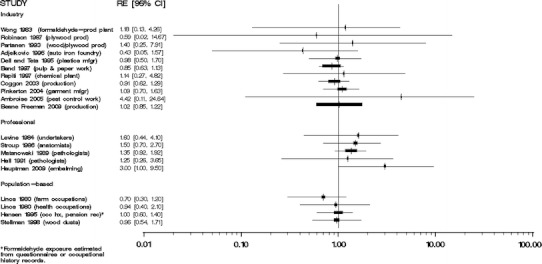
Forest plot of formaldehyde exposure and leukemias
Fig. 2.

Forest plot of formaldehyde exposure and myeloid leukemia
Fig. 3.

Forest plot of formaldehyde exposure and chronic lymphocytic leukemia
Fig. 4.
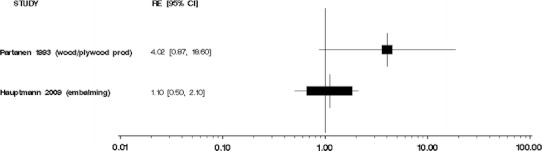
Forest plot of formaldehyde exposure and lymphomas
Fig. 5.
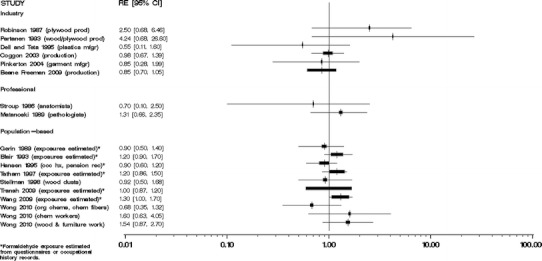
Forest plot of formaldehyde exposure and non-Hodgkin lymphoma
Epidemiologic literature
Associations between formaldehyde exposure and the LHM have been investigated among anatomists, pathologists, embalmers, and industrial workers involved in the manufacture and use of formaldehyde and formaldehyde-containing products, such as resins, adhesives, wood products, fabrics, and garments. Formaldehyde has also been examined as a risk factor in numerous studies conducted in the general population, including population-based case–control studies and analyses correlating occupations with LHM incidence and mortality. Accordingly, we present summaries of literature in tabular form separately for the following categories: cohort studies of industrial workers, cohort studies of professional workers, and population-based cohort and case–control studies.
Among all available literature, we regard two large occupational cohort studies as most informative because of the cohort design, greatest likelihood of exposure, quantification of exposure, and minimized bias and confounding. These are mortality studies of (1) a cohort of employees of ten US factories that produced or used formaldehyde, conducted by the US National Cancer Institute (henceforth termed the “NCI producers study”) [39]1 and (2) a cohort of employees of six UK factories engaged in the production of resins, adhesives, and formalin (henceforth termed the “UK producers study”) [48].2
A second group of occupational studies that we regard as less informative includes a cohort of US garment workers [51–53]3 and a case–control analysis of deaths among US embalmers and funeral directors [54] that was based on a series of earlier proportionate mortality studies [21, 55, 56]. The study base in which the nested case–control study of LHM in the US embalmers and funeral directors study was conducted was poorly defined [54], and the formaldehyde exposure assessment in the garment workers study [53] was less specific and detailed than in the two “producers” cohort studies.
The remaining occupational studies reviewed were those conducted among cohorts of undertakers [57], pathologists [58], anatomists [59, 60], wood industry workers [61–63], and general chemical industry workers [20, 64–67]. In these studies, formaldehyde exposure was less certain than in aforementioned occupational cohort studies and, in many cases, was inferred from job title or work area.
The other major categories of epidemiologic studies reviewed were community-based cohort and case–control studies and general population surveys, which also provide limited information on formaldehyde exposure and LHM risks. Exposure assessment in these studies was generally based on crude exposure metrics, such as “low” versus “high” exposure probability combinations of heterogeneous job titles. Details of study design and exposure assessment for the studies reviewed are summarized in Table 1.
Table 1.
Studies of formaldehyde and lymphohematopoeitic malignancies and exposure metrics
| Study | Location | Occupational group | Cohort size | Follow-up | Relevant exposure metrics | Comments |
|---|---|---|---|---|---|---|
| Occupational cohort studies | ||||||
| Fayerweather [64] | USA | 8 Formaldehyde-producing or formaldehyde-using plants | 481 | 1957–1979 |
Latency period (years, highest category: ≥20 years) Source of work history Pay class Duration of exposure (years, ≥5 years) Frequency of exposure Frequency and level of exposure Cumulative exposure index |
Jobs were categorized into three exposure categories: continuous-direct, intermittent, and background. Exposure potentials were extrapolations based on air recent/past air monitoring, statements from long-term employees, knowledge of odor/sensory irritation thresholds, knowledge of past process changes, engineering/personal controls. Highest category of continuous exposure: Level 3; 8-hr TWA concentrations of ≥2.0 ppm Highest category of intermittent exposure: “High:” jobs permitting a worker to be exposed to peak formaldehyde concentrations ≥2.0 ppm Almost all exposure categories analyzed with respect to various latency period categories. |
| Wong [20] | USA | Formaldehyde-producing chemical plant | 2,026 | 1940s–1977 |
Exposed/non-exposed Date of hire Latency period (years, highest category: 20 years) Length of employment (highest category: ≥20 years) |
Analysis does not include detailed information re: individual work histories, exposures. |
| Levine [57] | Canada | Undertakers | 1,477 | 1928–1977 | Exposed/non-exposed |
Exposure levels assayed from breathing zone of embalmers from seven US funeral homes, but not included in analysis. Expected deaths before 1950 determined by applying age- and calendar-year-specific mortality rates of men from the 1950–1977 cohort. |
| Liebling [86] | USA | Chemical plant | 24 | 1976–1980 | Exposed/non-exposed | Exposure to formaldehyde estimated from work histories. |
| Bertazzi [65] | Italy | Resins-manufacturing plant | 1,332 | 1959–1980 |
Exposed/non-exposed Type of exposure (formaldehyde, other, unknown) |
Jobs categorized into types of exposure (exposed to formaldehyde, exposed to other compounds, exposure unknown). Sampling data was not suitable for use in estimating exposures. Analysis for other cancers included analysis by year since first employment, length of employment, and years since first exposure. |
| Hagmar [87] | Sweden | Chemical plant | 664 | 1942–1979 |
Exposed/non-exposed Duration of employment, induction/latency period (higher category: work for ≥6 months and an induction/latency period of ≥10 years) Previous chemical exposure (from history or records) |
Exposures estimated from worker reports of time spent at various work processes involving possible exposure to the established or suspected carcinogens. Those working for ≥6 months and with an induction/latency period of ≥10 years placed into a restricted cohort. |
| Logue [88] | USA | Radiologists and pathologists | 13,537 | 1962–1972 | Exposed/non-exposed | Specific exposure measurements/assumptions not considered. |
| Stroup [86] | USA | Anatomists | 2,317 | 1925–1979 | Exposed/non-exposed | Exposures assumed based on duration of American Association of Anatomists membership and the time period in which anatomists joined the Association. Specific exposure measurements/assumptions not considered. |
| Robinson [61] | USA | Plywood mill workers | 2,283 | 1945–1977 |
Exposed/non-exposed Years of employment Years of latency |
Workers presumed to have formaldehyde exposures (based on job responsibilities) were placed into a separate subcohort. |
| Matanoski [60] | USA | Pathologists | 6,411 | 1925–1978 | Exposed/non-exposed | Specific exposure measurements/assumptions not considered. |
| Ott [66] | USA | 3 chemical manufacturing facilities | 129 | 1940–1978 |
Ever/never exposed (“ever”: employee worked for ≥1 day with a chemical in a specific work area) Work areas (+duration of work in these areas; highest category: ≥5 years) Chemical |
Exposures assigned to work categories by using work histories, departmental and job assignment records, and historical information regarding process dates and descriptions. Individual contact with specific substances also estimated using employee work assignments and records with department usage for each substance. Further analysis conducted by chemical functional group |
| Hall [58] | UK | Pathologists | 4,512 | 1974–1987 | Exposed/non-exposed | Formaldehyde exposure assumed consistent among members of cohort due to the fact that cohort members had passed an examination for membership requiring some years of experience. No specific exposure measurements/assumptions. |
| Partanen [62] | Finland | Wood industry production workers | 7,307 | 1945–1983 | Type of exposure (yes/no to various categories of exposure) | Individual types of exposure (formaldehyde, wood dust, pesticides, chlorophenols, phenol, etc.) reconstructed from company records, interviews with personnel, questionnaires sent to next-of-kin. |
| Andjelkovich [89] | USA | Automotive iron foundry | 3,929 | 1950–1989 | Exposed/non-exposed | Occupational titles obtained from work histories categorized as high, medium, low, or no exposure to formaldehyde. |
| Dell [67] | USA | Plastics manufacturing, research, development facility | 5,932 | 1946–1988 |
Exposed/non-exposed Salaried employees |
Duration of employment used as an indirect measure of cumulative exposure. Specific exposure measurements/assumptions not considered. Additional analyses carried out for other cancers (by duration of employment, lag interval in years) |
| Rapiti [90] | Italy | Chemical plant | 505 | 1954–1991 | Ever/never work in a specific process | Specific exposure measurements/assumptions not considered |
| Stellman [63] | USA | Woodworkers, wood dust-exposed men | 45,399 | 1982–1988 |
Type of employment Duration of wood dust exposure (years) Type of exposure (formaldehyde, asbestos, etc.) |
Individual categorical exposures ascertained from completed checklists. |
| Coggon [48] | UK | 6 Formaldehyde-producing or formaldehyde-using factories | 14,014 | 1941–2000 |
Exposed/non-exposed “High” exposure (>2.0 ppm) |
Exposures before 1970 estimated using later measurements and workers’ recall of irritant symptoms. Each job classified into one of five exposure categories (background, low, moderate, high, or unknown). Other exposure metrics (exposure category, years of employment, years since first employment in jobs with high exposures) included in analyses involving other outcomes. LHP-specific analyses, only included comparisons of exposed/non-exposed and high exposure/non-exposed populations. |
| Pinkerton [53] | USA | 3 garment mfg. plants | 11,039 | 1955–1998 |
Exposed/non-exposed Duration of exposure (years, highest category: ≥10 years) Time since first exposure (years, highest category: ≥20 years) Year of first exposure |
Individual formaldehyde exposure levels determined for 549 (40 %) of then-current employees using a NIOSH sampling method. Historic exposures were not available, not estimated. |
| Ambroise [91] | France | Pest-control workers | 181 | 1979–2000 | Exposed/non-exposed | Exposures estimated from administrative records for job histories, interviews with former and present workers on workplaces, historical description of activities and relevant information on exposure and working conditions, and linked to a job matrix. |
| Beane Freeman [39] | USA | 10 Formaldehyde-producing or formaldehyde-using factories | 25,619 | 1966–2004 |
Exposed/non-exposed Peak exposure (ppm, highest category: ≥4.0 ppm) Average intensity (ppm, highest category: ≥1.0 ppm) Cumulative exposure (ppm-yr, highest category: ≥5.5 ppm-years) |
Exposures estimated from individual work histories, expert assessments of job and department titles and tasks associated with jobs by using current and past measurement data. Exposures estimated for jobs, plants, and calendar-time. |
| Hauptmann [54] | USA | Embalmers and funeral directors | 168 LHP deaths, 265 other deaths from 6,808 total deaths | 1960–1986 |
Duration of exposure (years, highest category: >34 years) No. of embalmings (highest category: >3,068) Cumulative exposure (ppm-h, highest category: >9,253 years ppm-h) Average intensity (ppm, highest category: >1.9 ppm) Time-weighted average intensity (ppm, highest category: >0.18 ppm) Peak exposure (ppm, highest category: >9.3 ppm) Ever vs. never embalming |
Individual job and year-specific exposures were determined by a model matching interview responses to the results of a previous exposure assessment. |
| Study | Location | LHP outcome | No. cases, controls | Exposure assessment | Comments |
|---|---|---|---|---|---|
| Population-based study | |||||
| Linos [92] | USA | Leukemia (Acute lymphocytic, acute myelocytic, chronic lymphocytic, chronic myelocytic) |
138 cases, 176 controls |
Analyses were specific to occupational group (farm- and health-related occupations); occupational information ascertained from medical records. | Case–control study |
| Boffetta [93] | USA | Multiple myeloma |
128 cases, 512 controls |
Exposures estimated from questionnaire responses. | Case–control study |
| Gerin [94] | Canada | Hodgkin’s lymphoma, Non-Hodgkin’s lymphoma |
53 HL and 206 NHL cases, 533 general population controls, 2,599 cancer controls |
Occupational exposures estimated from interviews. Based on review of interviews, experts assigned to each job indices of probability, frequency, and intensity of exposure to multiple agents. | Case–control study |
| Heineman [95] | Denmark | Multiple myeloma | 1,098 cases, 4,169 controls | Occupational histories obtained from pension records and tax forms. Exposures estimated from occupational histories matched to a job-exposure matrix. | Case–control study |
| Pottern [96] | Denmark | Multiple myeloma | 1,010 cases, 4,040 controls | Occupational histories obtained from pension records and tax forms. Based on the obtained information, subjects were categorized by likelihood of exposure to various substances including formaldehyde. | Case–control study |
| Blair [97] | USA | Non-Hodgkin’s lymphoma | 622 cases, 1,245 controls | Exposures estimated from interviews linked to a job-exposure matrix. | Case–control study |
| Hansen [71] | Denmark | Non-Hodgkin’s lymphoma, Hodgkin’s lymphoma, leukemia | 91,182 | Occupational histories obtained from pension records. Those with occupational histories were stratified into “low” exposure or “above baseline” exposure groups based on job title and work at companies known to use/have used formaldehyde. | Cohort study |
| West [98] | UK | MDS |
400 cases, 400 controls |
Occupational and environmental exposures estimated from interviews and investigations of jobs associated with exposure. Subjects were categorized according to estimated intensities and sensitivities of exposure. | Case–control study |
| Band [99] | Canada | Non-Hodgkin’s lymphoma, multiple myeloma, Hodgkin’s disease, leukemia | 30,157 | Exposures were estimated using the time since subjects were first employed, duration of employment, and the type of mill worked in. | Cohort study |
| Tatham [100] | USA | Non-Hodgkin’s lymphoma | 1,048 cases, 1,659 controls | Exposures estimated from interviews. | Case–control study |
| Blair [70] | USA | Leukemia (AML, CML, ALL), MDS, CLL | 513 cases, 1,087 controls | Exposure probability and intensity estimates ascertained from interviews and linked to a job-exposure matrix. | Case–control study |
| Nisse [101] | France | MDS |
204 cases, 204 controls |
Occupational exposures to formaldehyde and other chemicals/compounds estimated from interviews. | Case–control study |
| Tranah [102] | USA | Non-Hodgkin’s lymphoma | 1,591 cases, 2,515 controls | Exposures estimated from interviews linked to a job-exposure matrix. | Case–control study |
| Wang [72] | USA | Non-Hodgkin’s lymphoma |
601 cases, 717 controls |
Exposures estimated utilizing a questionnaire linked to a job-exposure matrix. | Case–control study |
| Wong [103] | China | NHL | 649 cases, 1,298 controls |
Samples obtained, exposures estimated from questionnaires. Exposure assessment conducted for benzene. Reported results specific to type of industry. |
Case–control study |
Results
Summary of leukemia findings
The findings for the occupational cohort studies with leukemia outcomes are summarized in Table 2. The two most influential studies are considered first. Based on comparisons with national rates, no excesses for all leukemia (standardized mortality ratio (SMR) 1.02, 95 % confidence interval (CI) 0.85–1.22) or myeloid leukemia (SMR 0.90, 95 % CI 0.67–1.21) were found in the most recent follow-up of the NCI producers’ study. Among the formaldehyde-exposed portion of the cohort, there was a weak trend of relative risk (RR) with peak exposure, for both all leukemias and myeloid leukemia, largely influenced by elevated RRs of 1.78 (95 % CI 0.87–3.64) for myeloid leukemias and 1.42 (0.92–2.18) for “other” (non-myeloid) leukemias in the highest peak exposure category. However, most of the trends and individual RR estimates were not remarkable or precise. The association for peak exposure and myeloid leukemia was considerably attenuated from the previous follow-up of the cohort, RR 2.79 (95 % CI 1.08–7.21, 14 cases, p-trend 0.02) at the highest peak category. Beane Freeman [39] corrected the results published in Hauptmann [47] that inadvertently omitted 1,006 deaths, including 22 LHM deaths. No clear associations with average or cumulative exposure were found in the corrected data for any of the leukemias. Null findings were reported for lymphatic leukemia and “other and unspecified leukemia” [39].
Table 2.
Studies of formaldehyde exposure and leukemia, myeloid leukemia, and other/unspecified leukemias
| Study | Occupational group | All leukemias | Myeloid leukemia (including AML, CML, unless specified) | Other/unspecified leukemias | |||
|---|---|---|---|---|---|---|---|
| Occupational cohort studies | Overall (No. cases), RR (95 % CI) |
Highest exposed (No. cases), RR (95 % CI) |
Overall (No. cases), RR (95 % CI) |
Highest exposed (No. cases), RR (95 % CI) |
Overall (No. cases), RR (95 % CI) |
Highest exposed (No. cases), RR (95 % CI) |
|
| Wong [20] | Formaldehyde-producing chemical plant | (2), **1.18 (0.13–4.26) | (2), **1.35 (0.15–4.87)a | ||||
| Levine [57] | Undertakers |
4 Observed, 2.5 Expected |
|||||
| Logue [88] | Radiologists and pathologists |
Pathologists: 1.06** Radiologists: 1.55** |
|||||
| Stroup [86] | Anatomists | (10), **1.5 (0.7–2.7) | |||||
| Robinson [61] | Plywood mill workers |
1 Observed, 1.7 Expected |
|||||
| Matanoski [60] | Pathologists | (31), **1.35 (0.92–1.92) | |||||
| Ott [66] | 3 chemical manufacturing facilities | (2.6), **2 Non-lymphocytic leukemia | |||||
| Hall [58] | Pathologists | (3), **1.25 (0.26–3.65) | |||||
| Partanen [62] | Wood industry production workers | (2), **1.40 (0.25–7.91) | |||||
| Andjelkovich [89] | Automotive iron foundry | (2), **0.43 (0.05–1.57) | |||||
| Dell and Teta [67] | Plastics manufacturing, research, development facility | (12), **0.98 (0.50–1.70) | (11), **1.98 (0.99–3.54)b | ||||
| Band [99] | Pulp and paper workers | (35), **0.85 (0.63–1.13) | |||||
| Rapiti [90] | Chemical plant |
(1), **1.14 (0.40–7.15) Note: “organic substances” not specific to formaldehyde Note: 90 % CI |
|||||
| Coggon [48] | 6 Formaldehyde-producing or formaldehyde-using factories | (31), **0.91 (0.62–1.29) | (8), **0.71 (0.31–1.39)c | ||||
| Pinkerton [53] | 3 Garment mfg. plants | (24), **1.09 (0.70–1.63) | (12), **1.53d | (15), **1.44 (0.80–2.37) | (8), **2.19d | ||
|
AML (9), **1.34 (0.61–2.54) |
AML (5), **2.02d |
||||||
| Ambroise [91] | Pest-control workers | (1), **4.42 (0.11–24.64) | |||||
| Beane Freeman [39] | 10 Formaldehyde-producing or formaldehyde-using factories | (116), **1.02 (0.85–1.22) | (29), 1.11 (0.7–1.74)e | (44), **0.9 (0.67–1.21) | (10), 1.02 (0.48–2.16)e | (9), 1.44 (0.61–3.36)e | |
| Linos [92] | Farm-related occupations | (32), 0.70 (0.30–1.20) | AML, CML NS | ||||
| Health-related occupations | 0.94, (0.4–2.10) | AML, CML NS | |||||
| Hansen [71] | N/A | (23), **1.0 (0.6–1.4) | |||||
| Stellman [63] | Woodworkers, wood dust-exposed men | (12), 0.96 (0.54–1.71)h | |||||
| Blair [70] | N/A | (3), **0.7 (0.2–2.6)f |
AML (0)f |
||||
|
CML (1), **0.6 (0.1–5.3)f |
|||||||
| Hauptmann [54] | Embalmers and funeral directors |
(44), ** 3.0 (1.0–9.5) Non-lymphoid-origin LHPM |
(22), **4.0 (1.2–13.2) Non-lymphoid-origin LHPMg |
(33), **11.2 (1.3–95.6) | (14), **13.2 (1.5–115.4)g | ||
** Note: not all are RR
aHired prior to 1960
bSalaried employees (note: this is the only other measure given for LHP malignancies)
c“High” exposure, >2.0 ppm
dDuration of exposure ≥10 years
eCumulative exposure ≥5.5 ppm-years
f“High” exposure
gCumulative exposure >9,253 ppm-h
hFormaldehyde exposure only
Leukemia mortality was not elevated overall (SMR 0.91, 95 % CI 0.62–1.29) or in the most highly exposed (i.e., jobs with >2 ppm formaldehyde) segment (SMR 0.71, 95 % CI 0.31–1.39) of the UK formaldehyde producers study [48]. No separate results for myeloid leukemias were presented.
Among other occupational studies, the nested case–control analysis of US embalmers reported odds ratios for myeloid leukemias and for acute myeloid leukemias in the range of 2.0–3.2 for number of embalmings, and for cumulative and peak formaldehyde exposure categories, relative to the referent group that performed <500 career embalmings. However, the underlying sample of death certificates evaluated in this analysis demonstrated no excess of myeloid leukemias: the 29 myeloid leukemias reported in this study generated a proportionate mortality ratio (PMR) of 1.08 (95 % CI 0.70–1.56), and the subset of 20 acute myeloid leukemias generated a PMR of 1.16 (0.71–1.79) [68]. Moreover, there was little evidence of increasing exposure–response trends in the non-reference exposure categories [54]. In the study of US garment workers, the SMR for leukemia deaths was 1.09 (95 % CI 0.7–1.62), based on 24 total leukemia deaths. For the 15 observed myeloid leukemias, the SMR was 1.44 (95 % CI 0.8–2.37), and for the nine acute myeloid leukemias, the SMR was 1.34 (95 % CI 0.66–2.54). In the US garment workers study, SMRs were increased among workers with ≥10 years exposure (SMR for myeloid leukemia 2.19, 95 % CI 0.95, 4.32) [69]4 and ≥20 years since first exposure (SMR 1.91, 95 % CI 1.02, 3.27)5 [53].
No excesses were observed for all leukemia or for leukemia subtypes among persons classified as exposed to formaldehyde in the population-based case–control studies [70, 71]. In the remaining occupational studies, risk estimates for leukemia compared with the national or regional populations were consistently close to the null value and unstable due to small numbers.
The RR estimate was 5.79 (95 % CI 1.44, 23.25) for leukemia among the combined exposure group of “formaldehyde-exposed and wood-related occupations” in the American Cancer Society Cancer Prevention Study II; however, this result was based on only two deaths. The RR for those with formaldehyde exposure only was 0.96 (95 % CI 0.54–1.71), based on 12 leukemia deaths [63].
Summary of lymphoma findings
The lymphoma results, including those for chronic lymphocytic leukemia (CLL) when reported separately, are summarized in Table 3. With the exception of Hodgkin lymphoma (HL), there were no overall excesses of the lymphomas among exposed workers in the NCI producers cohort; HL risk was associated with peak exposure, with relative risk reaching 3.96 (95 % CI 1.31–12.02) only at the highest exposure category (≥4.0 ppm), based on 11 deaths. A similar, but weaker, trend was observed for HL and average exposure (RR 2.48, 95 % CI 0.84–2.32) at the highest category [39]. The only overall excess for any of the lymphomas reported in the UK producers study was a weak association for multiple myeloma (MM) in the subgroup classified as mostly highly exposed workers (SMR 1.18, 95 % CI 0.48–2.44) [48]. Quantitative exposure–response findings were not presented.
Table 3.
Studies of formaldehyde exposure and chronic lymphocytic leukemia, Hodgkin’s lymphoma, non-Hodgkin’s lymphoma, multiple myeloma, and all lymphomas
| Study | Occupational group | CLL | HL | NHL | MM | All lymphomas | |||||
|---|---|---|---|---|---|---|---|---|---|---|---|
| Occupational cohort studies | Overall (No. cases), RR (95 % CI) |
Highest exposed (No. cases), RR (95 % CI) |
Overall (No. cases), RR (95 % CI) |
Highest exposed (No. cases), RR (95 % CI) |
Overall (No. cases), RR (95 % CI) |
Highest exposed (No. cases), RR (95 % CI) |
Overall (No. cases), RR (95 % CI) |
Highest exposed (No. cases), RR (95 % CI) |
Overall (No. cases), RR (95 % CI) |
Highest exposed (No. cases), RR (95 % CI) |
|
| Wong [20] | Formaldehyde-producing chemical plant | (2), **2.40 (0.27–8.66) | (2), **2.94 (0.33–10.63)a | ||||||||
| Stroup [86] | Anatomists | (0), **0.0 (0.0– 2.0) |
(2), **0.7 (0.1– 2.5) Note: In study as lymphosarcoma/reticulosarcoma |
(6), **2.0 (0.7– 4.4) Note: Includes “Other neoplasms of lymphoid tissue,” “Polycythemia vere,” and “Myelofibrosis” |
|||||||
| Robinson [61] | Plywood mill workers | (2), **3.33 (0.59–10.49) Note: 90 % CI |
(3), **2.50 (0.68–6.46) Note: In study as lymphosarcoma/reticulosarcoma 90 % CI |
1 observed, 0.6 expected** Note: Includes “Other forms of lymphoma (reticulosis),” “Leukemia and aleukemia,” and “Mycosis fungoides” |
|||||||
| Matanoski [60] | Pathologists | (2), **0.36 (0.04–1.31) |
(11), **1.31 (0.66–2.35) Note: In study as lymphosarcoma/reticulosarcoma |
||||||||
| Ott [66] | 3 Chemical manufacturing facilities | (2), **2.0 | (1), **1.0 |
(1), **2.6 Lymphocytic leukemia |
|||||||
| Hall [58] | Pathologists | (1), **1.31 (0.03–7.33) | |||||||||
| Partanen [62] | Wood industry production workers | 1 Observed | (4), **4.24 (0.68–26.6) | (5), **4.02 (0.87–18.6) | |||||||
| Dell and Teta [67] | Plastics manufacturing, research, development facility |
(3), **0.55 (0.11–1.60) Note: In study as lymphosarcoma/reticulosarcoma |
(3), **1.26 (0.26–2.67) Note: In study as lymphosarcoma/reticulosarcomab |
||||||||
| Band [99] | Pulp and paper workers | (7), 0.71 (0.33–1.34) | (4), 1.62 (0.55–3.71)c | (12), 0.80 (0.48–1.29) | |||||||
| Coggon [48] | 6 Formaldehyde-producing or formaldehyde-using factories | (6), **0.70 (0.26–1.53) | (1), **0.36 (0.01–2.01)d | (31), **0.98 (0.67–1.39) | (9), **0.89 (0.41–1.70)d | (15), **0.86 (0.48–1.41) | (7), **1.18 (0.48–2.44)d | ||||
| Pinkerton [53] | 3 Garment mfg. plants | (3), **0.60 (0.12–1.75) | (2), **0.55 (0.07–1.98) |
(5), **0.85 (0.28–1.99) Note: In study as lymphosarcoma/reticulosarcoma |
(28), **0.97 (0.64–1.40) Note: Includes “Other malignant neoplasms of lymphoid and histocytic tissue” |
||||||
| Beane Freeman [39] | 10 Formaldehyde-producing or formaldehyde-using factories | (36), **1.15 (0.83–1.59) | (10), 1.02 (0.47–2.21)e | (25), **1.42 (0.96–2.10) | (4), 1.30 (0.40–4.19)e | (94), **0.85 (0.70–1.05) | (21), 0.91 (0.54–1.52)e | (48), **0.94 (0.71–1.25) | (15), 1.28 (0.67–2.44)e | (50), 1.06 (0.75–1.49) | |
| Study | Occupational group | CLL | HL | NHL | MM | All lymphomas | |||||
|---|---|---|---|---|---|---|---|---|---|---|---|
| Population-based studies | Overall (No. cases), RR (95 % CI) |
Highest exposed (No. cases), RR (95 % CI) |
Overall (No. cases), RR (95 % CI) |
Highest exposed (No. cases), RR (95 % CI) |
Overall (No. cases), RR (95 % CI) |
Highest exposed (No. cases), RR (95 % CI) |
Overall (No. cases), RR (95 % CI) |
Highest exposed (No. cases), RR (95 % CI) |
Overall (No. cases), RR (95 % CI) |
Highest exposed (No. cases), RR (95 % CI) |
|
| Linos [92] | Farm-related occupations | NS | |||||||||
| Health-related occupations | NS | ||||||||||
| Boffetta [93] | N/A | (4), 1.8 (0.6–5.7) | |||||||||
| Gerin [94] | N/A | (8), 0.5 (0.2–1.4) | (47), 0.9 (0.5–1.4) | (5), 0.5 (0.1–1.7)f | |||||||
| Heineman [95] | N/A | (144), 1.0 (0.8–1.30)a | (41), 1.1 (0.7–1.6)g | ||||||||
| Pottern [96] | N/A | (56), 1.1 (0.8–1.6)a | (4), 1.6 (0.4–5.3)g | ||||||||
| Blair [97] | N/A |
(84), 1.2 (0.9–1.7) |
(6), 1.3 (0.5–3.8)h |
||||||||
| Hansen [71] | N/A | (12), 1.0 (0.5–1.7)i | (32), 0.9 (0.6–1.2)i | ||||||||
| Tatham [100] | N/A | (93), 1.20 (0.86–1.50) | |||||||||
| Stellman [63] | Woodworkers wood dust-exposed men | (11), 0.92 (0.50–1.68)j | (4), 0.74 (0.27–2.02)j | ||||||||
| Blair [70] | N/A | (1), 0.6 (0.1–5.3)k | |||||||||
| Hauptmann [54] |
(81), **1.1 (0.5–2.1) Lymphoid-origin LHPM |
(25), **1.0 (0.4– 2.0) Lymphoid-origin LHPMl |
|||||||||
| Tranah [102] | N/A | (90), 1.0 (0.73–1.5) | (29), 1.2 (0.73–1.9)m | (757), 1.0 (0.87–1.2) | (205), 0.93 (0.76–1.1)m | ||||||
| Wang [72] | N/A | (24), 1.6 (0.9–3.1)n | (203), 1.3 (1.0–1.7) | (8), 1.2 (0.5–2.6)o | |||||||
| Wong [103] | Organic chemicals, chemical fibers and other products | (0) | (12), 0.68 (0.35–1.32) | ||||||||
| Chemical workers | (0) | (8), 1.60 (0.63–4.05) | |||||||||
| Wood and furniture workers | (3), 1.50 (0.34–6.70) | (23), 1.54 (0.87–2.70) | |||||||||
**Note: not all are RR
a“Possible exposure” to formaldehyde
bSalaried employees (Note: this is the only other measure given for LHP malignancies)
cWork duration ≥15 years time since first employed ≥15 years
d“High” exposure, >2.0 ppm
eCumulative exposure ≥5.5 ppm-years
fLong duration, high concentration exposure level
g“Probable exposure” to formaldehyde
h“Higher intensity” exposures
iLongest work experience had been in companies where there was exposure to formaldehyde at least 10 years before diagnosis
jFormaldehyde exposure only
k“High” exposure
lCumulative exposure >9,253 ppm-h
m“Medium–high average probability” of exposure
nMedium and high intensity, medium and high probability of exposure
o“Medium–high average” exposure intensity
Results of the nested case–control study of embalmers presented for all neoplasms of lymphoid origin, rather than for non-Hodgkin lymphoma (NHL) or MM specifically, did not suggest an association with any indices of formaldehyde exposure [54]. SMRs for lymphoma were less than 1.0 in the US garment workers study [53]. None of the other occupational cohort studies reported a significantly increased risk of NHL, HL, or MM (Table 3). Risk estimates for NHL, HL, and MM in community-based studies also suggested no association, with RR estimates ranging between 0.5 and 1.3, although positive results were reported in one NHL study from Connecticut [72]. Several community-based studies provided results for NHL subtypes, but there were no consistent associations [59–62].
Discussion
The main considerations pertinent to assessing epidemiological evidence for a causal relation between formaldehyde exposure and the leukemias or other specific LHM are consistency of findings across studies, evidence for exposure–response associations, accuracy of exposure and health outcome assessment, and minimal confounding and bias. The extent to which exposure assessment in a given study is valid, accurate, and, ideally, permits quantitative dose–response estimation is a critical aspect of research quality. Secondarily, epidemiologic findings suggestive of an association should be interpreted in relation to available evidence of mechanisms of pathogenesis.
The epidemiologic literature provides little or no evidence indicating excess risks overall or exposure–response associations between formaldehyde and any of the LHM, including leukemias, myeloid leukemias, and acute myeloid leukemias. In the majority of occupational cohort studies, which we regard as most informative, specific LHM risk estimates were consistent with the null value, with few exceptions, where the excesses were generally small (i.e., RR < 1.5) and statistically imprecise.
The NCI producers cohort [39] and the nested case–control analysis of the embalmers and funeral directors group [54] found elevated risk estimates based on some exposure metrics compared with an internal reference group. However, the increased relative risk for myeloid leukemia noted in an earlier follow-up of the NCI producers cohort [47] had diminished in the most recent update [39].
The strongest associations for myeloid leukemia observed in this cohort were with peak exposures; whereas cumulative exposure and average exposure intensity were unrelated to risk. As described in the original publication on the exposure assessment of the NCI producers study [73], there was no uniform definition of peak exposure. Instead, peak was defined on a job-specific basis as an excursion (usually of short duration, e.g., <15 min) relative to the estimated average exposure for the job. Moreover, epidemiologic associations of a specific disease with peak exposure can be difficult to interpret in the absence of prior mechanistic support, such as the requirement for acute above-threshold exposures. In general, established human carcinogens show strong and consistent associations between unbiased measures of cumulative exposure and cancer risk, and cumulative exposure is the default dose metric that is mostly used to assess cancer risk for etiologic exposures. A re-analysis of the data from the previous follow-up [47] corroborated the absence of associations with cumulative exposure but also indicated no consistent associations between myeloid leukemia and either duration of time worked at the highest peak or time since highest peak exposure [45]. Findings from similar re-analyses have not been reported for the most recent follow-up. In the other relatively strong occupational cohort study [48], there was no association between formaldehyde exposure and leukemia.
Among the other occupational studies, the US embalmers study generated elevated odds ratios for some formaldehyde exposure metrics [54]. However, as noted by Cole et al. [68], this study has notable limitations—including a lack of overall excess leukemia risks (based on PMR analysis), exposure assessment uncertainties, and a poorly defined study base originating from a convenience sample of death certificates obtained from previous proportionate mortality studies. In the study of US garment workers [53], the only support for an association with formaldehyde was the observation of moderately elevated relative risks for myeloid leukemia associated with long-term exposures and longest follow-up that are very crude exposure metrics correlated with older age. The results of the remaining lower-quality studies are not supportive of an association between formaldehyde exposure and leukemia risk. Another recent review of the literature reached similar conclusions for associations with the leukemias [74].
The pattern of epidemiological results for the lymphomas is inconsistent. In the NCI producers cohort, there were some notably elevated relative risks (in the range of 2.5–4.0) observed for exposure categories of highest peak for HL and MM [39, 47], yet null or at most very small excesses for these diseases were reported in the other studies of occupational formaldehyde exposure.
Consistency with toxicological and mechanistic evidence
Studies of workers in China have evaluated a potential association between exposure to formaldehyde and a change in one or more blood parameters indicative of hematotoxicity [75–77]. Evidence suggestive of pancytopenia and leukemia-specific chromosome changes was reported from a study of Chinese formaldehyde melamine resin–exposed workers [78]. However, the blood cell parameters among exposed workers were largely within the normal range for Chinese populations [79–82], and the chromosome findings were based on the progeny of circulating stem cells from a small numbers of workers (n = 10–12) after 14 days of culture. Overall, the available data do not provide evidence of a clinically or biologically relevant impact on blood cell parameters in humans following exposure to formaldehyde.
Although mechanisms for the development of leukemia or lymphoma following exposure to formaldehyde have been hypothesized [75], they remain speculative. Notably, proposed mechanisms rely heavily on the assumption that formaldehyde can have direct effects on cells or tissues beyond the portal of entry. One fundamental mechanistic question critical to these hypotheses is whether exogenously derived formaldehyde can enter the circulating bloodstream and subsequently damage circulating precursor cells or the bone marrow. Recent experimental research, using extremely sensitive assays with the power to detect as little as one exogenous DNA adduct in 10 billion deoxyguanosines, demonstrated identical endogenously formed DNA formaldehyde adducts in all rat and nonhuman primate non-portal-of-entry tissues, including bone marrow. No exogenous adducts were detected in any distant tissue [83–85]. These considerations call into question the plausibility of causal links between formaldehyde and the LHM.
Conclusions and recommendations
Existing epidemiologic evidence does not provide convincing support that formaldehyde causes any of the LHMs, including myeloid leukemia. Findings among the highest quality occupational cohort studies are largely null, the positive findings are inconsistent in terms of strength and specificity of association, and there are only isolated instances of exposure–response relations. Epidemiologic evidence from other formaldehyde-exposed occupational cohorts is similarly inconsistent, is often based on small numbers of events, and suffers from a greater likelihood of exposure misclassification and other potential limitations than the two large industrial cohort studies that we regard as highest quality. Available community-based studies, which generally have superior diagnostic classification but poorer quality exposure assessment than in the occupational cohort mortality studies, provide no support for etiologic associations of formaldehyde with any of the LHM.
Although we conclude that a causal connection between formaldehyde exposure and LHM is not supported by existing epidemiologic findings and that the evidence is further weakened by the absence of established carcinogenic mechanisms for the LHM, we nevertheless encourage further epidemiologic research on this topic. We make this recommendation with the caveat that, in order to be informative, further research should offer substantive improvements over the existing body of studies, especially in terms of application of modern diagnostic criteria for specific LHM and individual level quantitative exposure assessment. Well-defined occupational cohort studies should offer the best opportunities to evaluate associations between formaldehyde exposure and LHM risks. Because formaldehyde exposure is ubiquitous, accurately characterizing exposures from the many possible sources, including combustion, household furnishings, automobiles, and consumer products, is essentially impossible. Workplace exposures, on the other hand, are typically substantially higher than exposures from other environmental sources. Continued follow-up of the established high-quality occupational cohorts would be worthwhile, although the scientific yield may be limited because exposure and health outcome misclassification limitations can probably not be remedied. Re-analyses, including sensitivity analysis, of existing datasets may add insight into reported findings, as evidenced by previous re-analyses of the NCI producers cohort data [45]. Specifically, additional statistical analyses of risks of specific LHM in relation to the various exposure metrics in the original NCI producers study [73] are warranted.
A more attractive—but also more complicated and expensive—option would be to enumerate and follow new occupational cohorts exposed to formaldehyde. Professional groups, such as anatomists, pathologists, funeral directors, and embalmers, may be the most appropriate study populations because their exposures are frequent, generally remain at relatively high intensity, and may not be confounded by other potential exposures to leukemogens, such as benzene. Another advantage to studying such professions is that they are comprised of persons with comparable socioeconomic status, a characteristic often associated with baseline rates of LHM in the population.
In contrast, new cohort studies of industrial workers would likely encounter problems related to vastly reduced exposures in large workplaces during the past several decades in many high-income countries, and the resulting reduced capacity to test exposure-related associations rigorously. New occupational cohort studies in developing economies may offer opportunities for further research. Any new occupationally based studies should strive to obtain incidence data with modern LHM classification, and to incorporate valid, thorough exposure assessments for formaldehyde and potential confounders. Cross-sectional and, preferably, prospective investigations of biomarkers of bone marrow toxicity relevant to carcinogenesis that have adequate statistical power would also be worthwhile and might be incorporated into cohort studies where feasible (e.g., on subsets of workers).
In summary, we find insufficient epidemiologic evidence to support a causal relation between formaldehyde exposure and leukemia, including myeloid leukemia. We find no clear evidence of an excess risk of leukemia or myeloid leukemia in any large, well-conducted study. Furthermore, we find the occasional positive associations between various exposure metrics and leukemia or myeloid leukemia risk to be inconsistent, and in some instances, contradictory to results based on more conventional exposure characterization approaches. We also find no epidemiologic basis on which to conclude that formaldehyde causes any of the lymphomas. Further weakening arguments for causal associations is the absence of well-defined plausible models of pathogenesis. Nevertheless, in view of the ubiquitous presence of formaldehyde in the population and experimental evidence indicating high-dose carcinogenic potential, at least for portal-of-entry sites, we recommend improved epidemiologic research on potential risks for the LHM.
Acknowledgments
ENVIRON acknowledges receipt of a grant from the Research Foundation for Health and Environmental Effects® (RFHEE), a 501(c)(3) tax-exempt organization established by the American Chemistry Council (ACC) to conduct this review. RFHEE had no role in reviewing or interpreting the epidemiologic literature or in preparing or revising the manuscript. Drs. Checkoway and Boffetta received financial support from ENVIRON for their time in reviewing the literature and drafting and revising the manuscript. The authors are grateful for the contributions of the following colleagues who provided helpful comments on the draft manuscript: Dr. Philip Cole, University of Alabama, Dr. Jack Mandel, Exponent, Dr. Gary Marsh, University of Pittsburgh, Dr. Morel Symons, du Pont, Dr. Patricia Buffler, U California, Berkeley, Dr. David Coggon, University of Southampton, UK, Dr. David Savitz, Brown University. We especially appreciate the contributions of Dr. Robinan Gentry and Dr. James Swenberg to the section summarizing the mechanistic evidence and of Ms. Farah Chowdhury for creating summary tables.
Open Access
This article is distributed under the terms of the Creative Commons Attribution License which permits any use, distribution, and reproduction in any medium, provided the original author(s) and the source are credited.
Footnotes
References
- 1.Neuberger A. The metabolism of glycine and serine. In: Neuberger A, van Deenen LLM, editors. Comprehensive biochemistry. Amsterdam: Elsevier; 1981. pp. 257–303. [Google Scholar]
- 2.Kim KH, Jahan SA, Lee JT. Exposure to formaldehyde and its potential human health hazards. J Environ Sci Health C Environ Carcinog Ecotoxicol Rev. 2011;29(4):277–299. doi: 10.1080/10590501.2011.629972. [DOI] [PubMed] [Google Scholar]
- 3.Madrid PA, Sinclair H, Bankston AQ, et al. Building integrated mental health and medical programs for vulnerable populations post-disaster: connecting children and families to a medical home. Prehosp Disaster Med. 2008;23(4):314–321. doi: 10.1017/s1049023x0000594x. [DOI] [PubMed] [Google Scholar]
- 4.Parthasarathy S, Maddalena RL, Russell ML, Apte MG. Effect of temperature and humidity on formaldehyde emissions in temporary housing units. J Air Waste Manag Assoc. 2011;61(6):689–695. doi: 10.3155/1047-3289.61.6.689. [DOI] [PubMed] [Google Scholar]
- 5.Bolt HM. Experimental toxicology of formaldehyde. J Cancer Res Clin Oncol. 1987;113(4):305–309. doi: 10.1007/BF00397713. [DOI] [PMC free article] [PubMed] [Google Scholar]
- 6.Malorny G, Rietbrock N, Schneider M. The oxidation of formaldehyde to formic acid in the blood, a contribution to the metabolism of formaldehyde. Naunyn Schmiedebergs Arch Exp Pathol Pharmakol. 1965;250:419–436. doi: 10.1007/BF00246893. [DOI] [PubMed] [Google Scholar]
- 7.Uotila L, Koivusalo M. Formaldehyde dehydrogenase from human erythrocytes: purification, some properties and evidence for multiple forms. Prog Clin Biol Res. 1987;232:165–177. [PubMed] [Google Scholar]
- 8.Heck H, Casanova M. The implausibility of leukemia induction by formaldehyde: a critical review of the biological evidence on distant-site toxicity. Regul Toxicol Pharmacol. 2004;40(2):92–106. doi: 10.1016/j.yrtph.2004.05.001. [DOI] [PubMed] [Google Scholar]
- 9.Smith DL, Bolyard M, Kennedy ER. Instability of formaldehyde air samples collected on a solid sorbent. Am Ind Hyg Assoc J. 1983;44(2):97–99. doi: 10.1080/15298668391404437. [DOI] [PubMed] [Google Scholar]
- 10.Szende B, Tyihak E. Effect of formaldehyde on cell proliferation and death. Cell Biol Int. 2010;34(12):1273–1282. doi: 10.1042/CBI20100532. [DOI] [PubMed] [Google Scholar]
- 11.McGwin G, Jr, Lienert J, Kennedy JI., Jr Formaldehyde exposure and asthma in children: a systematic review. Cien Saude Colet. 2011;16(9):3845–3852. doi: 10.1590/S1413-81232011001000020. [DOI] [PubMed] [Google Scholar]
- 12.Songur A, Ozen OA, Sarsilmaz M. The toxic effects of formaldehyde on the nervous system. Rev Environ Contam Toxicol. 2010;203:105–118. doi: 10.1007/978-1-4419-1352-4_3. [DOI] [PubMed] [Google Scholar]
- 13.Duong A, Steinmaus C, McHale CM, Vaughan CP, Zhang L. Reproductive and developmental toxicity of formaldehyde: a systematic review. Mutat Res. 2011;728(3):118–138. doi: 10.1016/j.mrrev.2011.07.003. [DOI] [PMC free article] [PubMed] [Google Scholar]
- 14.Swenberg J, Kerns W, Pavkov K, Mitchell R, Gralla EJ. Carcinogenicity of formaldehyde vapor: interim findings in a long-term bioassay of rats and mice. Dev Toxicol Environ Sci. 1980;8:283–286. [PubMed] [Google Scholar]
- 15.Swenberg JA, Kerns WD, Mitchell RI, Gralla EJ, Pavkov KL. Induction of squamous cell carcinomas of the rat nasal cavity by inhalation exposure to formaldehyde vapor. Cancer Res. 1980;40(9):3398–3402. [PubMed] [Google Scholar]
- 16.Jensen OM. Cancer risk from formaldehyde. Lancet. 1980;2(8192):481–482. [PubMed] [Google Scholar]
- 17.Griesemer RA, Ulsamer AG, Arcos JC, Beall JR (1982) Report of the federal panel on formaldehyde. Environ Health Perspect 43:139–168 [DOI] [PMC free article] [PubMed]
- 18.Marsh GM. Proportional mortality patterns among chemical plant workers exposed to formaldehyde. Br J Ind Med. 1982;39(4):313–322. doi: 10.1136/oem.39.4.313. [DOI] [PMC free article] [PubMed] [Google Scholar]
- 19.Walrath JFJ (1982) Proportionate mortality among New York elbalmers. In: Proceedings of the third annual CIIT conference: formaldehyde toxicity. Hemisphere Publishing Corporation, New York
- 20.Wong O. An epidemiologic mortality study of a cohort of chemical workers potentially exposed to formaldehyde with a discussion on SMR and PMR. In: Gibson JE, editor. Formaldehyde toxicity. New York: Hemisphere Publishing Corp; 1983. pp. 256–272. [Google Scholar]
- 21.Walrath J, Fraumeni JF., Jr Cancer and other causes of death among embalmers. Cancer Res. 1984;44(10):4638–4641. [PubMed] [Google Scholar]
- 22.Harrington JM, Shannon HS. Mortality study of pathologists and medical laboratory technicians. Br Med J. 1975;4(5992):329–332. doi: 10.1136/bmj.4.5992.329. [DOI] [PMC free article] [PubMed] [Google Scholar]
- 23.IARC . Formaldehyde, 2-Butoxyethanol and 1-tert-Butoxypropan-2-ol. Monograph. 88. Lyons: International Agency for Research on Cancer; 2006. [PMC free article] [PubMed] [Google Scholar]
- 24.Baan R, Grosse Y, Straif K, et al. A review of human carcinogens—part F: chemical agents and related occupations. Lancet Oncol. 2009;10(12):1143–1144. doi: 10.1016/S1470-2045(09)70358-4. [DOI] [PubMed] [Google Scholar]
- 25.National Toxicology Program (2011) Report on Carcinogens, Twelfth Edition. US Department of Health and Human Services, Public Health Service, National Toxicology Program, pp iii–499
- 26.EPA . IRIS toxicological review of formaldehyde-inhalation assessment (External Review of Draft) Washington, DC: U.S. Environmental Protection Agency; 2010. [Google Scholar]
- 27.National Research Council . Review of the environmental protection agency’s draft IRIS assessment of formaldehyde. Washington, DC: The National Academies Press; 2011. [PubMed] [Google Scholar]
- 28.IARC . Preamble. Lyon: IARC Monographs on the Evaluation of Carcinogenic Risks to Humans; 2006. [Google Scholar]
- 29.IOM . Identifying and evaluating the literature. In: Grossblatt N, Kelly K, editors. Gulf war and health. Volume 2 insecticides and solvents. Washington, DC: National Academies Press; 2003. [Google Scholar]
- 30.Moher D, Liberati A, Tetzlaff J, Altman DG. Preferred reporting items for systematic reviews and meta-analyses: the PRISMA statement. Ann Int Med. 2009;151(4):264–269. doi: 10.7326/0003-4819-151-4-200908180-00135. [DOI] [PubMed] [Google Scholar]
- 31.West S, King V, Carey TS et al. (2002) Systems to rate the strength of scientific evidence. AHRQ Publication No. 02-E016 ed. Agency for Healthcare Research and Quality, Rockville, MD
- 32.WHO (1977) International statistical classification of diseases, injuries, and causes of death, 9th revision edn. World Health Organization, Geneva
- 33.Morton LM, Turner JJ, Cerhan JR, et al. Proposed classification of lymphoid neoplasms for epidemiologic research from the pathology working group of the international lymphoma epidemiology consortium (InterLymph) Blood. 2007;110(2):695–708. doi: 10.1182/blood-2006-11-051672. [DOI] [PMC free article] [PubMed] [Google Scholar]
- 34.Turner JJ, Morton LM, Linet MS, et al. InterLymph hierarchical classification of lymphoid neoplasms for epidemiologic research based on the WHO classification (2008): update and future directions. Blood. 2010;116(20):e90–e98. doi: 10.1182/blood-2010-06-289561. [DOI] [PMC free article] [PubMed] [Google Scholar]
- 35.Bachand AM, Mundt KA, Mundt DJ, Montgomery RR. Epidemiological studies of formaldehyde exposure and risk of leukemia and nasopharyngeal cancer: a meta-analysis. Crit Rev Toxicol. 2010;40(2):85–100. doi: 10.3109/10408440903341696. [DOI] [PubMed] [Google Scholar]
- 36.Collins JJ. Formaldehyde exposure and leukaemia. Occup Environ Med. 2004;61(11):875–876. doi: 10.1136/oem.2004.014324. [DOI] [PMC free article] [PubMed] [Google Scholar]
- 37.Zhang L, Steinmaus C, Eastmond DA, Xin XK, Smith MT. Formaldehyde exposure and leukemia: a new meta-analysis and potential mechanisms. Mutat Res. 2009;681(2–3):150–168. doi: 10.1016/j.mrrev.2008.07.002. [DOI] [PubMed] [Google Scholar]
- 38.Bosetti C, McLaughlin JK, Tarone RE, Pira E, La VC. Formaldehyde and cancer risk: a quantitative review of cohort studies through 2006. Ann Oncol. 2008;19(1):29–43. doi: 10.1093/annonc/mdm202. [DOI] [PubMed] [Google Scholar]
- 39.Beane Freeman LE, Blair A, Lubin JH, et al. Mortality from lymphohematopoietic malignancies among workers in formaldehyde industries: The National Cancer Institute Cohort. JNCI J Natl Cancer Inst. 2009;101(10):751–761. doi: 10.1093/jnci/djp096. [DOI] [PMC free article] [PubMed] [Google Scholar]
- 40.Blair A, Stewart P, O’Berg M, et al. Mortality among industrial workers exposed to formaldehyde [see comments] J Natl Cancer Inst. 1986;76(6):1071–1084. [PubMed] [Google Scholar]
- 41.Blair A, Stewart PA. Comments on the reanalysis of the National Cancer Institute study of workers exposed to formaldehyde. J Occup Med. 1989;31(11):881–884. doi: 10.1097/00043764-198911000-00001. [DOI] [PubMed] [Google Scholar]
- 42.Stewart PA, Rice C. A source of exposure data for occupational epidemiology studies. Appl Occup Environ Hyg. 1990;5(6):359–363. doi: 10.1080/1047322X.1990.10389655. [DOI] [Google Scholar]
- 43.Marsh GM, Stone RA, Esmen NA, Henderson VL. Mortality patterns among chemical plant workers exposed to formaldehyde and other substances. J Natl Cancer Inst. 1994;86(5):384–386. doi: 10.1093/jnci/86.5.384. [DOI] [PubMed] [Google Scholar]
- 44.Marsh GM, Stone RA, Esmen NA, Henderson VL, Lee KY. Mortality among chemical workers in a factory where formaldehyde was used. Occup Environ Med. 1996;53(9):613–627. doi: 10.1136/oem.53.9.613. [DOI] [PMC free article] [PubMed] [Google Scholar]
- 45.Marsh GM, Youk AO. Reevaluation of mortality risks from leukemia in the formaldehyde cohort study of the National Cancer Institute. Regul Toxicol Pharmacol. 2004;40(2):113–124. doi: 10.1016/j.yrtph.2004.05.012. [DOI] [PubMed] [Google Scholar]
- 46.Blair A, Stewart PA, Hoover RN. Mortality from lung cancer among workers employed in formaldehyde industries. Am J Ind Med. 1990;17(6):683–699. doi: 10.1002/ajim.4700170604. [DOI] [PubMed] [Google Scholar]
- 47.Hauptmann M, Lubin JH, Stewart PA, Hayes RB, Blair A. Mortality from lymphohematopoietic malignancies among workers in formaldehyde industries. J Natl Cancer Inst. 2003;95(21):1615–1623. doi: 10.1093/jnci/djg083. [DOI] [PubMed] [Google Scholar]
- 48.Coggon D, Harris EC, Poole J, Palmer KT. Extended follow-up of a cohort of british chemical workers exposed to formaldehyde. J Natl Cancer Inst. 2003;95(21):1608–1615. doi: 10.1093/jnci/djg046. [DOI] [PubMed] [Google Scholar]
- 49.Acheson ED, Barnes HR, Gardner MJ, Osmond C, Pannett B, Taylor CP. Formaldehyde in the British chemical industry. An occupational cohort study. Lancet. 1984;1(8377):611–616. doi: 10.1016/S0140-6736(84)91007-9. [DOI] [PubMed] [Google Scholar]
- 50.Gardner MJ, Pannett B, Winter PD, Cruddas AM. A cohort study of workers exposed to formaldehyde in the British chemical industry: an update. Br J Ind Med. 1993;50(9):827–834. doi: 10.1136/oem.50.9.827. [DOI] [PMC free article] [PubMed] [Google Scholar]
- 51.Stayner L, Smith AB, Reeve G, et al. Proportionate mortality study of workers in the garment industry exposed to formaldehyde. Am J Ind Med. 1985;7(3):229–240. doi: 10.1002/ajim.4700070305. [DOI] [PubMed] [Google Scholar]
- 52.Stayner LT, Elliott L, Blade L, Keenlyside R, Halperin W. A retrospective cohort mortality study of workers exposed to formaldehyde in the garment industry. Am J Ind Med. 1988;13(6):667–681. doi: 10.1002/ajim.4700130606. [DOI] [PubMed] [Google Scholar]
- 53.Pinkerton LE, Hein MJ, Stayner LT. Mortality among a cohort of garment workers exposed to formaldehyde: an update. Occup Environ Med. 2004;61(3):193–200. doi: 10.1136/oem.2003.007476. [DOI] [PMC free article] [PubMed] [Google Scholar]
- 54.Hauptmann M, Stewart PA, Lubin JH, et al. Mortality from lymphohematopoietic malignancies and brain cancer among embalmers exposed to formaldehyde. J Natl Cancer Inst. 2009;101(24):1696–1708. doi: 10.1093/jnci/djp416. [DOI] [PMC free article] [PubMed] [Google Scholar]
- 55.Walrath J, Fraumeni JF., Jr Mortality patterns among embalmers. Int J Cancer. 1983;31(4):407–411. doi: 10.1002/ijc.2910310403. [DOI] [PubMed] [Google Scholar]
- 56.Hayes RB, Blair A, Stewart PA, Herrick RF, Mahar H. Mortality of U.S. embalmers and funeral directors. Am J Ind Med. 1990;18(6):641–652. doi: 10.1002/ajim.4700180603. [DOI] [PubMed] [Google Scholar]
- 57.Levine RJ, Andjelkovich DA, Shaw LK. The mortality of Ontario undertakers and a review of formaldehyde-related mortality studies. J Occup Med. 1984;26(10):740–746. doi: 10.1097/00043764-198410000-00014. [DOI] [PubMed] [Google Scholar]
- 58.Hall A, Harrington JM, Aw TC. Mortality study of British pathologists. Am J Ind Med. 1991;20(1):83–89. doi: 10.1002/ajim.4700200108. [DOI] [PubMed] [Google Scholar]
- 59.Stroup NE, Blair A, Erikson GE. Brain cancer and other causes of death in anatomists. J Natl Cancer Inst. 1986;77(6):1217–1224. [PubMed] [Google Scholar]
- 60.Matanoski G (1989) Risk of pathologists exposed to formaldehyde. DHHS Grant No. 5 RO1 OHO1511-03 ed. John Hopkins University; Department of Epidemiology, School of Hygiene and Public Health
- 61.Robinson CF, Fowler D, Brown DP, Lemen RA (1987) Plywood mill workers’ mortality patterns 1945, 1977 (Revised). NTIS NIOSH
- 62.Partanen T, Kauppinen T, Luukkonen R, Hakulinen T, Pukkala E. Malignant lymphomas and leukemias, and exposures in the wood industry: an industry-based case-referent study. Int Arch Occup Environ Health. 1993;64(8):593–596. doi: 10.1007/BF00517706. [DOI] [PubMed] [Google Scholar]
- 63.Stellman SD, Demers PA, Colin D, Boffetta P. Cancer mortality and wood dust exposure among participants in the American Cancer Society Cancer Prevention Study-II (CPS-II) Am J Ind Med. 1998;34(3):229–237. doi: 10.1002/(SICI)1097-0274(199809)34:3<229::AID-AJIM4>3.0.CO;2-Q. [DOI] [PubMed] [Google Scholar]
- 64.Fayerweather WE, Pell S, Bender JR. Case-control study of cancer deaths in DuPont workers with potential exposure to formaldehyde. In: Clary JJ, Gibson JE, Waritz RS, editors. Formaldehyde: toxicology, epidemiology, mechanisms. New York: Marcel Dekker; 1983. pp. 47–125. [Google Scholar]
- 65.Bertazzi PA, Pesatori AC, Radice L, Zocchetti C, Vai T. Exposure to formaldehyde and cancer mortality in a cohort of workers producing resins. Scand J Work Environ Health. 1986;12(5):461–468. doi: 10.5271/sjweh.2111. [DOI] [PubMed] [Google Scholar]
- 66.Ott MG, Teta MJ, Greenberg HL. Lymphatic and hematopoietic tissue cancer in a chemical manufacturing environment. Am J Ind Med. 1989;16(6):631–643. doi: 10.1002/ajim.4700160603. [DOI] [PubMed] [Google Scholar]
- 67.Dell L, Teta MJ. Mortality among workers at a plastics manufacturing and research and development facility: 1946–1988. Am J Ind Med. 1995;28(3):373–384. doi: 10.1002/ajim.4700280307. [DOI] [PubMed] [Google Scholar]
- 68.Cole P, Adami HO, Trichopoulos D, Mandel J. Formaldehyde and lymphohematopoietic cancers: a review of two recent studies. Regul Toxicol Pharmacol. 2010;58(2):161–166. doi: 10.1016/j.yrtph.2010.08.013. [DOI] [PubMed] [Google Scholar]
- 69.Rothman KJ, Boice JD (1979) Epidemiologic analysis with a programmable calculator. NIH Publication No. 79-1649. U.S. Department of Health, Education, and Welfare, Public Health Service, National Institutes of Health, Washington, DC
- 70.Blair A, Zheng T, Linos A, Stewart PA, Zhang YW, Cantor KP. Occupation and leukemia: a population-based case-control study in Iowa and Minnesota. Am J Ind Med. 2001;40(1):3–14. doi: 10.1002/ajim.1066. [DOI] [PubMed] [Google Scholar]
- 71.Hansen J, Olsen JH. Formaldehyde and cancer morbidity among male employees in Denmark. Cancer Causes Control. 1995;6(4):354–360. doi: 10.1007/BF00051411. [DOI] [PubMed] [Google Scholar]
- 72.Wang R, Zhang Y, Lan Q, et al. Occupational exposure to solvents and risk of non-Hodgkin lymphoma in Connecticut women. Am J Epidemiol. 2009;169(2):176–185. doi: 10.1093/aje/kwn300. [DOI] [PMC free article] [PubMed] [Google Scholar]
- 73.Stewart PA, Blair A, Cubit D, et al. Estimating historical exposures to formaldehyde in a retrospective mortality study. Appl Ind Hyg. 1986;1(1):34–41. doi: 10.1080/08828032.1986.10390441. [DOI] [Google Scholar]
- 74.Rhomberg LR, Bailey LA, Goodman JE, Hamade AK, Mayfield D. Is exposure to formaldehyde in air causally associated with leukemia? A hypothesis-based weight-of-evidence analysis. Crit Rev Toxicol. 2011;41(7):555–621. doi: 10.3109/10408444.2011.560140. [DOI] [PMC free article] [PubMed] [Google Scholar]
- 75.Zhang L, Tang X, Rothman N, et al. Occupational exposure to formaldehyde, hematotoxicity, and leukemia-specific chromosome changes in cultured myeloid progenitor cells. Cancer Epidemiol Biomarkers Prev. 2010;19(1):80–88. doi: 10.1158/1055-9965.EPI-09-0762. [DOI] [PMC free article] [PubMed] [Google Scholar]
- 76.Kuo H, Jian G, Chen C, Liu C, Lai J. White blood cell count as an indicator of formaldehyde exposure. Bull Environ Contam Toxicol. 1997;59(2):261–267. doi: 10.1007/s001289900473. [DOI] [PubMed] [Google Scholar]
- 77.Tang X, Bai Y, Duong A, Smith MT, Li L, Zhang L. Formaldehyde in China: production, consumption, exposure levels, and health effects. Environ Int. 2009;35(8):1210–1224. doi: 10.1016/j.envint.2009.06.002. [DOI] [PubMed] [Google Scholar]
- 78.Zhang L, Freeman LE, Nakamura J, et al. Formaldehyde and leukemia: epidemiology, potential mechanisms, and implications for risk assessment. Environ Mol Mutagen. 2010;51(3):181–191. doi: 10.1002/em.20534. [DOI] [PMC free article] [PubMed] [Google Scholar]
- 79.Arumanayagam M, Lam YM, Swaminathan R, Donnan SP, Hom BL. Blood cell values in healthy Hong Kong Chinese adults. Clin Lab Haematol. 1987;9(3):263–269. doi: 10.1111/j.1365-2257.1987.tb00090.x. [DOI] [PubMed] [Google Scholar]
- 80.Chng WJ, Tan GB, Kuperan P. Establishment of adult peripheral blood lymphocyte subset reference range for an Asian population by single-platform flow cytometry: influence of age, sex, and race and comparison with other published studies. Clin Diagn Lab Immunol. 2004;11(1):168–173. doi: 10.1128/CDLI.11.1.168-173.2004. [DOI] [PMC free article] [PubMed] [Google Scholar]
- 81.Kam KM, Leung WL, Kwok MY, Hung MY, Lee SS, Mak WP. Lymphocyte subpopulation reference ranges for monitoring human immunodeficiency virus-infected Chinese adults. Clin Diagn Lab Immunol. 1996;3(3):326–330. doi: 10.1128/cdli.3.3.326-330.1996. [DOI] [PMC free article] [PubMed] [Google Scholar]
- 82.Grant J. Haematological indices in healthy Chinese (a survey of 3,983 students in Hong Kong) Singapore Med J. 1969;10(3):211–213. [PubMed] [Google Scholar]
- 83.Lu K, Collins LB, Ru H, Bermudez E, Swenberg JA. Distribution of DNA adducts caused by inhaled formaldehyde is consistent with induction of nasal carcinoma but not leukemia. Toxicol Sci. 2010;116(2):441–451. doi: 10.1093/toxsci/kfq061. [DOI] [PMC free article] [PubMed] [Google Scholar]
- 84.Moeller BC, Lu K, Doyle-Eisele M, McDonald J, Gigliotti A, Swenberg JA. Determination of N2-hydroxymethyl-dG adducts in the nasal epithelium and bone marrow of nonhuman primates following 13CD2-formaldehyde inhalation exposure. Chem Res Toxicol. 2011;24(2):162–164. doi: 10.1021/tx1004166. [DOI] [PMC free article] [PubMed] [Google Scholar]
- 85.Swenberg JA, Lu K, Moeller BC, et al. Endogenous versus exogenous DNA adducts: their role in carcinogenesis, epidemiology, and risk assessment. Toxicol Sci. 2011;120(Suppl 1):S130–S145. doi: 10.1093/toxsci/kfq371. [DOI] [PMC free article] [PubMed] [Google Scholar]
- 86.Liebling T, Rosenman KD, Pastides H, Griffith RG, Lemeshow S (1984) Cancer mortality among workers exposed to formaldehyde. Am J Ind Med 5(6):423–428 [DOI] [PubMed]
- 87.Hagmar L, Bellander T, Englander V, Ranstam J, Attewell R, Skerfving S (1986) Mortality and cancer morbidity among workers in a chemical factory. Scand J Work Environ Health 12(6):545–551 [DOI] [PubMed]
- 88.Logue JN, Barrick MK, Jessup GL Jr (1986) Mortality of radiologists and pathologists in the radiation registry of physicians. J Occup Med 28(2):91–99 [PubMed]
- 89.Andjelkovich DA, Janszen DB, Brown MH, Richardson RB, Miller FJ (1995) Mortality of iron foundry workers: IV. Analysis of a subcohort exposed to formaldehyde. J Occup Environ Med 37(7):826–837 [DOI] [PubMed]
- 90.Rapiti E, Fantini F, Dell'Orco V et al (1997) Cancer mortality among chemical workers in an Italian plant. Eur J Epidemiol 13(3):281–285 [DOI] [PubMed]
- 91.Ambroise D, Moulin JJ, Squinazi F, Protois JC, Fontana JM, Wild P (2005) Cancer mortality among municipal pest-control workers. Int Arch Occup Environ Health 78(5):387–393 [DOI] [PubMed]
- 92.Linos A, Kyle RA, O'Fallon WM, Kurland LT (1980) A case-control study of occupational exposures and leukaemia. Int J Epidemiol 9(2):131–135 [DOI] [PubMed]
- 93.Boffetta P, Stellman SD, Garfinkel L (1989) A case-control study of multiple myeloma nested in the American Cancer Society prospective study. Int J Cancer 43(4):554–559 [DOI] [PubMed]
- 94.Gerin M, Siemiatycki J, Nadon L, Dewar R, Krewski D (1989) Cancer risks due to occupational exposure to formaldehyde: results of a multi-site case-control study in Montreal. Int J Cancer 44(1):53–58 [DOI] [PubMed]
- 95.Heineman EF, Olsen JH, Pottern LM, Gomez M, Raffn E, Blair A (1992) Occupational risk factors for multiple myeloma among Danish men. Cancer Causes Control 3(6):555–568 [DOI] [PubMed]
- 96.Pottern LM, Heineman EF, Olsen JH, Raffn E, Blair A (1992) Multiple myeloma among Danish women: employment history and workplace exposures. Cancer Causes Control 3(5):427–432 [DOI] [PubMed]
- 97.Blair A, Linos A, Stewart PA et al (1993) Evaluation of risks for non-Hodgkin's lymphoma by occupation and industry exposures from a case-control study. Am J Ind Med 23(2):301–312 [DOI] [PubMed]
- 98.West RR, Stafford DA, Farrow A, Jacobs A (1995) Occupational and environmental exposures and myelodysplasia: a case-control study. Leuk Res 19(2):127–139 [DOI] [PubMed]
- 99.Band PR, Le ND, Fang R et al (1997) Cohort mortality study of pulp and paper mill workers in British Columbia, Canada. Am J Epidemiol 146(2):186–194 [DOI] [PubMed]
- 100.Tatham L, Tolbert P, Kjeldsberg C (1997) Occupational risk factors for subgroups of non-Hodgkin's lymphoma. Epidemiology 8(5):551–558 [DOI] [PubMed]
- 101.Nisse C, Haguenoer JM, Grandbastien B et al (2001) Occupational and environmental risk factors of the myelodysplastic syndromes in the North of France. Br J Haematol 112(4):927–935 [DOI] [PubMed]
- 102.Tranah GJ, Holly EA, Bracci PM (2009) Solvent exposure and non-Hodgkin lymphoma: no risk in a population-based study in the San Francisco Bay Area. Cancer Epidemiol Biomarkers Prev 18(11):3130–3132 [DOI] [PMC free article] [PubMed]
- 103.Wong O, Harris F, Armstrong TW, Hua F (2010) A hospital-based case-control study of non-Hodgkin lymphoid neoplasms in Shanghai: analysis of environmental and occupational risk factors by subtypes of the WHO classification. Chem Biol Interact 184(1–2):129–146 [DOI] [PubMed]