



Abstract
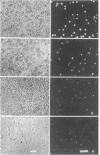
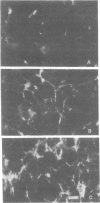
We have found striking changes in the morphology of colonies of Chinese hamster ovary cells grown on agar containing low doses of dimethyl sulfoxide. Effects on morphology of cells grown on plastic at the same dimethyl sulfoxide concentrations were not as pronounced. Computer-assisted analysis of darkfield photographs of growing colonies proved very useful in measuring the magnitude of morphological changes at various doses. A large decrease in total cell-bound and released glycosaminoglycans (GAGs) was observed in the presence of dimethyl sulfoxide by measuring incorporation of radiolabeled precursors into cetylpyridinium chloride-precipitable GAGs in Chinese hamster ovary cells. By contrast, dimethyl sulfoxide was found to cause an increase in the network of fibronectin (the large external transformation-sensitive protein) at the cell surface. These observations demonstrate the association of GAGs and fibronectin in processes affecting the three-dimensional growth patterns of aggregates of mammalian cells and also demonstrate the sensitivity of agargrown colonies as model systems for quantitatively measuring the morphological changes induced by exogenous agents such as drugs, hormones, growth factors, mutagens, and carcinogens. These findings might be relevant to the study and treatment of the important class of genetic diseases called mucopolysaccharidoses which result in mental, skeletal, and ocular defects as a consequence of GAG accumulation.
Full text
PDF


Images in this article
Selected References
These references are in PubMed. This may not be the complete list of references from this article.
- Aidells B. D., Konrad M. W., Glaser D. A. Growth and morphology of colonies of Chinese hamster ovary cells growing on agar is affected by insulin. Proc Natl Acad Sci U S A. 1979 Apr;76(4):1863–1867. doi: 10.1073/pnas.76.4.1863. [DOI] [PMC free article] [PubMed] [Google Scholar]
- Borenfreund E., Steinglass M., Korngold G., Bendich A. Effect of dimethyl sulfoxide and dimethylformamide on the growth and morphology of tumor cells. Ann N Y Acad Sci. 1975 Jan 27;243:164–167. doi: 10.1111/j.1749-6632.1975.tb25355.x. [DOI] [PubMed] [Google Scholar]
- Brown A. E., Case K. R., Bosmann H. B., Sartorelli A. C. Cell surface charge alterations occurring during dimethylsulfoxide-induced erythrodifferentiation of Friend leukemia cells. Biochem Biophys Res Commun. 1979 Feb 28;86(4):1281–1287. doi: 10.1016/0006-291x(79)90255-9. [DOI] [PubMed] [Google Scholar]
- Culp L. A., Rollins B. J., Buniel J., Hitri S. Two functionally distinct pools of glycosaminoglycan in the substrate adhesion site of murine cells. J Cell Biol. 1978 Dec;79(3):788–801. doi: 10.1083/jcb.79.3.788. [DOI] [PMC free article] [PubMed] [Google Scholar]
- Dexter D. L., Barbosa J. A., Calabresi P. N,N-dimethylformamide-induced alteration of cell culture characteristics and loss of tumorigenicity in cultured human colon carcinoma cells. Cancer Res. 1979 Mar;39(3):1020–1025. [PubMed] [Google Scholar]
- Dexter D. L. N,N-Dimethylformamide-induced morphological differentiation and reduction of tumorigenicity in cultured mouse rhabdomyosarcoma cells. Cancer Res. 1977 Sep;37(9):3136–3140. [PubMed] [Google Scholar]
- Fratantoni J. C., Hall C. W., Neufeld E. F. Hurler and Hunter syndromes: mutual correction of the defect in cultured fibroblasts. Science. 1968 Nov 1;162(3853):570–572. doi: 10.1126/science.162.3853.570. [DOI] [PubMed] [Google Scholar]
- Gospodarowicz D., Greenburg G., Birdwell C. R. Determination of cellular shape by the extracellular matrix and its correlation with the control of cellular growth. Cancer Res. 1978 Nov;38(11 Pt 2):4155–4171. [PubMed] [Google Scholar]
- Grinnell F. Cellular adhesiveness and extracellular substrata. Int Rev Cytol. 1978;53:65–144. doi: 10.1016/s0074-7696(08)62241-x. [DOI] [PubMed] [Google Scholar]
- Hayman E. G., Ruoslahti E. Distribution of fetal bovine serum fibronectin and endogenous rat cell fibronectin in extracellular matrix. J Cell Biol. 1979 Oct;83(1):255–259. doi: 10.1083/jcb.83.1.255. [DOI] [PMC free article] [PubMed] [Google Scholar]
- Hopwood J. J., Dorfman A. Glycosaminoglycan synthesis by cultured human skin fibroblasts after transformation with simian virus 40. J Biol Chem. 1977 Jul 25;252(14):4777–4785. [PubMed] [Google Scholar]
- Kisch A. L., Kelley R. O., Crissman H., Paxton L. Dimethyl sulfoxide-induced reversion of several features of polyoma transformed baby hamster kidney cells (BHK-21). Alterations in growth and morphology. J Cell Biol. 1973 Apr;57(1):38–53. doi: 10.1083/jcb.57.1.38. [DOI] [PMC free article] [PubMed] [Google Scholar]
- Konrad M. W., Couch J. L., Glaser D. A. A grey level frequency histogram representation of animal cell colonies seen by scattered light. Comput Biomed Res. 1980 Aug;13(4):333–349. doi: 10.1016/0010-4809(80)90026-9. [DOI] [PubMed] [Google Scholar]
- Konrad M. W., Storrie B., Glaser D. A., Thompson L. H. Clonal variation in colony morphology and growth of CHO cells cultured on agar. Cell. 1977 Feb;10(2):305–312. doi: 10.1016/0092-8674(77)90224-0. [DOI] [PubMed] [Google Scholar]
- LOWRY O. H., ROSEBROUGH N. J., FARR A. L., RANDALL R. J. Protein measurement with the Folin phenol reagent. J Biol Chem. 1951 Nov;193(1):265–275. [PubMed] [Google Scholar]
- Makita A., Shimojo H. Polysaccharides of SV 40-transformed green monkey kidney cells. Biochim Biophys Acta. 1973 Apr 28;304(2):571–574. doi: 10.1016/0304-4165(73)90278-x. [DOI] [PubMed] [Google Scholar]
- Matalon R., Dorfman A. Hurler's syndrome: biosynthesis of acid mucopolysaccharides in tissue culture. Proc Natl Acad Sci U S A. 1966 Oct;56(4):1310–1316. doi: 10.1073/pnas.56.4.1310. [DOI] [PMC free article] [PubMed] [Google Scholar]
- Matsuhisa T., Mori Y., Tamura H. Phenotypic reversion of SV40-transformed 3T3 cells by dimethylsulfoxide. Cell Biol Int Rep. 1981 Feb;5(2):179–186. doi: 10.1016/0309-1651(81)90026-6. [DOI] [PubMed] [Google Scholar]
- Nielson S. E., Puck T. T. Deposition of fibronectin in the course of reverse transformation of Chinese hamster ovary cells by cyclic AMP. Proc Natl Acad Sci U S A. 1980 Feb;77(2):985–989. doi: 10.1073/pnas.77.2.985. [DOI] [PMC free article] [PubMed] [Google Scholar]
- Preisler H. D., Lutton J. D., Giladi M., Goldstein K., Zanjani E. D. Loss of clonogenicity in agar by differentiating erythroleukemic cells. Life Sci. 1975 Apr 15;16(8):1241–1251. doi: 10.1016/0024-3205(75)90309-4. [DOI] [PubMed] [Google Scholar]
- SCOTT J. E. The solubility of cetylpyridinium complexes of biological polyanions in solution of salts. Biochim Biophys Acta. 1955 Nov;18(3):428–429. doi: 10.1016/0006-3002(55)90108-6. [DOI] [PubMed] [Google Scholar]
- Sato C., Kojima K., Nishizawa K., Ikawa Y. Early decrease in hyaluronidase-sensitive cell surface charge during the differentiation of Friend erythroleukemic cells by dimethyl sulfoxide. Cancer Res. 1979 Mar;39(3):1113–1117. [PubMed] [Google Scholar]
- Satoh C., Duff R., Rapp F., Davidson E. A. Production of mucopolysaccharides by normal and transformed cells. Proc Natl Acad Sci U S A. 1973 Jan;70(1):54–56. doi: 10.1073/pnas.70.1.54. [DOI] [PMC free article] [PubMed] [Google Scholar]
- Stanley E. R., Palmer R. E., Sohn U. Development of methods for the quantitative in vitro analysis of androgen-dependent and autonomous Shionogi carcinoma 115 cells. Cell. 1977 Jan;10(1):35–44. doi: 10.1016/0092-8674(77)90137-4. [DOI] [PubMed] [Google Scholar]
- Tchao R., Schleich A. B. Can cell morphology in monolayer reveal its behaviour in aggregates? Cell Biol Int Rep. 1978 Jul;2(4):353–363. doi: 10.1016/0309-1651(78)90021-8. [DOI] [PubMed] [Google Scholar]
- Underhill C., Dorfman A. The role of hyaluronic acid in intercellular adhesion of cultured mouse cells. Exp Cell Res. 1978 Nov;117(1):155–164. doi: 10.1016/0014-4827(78)90438-x. [DOI] [PubMed] [Google Scholar]