



Abstract
Context:
Studies have documented that nurses and other health care professionals are inadequately prepared to care for patients in palliative care. Several reasons have been identified including inadequacies in nursing education, absence of curriculum content related to pain management, and knowledge related to pain and palliative care.
Aims:
The objective of this paper was to assess the knowledge about palliative care amongst nursing professionals using the palliative care knowledge test (PCKT).
Settings and Design:
Cross-sectional survey of 363 nurses in a multispecialty hospital.
Materials and Methods:
The study utilized a self-report questionnaire- PCKT developed by Nakazawa et al., which had 20 items (statements about palliative care) for each of which the person had to indicate ‘correct’, ‘incorrect’, or ‘unsure.’ The PCKT had 5 subscales (philosophy- 2 items, pain- 6 items, dyspnea- 4 items, psychiatric problems- 4 items, and gastro-intestinal problems- 4 items).
Statistical Analysis Used:
Comparison across individual and professional variables for both dimensions were done using one-way ANOVA, and correlations were done using Karl-Pearson's co-efficient using SPSS version 16.0 for Windows.
Results:
The overall total score of PCKT was 7.16 ± 2.69 (35.8%). The philosophy score was 73 ± .65 (36.5%), pain score was 2.09 ± 1.19 (34.83%), dyspnea score was 1.13 ± .95 (28.25%), psychiatric problems score was 1.83 ± 1.02 (45.75%), and gastro-intestinal problems score was 1.36 ± .97 (34%). (P = .00). The female nurses scored higher than their male counterparts, but the difference was not significant (P > .05).
Conclusions:
Overall level of knowledge about palliative care was poor, and nurses had a greater knowledge about psychiatric problems and philosophy than the other aspects indicated in PCKT.
Keywords: Information, Nursing education, Palliative care education, Professional knowledge
INTRODUCTION
One of the important factors influencing a successful delivery of palliative healthcare is the health care professionals’ knowledge, attitudes, beliefs, and experiences, which determine not only their procedure but also their behavior during evaluation and treatment of patients.[1] After physicians, the nurses are the most valuable palliative care team members who address the physical, functional, social, and spiritual dimensions of care.[2] Studies have documented that nurses and other health care professionals are inadequately prepared to care for patients in pain. Several reasons have been identified including inadequacies education, absence of curriculum content related to pain management, and faculty attitudes and beliefs related to pain.[3]
A public health strategy, as recommended by the World Health Organization (WHO), offers the best approach for translating knowledge and skills into evidence-based, cost-effective interventions that can reach everyone in need of palliative care in developing countries.[4] The World Health Organization (WHO) pioneered a public health strategy (PHS) for integrating palliative care into a country's health care system. The WHO PHS addresses 1) appropriate policies; 2) adequate drug availability; 3) education of policy makers, health care workers, and the public; and 4) implementation of palliative care services at all levels throughout the society.[5] Education of health care workers has a great influence on their knowledge, which acts as a foundation for better clinical practice.[6] The role of multidisciplinary collaborative team work cannot be over-emphasized in the provision of palliative nursing care services.[2] Nurses considered next only to physicians, for their important role in providing palliative care and for being responsible for patients with life-limiting and/or life-threatening.[7] However, various factors affect nurses’ effective role as a health care provider, in a palliative care setting. The most important factor amongst them is knowledge about palliative care.
The knowledge and understanding about pain had undergone a paradigm shift from a biomedical dimension to a behavioral dimension.[8,9] In other words, an anatomical or pathological understanding is now replaced with biopsychosocial perspective for pain.[10] One such recent biopsychosocial explanation of pain is the mechanism-based classification, used by physical therapists’ management in palliative care.[11] A recent survey found that nurses had a biomedical orientation to chronic pain rather than a behavioral one.[12] Such attitudes and beliefs not only result from inadequate knowledge per se, but also vice versa.
Knowing the present levels of professionals’ knowledge facilitate appropriate training programs[13,14] to address identified deficits and thereby to improve the quality of provided care.
There were many studies that previously reported levels of knowledge about palliative care amongst nurses,[15–25] but none of the earlier studies provide information on knowledge about distinct aspects of palliative care such as philosophy, pain, dyspnea, psychiatric problems, and gastro-intestinal problems. Nakazawa et al.[26] developed and validated the palliative care knowledge test (PCKT) for evaluating knowledge on palliative care amongst health care professionals. PCKT has 5 distinct subscales for each of the above-mentioned issues in palliative care practice. To our knowledge, there is no study that evaluated the knowledge of nurses using the PCKT. The objective of the present study was to evaluate the nurses on knowledge about palliative care using the PCKT.
MATERIALS AND METHODS
The study was conducted at a multispecialty tertiary care hospital where the participants included those who attended a continuing professional development program exclusively for staff nurses. The study's ethical approval was obtained from the institutional ethics committee, and all participants were required to provide their written informed consent prior to their participation. Consented participants were then given the survey questionnaire.
The study utilized a self-report questionnaire originally used by Nakazawa et al.[26] The scale had 20 items (statements about pain) for each of which the person had to answer ‘correct,’ ‘incorrect,’ or ‘unsure.’ Items 1 and 2 indicate philosophy (2 points), 3 to 8 for pain (6 points), 9 to 12 for dyspnea (4 points), 13 to 16 for psychiatric problems (4 points), and 17 to 20 for gastro-intestinal problems (4 points). Total score for an all-correct response is 20.
The received questionnaires were then screened for their suitability of responses to get the final number of included participants’ questionnaires. Thus, we arrived at the response rate for our survey.
Comparison across individual and professional variables for both dimensions were done using one-way ANOVA (post-hoc analysis using Bonferonni test), and correlations were done using Karl-Pearson's co-efficient using SPSS version 11.5 for Windows (SPSS Inc, IL).
RESULTS
Out of total 392 questionnaires distributed and collected, 363 valid questionnaires were included for analysis, with a response rate of 92.6%. The overall descriptive data of the study participants is provided in Table 1. The item-specific responses for the subscales of PCKT and their corresponding prevalence rates are shown in Table 2 and Figure 1, respectively.
Table 1.
Overall descriptive data of study participants
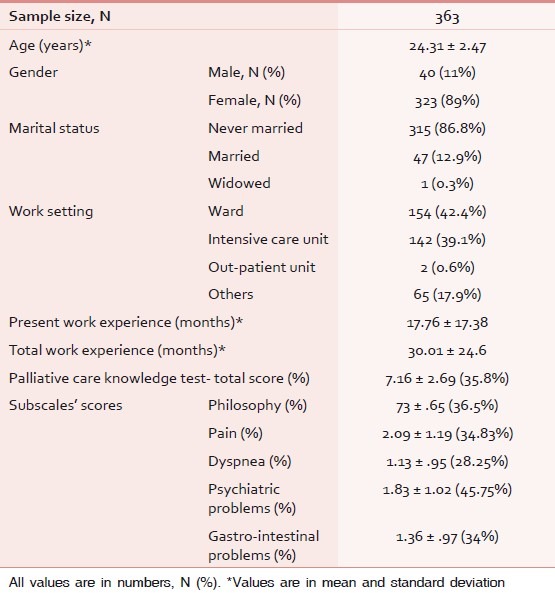
Table 2.
Responses for the PCKT subscales in the study sample
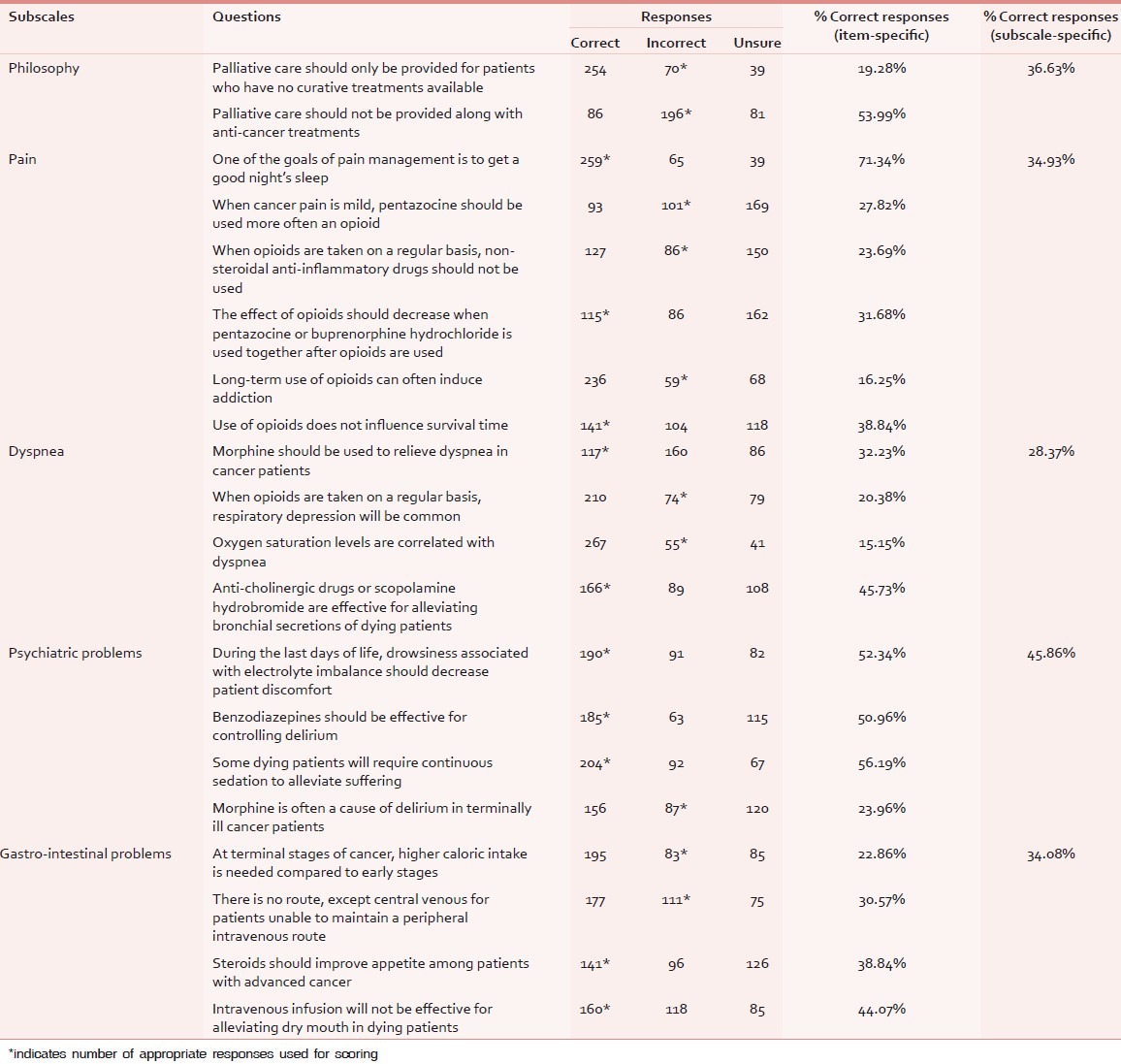
Figure 1.

Item-responses for the palliative care knowledge test (PCKT) in the study sample
Comparison of knowledge between genders
Between-group comparison [Figure 2] found that female nurses had slightly higher scores than male nurses, which was not statistically significant (P > .05).
Figure 2.
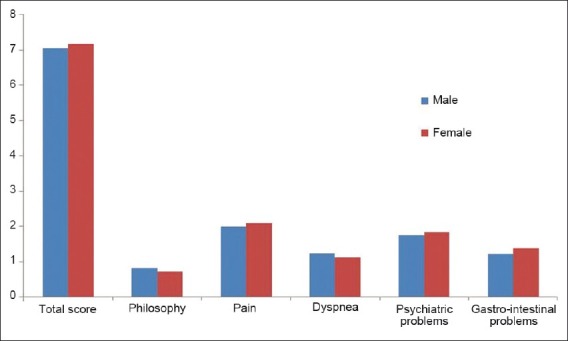
Comparison of palliative care knowledge test (PCKT) total and subscale scores between genders
Comparison of knowledge scores between work setting categories
Between-group comparison for total PCKT score (P = .142) and subscales’ scores (philosophy: P = .606; pain: P = .250; dyspnea: P = .752; psychiatric problems: P = .244; gastro-intestinal problems: P = .116) were not statistically significant. The schematic comparison is shown in Figure 3.
Figure 3.
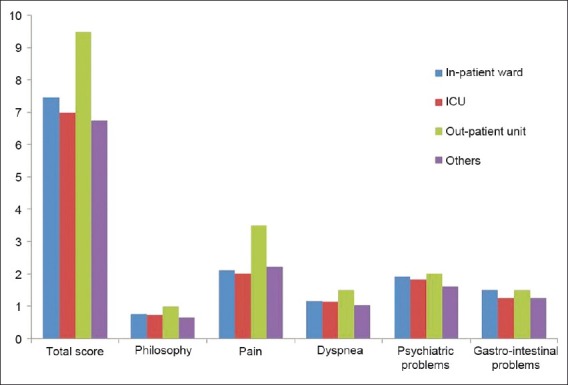
Comparison of palliative care knowledge test (PCKT) total and subscale scores between types of work setting
Relationship of PCKT total score and subscales’ scores with age, present work experience, and total work experience
Weak correlations were found between the scores (PCKT total score and subscales’ scores) and age, present work experience, and total work experience, which were not statistically significant [Table 3].
Table 3.
Correlations of PCKT total and subscales’ scores with age, present work experience, and total work experience

DISCUSSION
Previous systematic review identified PCKT as a single quantitative assessment tool yet to be studied and reported in healthcare professionals, be it nurses which was done in this study for the first time in Indian professional population. The principal focus for previous palliative care studies evaluating knowledge was on a website,[27] telephone advice,[28] a disease condition,[29] questionnaire development,[30,31] research,[32,33] and theory[34–36] of palliative care. Although this study did not evaluate interventions to improve palliative care knowledge amongst nurses, some recommendations on improving the same could be considered both for practice and for future research: Fundamental changes in nursing curriculum that includes a comprehensive information on palliative care; training programs on palliative care; and, telephone/online (web- based) advice.
This study's findings are in agreement with previous reports of inadequacies in knowledge in various issues related to palliative care such as pain management, opioid usage, and adverse drug events. However, direct comparison of this study's findings with earlier studies is not possible since this study is the first quantitative study that explored the 5 aspects of philosophy, pain, dyspnea, psychiatric problems, and gastro-intestinal problems. Future studies can evaluate palliative care knowledge across a curriculum, comparison between nurses from different work settings or educational background, in different countries across the globe.
This study included biopsychosocial factors related to nursing staff such as age, gender, work experience, and work setting. Education and clinical experience influence nurses’ knowledge, attitudes, and beliefs about palliative care. However, it would appear that the specialist nurses’ working environment and knowledge base engenders a practice theory divide, resulting in desensitization to patients’ physical pain.[37]
Inadequacies in the pain management process may not be tied to myth and bias originating from general attitudes and beliefs, but may reflect an inadequate pain knowledge.[38] This study also found that knowledge about pain was low, only less than 35% of nurses had correct responses for knowledge subscale. Future studies may assess such relationship between knowledge, attitudes, beliefs, and behaviors of nurses in real life palliative care situations.[39] The study findings are of utmost significance since individual’ own knowledge largely determines inter-individual and inter-disciplinary communication in a multidisciplinary care framework for pain and palliative care.[40] Knowledge-practice[41] translation depends upon behaviors are essential to answer inadequacies of nursing care, which directly then would facilitate appropriate educational interventions by integrating research, practice, and education in knowledge about palliative care.[42–44]
Being knowledgeable about palliative care assessment and management can help nurses and other healthcare providers overcome many of the barriers to successful pain control and palliative care.[45] Future studies could focus on different ways of knowing,[46] and the methods of knowledge constructions,[47] the inter-relationship with practice and research,[48] and the influence of evidence-base,[49] and cultural competence[50] in evidence-based palliative care nursing.[51]
CONCLUSION
Overall level of knowledge about palliative care was poor, and nurses had a greater knowledge about psychiatric problems and philosophy than the other aspects as indicated in PCKT. The study findings have important curricular implications for nurses and practical implications in palliative care.
ACKNOWLEDGEMENTS
The authors wish to thank nurses who participated in the study for taking their valuable time and sharing their knowledge, views, and opinions in the survey.
Footnotes
Source of Support: Nil.
Conflict of Interest: None declared.
REFERENCES
- 1.Skår R. Knowledge use in nursing practice: The importance of practical understanding and personal involvement. Nurse Educ Today. 2010;30:132–6. doi: 10.1016/j.nedt.2009.06.012. [DOI] [PubMed] [Google Scholar]
- 2.Egan KA, Abbott P. Interdisciplinary team training- preparing new employees for the specialty of hospice and palliative care. J Hosp Palliat Nurs. 2002;4:161–71. [Google Scholar]
- 3.Ferrell BR, McGuire DB, Donovan MI. Knowledge and beliefs regarding pain in a sample of nursing faculty. J Prof Nurs. 1993;9:79–88. doi: 10.1016/8755-7223(93)90023-6. [DOI] [PubMed] [Google Scholar]
- 4.Ddungu H. Palliative care: What approaches are suitable in developing countries? Br J Haematol. 2011 doi: 10.1111/j.1365-2141.2011.08764.x. [In press] [DOI] [PubMed] [Google Scholar]
- 5.Stjernswärd J, Foley KM, Ferris FD. The public health strategy for palliative care. J Pain Symptom Manage. 2007;33:486–93. doi: 10.1016/j.jpainsymman.2007.02.016. [DOI] [PubMed] [Google Scholar]
- 6.Crossetti Mda G. Production of knowledge and the quality of nursing practice. Rev Gaucha Enferm. 2009;30:372–4. [PubMed] [Google Scholar]
- 7.Jamison RN, Rudy TE, Penzien DB, Mosley TH., Jr Cognitive-behavioral classifications of chronic pain: Replication and extension of empirically derived patient profiles. Pain. 1994;57:277–92. doi: 10.1016/0304-3959(94)90003-5. [DOI] [PubMed] [Google Scholar]
- 8.Soyannwo OA. Palliative care and nursing. Afr J Med Med Sci. 2009;38(Suppl 2):67–70. [PubMed] [Google Scholar]
- 9.Lipsky PE, Buckland J. Pain by name, pain by nature. Nat Rev Rheumatol. 2010;6:179–80. doi: 10.1038/nrrheum.2010.38. [DOI] [PubMed] [Google Scholar]
- 10.Syrjala KL, Chapko ME. Evidence for a biopsychosocial model of cancer treatment-related pain. Pain. 1995;61:69–79. doi: 10.1016/0304-3959(94)00153-6. [DOI] [PubMed] [Google Scholar]
- 11.Kumar SP, Saha S. Mechanism-based classification of pain for physical therapy management in palliative care. Indian J Palliat Care. 2011;17:80–6. doi: 10.4103/0973-1075.78458. [DOI] [PMC free article] [PubMed] [Google Scholar]
- 12.Prem V, Karvannan H, Chakravarthy RD, Binukumar V, Jaykumar S, Kumar SP. Attitudes and beliefs about chronic pain amongst nurses: biomedical or behavioral? A cross-sectional study. Indian J Palliat Care. 2011;17:215–22. doi: 10.4103/0973-1075.92341. [DOI] [PMC free article] [PubMed] [Google Scholar]
- 13.Kwekkeboom KL, Vahl C, Eland J. Impact of a volunteer companion program on nursing students’ knowledge and concerns related to palliative care. J Palliat Med. 2006;9:90–9. doi: 10.1089/jpm.2006.9.90. [DOI] [PubMed] [Google Scholar]
- 14.Kumar SP, Jim A, Sisodia V. Effects of palliative care training program on knowledge, attitudes, beliefs and experiences among student physiotherapists: A preliminary quasi-experimental study. Indian J Palliat Care. 2011;17:47–53. doi: 10.4103/0973-1075.78449. [DOI] [PMC free article] [PubMed] [Google Scholar]
- 15.Abu-Saad Huijer H, Dimassi H. Palliative care in Lebanon: knowledge, attitudes and practices of physicians and nurses. J Med Liban. 2007;55:121–8. [PubMed] [Google Scholar]
- 16.Berrang T, Samant R. Palliative radiotherapy knowledge among community family physicians and nurses. J Cancer Educ. 2008;23:156–60. doi: 10.1080/08858190802039136. [DOI] [PubMed] [Google Scholar]
- 17.Abu-Saad Huijer H, Dimassi H, Abboud S. Perspectives on palliative care in Lebanon: knowledge, attitudes, and practices of medical and nursing specialties. Palliat Support Care. 2009;7:339–47. doi: 10.1017/S1478951509990277. [DOI] [PubMed] [Google Scholar]
- 18.Gibbs G. Nurses in private nursing homes: A study of their knowledge and attitudes to pain management in palliative care. Palliat Med. 1995;9:245–53. doi: 10.1177/026921639500900310. [DOI] [PubMed] [Google Scholar]
- 19.Proctor M, Grealish L, Coates M, Sears P. Nurses’ knowledge of palliative care in the Australian Capital Territory. Int J Palliat Nurs. 2000;6:421–8. doi: 10.12968/ijpn.2000.6.9.9053. [DOI] [PubMed] [Google Scholar]
- 20.Dunniece U, Slevin E. Giving voice to the less articulated knowledge of palliative nursing: An interpretative study. Int J Palliat Nurs. 2002;8:13–20. doi: 10.12968/ijpn.2002.8.1.10230. [DOI] [PubMed] [Google Scholar]
- 21.Ronaldson S, Hayes L, Carey M, Aggar C. A study of nurses’ knowledge of a palliative approach in residential aged care facilities. Int J Older People Nurs. 2008;3:258–67. doi: 10.1111/j.1748-3743.2008.00136.x. [DOI] [PubMed] [Google Scholar]
- 22.Shipman C, Burt J, Ream E, Beynon T, Richardson A, Addington-Hall J. Improving district nurses’ confidence and knowledge in the principles and practice of palliative care. J Adv Nurs. 2008;63:494–505. doi: 10.1111/j.1365-2648.2008.04729.x. [DOI] [PubMed] [Google Scholar]
- 23.Abu-Saad Huijer H, Abboud S, Dimassi H. Palliative care in Lebanon: knowledge, attitudes and practices. Int J Palliat Nurs. 2009;15:346–53. doi: 10.12968/ijpn.2009.15.7.43425. [DOI] [PubMed] [Google Scholar]
- 24.Stevens E. Extending knowledge of terror management theory to improve palliative nursing care. Int J Palliat Nurs. 2009;15:368–70. doi: 10.12968/ijpn.2009.15.8.43793. [DOI] [PubMed] [Google Scholar]
- 25.Knapp CA, Madden V, Wang H, Kassing K, Curtis C, Sloyer P, et al. Paediatric nurses’ knowledge of palliative care in Florida: A quantitative study. Int J Palliat Nurs. 2009;15:432–9. doi: 10.12968/ijpn.2009.15.9.44255. [DOI] [PubMed] [Google Scholar]
- 26.Nakazawa Y, Miyashita M, Morita T, Umeda M, Oyagi Y, Ogasawara T. The palliative care knowledge test: reliability and validity of an instrument to measure palliative care knowledge among health professionals. Palliat Med. 2009;23:754–66. doi: 10.1177/0269216309106871. [DOI] [PubMed] [Google Scholar]
- 27.Gavrin J. Expert knowledge in palliative care on the World Wide Web: palliativedrugs.org. J Pain Palliat Care Pharmacother. 2009;23:374–9. doi: 10.3109/15360280903327336. [DOI] [PubMed] [Google Scholar]
- 28.Carr SM, Lhussier M, Wilcockson J. Transferring palliative care knowledge: Evaluating the use of a telephone advice line. Int J Palliat Nurs. 2008;14:303–8. doi: 10.12968/ijpn.2008.14.6.30026. [DOI] [PubMed] [Google Scholar]
- 29.Bailey B, Aranda S, Quinn K, Kean H. Creutzfeldt-Jakob disease: Extending palliative care nursing knowledge. Int J Palliat Nurs. 2000;6:131–9. doi: 10.12968/ijpn.2000.6.3.8940. [DOI] [PubMed] [Google Scholar]
- 30.Reed VA, Jernstedt GC, Goodlin SJ. A palliative care survey to measure medical students’ and health care professionals’ knowledge and attitudes. Acad Med. 1998;73:578. doi: 10.1097/00001888-199805000-00039. [DOI] [PubMed] [Google Scholar]
- 31.Ross MM, McDonald B, McGuinness J. The palliative care quiz for nursing (PCQN): The development of an instrument to measure nurses’ knowledge of palliative care. J Adv Nurs. 1996;23:126–37. doi: 10.1111/j.1365-2648.1996.tb03106.x. [DOI] [PubMed] [Google Scholar]
- 32.Vandam LD. A palliative approach to the newgrowth of medical knowledge. Anesthesiology. 1962;23:576–7. [PubMed] [Google Scholar]
- 33.Twycross RG. Research and palliative care: the pursuit of reliable knowledge. Palliat Med. 1993;7:175–7. doi: 10.1177/026921639300700301. [DOI] [PubMed] [Google Scholar]
- 34.Hockley J, Froggatt K. The development of palliative care knowledge in care homes for older people: The place of action research. Palliat Med. 2006;20:835–43. doi: 10.1177/0269216306073111. [DOI] [PubMed] [Google Scholar]
- 35.Jackson A. Palliative care. Source of knowledge. Nurs Times. 1995;91:55–7. [PubMed] [Google Scholar]
- 36.Degner LF. Knowledge translation in palliative care: Can theory help? Can J Nurs Res. 2005;37:105–13. [PubMed] [Google Scholar]
- 37.Wilson B, McSherry W. A study of nurses’ inferences of patients’ physical pain. J Clin Nurs. 2006;15:459–68. doi: 10.1111/j.1365-2702.2006.01358.x. [DOI] [PubMed] [Google Scholar]
- 38.Wilson B. Nurses’ knowledge of pain. J Clin Nurs. 2007;16:1012–20. doi: 10.1111/j.1365-2702.2007.01692.x. [DOI] [PubMed] [Google Scholar]
- 39.Beach DJ. Professional knowledge and its impact on nursing practice. Nurse Educ Pract. 2002;2:80–6. doi: 10.1054/nepr.2002.0064. [DOI] [PubMed] [Google Scholar]
- 40.Nairn S. A critical realist approach to knowledge: implications for evidence-based practice in and beyond nursing. Nurs Inq. 2012;19:6–17. doi: 10.1111/j.1440-1800.2011.00566.x. [DOI] [PubMed] [Google Scholar]
- 41.Lundeen S, Harper E, Kerfoot K. Translating nursing knowledge into practice: An uncommon partnership. Nurs Outlook. 2009;57:173–5. doi: 10.1016/j.outlook.2009.03.005. [DOI] [PubMed] [Google Scholar]
- 42.Daly J, Jackson D. On the use of nursing theory in nurse education, nursing practice, and nursing research in Australia. Nurs Sci Q. 1999;12:342–5. doi: 10.1177/089431849901200418. [DOI] [PubMed] [Google Scholar]
- 43.Fralic MF. Hardwiring the “three-legged stool”: Nursing's vital education/ practice/ research triad. J Prof Nurs. 2004;20:281–4. doi: 10.1016/j.profnurs.2004.07.004. [DOI] [PubMed] [Google Scholar]
- 44.Leahey M, Svavarsdottir EK. Implementing family nursing: How do we translate knowledge into clinical practice? J Fam Nurs. 2009;15:445–60. doi: 10.1177/1074840709349070. [DOI] [PubMed] [Google Scholar]
- 45.Mitchell PH. Knowledge that matters: Integrating research, practice, and education. Commun Nurs Res. 2008;41:3–10. [PubMed] [Google Scholar]
- 46.Berragan L. Nursing practice draws upon several different ways of knowing. J Clin Nurs. 1998;7:209–17. doi: 10.1046/j.1365-2702.1998.00146.x. [DOI] [PubMed] [Google Scholar]
- 47.James I, Andershed B, Gustavsson B, Ternestedt BM. Knowledge constructions in nursing practice: understanding and integrating different forms of knowledge. Qual Health Res. 2010;20:1500–18. doi: 10.1177/1049732310374042. [DOI] [PubMed] [Google Scholar]
- 48.McNeil PA. The circle of nursing knowledge: Education, practice, and research. Foreword. Commun Nurs Res. 2008;41:xxiii. [PubMed] [Google Scholar]
- 49.Mills J, Field J, Cant R. The place of knowledge and evidence in the context of Australian general practice nursing. Worldviews Evid Based Nurs. 2009;6:219–28. doi: 10.1111/j.1741-6787.2009.00163.x. [DOI] [PubMed] [Google Scholar]
- 50.Waite R, Calamaro CJ. Cultural competence: A systemic challenge to nursing education, knowledge exchange, and the knowledge development process. Perspect Psychiatr Care. 2010;46:74–80. doi: 10.1111/j.1744-6163.2009.00240.x. [DOI] [PubMed] [Google Scholar]
- 51.Tagney J, Haines C. Using evidence-based practice to address gaps in nursing knowledge. Br J Nurs. 2009;18:484–9. doi: 10.12968/bjon.2009.18.8.41811. [DOI] [PubMed] [Google Scholar]