



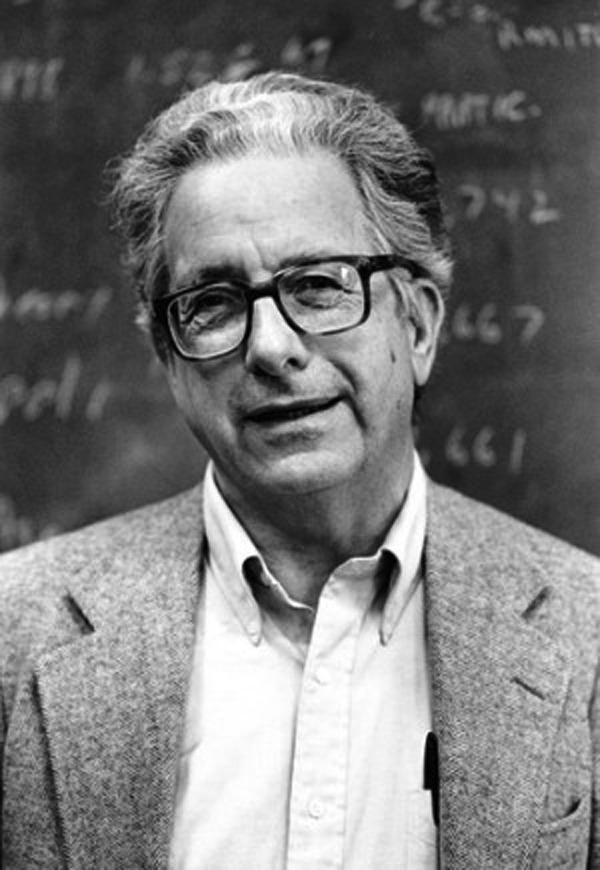
Paul Meier. Courtesy of the University of Chicago. Printed with permission.
IN 1951, WHEN PAUL MEIER received his doctorate in mathematics from Princeton University and became one of the first statisticians to enter medical research, potential new medical treatments were evaluated in a very different fashion than they are today. At the time, researchers commonly followed practices such as giving a new remedy to patients they thought might benefit from it and comparing the outcomes with other patients who were not treated. In other situations, patients who stopped taking a new medicine might be counted as controls who had never been exposed to it.
PAUL MEIER HAD A PROFOUND IMPACT on how clinical trials now evaluate the efficacy of new drugs and treatment methodologies throughout the world. Meier’s tireless promotion of the now-standard practice of randomly assigning patients enrolled in clinical trials to receive either the conventional remedy or the new treatment being evaluated helped ensure its current status as the most rigorous way to gather evidence of a new drug or treatment’s effectiveness. Meier also helped formulate the Kaplan-Meier estimator, which is now the most popular method of estimating clinical trial participant survival. It is one of the most widely cited articles in the medical literature.
Meier, who died on August 7, 2011, at the age of 87, had a profound impact on how clinical trials now evaluate the efficacy of new drugs and treatment methodologies throughout the world. Meier’s “many published works and writings have had a huge influence on the application of statistics to medical research—particularly the design, conduct, and analysis of randomized clinical trials and in the advancement of evidence-based medicine in general,” according to the Society of Clinical Trials, which Meier helped found in 1978.1
Meier was tireless in his promotion of the now-standard practice of randomly assigning patients enrolled in clinical trials to receive either the conventional remedy or the new treatment being evaluated. This is now considered the most rigorous way to conduct a study and the best way to gather evidence of a new drug or treatment’s effectiveness. “Perhaps more than any other U.S. statistician, [Dr. Meier] influenced U.S. drug regulatory agencies, and hence clinical researchers throughout the U.S. and other countries, to insist on the central importance of randomized evidence,” said Sir Richard Peto of Oxford University, who was also a leading advocate for randomization, in Meier’s New York Times obituary.2 “That strategic decision half a century ago has already saved millions of lives, and those millions should be attributed to Paul,” Peto said.
“I defended randomization every chance I got, and I had a fair number of chances,” Meier said in a 2003 interview in the journal Clinical Trials.3(p137) “For a fairly long time randomization was not thought of so highly,” he explained. He said that in 2001,
a very distinguished statistician told me that I had a major influence on the Food and Drug Administration’s policies on randomized clinical trials. I don’t know how true that was, but if so, it would be something of which I am very proud,
adding that his success in encouraging the use of randomization in clinical trials is the achievement he prized most highly.3(p137)
Together with Edward L. Kaplan of the California Radiation Laboratory, Meier also helped formulate what the Society for Clinical Trials terms “our most popular method of estimating survival functions from continuously observed data.”4 Published in the Journal of the American Statistical Association4 in 1958, it went on to become one of the most widely cited articles in the medical literature. At the time of Meier’s death, the Kaplan-Meier article had been cited more than 34000 times. Theodore Karrison, PhD, director of the University of Chicago Department of Health Studies’ Biostat Lab and one of Meier’s doctoral students, attested to the article’s continuing relevance by noting: “If you open up at random a medical journal you’re likely to see in at least one of the articles a citation to the Kaplan-Meier paper” (oral communication, December 1, 2011).
Over his long and distinguished career, Meier earned many honors—as well as widespread admiration for being quick on his feet.
At professional meetings … he often astonished me by giving comments from the audience, which, though spontaneous, displayed a depth of reasoning and perfect eloquence, which few others could have matched with any amount of advanced preparation,
recalled Rick Chappell (written communication, November 8, 2011; and oral communication, November 23, 2011), who was Meier’s last doctoral student and is now a professor of biostatistics and medical informatics at the University of Wisconsin at Madison.
Through it all, including the stroke in 1995 that robbed him of some of his eloquence, Meier was also a kind and gentle man, according to a statement issued by the Statistics Department at Columbia University,5 where Meier spent his final years (he also held a joint appointment at Columbia’s Mailman School of Public Health). Karrison, Chappell, and Daniel Heitjan, PhD, a professor of biostatistics at the University of Pennsylvania’s Perelman School of Medicine, attested that Meier was both widely respected and loved. “He was a person who cared about people … and someone you could go to with a problem,” Karrison said.
A RELUCTANT BIOSTATISTICIAN
Meier graduated from Oberlin College in 1945 and went on to Princeton University to pursue a doctorate in mathematics, where he studied under the celebrated mathematician John Tukey. Meier’s dissertation project involved a statistical problem suggested by William Cochran, the noted statistician who chaired Johns Hopkins University’s Department of Biostatistics from 1948 to 1958. At the time, Meier was also very interested in “the notion that randomization could clear away confounders that you did not know about.”3(p133) As one of a very few mathematicians focusing on medical applications, Meier recognized the potential value of randomization’s application in medicine.3
After Meier earned his doctorate, he spent one more year at Lehigh University, where he had been teaching since 1948. Tukey recommended that he accept a position at Hopkins with Cochran, who was enthusiastic about Meier’s dissertation.
I was a little nervous because by and large, biostatistics was not a field with a lot of mathematics in it, and I wished more or less to be a mathematician,
Meier said. But when Cochran insisted that going to Hopkins was a good idea, Meier accepted his first position as a statistician.3
In those early days, Meier said, “I was looked at with amazement by my medical colleagues,” when he brought up the idea of randomization for assessing new medical treatments, he recalled. The physicians would say “‘Randomize? We know that this treatment is better than that one,’” he explained. “People who knew and respected me were astounded that I should want to randomize their patients.”3(p133)
Meier´s Recollections of the Salk Polio Vaccine Trial
The 1954 field trial of Jonas Salk's polio vaccine “was the most elaborate trial that was ever done,” Meier recalled. One of the reasons that the trial was so complicated is because polio was very scarce, he explained. “I’ve not been involved in many trials like that and I’ve been involved in lots of multicenter studies,” he said.3(p133)
The situation was further handicapped because the diagnosis of polio is tricky, Meier said. “We need to have the entire country’s physicians participate, because we can’t look over every case where there’s some kind of paralysis. So physicians reported the cases they thought were polio according to the protocol, and we accepted those cases.” Meier estimated that “about half those cases were probably not polio at all.”3(p133)
But the biggest issue, for Meier, emerged during a seminar attended by many of the researchers working on the project, where it became apparent that members of the team were suppressing the data related to some of the test vaccine lots. As soon became clear, the polio virus used in the trial vaccines was not always properly inactivated. Jonas Salk, the vaccine’s inventor, “cut out data in order not to show what happened to some lots,” Meier charged.3(p134) He said that the National Foundation for Infantile Paralysis, which sponsored the study, dropped from its advisory committee scientists who did not agree with how the results were being presented.3
The field trial’s findings were reported to show the vaccine’s effectiveness, over the objections of some of the committee members, Meier said. Soon after, the US Public Health Service reported cases of paralytic polio in children inoculated with the vaccine. The original cases were traced back to lots produced by Cutter Laboratories, of Berkeley, CA, one of six manufacturers licensed to produce the vaccine. However, Meier said that the problem was more widespread. He said:
I got some data from a physician who was working on this, and we found that not only was Cutter wrong, but there were various other companies that had the same polio virus in their samples, although not as much as the samples from Cutter Laboratories. But because there were so many improperly diagnosed cases out there, and because the other manufacturers went around to various newspapers and threatened to cut their advertising, it was dumped on Cutter. Cutter was responsible because they did things in producing and testing the vaccine they were told not to do.3(p134)
Then Meier became involved with the controversial 1954 Salk Polio Vaccine field trials. The Society for Clinical Trials called the polio vaccine trial “the project that put randomized trials on the map in this country” in part because of the key role Meier played by publishing a critical article in Science in 1957.6 The article reviewed “some aspects of the poliomyelitis vaccine testing program which seem to have important implications for scientists generally.”6(p1067) It indicted both the National Foundation for Infantile Paralysis and the government for withholding information from the participants. It also faulted the testing program for accepting without scrutiny Salk’s assertion that the vaccine was “absolute[ly] safe,” and for not employing the expensive and difficult tests that had been suggested to ensure that the final product was free of residual live virus. Meier said that many journals turned his manuscript down and their editors warned him that publishing such an article would limit his career path.3
Honors and Awards
Meier was named as a fellow of the American Association for the Advancement of Science, the American Statistical Association, the Institute of Mathematical Statistics, the American Academy of Arts and Sciences, the Royal Statistical Society, and the John Guggenheim Memorial Foundation. He served as president of both the Institute of Mathematical Statistics and the Society for Clinical Trials. He was also elected to senior membership in the National Academy of Sciences’ Institute of Medicine.5,11
He also held temporary appointments as a National Institutes of Health Special Fellow at the University of London and Imperial College; he was a visiting professor at Harvard University and Jerusalem’s Hebrew University; and he was a fellow of Stanford University’s Center for Advanced Study in the Behavioral Sciences.5,11
Although Meier was denied tenure at Hopkins, he succeeded in securing an appointment to the University of Chicago in 1957. He stayed there until 1992, and taught at different schools and departments—including the college, graduate school, law school, and medical school—over the years. For more than a decade, he led the Department of Statistics as chair or acting chair.
In 1958, Meier published his highly cited article describing what is now known as the Kaplan-Meier estimator in the Journal of the American Statistical Association.4 Kaplan was also a student of Tukey at Princeton. Working independently, Meier and Kaplan solved a problem that was dogging medical researchers at the time. The issue revolved around the fact that many participants in clinical trials do not participate in the experiment for the same length of time because of the time required to recruit study volunteers. The Kaplan-Meier statistic enables researchers to take into account observable time of survival and death.
Initially, Meier recalled, both he and Kaplan had submitted separate articles. The publication’s editor asked them to collaborate to produce one article. “I swallowed hard, and I guess Kaplan swallowed hard as well,” Meier said. “We worked quite hard and at one place he solved a problem that I couldn’t solve; other cases I solved problems he couldn’t.”3(p133)
LOVE FOR CLINICAL TRIALS
In the subsequent decades, Meier’s stature continued to grow, and he was involved in many clinical trials, which he called his “true love.” In addition to helping found the Society for Clinical Trials in the 1970s, he wrote some influential articles about the ethics of performing them.7,8 In his spare time, Meier enjoyed music, particularly folk songs, and played the flute, recalled Chappell, Heitjan, and Karrison. Meier was also a sailor, and he took out his small sailboat, The Salty Dog, in the waters near his summer home near Lake Michigan during his years at the University of Chicago. After Meier moved to New York City in 1992, he sailed in the Hudson River outside Dutchess County, New York.
Over the course of his 50-plus-year career, Meier’s facility for explaining statistical concepts to people outside the discipline resulted in calls to testify before the US Congress and popularity with journalists such as Gina Kolata of the New York Times, Chappell remembered. It also made him popular with clinicians, such as the University of Chicago medical school students he taught about clinical trials, Karrison said.
Meier’s stroke occurred three years after he retired from the University of Chicago in 1992 and moved to Columbia University. There, he held appointments as both the Howard Levene Professor of Statistics in the statistics department and head of the Mailman School of Public Health’s biostatistics department, and he remained active professionally for years after his stroke. “He still kept going to meetings,” Karrison recalled. Meier “struggled courageously,” added Heitjan, who worked closely with him at Columbia (oral communication, November 22, 2012).
Heitjan collaborated with Meier during the Randomized Evaluation of Mechanical Assistance for the Treatment of Congestive Heart Failure (REMATCH) trial, which began in 1998 and ran through 2001 and involved 20 cardiac transplant centers around the country.9,10 Although this artificial heart trial was relatively small compared with many drug trials, it was one of the most significant device trials ever conducted, Heitjan said. Meier insisted that the trial needed to be randomized and he refused to allow the group carrying it out to cut corners, Heitjan recalled.
Clinical trials in the device world are often small, single-arm trials [where results are compared with historical controls] … in part because a lot of the companies that make devices are small and can’t support major trials,
Heitjan explained. The trial was randomized so it could determine whether the devices could extend and improve the quality of recipients’ lives sufficiently to justify the expense of implanting them, he said.
It was the first high-profile randomized clinical trial that Heitjan had worked on, and “having Paul around to be my mentor and guide was very important to me.” When the two would attend meetings related to the trial, Meier was quiet most of the time
because it was a little harder for him to communicate and get his point across so he had to choose his battles carefully. He would only speak out at what I considered critical moments,
Heitjan said. Nevertheless it was clear that Meier’s understanding of both the technical and political issues in the trial was undiminished, Heitjan said.
Heitjan recalled attending a Society for Clinical Trials meeting with Meier in 1998. One after another, distinguished senior physician–scientists came up to greet Meier, pay homage to him, and testify to how he had opened their eyes to the critical importance of the randomized clinical trial, Heitjan remembered.
“Being with [Meier] lifted you up,” Heitjan summarized. Perhaps just as important as his intellect and accomplishments, Meier “was a genuinely good human being,” Karrison said. He was a “great and gentle man,” Chappell agreed.
Acknowledgments
The author would like to thank Rick Chappell, Daniel Heitjan, and Theodore Karrison for their help in putting together this article.
References
- 1.Society of Clinical Trials. Fellows listing [Society of Clinical Trials Web site]. Available at: http://www.sctweb.org/fellows.cfm?id=12. Accessed December 6, 2011.
- 2.Hevesi D. Paul Meier, statistician who revolutionized medical trials, dies at 87. New York Times. August 14, 2011: A18.
- 3.Marks HM. A conversation with Paul Meier. Clin Trials. 2004;1(1):131–138 [DOI] [PubMed] [Google Scholar]
- 4.Meier P, Kaplan EL. Nonparametric estimation from incomplete observations. J Am Stat Assoc. 1958;53:457–481 [Google Scholar]
- 5. Paul Meier 1924–2011. Available at: http://statistics.columbia.edu/content/paul-meier-1924-2011. Accessed August 1, 2012.
- 6.Meier P. Safety testing of a poliomyelitis vaccine. Science. 1957;125(3257):1067–1071 [DOI] [PubMed] [Google Scholar]
- 7.Meier P. Statistics and medical experimentation. Biometrics. 1975;31(2):511–529 [PubMed] [Google Scholar]
- 8.Meier P. Terminating a trial—the ethical problem. Clin Pharmacol Ther. 1979;25(5 Pt 2):633–640 [DOI] [PubMed] [Google Scholar]
- 9.Rose EA, Gelijns AC, Moskowitz AJet al. Long-term use of a left ventricular assist device for end-stage heart failure. N Engl J Med. 2001;345(20):1435–1443 [DOI] [PubMed] [Google Scholar]
- 10.Jessup M. Mechanical cardiac-support devices—dreams and devilish details. N Engl J Med. 2001;345(20):1490–1493 [DOI] [PubMed] [Google Scholar]
- 11. Koppes S. Paul Meier, statistician who helped change clinical research, 1924–2011 [press release]. UChicagoNews. Available at: http://news.uchicago.edu/article/2011/08/11/paul-meier-statistician-who-helped-change-clinical-research-1924-2011. Accessed August 3, 2012.