



Contraindications
Overlying infection. As always, doubt about technique or interpretation.
Applications
Diagnosis and treatment of benign breast cysts.
Equipment necessary
Cleaning solution (chlorhexidine or povidone iodine)
1% lidocaine without epinephrine
3-mL syringe for anesthetic
5- to 10-mL syringe for aspiration
1.5-inch, 21-gauge needle for aspiration
Cytologic fixative fluid
Procedure
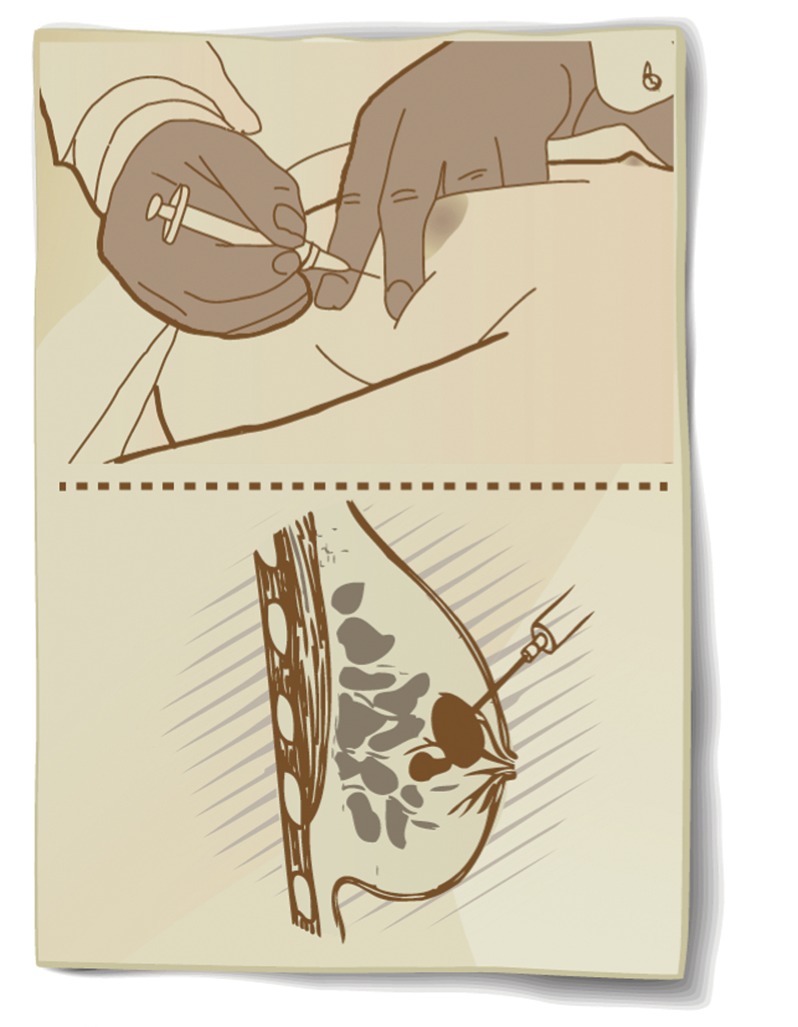
Mark the needle insertion site. Clean the site appropriately. Infiltrate the site with less than 1 mL of lidocaine, without raising a wheal or deforming the skin. Allow 5 minutes for the anesthetic to take effect. Before insertion of the aspiration needle and syringe, fill the syringe with 1 to 2 mL of air to allow for expulsion of any contents in the needle. Insert the aspiration needle and syringe while pulling back on the syringe. You can stabilize the mass with your free hand. To decrease the risk of pneumothorax, perform over a rib or avoid entering perpendicular to the lung. If nonbloody yellow or green serous fluid is obtained, you may discard it if the mass fully disappears after aspiration. If the fluid is bloody or the clinical scenario is otherwise suspicious, send the fluid for cytopathology.
Evidence and diagnostic confirmation
If the mass disappears after aspiration, and the fluid is nonbloody, yellow or green, and serous, then no further workup is necessary. However, if this is not the case, samples should be sent to a cytopathologist for review. The patient should then be sent for mammography. If clinical examination, mammography, and cytology results are all normal, the cumulative negative predictive value is 100% for breast cancer.1 If you are uncomfortable with your aspiration technique or have any doubts about the procedure, or if any of the tests yield abnormal results, then referral to a general surgeon for an open biopsy must be made to rule out breast cancer.
The physical examination is facing extinction in modern medicine. The Top Ten Forgotten Diagnostic Procedures series was developed as a teaching tool for residents in family medicine to reaffirm the most important examination-based diagnostic procedures, once commonly used in everyday practice. For a complete pdF of the Top Ten Forgotten diagnostic procedures, go to http://dl.dropbox.com/u/24988253/bookpreview%5B1%5D.pdf.
Reference
- 1.Kaufman Z, Shpitz B, Shapiro M, Rona R, Lew S, Dinbar A. Triple approach in the diagnosis of dominant breast masses: combined physical examination, mammography, and fine-needle aspiration. J Surg Oncol. 1994;56(4):254–7. doi: 10.1002/jso.2930560413. [DOI] [PubMed] [Google Scholar]