



Abstract
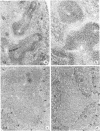
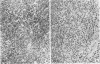
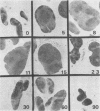
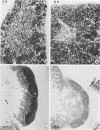
Mice infected with Trypanosoma musculi developed hyperplasia of the spleen, lymph nodes, and liver; in contrast, their thymuses displayed transient involution. All organs returned to normal in a month or less. There was modest anemia, lasting until the parasites were cleared from the bloodstream, followed by a rapid influx of erythrocytes into the blood and a subsequent return to normal erythrocyte numbers. During the first 2 weeks, trypanosomes and trypanosome-derived substances were found in the livers and, in moderate amounts, in the red pulp of the spleens; thereafter, trypanosomes and trypanosome-derived substances gradually decreased in these organs. The lymphoreticular hyperplasia involved a large increase of immunoglobulin G (IgG)-containing cells in the spleens and lymph nodes at 2 weeks of infection. Hyperplasia of immunoglobulin-producing cells correlated with elevation of serum immunoglobulins, especially IgG. Cells producing IgG in the spleens proliferated mainly around the central arterioles of the white pulp, i.e., in the T-cell-dependent areas. The decline of trypanosome-derived substances in the livers and spleens was associated with marked hyperplasia of IgG-containing cells in the spleens and lymph nodes. These results suggest that trypanosome-mediated depression of murine immune responses is attributable to proliferation and terminal differentiation of more-mature lymphoid cells and temporary inhibition of normal maturation of less-mature precursor cells.
Full text
PDF


Images in this article

Selected References
These references are in PubMed. This may not be the complete list of references from this article.
- Albright J. F., Albright J. W., Dusanic D. G. Trypanosome-induced splenomegaly and suppression of mouse spleen cell responses to antigen and mitogens. J Reticuloendothel Soc. 1977 Jan;21(1):21–31. [PubMed] [Google Scholar]
- Albright J. W., Albright J. F., Dusanic D. G. Mechanisms of trypanosome-mediated suppression of humoral immunity in mice. Proc Natl Acad Sci U S A. 1978 Aug;75(8):3923–3927. doi: 10.1073/pnas.75.8.3923. [DOI] [PMC free article] [PubMed] [Google Scholar]
- Albright J. W., Albright J. F. Inhibition of murine humoral immune responses by substances derived from trypanosomes. J Immunol. 1981 Jan;126(1):300–303. [PubMed] [Google Scholar]
- Albright J. W., Albright J. F. Trypanosome-mediated suppression of murine humoral immunity independent of typical suppressor cells. J Immunol. 1980 May;124(5):2481–2484. [PubMed] [Google Scholar]
- Askonas B. A., Corsini A. C., Clayton C. E., Ogilvie B. M. Functional depletion of T- and B-memory cells and other lymphoid cell subpopulations-during trypanosomiasis. Immunology. 1979 Feb;36(2):313–321. [PMC free article] [PubMed] [Google Scholar]
- Banks K. L. Injury induced by Trypanosoma congolense adhesion to cell membranes. J Parasitol. 1980 Feb;66(1):34–37. [PubMed] [Google Scholar]
- Clayton C. E., Sacks D. L., Ogilvie B. M., Askonas B. A. Membrane fractions of trypanosomes mimic the immunosuppressive and mitogenic effects of living parasites on the host. Parasite Immunol. 1979 Autumn;1(3):241–249. doi: 10.1111/j.1365-3024.1979.tb00709.x. [DOI] [PubMed] [Google Scholar]
- Clayton C. E., Selkirk M. E., Corsini C. A., Ogilvie B. M., Askonas B. A. Murine trypanosomiasis: cellular proliferation and functional depletion in the blood, peritoneum, and spleen related to changes in bone marrow stem cells. Infect Immun. 1980 Jun;28(3):824–831. doi: 10.1128/iai.28.3.824-831.1980. [DOI] [PMC free article] [PubMed] [Google Scholar]
- Corsini A. C., Clayton C., Askonas B. A., Ogilvie B. M. Suppressor cells and loss of B-cell potential in mice infected with Trypanosoma brucei. Clin Exp Immunol. 1977 Jul;29(1):122–131. [PMC free article] [PubMed] [Google Scholar]
- Cunningham D. S., Kuhn R. E. Trypanosoma cruzi-induced suppression of the primary immune response in murine cell cultures to T-cell-dependent and -independent antigens. J Parasitol. 1980 Feb;66(1):16–27. [PubMed] [Google Scholar]
- Cunningham D. S., Kuhn R. E. Trypanosoma cruzi-induced suppressor substance. I. cellular involvement and partial characterization. J Immunol. 1980 May;124(5):2122–2129. [PubMed] [Google Scholar]
- Eardley D. D., Jayawardena A. N. Suppressor cells in mice infected with Trypanosoma brucei. J Immunol. 1977 Sep;119(3):1029–1033. [PubMed] [Google Scholar]
- Hudson K. M., Byner C., Freeman J., Terry R. J. Immunodepression, high IgM levels and evasion of the immune response in murine trypanosomiasis. Nature. 1976 Nov 18;264(5583):256–258. doi: 10.1038/264256a0. [DOI] [PubMed] [Google Scholar]
- Jayawardena A. N., Waksman B. H., Eardley D. D. Activation of distinct helper and suppressor T cells in experimental trypanosomiasis. J Immunol. 1978 Aug;121(2):622–628. [PubMed] [Google Scholar]
- Kobayakawa T., Louis J., Izui S., Lambert P. H. Autoimmune response to DNA, red blood cells, and thymocyte antigens in association with polyclonal antibody synthesis during experimental African trypanosomiasis. J Immunol. 1979 Jan;122(1):296–301. [PubMed] [Google Scholar]
- Mitchell G. F. Responses to infection with metazoan and protozoan parasites in mice. Adv Immunol. 1979;28:451–511. doi: 10.1016/s0065-2776(08)60803-2. [DOI] [PubMed] [Google Scholar]
- Moulton J. E., Coleman J. L. Immunosuppression in deer mice with experimentally induced trypanosomiasis. Am J Vet Res. 1977 May;38(5):573–579. [PubMed] [Google Scholar]
- Murray P. K., Jennings F. W., Murray M., Urquhart G. M. The nature of immunosuppression in Trypanosoma brucei infections in mice. II. The role of the T and B lymphocytes. Immunology. 1974 Nov;27(5):825–840. [PMC free article] [PubMed] [Google Scholar]
- Pearson T. W., Roelants G. E., Pinder M., Lundin L. B., Mayor-Withey K. S. Immune depression in trypanosome-infected mice. III. suppressor cells. Eur J Immunol. 1979 Mar;9(3):200–204. doi: 10.1002/eji.1830090306. [DOI] [PubMed] [Google Scholar]
- Playfair J. H. Effective and ineffective immune responses to parasites: evidence from experimental models. Curr Top Microbiol Immunol. 1978;80:37–64. doi: 10.1007/978-3-642-66956-9_2. [DOI] [PubMed] [Google Scholar]
- Ribeiro Dos Santos R., Hudson L. Trypanosoma cruzi: immunological consequences of parasite modification of host cells. Clin Exp Immunol. 1980 Apr;40(1):36–41. [PMC free article] [PubMed] [Google Scholar]
- Roelants G. E., Pearson T. W., Tyrer H. W., Mayor-Withey K. S., Lundin L. B. Immune depression in trypanosome-infected mice. II. Characterization of the spleen cell types involved. Eur J Immunol. 1979 Mar;9(3):195–199. doi: 10.1002/eji.1830090305. [DOI] [PubMed] [Google Scholar]
- Wellhausen S. R., Mansfield J. M. Characteristics of the splenic suppressor cell--target cell interaction in experimental African trypanosomiasis. Cell Immunol. 1980 Sep 1;54(2):414–424. doi: 10.1016/0008-8749(80)90221-x. [DOI] [PubMed] [Google Scholar]
- Wellhausen S. R., Mansfield J. M. Lymphocyte function in experimental African trypanosomiasis. II. Splenic suppressor cell activity. J Immunol. 1979 Mar;122(3):818–824. [PubMed] [Google Scholar]