


David L. Rimoin, M.D., Ph.D. (Figure 1) died on May 27, 2012, only two weeks after being diagnosed with pancreatic cancer. David was a towering figure in medical genetics, a field that he played a pivotal role in creating. His contributions to the profession in its organization, education, research, and clinical care have left a permanent imprint that will always be remembered. The enormous influence that David had on the careers of others, including students, his fellows, and colleagues throughout the world is unparalleled. His departure has left a void that will be impossible to fill.
Figure 1.
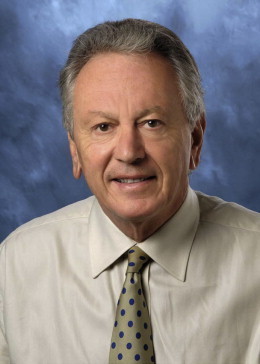
Photograph of David Rimoin
Photograph courtesy of Cedars-Sinai Medical Center.
David was born in Montreal to middle-class Jewish parents. The oldest of three children, and the first grandchild, he grew up knowing the love and importance of family and carried this viewpoint with him for his entire life. Education and industriousness were emphasized in his family, and David stood out as exceptionally bright from an early age. He once remarked that he could not remember a time when he did not want to be a medical doctor, and he pursued this goal at McGill University, where he obtained his B.Sc., M.Sc., and M.D. degrees. His two sisters also chose careers in the health professions: Mona in occupational therapy, and Shirley as a registered nurse. To be able to afford his education, David lived at home and worked a variety of jobs from restaurant dishwasher to carhop, often holding more than one job at a time.
During his undergraduate and medical training, David received multiple awards each year, a pattern that would continue throughout his career. These awards reflected achievement across a broad range of topics, including prizes in neurophysiology, microbiology, obstetrics and gynecology, pathology, clinical medicine, and surgery. He was introduced to clinical and laboratory genetics by F. Clarke Fraser and Julius Metrakos, professors of medical genetics at McGill University. Through this experience he gained an appreciation for the importance of laboratory studies but found clinical research more appealing. While an intern at Royal Victoria Hospital and Montreal Children’s Hospital, he completed a master’s degree in genetics on the topic of the genetics of convulsive disorders.
Because of his interest and early accomplishments in genetics, he came to the attention of Victor McKusick at Johns Hopkins University. David told the story of how Victor called him to ask whether he would consider coming to Baltimore for a fellowship in medical genetics. He didn’t believe that it was actually Victor on the phone, thinking that someone was pulling his leg because “Victor McKusick was the most famous person in genetics.” However, in 1964, following his residency in internal medicine, David moved to Johns Hopkins and began a lifelong relationship with both Victor and Anne McKusick. While there, he also overlapped with many individuals who would become leaders in the emerging science of medical genetics and formed many long-lasting personal and professional friendships.
Concomitant with his fellowship, David earned a Ph.D. in human genetics at Johns Hopkins, writing his thesis on genetic disorders of the endocrine glands. The disorders he studied included growth hormone deficiency, where he identified the long-suspected autosomal-recessive form of isolated growth hormone deficiency1 and demonstrated that growth hormone is not required for either sexual development or lactation. David also traveled with McKusick to study families with short stature among the Amish communities of Pennsylvania. During this period, David realized that there were great unexplored clinical differences among short-statured individuals and that there might be an opportunity to define these differences both clinically and genetically. Recognizing a void and filling it was one of David’s characteristic attributes.
Following the growth hormone studies, David had the opportunity to join expeditions organized by Luigi L. Cavalli-Sforza to study pygmies in the Central African Republic, testing the idea that short stature among the pygmies was the result of growth hormone deficiency. Setting up a field clinic for these studies (Figure 2), they showed that growth hormone was present but that there was a lack of end-organ responsiveness to its actions.2,3 The phenotype is distinct from the receptor defect underlying Laron syndrome, but the underlying cause of short stature among the pygmies remains unidentified.
Figure 2.

Clinical Studies of the Pygmies, Central African Republic, 1965
Photograph from David Rimoin’s archive.
David also became interested in the genetics of diabetes and, although it was clear that the disease was not a simple Mendelian disorder, in a 1967 paper4 he argued that diabetes reflects a final common pathway of relative insulin resistance and/or deficiency and that the underlying genetics are heterogeneous, hypothesizing an endocrine-type model to explain the potential mechanisms. His concept of the genetic and etiologic heterogeneity of diabetes has been amply validated by subsequent studies worldwide over the past 45 years. He continued to study the genetics of diabetes and other common diseases, providing national leadership on these topics. In subsequent years, many of these studies were carried out in Los Angeles in partnership with his longtime colleague Jerry Rotter.
In 1967 David moved west to assume his first faculty position and founded the Medical Genetics Clinic at Washington University in St. Louis, which served and continues to serve patients there and at St. Louis Children’s Hospital as well as Barnes-Jewish Hospital. In collaboration with Bill Sly, he offered one of the first formal courses in medical genetics as part of a regular medical school curriculum. While there, he continued his work on defining the growth hormone axis in the pygmies and in endocrine disorders generally. His work in this area led to publication of a landmark book, Genetic Disorders of the Endocrine Glands, coauthored with R. Neil Schimke. In 1967, David also received an NIH Research Career Development Award to support his research, and he was continuously funded by the NIH from that time onward through his entire career.
The call of Southern California, with its sunshine, palm trees, ocean, and opportunity, beckoned him to move to Los Angeles in 1970. There David again established a new medical genetics program, this time at Harbor General Hospital (later renamed Harbor-UCLA Medical Center), a Los Angeles County hospital providing care to the indigent. The ability to see patients and carry out research in a relatively unfettered environment was highly conducive to allowing David to create a uniquely dynamic program, which attracted an outstanding cadre of faculty and fellows (Figure 3). Many of the individuals who got their start under David’s mentorship would go on to stellar careers as research investigators, clinicians, department chairs, and deans.
Figure 3.

Medical Genetics Faculty, Fellows, and Staff at Harbor-UCLA Medical Center, 1978
Photograph from Michael Kaback’s archive.
Also at Harbor, David teamed up with Ralph Lachman to create the International Skeletal Dysplasia Registry (ISDR), a referral center for diagnosis, clinical management, and research on inherited human skeletal dysplasias. The ISDR became the platform for defining the clinical and genetic heterogeneity among these disorders, for the training of many of the current experts in the field, and for a continuous series of findings that helped reveal the complexity of skeletal development reflected by patients with these conditions. Many of the disorders in the current nosology of the skeletal dysplasias were defined clinically, genetically, and radiographically by David and his team, including a long succession of fellows. Subsequently, working with Bill Horton, he pioneered the use of plastic embedding to visualize the growth plate as a way of distinguishing the different skeletal dysplasias.5 The vast ISDR archive of skeletal tissues and other biological materials continued to be studied and in recent years has led to the characterization of the molecular basis of many of these disorders. This was David’s dream and long-term goal, and David credited progress in this endeavor in part to the benefits of being a “pack rat.” The ISDR remains one of the leading centers comprehensively studying the skeletal dysplasias and is one of David’s lasting legacies.
David published over 400 papers covering the clinical and molecular basis of skeletal dysplasias, a remarkably broad spectrum of additional genetic disorders, and policy papers outlining his views on issues of national importance in medical genetics. With Alan Emery, he conceived and edited Principles and Practice of Medical Genetics, a textbook regarded as the most definitive and comprehensive reference work in the field. It has served to educate medical genetics professionals since its initial publication in 1981, and the sixth edition will be published next year.
A part of David’s interest in skeletal disorders stemmed from his engagement with Little People of America (LPA), and he and his group participated in local, regional, and national LPA gatherings to provide clinical care to affected individuals. He viewed the ISDR and LPA as a way to use his expertise to give back to the community of individuals who had contributed so much to his research career. The LPA honored David’s commitment with an honorary life membership to the organization.
In 1986 David was recruited as chair of pediatrics to Cedars-Sinai Medical Center, a UCLA-affiliated community hospital, where he occupied the Steven Spielberg Chair in Pediatrics and started a new program in medical genetics, the third such program he created. Despite being an internist by training, David was a force in pediatrics across the UCLA system (and nationwide), strengthening the residency program and helping develop the careers of many young pediatrics faculty members. Eventually he used his leadership skills to help merge the training programs at Cedars-Sinai Medical Center and UCLA Medical Center into a single integrated program. In medical genetics, David was able to construct a comprehensive program that included everything from prenatal through adult genetics. Of particular importance was the creation, with Elizabeth Neufeld, of the UCLA Intercampus Training Program in Medical Genetics, under which medical genetics at Cedars-Sinai Medical Center, UCLA Medical Center, and Harbor-UCLA Medical Center flourished. In his honor, the David L. Rimoin Lectureship was created to invite a prominent medical geneticist to participate in the annual graduation activities of the program. David stepped down as Chair of Pediatrics in 2004, coincident with assuming the directorship of an independent Medical Genetics Institute.
David provided exemplary leadership at the local, national, and international levels. His view was that if he was going to be involved in something, he might as well run it. However, he embraced leadership with equanimity, encouraging the involvement of others and providing them with opportunity. His confidence in the abilities of his colleagues, and the recognition that when good things happen there is always enough credit to go around, engendered loyalty that was a hallmark of his professional relationships. Collaboration on issues of significance, along with warm, magnetic enthusiasm, made working with him both successful and a pleasure.
Nowhere was this more evident than in his vision of the future of medical genetics as a discipline. A subspecialty typically housed within pediatrics, as early as 19706 David imagined a time when medical genetics would be an independent medical specialty serving the needs of health professionals and their patients. This future would give a platform and voice to clinical and laboratory practitioners of medical genetics and genetic counselors as well as facilitating insurance reimbursement for their services. It would also bring the benefits of human genetics research to patients and their families. To this end, he worked to establish the 12-person founding board of directors of the American Board of Medical Genetics and served as its founding president from 1979 to 1983. His vision was rewarded when, in 1991, medical genetics was approved as the 24th full medical specialty of the American Board of Medical Specialties (ABMS), the first new specialty in 12 years.
A part of this effort was the politically delicate need to separate the accrediting body for genetic counselors into its own entity. David had great respect for genetic counselors, thought that there were too few nationally to serve the needs of patients, and did not want to disenfranchise them from the larger medical genetics community. At the same time, the benefits of specialty recognition by the ABMS were too great to be set aside over this issue. He participated in solving this problem by helping to create the American Board of Genetic Counseling and the National Society of Genetic Counselors as two independent bodies, distinct from the American College of Medical Genetics and the American Board of Medical Genetics. David then participated in the formation of the Council of Medical Genetics Organizations (COMGO) as an umbrella organization for keeping all genetics professionals and lay organizations integrated and interactive, and he served as that organization’s founding president. In retrospect, David felt that all of the medical genetics stakeholders benefitted from this evolution.
The new specialty of medical genetics needed a voice separate from the American Society of Human Genetics, an organization that David was the president of in 1984, so David helped to organize the American College of Medical Genetics (ACMG) and became its founding president, serving from 1992 to 1998. The growth of the College and the success of its independent mission and annual meeting were a source of great satisfaction to David. Subsequently, he served as president of the American College of Medical Genetics Foundation, the nonprofit fundraising arm of the College. Although the Foundation raises and provides funding for many worthy ACMG activities, David was especially interested in using the ACMG as a primary motivator to attract younger people to the field. In his honor, the ACMG Foundation has established the David L. Rimoin Lifetime Achievement Award. (Contributions in David’s memory to the endowment supporting this award can be made at http://www.acmgfoundation.org/rimoin.)
In recognition of his accomplishments, David received many of the most prestigious awards in his field, some of which are summarized here. Early on he received the Ross Outstanding Young Investigator Award from the Western Society for Pediatric Research and the E. Mead Johnson Award for Research in Pediatrics from the American Academy of Pediatrics. He was elected to the Institute of Medicine of the National Academy of Sciences in 1992 and was a fellow of the American Association for the Advancement of Science. David was engaged with the March of Dimes throughout his career and received the Colonel Harland Sanders Award for Lifetime Achievement in the genetic sciences. He was the first recipient of the McKusick Leadership Award from the American Society of Human Genetics, an award dear to him because it was named for his mentor. In recent years he received lifetime achievement awards from the American College of Medical Genetics and the Western Society for Clinical Investigation. Last year he was thrilled to receive the Distinguished Alumnus Award from Johns Hopkins University and just this year was named a Master by the American College of Physicians.
Beyond the effect David had on national policy in genetics, over 150 fellows trained with him. Many became leaders in clinical research in genetics, particularly in skeletal dysplasia research, but David also recognized and fully supported fellows who wanted to be practicing clinical geneticists. David was proud of each one of them, regarding them with nearly as much pride as he had in his own children, and there was a bond among Rimoin fellows, even those who did not overlap during their training. He was as encouraging and passionate about individual trainees as he was regarding initiatives with national impact. He was especially proud of the many Israeli fellows who trained with him and their subsequent impact on genetics in Israel.
David was continuously engaged in promoting the careers of his former fellows, faculty, and colleagues by nominating them for awards recognizing their accomplishments, supporting accelerated promotions for deserving individuals, inviting them to committee meetings or conferences to get them involved in activities he thought might benefit them, and generally advocating on their behalf. His advocacy also included his mentor, as David successfully nominated Victor McKusick for the Lasker Award. He enjoyed when others were acknowledged as much as he appreciated the awards given to him. On such occasions, he did not miss the opportunity to celebrate, recognizing the joy and importance of such milestone events. His genuine warmth and gentle nature led to a long list of treasured collegial relationships and friendships.
If one could characterize it as a hobby, David’s was travel. He never tired of going to far-flung places throughout the world to participate in conferences and visit with friends and colleagues. In recent years he enjoyed contributing to the Human Variome Project, for which he chaired the Scientific Advisory Committee. He saw his role as advocating for the understanding the clinical consequences of human DNA sequence variation. He was fond of saying that “genotype without phenotype leads to missense or nonsense.” Frequently he would augment his trips with a vacation, especially on a beach, on those occasions when he was accompanied by Ann, his wife of 32 years, who was his best friend and life partner. As much as he relished his professional work, Ann and his three children, Annie, Michael, and Lauren, were the center of his life (Figure 4). Each of his children has achieved professional success, and they attribute a part of that to his positive encouragement. He took great pride in Annie, a tenured professor at the UCLA School of Public Health, and her work studying emerging viruses in Africa. It reminded him of the pygmy expeditions, and the two of them had been planning a new project to finally determine the genetic basis of height in the pygmy population. He was equally supportive of Michael, an M.B.A. with a passion for environmental sustainability in the fields of local food systems and energy, and provided counsel to Lauren in her desire to follow in his footsteps to become a medical doctor. Through his tremendous capacity for love of family, David set an example for living.
Figure 4.
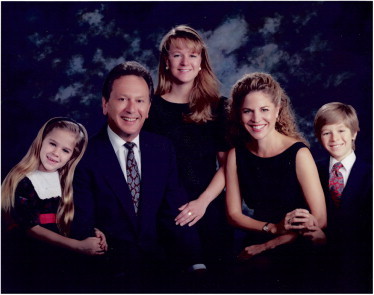
Lauren, David, Annie, Ann, and Michael circa 1992
Photograph courtesy of Ann Garber.
When David was diagnosed with pancreatic cancer, he didn’t want to tell anyone, in part because he didn’t want to detract from Lauren’s UCLA Medical School graduation, at which he was planning to participate in her hooding ceremony. However, the disease progressed too rapidly to allow this. Consequently, with permission from the dean of the David Geffen School of Medicine, Eugene Washington, Lauren’s graduation ceremony was held at David’s hospital bedside in the presence of family and close friends. It was a joyous occasion with balloons, photographs, tears, and smiles. With great pride, David placed the hood on Lauren. He showed great dignity, poise, and strength.
David did have a chance to reflect on his life and was very content with all that he had achieved, which he said was far more than he could have ever hoped to accomplish. He felt grateful and fulfilled and believed that he had made a positive difference in both his professional and personal life. He stated that his reward was the ability to do what he loved for his entire life. His was a life of significance, kindness, and collaboration, with a legacy represented by the individuals he touched and an indelible imprint on the world that will be remembered always.
Acknowledgments
We thank Glenn Braunstein, Shirley Entis, Ann Garber, Deborah Krakow, Sue Lief, Elizabeth Neufeld, Maryann Priore, and Jerry Rotter, who served as resources for the preparation of this tribute.
References
- 1.Rimoin D.L., Merimee T.J., McKusick V.A. Growth-hormone deficiency in man: an isolated, recessively inherited defect. Science. 1966;152:1635–1637. doi: 10.1126/science.152.3729.1635. [DOI] [PubMed] [Google Scholar]
- 2.Rimoin D.L., Merimee T.J., Rabinowitz D., McKusick V.A., Cavalli-Sforza L.L. Growth hormone in African pygmies. Lancet. 1967;2:523–526. doi: 10.1016/s0140-6736(67)90492-8. [DOI] [PubMed] [Google Scholar]
- 3.Merimee T.J., Rimoin D.L., Rabinowitz D., Cavalli-Sforza L.L., McKusick V.A. Metabolic studies in the African pygmy. Trans. Assoc. Am. Physicians. 1968;81:221–230. [PubMed] [Google Scholar]
- 4.Rimoin D.L. Genetics of diabetes mellitus. Diabetes. 1967;16:346–351. doi: 10.2337/diab.16.5.346. [DOI] [PubMed] [Google Scholar]
- 5.Horton W.A., Rimoin D.L. Histochemical characterization of the endochondral growth plate: a new approach to the study of the chondrodystrophies. Birth Defects Orig. Artic. Ser. 1978;14(6B):81–93. [PubMed] [Google Scholar]
- 6.Rimoin D.L. The medical genetics clinic and community health. Birth Defects Orig. Artic. Ser. 1970;6:67–75. [PubMed] [Google Scholar]