



Abstract
Objective
The purpose of the present study was to investigate the articular eminence inclination and height according to age and gender in patients with temporomandibular joint (TMJ) dysfunction and healthy controls using cone beam CT (CBCT).
Methods
The measurements were performed on CBCT records of 52 TMJ dysfunction patients (11 males and 41 females) and 41 control patients (17 males and 24 females). The eminence inclination and height were measured on the CBCT images.
Results
The eminence inclination and height values were higher in males than in females in both TMJ dysfunction patient and control groups; however, these differences were not statistically significant (p>0.05). While no statistically significant differences were found in the eminence inclination and height values between the age groups (p>0.05) in the TMJ dysfunction patient group, there were statistically significant differences in the control group. The eminence inclination was highest between the ages of 21 and 30 years and showed a decrease after the age of 30 years. Additionally, the eminence inclinations of the control patients were statistically higher than those of the TMJ dysfunction patients.
Conclusion
There were no statistically significant differences in eminence inclination and height according to gender. The eminence inclination reaches its highest value between the ages of 21 and 30 years and shows a decrease after the age of 31 years in healthy patients. The eminence inclination was steeper in healthy control patients than in patients with TMJ dysfunction.
Keywords: eminence inclination, eminence height, cone beam computed tomography
Introduction
The temporomandibular joint (TMJ) is a complex articular system which is located between the mandible and the temporal bone. It achieves the mandibular functions with a dynamic balance mechanism and has the ability to move within the three planes of space. The glenoid fossa creates the superior bone part and the mandibular condylar process creates the inferior bone part of the joint. The articular eminence is a part of the temporal bone on which the condylar process slides during mandibular movements. The inclination of articular eminence varies among people and it dictates the path of condylar movement as well as the degree of rotation of the disc over the condyle.1,2
Many methods are used to examine the inclination of articular eminence, such as measurements on dry skulls,3-5 conventional radiography6 and tomography,1,7 MRI8-11 and CT.12-14 However, CT machines have limitations in dentistry because of their high cost, large footprint and high radiation exposure. Cone beam CT (CBCT) has recently been developed as an alternative to conventional CT for dental and maxillofacial diagnostic osseous tasks. CBCT, which was also used in the present study, allows the use of a shorter scanning time, while the radiation dose is lower than with conventional CT scans15.
The purpose of the present study was to investigate the articular eminence inclination and height according to age and gender in patients with TMJ dysfunction and compare them with healthy controls by using flat panel detector-based CBCT.
Materials and methods
Patients
This study was carried out in the Oral Diagnosis and Oral Radiology Department of Ataturk University, Turkey. The measurements were performed retrospectively on CBCT records of 104 joints of 52 patients with TMJ dysfunction and 82 joints of 41 patients without TMJ dysfunction who had been previously referred to our clinic. All patients in the first group had clinical signs and symptoms of TMJ dysfunction such as clicking, pain, mandibular hypomobility or subluxation. The exclusion criteria were the presence of congenital craniofacial abnormalities and any systemic diseases which may affect joint morphology such as rheumatoid arthritis.
Imaging procedures
The cone beam images were performed using a NewTom 3G (Quantitative Radiology, Verona, Italy) flat panel-based CBCT machine. The patient was placed in a horizontal position so that the Frankfort horizontal plane was perpendicular to the table, with their head within the circular gantry housing of the X-ray tube in order to obtain a consistent orientation of sagittal images. The X-ray tube–detectors system performed a 360° rotation around the head of the patient and the scanning time was 36 s. The scanner operated with a maximum output of 110 kV and 15 mAs, 0.16 mm voxel size and had a typical exposure time of 5.4 s. The QR-NNT version 2.21 (Quantitative Radiology) software program was used for analyses.
After the completion of raw data, the patient left the examination room and the clinician was able to perform the primary reconstruction. The TMJ was defined on 0.5 mm-thick axial slices. One of the axial views on which the condylar processes were seen with their widest mediolateral extent was used as a reference view for secondary reconstruction. The lateral slices of the TMJ were performed perpendicular to the long axis of the condylar process with 1 mm thickness, and the coronal slices were performed parallel to the long axis of the condylar process with 1 mm thickness, on the selected axial image.
Measurements
The measurements belonging to the articular eminence were performed on the slices defined above. The points used in this study were as follows (Figure 1):
Figure 1.

Lines and angles used in the study. Ebf, eminence inclination best-fit line; Etr, eminence inclination top-roof line; Eh, eminence height
Ce: the point which the F′ line cut the eminence posterior surface
Cu: the highest point of the condylar process
Po: porion (the highest point of auditory meatus)
R: the highest point of the fossa
T: the lowest point of the articular eminence.
Using these points, the following planes were established (Figure 1):
Ebf plane: the best-fit plane of the articular eminence inclination connecting the Ce
Etr plane: the plane passing through the points Cu and R
F: Frankfort horizontal
F′: the parallel line to the F passing through the point Cu
F′′: the parallel line to the F passing through the point R.
Using these planes, the eminence inclination was measured in two ways. The first was the best-fit line method that was the angle between Ebf and Frankfort horizontal (Figure 2); the second was the top-roof line method that was the angle between Etr and Frankfort horizontal (Figure 3).7-16 The eminence height was established by the measurement of the perpendicular distance between the lowest point of the articular eminence and the highest point of the fossa (Figure 4). The measurements were established on the central sagittal slice of the TMJ. Figure 5 shows the measured distance and angles in a sample case.
Figure 2.

The measurement of eminence inclination with the best-fit line method
Figure 3.
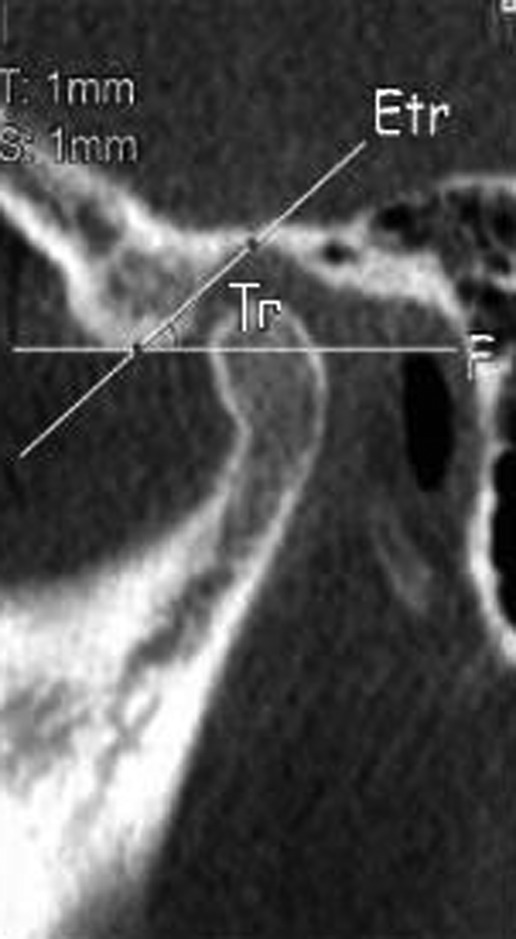
The measurement of eminence inclination with the top-roof line method
Figure 4.

The measurement of eminence height
Figure 5.

A case that showed measured distance and angles in the study
Statistical analyses
Statistical analysis was conducted with the program SPSS for Windows (IBM Corporation, Armonk, NY). The one-way analysis of variance (ANOVA) test was used to determine differences in the inclination and eminence height between age groups. The Student's t-test was used to determine the differences in eminence height and inclination between the patient and control groups and genders. A p-value of<0.05 was considered statistically significant. All of the measurements were established by three observers and the mean of the results was used to ensure the reliability of the study.
Results
The eminence inclination and height values of males were higher than those of females in both the patient and control groups; however, these differences were not statistically significant (p>0.05) (Table 1).
Table 1. The eminence inclination and eminence height values of the patient and control groups according to gender.
| Male |
Female |
n | p-Value | |||
| n | Mean ± SD | n | Mean ± SD | |||
| Study group | ||||||
| Best-fit line | 22 | 55.92 ± 12.77 | 82 | 51.66 ± 13.78 | 1.304 | 0.195 |
| Top-roof line | 22 | 36.53 ± 7.11 | 82 | 34.73 ± 8.20 | 0.937 | 0.351 |
| Eminence height | 22 | 7.17 ± 1.50 | 82 | 6.68 ± 1.98 | 1.086 | 0.280 |
| Control group | ||||||
| Best-fit line | 34 | 58.46 ± 8.13 | 48 | 56.13 ± 13.95 | 0.876 | 0.384 |
| Top-roof line | 34 | 38.67 ± 5.12 | 48 | 37.30 ± 7.71 | 0.907 | 0.367 |
| Eminence height | 34 | 6.92 ± 0.85 | 48 | 6.66 ± 1.48 | 0.941 | 0.350 |
n, number of joints; SD, standard deviation.
Additionally, no statistically significant differences were found in the eminence inclination and height values between the age groups (p>0.05) in the patient group. However, there were statistically significant differences between age groups in the control group (p<0.05). The eminence inclination and height values were lowest in patients aged 16–20 years, highest in patients aged 21–30 years and decreased after the age of 31 years in the control group (Table 2).
Table 2. The eminence inclination and eminence height values of the patient and control groups according to age (years).
| 16–20 |
21–30 |
<31 |
p*-Value | ||||
| n | Mean ± SD | n | Mean ± SD | n | Mean ± SD | ||
| Patient group | |||||||
| Best-fit line | 16 | 53.14 ± 11.70 | 48 | 53.77 ± 13.85 | 40 | 50.90 ± 14.22 | 0.611 |
| Top-roof line | 16 | 33.82 ± 5.66 | 48 | 36.12 ± 7.65 | 40 | 34.41 ± 9.12 | 0.479 |
| Height (mm) | 16 | 6.47 ± 1.40 | 48 | 6.78 ± 1.54 | 40 | 6.92 ± 2.42 | 0.734 |
| Control group | |||||||
| Best-fit line | 32 | 51.00 ± 12.25a | 24 | 62.95 ± 9.65b | 26 | 59.33 ± 10.05b | 0.0001*** |
| Top-roof line | 32 | 33.94 ± 7.51a | 24 | 42.03 ± 4.10b | 26 | 39.00 ± 5.01b | 0.0001*** |
| Height (mm) | 32 | 6.36 ± 1.61a | 24 | 7.29 ± 0.84b | 26 | 6.80 ± 0.88a,b | 0.023** |
n, number of patients; SD, standard deviation.
a,b Indicate values that are significantly different at 0.05% probability level (Duncan test).
*One-way ANOVA; **p<0.05; ***p<0.0001.
There was a statistically significant difference in eminence inclination between the patient and control groups (p<0.05). The eminence inclination values for both best-fit line and top-roof line methods were lower in patients with TMJ dysfunction than in control patients (Table 3).
Table 3. The difference in eminence inclination and eminence height values in the patient and control groups.
| Patient group |
Control group |
t | p-Value | |||
| n | Mean ± SD | n | Mean ± SD | |||
| Eminence inclination (best-fit line) | 104 | 52.57 ± 13.63 | 82 | 57.10 ± 11.88 | 2.379 | 0.018* |
| Eminence inclination (top-roof line) | 104 | 35.11 ± 7.99 | 82 | 37.87 ± 6.76 | 2.502 | 0.013* |
| Eminence height (mm) | 104 | 6.79 ± 1.90 | 82 | 6.77 ± 1.26 | 0.079 | 0.937 |
n, number of joints; SD, standard deviation.
*P<0.05.
Discussion
The articular eminence is a small bone part which is situated in front of the glenoid fossa and its posterior surface slope varies among people. Although it is an anatomical structure belonging to the cranium, it is exposed to functional load arising from chewing forces with other structures within the TMJ, and these loads influence the morphological shape of it.17
Various methods have been used in previous studies to measure the inclination of the posterior slope of the articular eminence. It is very important to choose an appropriate method for true measurement of eminence inclination. The direct measurements of eminence inclination on dry skulls or cadaver specimens as well as radiographic examination of tomograms demonstrated differences in inclination of the articular eminence. Consequently, it has been noted that studies performed with only a single slice or with transcranial or panoramic radiographic examinations where no slices are made may not depict a true measurement of eminence inclination.11 The view of the eminence in the central slice is the steepest part of the eminence and it gives the best representation of eminence inclination,18 which is why we chose the central sagittal slice of the condylar process for measurements.
The TMJ is difficult to view with conventional techniques because of superimposition of the adjacent dense temporal bone. In particular, panoramic imaging and conventional tomography may yield disappointing results. CT has been used since its development for evaluation of orofacial bone structures. However, CT machines have limitations for dentistry, as previously mentioned. CBCT addresses these issues and provides many advantages in dentistry. It was mentioned that CBCT offered a dose- and cost-effective alternative to conventional CT for the diagnostic evaluation of osseous abnormalities of the TMJ.15,19,20 It also allows practitioners to measure angles and distances with real dimensions and without superimposition or distortion. The flat panel detector also used in this study offers high spatial resolution and higher signal-to-noise ratios than image intensifiers in cone beam machines.21 To our knowledge, there is no other study in the literature that measured the articular eminence inclination and height using CBCT.
Katsavrias and Dibbets22 mentioned that the articular eminence inclination completed approximately 45% of its development with the completion of primer dentition, reaching 70–72% of its adult value around the age of 10 years and by the age of 20 years it was 90–94% complete. We established the age groups according to the information above. The minimum age in our study group was 16 years, so we took the ages 16–20 years as Group 1. It is usually thought that morphological changes owing to function may occur in the eminence structure with advanced age and this situation results in the differentiation of bone contours and flattening of the eminence in the long term.10,11 In the present study, we observed that the value of eminence inclination was lower in patients aged 16–20 years, reached its highest value in patients aged 21–30 years and decreased in patients aged over 30 years in the control group. By contrast, we could not find any significant association between advanced age and eminence anatomy for either eminence height or inclination in the patient group. However, it should be noted that eminence inclination is dependent not only upon age but also on various factors in patients with TMJ dysfunction, so it would be wrong to assess eminence inclination according to age only in patients with TMJ dysfunction. Jasinevicius et al3-5 could not find any association between age and eminence inclination in their three different studies of measurements on dry skulls.
The morphological differences due to sex hormones and metabolic activity differences become apparent between male and female patients during the adolescent period.23 Furthermore, the amount of functional force affecting the TMJ varies between male and female individuals and causes morphological differences according to gender.24 Lewis et al25 mentioned that gender differences in the shapes of condylar pathways indicated gender differences in articular eminence morphological features. There are few studies in the literature that found a difference in eminence inclination according to gender.26 Jasinevicius et al5 found that there were no differences in eminence inclination by gender. In the present study, eminence inclination and height values of males were higher than in females; however, these marginal differences were not statistically significant. This situation was potentially because of the small number of males in the patient group; it is already known that TMJ dysfunctions occur more often in females than in males.
It was reported that a steep slope of the articular eminence predisposes to certain disorders in the internal derangement.8,9,11 However, in the present study, we have found the eminence inclination to be higher in patients without TMJ dysfunction than in patients with TMJ dysfunction. Similarly, Ren et al27 found the eminence inclination to be steeper in symptom-free patients than in those with internal derangement. It was also noted that flattening of the articular eminence was observed in internal derangement.10 Therefore, TMJ disorders can lead to a decrease in the slope of the articular eminence over time by remodelling.
In conclusion, this was the first study in the literature that measured the articular eminence inclination and height using flat panel detector-based CBCT and the conclusions we have reached were as follows: there were no statistically significant differences in eminence inclination and height according to gender—there were only marginal differences and the eminence inclination in males was slightly higher; the eminence inclination reached its highest value between the ages of 21 and 30 years and showed a decrease after the age of 31 years in healthy individuals; and the eminence inclination was steeper in healthy control patients than in patients with TMJ dysfunction.
References
- 1.Pandis N, Karpac J, Trevino R, Williams B. A radiographic study of condyle position at various depths of cut in dry skulls with axially corrected lateral tomograms. Am J Orthod Dentofacial Orthop 1991;100:116–122 [DOI] [PubMed] [Google Scholar]
- 2.Katsavrias EG. Changes in articular eminence inclination during the craniofacial growth period. Angle Orthod 2002;72:258–264 [DOI] [PubMed] [Google Scholar]
- 3.Jasinevicius TR, Pyle MA, Nelson S, Lalumandier JA, Kohrs KJ, Sawyer DR. Relationship of degenerative changes of the temporomandibular joint (TMJ) with the angle of eminentia. J Oral Rehabil 2006;33:638–645 [DOI] [PubMed] [Google Scholar]
- 4.Jasinevicius TR, Pyle MA, Lalumandier JA, Nelson S, Kohrs KJ, Türp JC, et al. Asymmetry of the articular eminence in dentate and partially edentulous populations. Cranio 2006;24:85–94 [DOI] [PubMed] [Google Scholar]
- 5.Jasinevicius TR, Pyle MA, Lalumandier JA, Nelson S, Kohrs KJ, Sawyer DR. The angle of the articular eminence in modern dentate African-Americans and European-Americans. Cranio 2005;23:249–256 [DOI] [PubMed] [Google Scholar]
- 6.Baccetti T, Antonini A, Franchi L, Tonti M, Tollaro I. Glenoid fossa position in different facial types: a cephalometric study. Br J Orthod 1997;24:55–59 [DOI] [PubMed] [Google Scholar]
- 7.Katsavrias EG. The effect of mandibular protrusive (activator) appliances on articular eminence morphology. Angle Orthod 2003;73:647–653 [DOI] [PubMed] [Google Scholar]
- 8.Gökalp H, Türkkahraman H, Bzeizi N. Correlation between eminence steepness and condyle disc movements in temporomandibular joints with internal derangements on magnetic resonance imaging. Eur J Orthod 2001;23:579–584 [DOI] [PubMed] [Google Scholar]
- 9.Kurita H, Ohtsuka A, Kobayashi H, Kurashina K. Is the morphology of the articular eminence of the temporomandibular joint a predisposing factor for disc displacement? Dentomaxillofac Radiol 2000;29:159–162 [DOI] [PubMed] [Google Scholar]
- 10.Kurita H, Ohtsuka A, Kobayashi H, Kurashina K. Flattening of the articular eminence correlates with progressive internal derangement of the temporomandibular joint. Dentomaxillofac Radiol 2000;29:277–279 [DOI] [PubMed] [Google Scholar]
- 11.Sülün T, Cemgil T, Duc JM, Rammelsberg P, Jäger L, Gernet W. Morphology of the mandibular fossa and inclination of the articular eminence in patients with internal derangement and in symptom-free volunteers. Oral Surg Oral Med Oral Pathol Oral Radiol Endod 2001;92:98–107 [DOI] [PubMed] [Google Scholar]
- 12.Yamada K, Tsuruta A, Hanada K, Hayashi T. Morphology of the articular eminence in temporomandibular joints and condylar bone change. J Oral Rehabil 2004;31:438–444 [DOI] [PubMed] [Google Scholar]
- 13.Kikuchi K, Takeuchi S, Tanaka E, Shibaguchi T, Tanne K. Association between condylar position, joint morphology and craniofacial morphology in orthodontic patients without temporomandibular joint disorders. J Oral Rehabil 2003;30:1070–1075 [DOI] [PubMed] [Google Scholar]
- 14.Estomaguio GA, Yamada K, Ochi K, Hayashi T, Hanada K. Craniofacial morphology and inclination of the posterior slope of the articular eminence in female patients with and without condylar bone change. Cranio 2005;23:257–263 [DOI] [PubMed] [Google Scholar]
- 15.Hintze H, Wiese M, Wenzel A. Cone beam CT and conventional tomography for the detection of morphological temporomandibular joint changes. Dentomaxillofac Radiol 2007;36:192–197 [DOI] [PubMed] [Google Scholar]
- 16.Katsavrias EG. Morphology of the temporomandibular joint in subjects with class II division 2 malocclusions. Am J Orthod Dentofacial Orthop 2006;129:470–478 [DOI] [PubMed] [Google Scholar]
- 17.O'Ryan F, Epker BN. Temporomandibular joint function and morphology: observations on the spectra of normalcy. Oral Surg Oral Med Oral Pathol 1984;58:272–279 [DOI] [PubMed] [Google Scholar]
- 18.Ichikawa J, Hara T, Tamatsu Y, Ide Y. Morphological changes in the internal structure of the articular eminence of the temporal bone during growth from deciduous to early mixed dentition. J Biomech 2007;40:3541–3547 [DOI] [PubMed] [Google Scholar]
- 19.White SC. Cone-beam imaging in dentistry. Health Phys 2008;95:628–637 [DOI] [PubMed] [Google Scholar]
- 20.Ludlow JB, Davies-Ludlow LE, Brooks SL, Howerton WB. Dosimetry of 3 CBCT devices for oral and maxillofacial radiology: CB Mercuray, NewTom 3G and i-CAT. Dentomaxillofac Radiol 2006;35:219–226 [DOI] [PubMed] [Google Scholar]
- 21.Baba R, Ueda K, Okabe M. Using a flat-panel detector in high resolution cone beam CT for dental imaging. Dentomaxillofac Radiol 2004;33:285–290 [DOI] [PubMed] [Google Scholar]
- 22.Katsavrias EG, Dibbets JM. The growth of articular eminence height during craniofacial growth period. Cranio 2001;19:13–20 [DOI] [PubMed] [Google Scholar]
- 23.Siriwat PP, Jarabak JR. Malocclusion and facial morphology is there a relationship? An epidemiologic study. Angle Orthod 1985;55:127–138 [DOI] [PubMed] [Google Scholar]
- 24.Zivko-Babić J, Pandurić J, Jerolimov V, Mioc M, Pizeta L, Jakovac M. Bite force in subjects with complete dentition. Coll Antropol 2002;26:293–302 [PubMed] [Google Scholar]
- 25.Lewis RP, Buschang PH, Throckmorton GS. Sex differences in mandibular movements during opening and closing. Am J Orthod Dentofacial Orthop 2001;120:294–303 [DOI] [PubMed] [Google Scholar]
- 26.Zabarović D, Jerolimov V, Carek V, Vojvodić D, Zabarović K, Buković D., Jr The effect of tooth loss on the TM-joint articular eminence inclination. Coll Antropol 2000;24:37–42 [PubMed] [Google Scholar]
- 27.Ren YF, Isberg A, Westesson PL. Steepness of the articular eminence in the temporomandibular joint. Tomographic comparison between asymptomatic volunteers with normal disk position and patients with disk displacement. Oral Surg Oral Med Oral Pathol Oral Radiol Endod 1995;80:258–266 [DOI] [PubMed] [Google Scholar]