



Elite athletes are unlike other people. They are gifted with the ability to be able to work their bodies faster, harder, and more skillfully than “mere mortals.” While the exercise of prodigious discipline is undoubtedly key to their successes, genetic and other biological variants likely factor into world-class performances, although how they do so is both complicated and poorly understood. In this context, disorders of sexual differentiation (DSDs) can sometimes give female competitors a masculine edge. As the 2012 Olympic Games approach, one such athlete, Caster Semenya, a middle-distance runner from South Africa, has been cleared to compete, although not without considerable controversy that triggered an extensive medical work-up ordered by the International Association of Athletics Federations (IAAF) that confirmed a DSD and judged her to be a woman for the purpose of competition.
Is the IAAF's sexual classification fair? While most biological variants that convey athletic advantage go unquestioned and unchallenged, this article explores whether athletes with DSDs should be singled out for specific scrutiny or whether they are just another way in which Olympians tower over the rest of us, at least on the athletic field. Neither author has treated the athletes discussed herein; all clinical data has been gleaned from the scientific literature or popular press.
Between July 27th and August 12th, 2012, the Summer Olympics, officially known as the Games of the XXX Olympiad, will unfold in London, England. Semenya is expected to be there, competing as a woman.1 She is the runner who electrified the sports world in 2009 when she burst onto the international scene, seemingly out of nowhere, to win the women's 800-meter race at the World Field and Track Championships in Berlin in 1:55.45, the fastest time recorded in the world that year.2,3
After her victory, Semenya received much more than a gold medal. With her broad shoulders, strong jaw, flat chest, and chiseled musculature, the masculine cues were striking and the scrutiny withering. Clearly there was something different and even disturbing about the way she looked. Her sex was immediately questioned. One of the runners she trounced, Italy's Elisa Cusma, said, “These kind of people should not run with us. For me, she's not a woman. She's a man.” Another, Mariya Seminova of Russia, gave her the visual once-over and opined that Semenya wouldn't be able to pass a sex-determination test.4 Amid rumors that she had a testosterone level far beyond that of a “normal” female and that she might even have internal testicles, the IAAF, the world governing body for track and field, pulled her gold medal, forbade her from competition until she had submitted to the previously mentioned comprehensive examination to determine if she was eligible to compete as a woman, and threatened to permanently revoke the victory if the investigation concluded that she was not female.3
Semenya's participation in the Olympics underscores the vexing question of who does and doesn't qualify to be a woman. The politics of gender, fundamentally subjective and fluid, enter into this equation. A personal sense of basic maleness or femaleness—known as core gender identity (CGI)—exists.5,6 Irrespective of how a child looks or acts, he or she knows at core by age 3 that he or she is male or female.7 Gender presentation—how the child expresses his or her sense of maleness or femaleness—varies from culture to culture and epoch to epoch8 and may not be synchronous with CGI.
In contrast to the socially constructed concept of gender, sex is understood to be objective and scientific, the group of biological characteristics categorizing an individual as male or female, with contributions from the disciplines of anatomy, physiology, genetics, endocrinology, and psychology that “affect how we are labeled and treated in the world.”8 The vast majority of males have the chromosomal makeup 46,XY, and females have 46,XX, with physiognomies, CGIs, and gendered behaviors to match. Phenotypically, most males and females have external genitalia that place them in one group or the other as early as the first prenatal ultrasonogram or their delivery at birth. Internal genitalia and sex hormones are routinely assumed to be congruent with external genitalia. Nonetheless, as Semenya demonstrates, scientific objectivity fails when its goal has been to adhere to a binary construct of male and female.
With all females excluded except for a few equestriennes, the ancient Olympics didn't have to confront the issue of athletes with ambiguous gender presentations. Not only were women explicitly forbidden to participate, but the defining body parts were readily visible for inspection since the games were conducted in the nude.9,10 In the modern games, however, since 1928 when women began competing in considerable numbers,11 officials have grappled repeatedly and mostly inconclusively with the fear that men might masquerade as women in order to gain competitive advantage.
A by-no-means complete series of cases opens with the top 2 finishers in the women's 100-meter sprint at the infamous “Hitler Olympics” in Berlin in 1936. When the runner-up, Stella Walsh of the United States, accused winner Helen Stephens, also American, of being male, Stephens was forced to submit to visual inspection of her internal genitalia. She passed. Ironically, when Walsh herself was caught and killed in cross fire during a bank robbery nearly 50 years later, the autopsy revealed that she herself had ambiguous genitalia and abnormal sex chromosomes.12 In the 1960s, several Soviet bloc athletes—most notoriously the powerfully built Press sisters, Irina and Tamara, “formidable track and field athletes”—dropped out of Olympic competition rather than face gender verification.13 Ewa Klobukowka, medalist in 2 running events in the 1964 Olympics, became the first person to fail a compulsory chromosomal analysis 4 years later at the 1968 Olympics, with speculation (without confirmation) centering on her having an XX/XXY mosaicism.13 Between the 1984 and 1988 games, a world-class Spanish runner, Maria Martinez Patino, was found to have an unsuspected XY karyotype consistent with a previously undiagnosed complete androgen insensitivity syndrome and forbidden to compete. She was the first woman to fight for reinstatement and win.13,14
An actual man has never been detected, but women who appeared a little too masculine have repeatedly been forced to prove their femininity, starting with invasive and humiliating strip searches—so-called nude parades13—in the 1930s and advancing only in the 1960s to a series of laboratory tests that have proved problematic in execution, given their lack of both sensitivity and specificity for the task of distinguishing “real” males and females from among an array of intersexual variants.15-17
In both ancient and modern times, athletes have turned to “doping” with exogenous substances to improve their performances. In ancient Greece, performance enhancers ranged from hallucinogenic herbs and fungi to honey, strychnine, and opium.18 For both men and women in modern competitive athletics, doping with various exogenous substances has been for decades a major preoccupation of the IAAF and other governing bodies like the International Olympic Committee. Chief among a platoon of modern performance-enhancing substances are anabolic steroids, compounds with the purported capacity to transform normal men into Superman-type exaggerations of the male phenotype or endow genetic females with Wonder Woman characteristics that invoke the testosterone-fueled male prerogative. In reality, world-class athletes are typically so closely matched that they may turn to doping to gain the slight edge—the split second, enhanced distance, or extra point—that can distinguish victors from also-rans.
Regarding androgens, the IAAF's concern with doping in general and Semenya specifically has overlapped. While Semenya has never been accused of using anabolic steroids, IAAF leadership felt compelled to investigate her for the inborn equivalent of androgen doping. An appointed panel that included experts in internal medicine, gynecology, endocrinology, psychology, and gender studies was tasked with pooling their collective expertise to decide if Semenya was benefitting from a medical condition—a DSD—that gave her what Dreger in the New York Times labeled a potential “unnatural advantage.”19 Just as male phenotypes manifest on a continuum from lesser to greater overt masculine traits such as bulky muscle mass, so too is there a phenotype continuum in genetic females. Some of these variations not surprisingly contribute to differences between high- and low-performing athletes of either sex, with optimal phenotypic profiles depending on the sport in which the athlete competes. Most DSDs afford no advantage at all.20
All of this is premised on the cultural assumption that male and female phenotypes are—and should be—distinct, which they clearly are not. Dreger states the problem that faced the IAAF: “Perhaps [Semenya's] biology is just too male to entitle her to compete on the women's playing field.”19 Was her competing as a female unfair to women without her specific genetic endowments?
It is worth considering why the issue of Semenya's sex has been singled out for particular scrutiny. Many other physical attributes, both visible and invisible, afford competitive advantage without anyone suggesting that their fortunate bearers should be forbidden from competition. What if swimmer Michael Phelps' disproportionately long arms and overly lax joints preempted him from swimming races because they give him a reach and flexibility that deprive shorter-armed, more tightly jointed contestants of victory? The Australian champion swimmer Ian Thorpe is celebrated for huge, flipperlike feet that power him through the pool, and Olympic gold medalist basketballer Kevin Garnett has speed, agility, and jumping ability that seem incongruous with his immense height. Similarly, cyclist Lance Armstrong has a preternaturally high maximum oxygen consumption and superbly efficient oxygen use, and one of the greats of women's volleyball, the late Flo Hyman, had Marfan syndrome that gave her the tall stature and long arms that likely contributed to her success.17 Should they be ousted for possessing their distinctive edges? As of early 2011, Ethiopians and Kenyans, with their slight, lithe physiques and exposure to high altitudes, had run 41 of the 50 fastest marathons in history.21 Should East Africans be excluded to give long-distance runners from other parts of the world more of a chance?
Ostrander Figure 1 et al22 postulate advantages that may accrue to those with genetic polymorphisms that increase respiratory capacity via alterations in angiotensin-converting enzyme degradation, increase stamina via elevated adenosine triphosphate production during exercise, or increase strength via alterations in muscle protein structures. According to Joyner and Coyle,23 the “physiology of champions” is characterized by 3 characteristics, including the 2 that Lance Armstrong possesses plus a high lactate threshold. Even testosterone can have augmented punch, depending on the individual. Known sequence variations in testosterone receptor genes afford them more “bang for the androgen buck” from the same amount of testosterone as those without the fortunate polymorphisms.24 Some individuals simply produce more endogenous testosterone than others.25 Should they be relegated to the sidelines? Carrying the issue of inborn advantage to an extreme, perhaps athletes with hypertrophied powers of concentration, outsized persistence, or particularly aggressive drives to win—what Ostrander and colleagues call “the innate desire to excel”—should be forbidden to compete because they have more of these traits than the Average Joe.22
FIGURE.
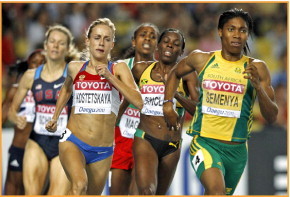
Semenya runs ahead of Kostetskaya and Sinclair during the women's 800 meters semi-finals at the IAAF World Championships.
Used with permission from Lee Jae Won/Reuters.3
Joyner and Coyle warn against “scientific reductionism” as it relates to elite athletic performance.23 What advantage exists is likely to be polygenic, although efforts to define an “optimum endurance polygenic profile” have failed to separate definitively the genetic endowments of elite athletes from those of the general population.26 Moreover, epigenetic factors may well play their part. While an advantageous genetic profile has not been identified in the East African runners who routinely dominate international distance running competition, they differ from more urbanized counterparts in several respects that may predispose them to honing athletic abilities specific to running. Many were raised in rural regions at high altitude, ate comparatively low-calorie diets, and used running as their primary means of transportation at an early age.27 Reeser17 proposes that while “elite sport selects for physiological outliers … genetic potential for excellence [is] realised through fortuitous interactions with environmental and cultural factors.”17 In sum, the genetic substrate by itself remains elusive, nonspecific, and insufficient to explain the making of a champion.
The murky role of testosterone in male and female physiology generally, and in Semenya's athleticism specifically, is another illustration of Joyner and Coyle's caveat. The reference range for total testosterone for adult males is roughly 300 to 1200 ng/dL and for adult females less than 100 ng/dL.28,29 Do these values represent anything but vague generalizations that reveal little about how testosterone actually works in vivo? In illustrating problems with testosterone assays, Wylie et al30 observed that total testosterone concentrations vary with disease, exposure to exogenous hormones such as estrogen and thyroxine, the time of day, and the age of the individual. Reference ranges, particularly as they relate to sexual health, are generally lacking, the relevance of free testosterone vs the fraction actually available to tissues (the “bio-testosterone”) is not well understood, and universally accepted standards for testosterone calibration do not exist.30
Testosterone's relationship to DSDs, one of which Semenya presumably has, is, if possible, even more ill-defined and difficult to specifically characterize. Disorders of sexual differentiation are a constellation of conditions that include various combinations of both male and female anatomic features, “disorders in which a discrepancy exists between chromosomal and anatomic sex as a result of the absence or insensitivity to key hormones in the sex development process.”31 These generally rare entities have in common imbalances in production of male and female hormones during intrauterine life and sometimes extending through childhood into adult life.
In the wake of the Semenya debacle, the IAAF promulgated a new set of standards, released in 2011, for dealing with women athletes whose femaleness is called into question. In “Regulations Governing Eligibility of Females With Hyperandrogenism to Compete in Women's Competition,” the IAAF has settled on 100 ng/dL as the value defining who is male and who is female for competitive purposes.32 It doesn't settle the problem. Were a man with a testosterone level of 101 ng/dL, a male level by this definition, to show up in his doctor's office with complaints of fatigue and low libido, he would be considered to have hypogonadism. Such an undermasculinized man would be out of luck as a competitive athlete. A woman with that testosterone level might have congenital adrenal hyperplasia. If she had 5α-reductase deficiency or androgen insensitivity syndrome, either partial or complete, she would have testosterone levels commensurate with a “normal” man.33 Yet a woman declared to be a man for competition on the basis of elevated testosterone alone—Semenya, for example—would never be able to win or even contend in most male track and field events.
In context, Semenya's 2009 win is not that astounding. While it was the fastest time in the world that year and the fifth fastest time ever posted, it was more than 2 seconds off the former Czechoslovakia's Jarmila Kratochvilova's blazing 1:53.28, a world record in the women's 800-meter race that has stood for nearly 30 years (although admittedly from an era of widespread, if not ubiquitous, doping in Soviet bloc countries).34 Moreover, after the IAAF cleared Semenya to return to competition, Seminova, one of her most vocal detractors in 2009, came back to beat her in the 2011 World Championship in Daegu, South Korea, in 1:55.87, less than a half second off Semenya's 2009 time.35,36 Against male times, there is no comparison. When the IAAF began certifying world records in the men's 800-meter race in 1912, the American Ted Meredith had the record of 1:52.9, a standard that held for the next 14 years. Today, Kenya's David Rudisha carries the record with a time of 1:41.01 that he ran in 2010.34 Women, even allegedly hyperandrogenic ones like Semenya, have never been—and likely will never be—in that league.
Even though it doesn't make her unbeatable, let's assume that Semenya has a testosterone-driven advantage. Is this fair? Dreger points out that testosterone is the only endogenous biochemical variant being regulated, and then only in women. “If a man has a mutation that gives him a big advantage—say he makes lots of testosterone—he can count that as a natural advantage,” she writes. “Indeed, at least now, men and women are allowed all other advantageous biochemical mutations.”37 Women with levels greater than the 100-ng/mL threshold are not automatically disqualified. The new regulations permit androgen-suppressive therapy to bring testosterone levels into compliance, a situation in which Ritchie38 detects a sexist motive, a verification of stereotyped femininity so that women will not be able to usurp a male hormonal prerogative. Dreger goes so far as to call the new testing requirements a “biological reduction of women to a hormonally disadvantaged class of people,” with females who have bountiful testosterone levels “medically made disadvantaged” through suppressive treatment.37 Lest there be any doubts about the IAAF's intentions to enforce traditional standards of femininity and a sharp bifurcation between males and females, 2 of the 6 principles underlying the new regulations are explicit about the split, on the one hand having “respect for the fundamental notion of fairness of competition in female Athletics” and on the other “a respect for the very essence of the male and female classifications in Athletics.”32
Is it legitimate for testosterone-replete women to be singled out for special treatment among all those men and women who seem to have a leg up on the competition? Genetic advantages could be considered the norm in world-class competitive sports, in which selective forces are at work from the moment a child starts running laps or bouncing a ball, with the naturally gifted achieving lofty heights unattainable to the less favorably endowed, no matter how hard they exert themselves. Indeed the existence of such gifted athletes precludes the appealing but unrealistic truism that the playing fields are actually level—that anyone with the right character can win Olympic gold if he or she just pushes hard enough. Fairness based on hard work alone, irrespective of biological considerations, becomes illusory. As Hercher39 states, “taking an excess of testosterone is cheating,” while “producing an excess of testosterone is a genetic advantage.” Foddy and Savulescu24 add that for women like Semenya, it is “as though they have taken steroids, except … they have not broken any rules.” Like Phelps or 7-foot basketball players, their advantage can be seen as inborn, endogenous. “Fairness” could thus become a construct based not on excluding genetic “uniqueness” that bestows a competitive edge but rather on eliminating “cheating,” defined as “breaking rules that have been reached through consensus to provide a fair competition.”16
Fortunately for Semenya's privacy, unfortunately for clarity for the general public as well as the sporting world as to what constitutes a woman for purposes of athletic competition, the IAAF has chosen to reveal neither the specific findings of Semenya's case nor its expert committee's reasoning in reaching its conclusion that she could continue to compete as a woman. For now the “challenge system” remains in place, portending equally ugly future situations grappling with what continues to be an insoluble puzzle, particularly when maleness and femaleness are rigidly defined by social norms and questioned only when athletes of either sex don't physically look the part. In every Olympic Games in which genetic testing was required, women with DSDs were exposed whose appearances alone would never have drawn attention to them as questionable females. Semenya's real problem thus is not in having a DSD but rather in failing to fit the stereotype of what a woman is supposed to look like. Had she more closely resembled that traditional feminine stereotype, this whole investigation would likely never have been triggered.
Should genetic surveillance in competitive sports be restricted to ambiguous-appearing women? Given the range of potentially advantageous genetic variants, many of which—like Michael Phelps' long arms or a Kenyan runner's wiry frame—are readily visible, the viewer who glues himself to the screen later this year for the Olympics might want to consider, in all fairness, how many world-class athletes actually bear any resemblance to regular Joes and Joans, either in how they look or perform.
Supplemental Online Material
Author Interview Video
References
- 1.London 2012 Olympics: South African athlete Caster Semenya will cut down schedule to reach peak at Games: Telegraph Web site. http://www.telegraph.co.uk/sport/olympics/athletics/9059305/London-2012-Olympics-South-African-athlete-Caster-Semenya-will-cut-down-schedule-to-reach-peak-at-Games.html Accessed May 8, 2012.
- 2.Clarey C. As Semenya returns, so do questions: The New York Times Web site. http://www.nytimes.com/2010/08/23/sports/23iht-TRACK.html Published August 22, 2010. Accessed March 3, 2012.
- 3.Clarey C. Gender test after a gold-medal finish: winner in women's 800 draws scrutiny: The New York Times Web site. http://www.nytimes.com/2009/08/20/sports/20runner.html?_r=2 Published August 20, 2009:B13, 15. Accessed May 18, 2012.
- 4.Clarey C., Kolata G. Gold awarded amid dispute over runner's sex: The New York Times Web site. http://www.nytimes.com/2009/08/21/sports/21runner.html Published August 20, 2009. Accessed March 3, 2012.
- 5.Stoller R.J. A contribution to the study of gender identity. Int J Psychoanal. 1964;45:220–226. [PubMed] [Google Scholar]
- 6.Money J. The concept of gender identity disorder in childhood and adolescence after 39 years. J Sex Marital Ther. 1994;20(3):163–177. doi: 10.1080/00926239408403428. [DOI] [PubMed] [Google Scholar]
- 7.Thyen U., Richter-Appelt H., Wiesemann C., Holterhus P.M., Hiort O. Deciding on gender in children with intersex conditions: considerations and controversies. Treat Endocrinol. 2005;4(1):1–8. doi: 10.2165/00024677-200504010-00001. [DOI] [PubMed] [Google Scholar]
- 8.Johnson J.L., Greaves A., Repta R. Better science with sex and gender: facilitating the use of a sex and gender-based analysis in health research. Int J Equity Health. 2009;8:14. doi: 10.1186/1475-9276-8-14. [DOI] [PMC free article] [PubMed] [Google Scholar]
- 9.The ancient Olympic games Topend Sports Web site. http://www.topendsports.com/events/summer/ancient.htm Accessed March 3, 2012.
- 10.Gill N.S. Why weren't women at the Olympic Games? http://ancienthistory.about.com/od/olympics/f/080708OlympicWo.htm About.com Web site. Accessed March 8, 2012.
- 11.Alshabrawi M. Women's participation in the Olympics … an ambitious dream comes true. http://twocircles.net/2008aug06/womens_participation_olympics_ambitious_dream_comes_true.html TwoCircles.net Web site. Accessed March 4, 2012.
- 12.Ritchie R., Reynard J., Lewis T. Intersex and the Olympic Games. J R Soc Med. 2008;101(8):395–399. doi: 10.1258/jrsm.2008.080086. [DOI] [PMC free article] [PubMed] [Google Scholar]
- 13.Rupert J.L. Genitals to genes: the history and biology of gender verification in the Olympics. Can Bull Med Hist. 2011;28(2):339–365. doi: 10.3138/cbmh.28.2.339. [DOI] [PubMed] [Google Scholar]
- 14.Simpson J.L., Ljungqvist A., Ferguson-Smith M.A. Gender verification in the Olympics. JAMA. 2000;284(12):1568–1569. doi: 10.1001/jama.284.12.1568. [DOI] [PubMed] [Google Scholar]
- 15.Wonkam A., Fieggen K., Ramesar R. Beyond the Caster Semenya controversy: the case of the use of genetics for gender testing in sport. J Genet Couns. 2010;19(6):545–548. doi: 10.1007/s10897-010-9320-2. [DOI] [PubMed] [Google Scholar]
- 16.Camporesi S., Maugeri P. Caster Semenya: sport, categories and the creative role of ethics. J Med Ethics. 2010;36(6):378–379. doi: 10.1136/jme.2010.035634. [DOI] [PubMed] [Google Scholar]
- 17.Reeser J.C. Gender identity and sport: is the playing field level? Br J Sports Med. 2005;39(10):695–699. doi: 10.1136/bjsm.2005.018119. [DOI] [PMC free article] [PubMed] [Google Scholar]
- 18.Papagelopoulos P.J., Mavrogenis A.F., Soucacos P.N. Doping in ancient and modern Olympic Games. Orthopedics. 2004;27(12):1226. doi: 10.3928/0147-7447-20041201-05. 1231. [DOI] [PubMed] [Google Scholar]
- 19.Dreger A. Science is forcing sports to re-examine their core principles: The New York Times Web site. http://www.nytimes.com/2009/09/13/sports/13dreger.html?ref=oscarpistorius Published September 12, 2009. Accessed March 4, 2012.
- 20.Wiesemann C. Is there a right not to know one's sex?: The ethics of ‘gender verification’ in women's sports competition. J Med Ethics. 2011;37(4):216–220. doi: 10.1136/jme.2010.039081. [DOI] [PubMed] [Google Scholar]
- 21.Joyner M.J., Ruiz J.R., Lucia A. The two-hour marathon: who and when? J Appl Physiol. 2011;110(1):275–277. doi: 10.1152/japplphysiol.00563.2010. [DOI] [PubMed] [Google Scholar]
- 22.Ostrander E.A., Huson H.J., Ostrander G.K. Genetics of athletic performance. Annu Rev Genomics Hum Genet. 2009;10:407–429. doi: 10.1146/annurev-genom-082908-150058. [DOI] [PubMed] [Google Scholar]
- 23.Joyner M.J., Coyle E.F. Endurance exercise performance: the physiology of champions. J Physiol. 2008;586(1):35–44. doi: 10.1113/jphysiol.2007.143834. [DOI] [PMC free article] [PubMed] [Google Scholar]
- 24.Foddy B., Savulescu J. Time to re-evaluate gender segregation in athletics? Br J Sports Med. 2011;45(15):1184–1188. doi: 10.1136/bjsm.2010.071639. [DOI] [PubMed] [Google Scholar]
- 25.Dreger A. Where's the rulebook for sex verification?: The New York Times Web site. http://www.nytimes.com/2009/08/22/sports/22runner.html Published August 21, 2009. Accessed May 8, 2012.
- 26.Ruiz J.R., Gómez-Gallego F., Santiago C. Is there an optimum endurance polygenic profile? J Physiol. 2009;587(pt 7):1527–1534. doi: 10.1113/jphysiol.2008.166645. [DOI] [PMC free article] [PubMed] [Google Scholar]
- 27.Scott R.A., Pitsiladis Y.P. Genotypes and distance running: clues from Africa. Sports Med. 2007;37(4-5):424–427. doi: 10.2165/00007256-200737040-00039. [DOI] [PubMed] [Google Scholar]
- 28.Mayo Medical Laboratories Test ID: TTFB; Testosterone, Total, Bioavailable, and Free, Serum: Mayo Medical Laboratories Web site. http://www.mayomedicallaboratories.com/test-catalog/Clinical+and+Interpretive/83686 Accessed March 4, 2012.
- 29.Cooper R. Testosterone. http://www.nlm.nih.gov/medlineplus/ency/article/003707.htm Updated January 21, 2010. MedlinePlus Web site. Accessed March 4, 2012.
- 30.Wylie K., Rees M., Hackett G. Androgens, health and sexuality in women and men. Maturitas. 2010;67(3):275–289. doi: 10.1016/j.maturitas.2010.07.011. [DOI] [PubMed] [Google Scholar]
- 31.Tucker R., Collins M. The science of sex verification and athletic performance. Int J Sports Physiol Perform. 2010;5(2):127–139. doi: 10.1123/ijspp.5.2.127. [DOI] [PubMed] [Google Scholar]
- 32.International Association of Athletics Federations IAAF Regulations Governing Eligibility of Females With Hyperandrogenism to Compete in Women's Competition: in Force as From 1st May 2011: IAAF Web site. http://www.iaaf.org/mm/Document/AboutIAAF/Publications/05/98/78/20110430054216_httppostedfile_HARegulations%28Final%29-Appendices-AMG-30.04.2011_24299.pdf Accessed March 4, 2012.
- 33.Conte F.A., Grumbach M.M. Abnormalities of sexual determination and differentiation. In: Greenspan F.S., Gardner D.G., editors. Basic and Clinical Endocrinology. 7th ed. McGraw-Hill; New York, NY: 2004. pp. 564–607. [Google Scholar]
- 34.800 Metres world record progression: Wikipedia Web site. http://en.wikipedia.org/wiki/800_metres_world_record_progression Accessed March 4, 2012.
- 35.Clarey C. In final event, Jamaica sets a world record in relay: New York Times Web site. http://www.nytimes.com/2011/09/05/sports/05iht-track05.html Published September 4, 2011. Accessed March 4, 2012.
- 36.Caster Semenya loses 800m world championships title to Mariya Savinova: The Guardian Web site. http://www.guardian.co.uk/sport/2011/sep/04/caster-semenya-mariya-savinova Published September 4, 2011. Accessed March 4, 2012.
- 37.Dreger A. Redefining the sexes in unequal terms: The New York Times Web site. http://www.nytimes.com/2011/04/24/sports/24testosterone.html Published April 23, 2011. Accessed March 4, 2012.
- 38.Ritchie I. Sex tested, gender verified: controlling female sexuality in the age of containment. Sport History Review. 2003;34(1):80–98. [Google Scholar]
- 39.Hercher L. Gender verification: a term whose time has come and gone. J Genet Couns. 2010;19(6):551–553. doi: 10.1007/s10897-010-9323-z. [DOI] [PubMed] [Google Scholar]
Associated Data
This section collects any data citations, data availability statements, or supplementary materials included in this article.
Supplementary Materials
Author Interview Video