


Abstract
Brahmi(Bacopa monnieri), an Ayurvedic herb has primarily been used to enhance cognitive ability, memory and learning skills. We present a case study of schizophrenia in which add-on Brahmi extracts 500 mg/day for a period of one month resulted in reduction in psychopathology without any treatment-emergent adverse effect. Although preliminary, our case study suggests therapeutic efficacy of add-on Brahmi in schizophrenia, thus opening up a new dimension of its role in alternative medicines.
Keywords: Bacopa monnieri, Brahmi, schizophrenia
INTRODUCTION
Ayurvedic medicine differs from the orthodox western medicine in terms of attributes and applications and may be used to complement, support, or replace it.[1] Brahmi (Bacopa monnieri, family: Scrophulariaceae) has primarily been used to enhance cognitive ability, memory and learning skills.[2–4] This Ayurvedic herb has found its use in diverse medical conditions like asthma, bronchitis, dyspepsia, urinary disorders and also a few other diseases.[4] In psychiatry, Brahmi has found its use in the treatment of agitation, anxiety and depression.[5] While the exact mechanism of action of Brahmi is not clear, few pre-clinical studies have reported its cholinergic, anti-oxidant and adaptogenic effect on central nervous system.[6] We present a case study suggesting the therapeutic efficacy of add-on Brahmi in schizophrenia, thus opening up a new dimension of its role in alternative medicines.
CASE REPORT
Mr. A, a 34-year-old single graduate male, presented with suspiciousness and fearfulness, wandering behavior, muttering to self, unprovoked aggression and disorganized behavior for the past 15 years. Mental status examination revealed delusion of persecution and grandiosity, third-person auditory hallucinations, irritable effect and grade I insight. He was diagnosed as having paranoid schizophrenia according to ICD-10 diagnostic criteria for research. On positive and negative syndrome scale (PANSS), the total score was 108 (positive 59, negative 21 and general psychopathology 28) and on brief psychiatric rating scale (BPRS) the total score was 48. He was started on olanzapine tablets 10 mg/day, which was increased gradually up to 20 mg/day over a period of two weeks. Although there was initial improvement in psychopathology, it did not sustain after three-week trial on the same dose of olanzapine. His rating on PANSS was 92 (positive 43, negative 21 and general psychopathology 28) and on BPRS was 38. Subsequently, after obtaining written informed consent, after five weeks on olanzapine tablets, he was given an add-on trial of Ayurvedic drug Brahmi (each tablet containing 250 mg of Brahmi extract, a pure herb extract by Himalaya Herbal Healthcare) at a dose of two tablets, a day for a period of one month, as prescribed by a qualified Ayurvedic physician on the basis of research reports and not on Ayurvedic parameters. Weekly rating was done for four weeks on PANSS, BPRS and Udvalg for Kliniske Undersogelser (UKU) side effect rating scale. The dose of olanzapine was kept constant, and no other drugs were added during this period. At the end of four weeks there was a reduction in psychotic symptoms and on PANSS, his score was 67 (positive 29, negative 18 and general psychopathology 20) and BPRS totals score was 27. The changes in psychopathology scores over time are summarized in Figure 1. There were no side effects as assessed on the UKU scale.
Figure 1.
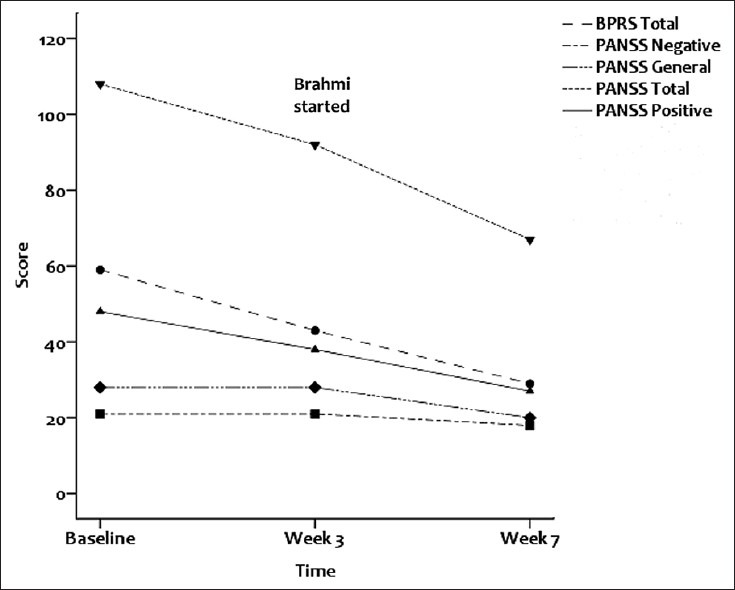
Changes in psychopathology scores over time
DISCUSSION
Despite treatment advances over the past decades, schizophrenia still remains a challenge for the mental health professionals and produces marked functional impairment in a substantial proportion of patients. Researchers have found out novel agents like metabotropic glutamate agonists, alpha nicotinic receptor agonists, muscarinic agonists, etc. with the hope to reduce the magnitude of morbidity across various dimensions of schizophrenia.[7] The advent of alternative medicines has opened up new avenues for research and treatment in schizophrenia. In our patient, after a five-week trial of olanzapine 20 mg/ day, the substantial improvement in positive symptoms on addition of Brahmi, an Ayurvedic herb, suggests its potential therapeutic effect in schizophrenia. There was initial improvement in psychopathology with olanzapine 20 mg/ day, which reached a plateau after two weeks. The second peak in positive symptom improvement after five weeks could also be due to the delayed effects of olanzapine.
The exact mechanism through which Brahmi produces improvement in positive symptoms of schizophrenia is not known. Animal researchers have demonstrated the anti-oxidant properties of Bacopa extracts in the brain, which could potentially lead to its positive effect on mental function.[6] Bacopa monnieri has been reported to repair damaged neurons by enhancing kinase activity, restoration of synaptic activity, ultimately enhancing nerve impulse transmission in brain.[2] The nootropic properties of Brahmi have been reported to be possibly mediated by its constituent saponins, bacosides A and B through glutaminergic mechanism.[4] There is lack of literature to support the therapeutic effect of Brahmi in schizophrenia. A small pilot study by Ramu et al.[8] showed improvement in positive and negative symptoms of chronic unmada (schizophrenia) in 6 out of 10 patients with Brahmyadiyoga, an herbal compound which contains Brahmi (Centella asiatica), along with other ayurvedic drugs. However, Brahmyadiyoga also contains Sarpagandha (Rauwolfia serpentina), which is a known antipsychotic.[9,10] The improvement produced by Brahmi in positive symptoms and general psychopathology in schizophrenia could possibly be mediated through dopaminergic mechanism and its neurotransmission enhancing properties. Further researches are required to establish the therapeutic effects of Brahmi in various dimensions of schizophrenia and also explore the neurophysiological and neurochemical mechanisms behind the same.
In Ayurveda, psychosis (unmada) including schizophrenia has been conceptualized as a disorder of mind, caused owing to the imbalance or anomalies of the tridoshas (vata, pitta and kapha).[11–13] Based on the vitiation of the dosha, three distinct types of unmada as vataja, pittaja and kaphaja have been described in the classics. Brahmi is a rejuvenating and nervine (nerve tonic, which quiets nervous excitement akin to sedative property) herb.[2] The Ayurvedic attributes of Brahmi include tikta, kashaaya rasa (~ sharp, astringent taste), sheeta virya (~ cold active principle), madhur vipaka (~ effect observed after digestion) and its therapeutic effect (karma) has been described as tridoshanashaka (suppressing excesses of all the three doshas), especially vataghna, pittaghna (vata and pitta abating) attributes.[11]
In summary, add-on Brahmi to olanzapine in a case of paranoid schizophrenia resulted in improvement in psychopathology as evidenced by reduction in PANSS and BPRS scores, without any treatment emergent adverse effect. Short duration of the study is a limitation of the case report. In addition, studies for toxicity and drug interaction are essential. The efficacy of add-on Brahmi for paranoid schizophrenia needs to be examined in placebo-controlled randomized controlled trials
Footnotes
Source of Support: Nil
Conflict of Interest: None declared.
REFERENCES
- 1.Fava M. Using complementary and alternative medicines for depression. J Clin Psychiatry. 2010;71:e24. doi: 10.4088/JCP.8157tx3c. [DOI] [PubMed] [Google Scholar]
- 2.Agrawal A, Pandey MN, Dubey GP. Management of mental deficiency by an indigenous drug, Brahmi(Bacopa monnieri) Pharmacopsychoecologia. 1993;6:1–5. [Google Scholar]
- 3.Stough C, Lloyd J, Clarke J, Downey LA, Hutchison CW, Rodgers T, et al. The chronic effects of an extract of Bacopa monnieri (Brahmi) on cognitive function in healthy human subjects. Psychopharmacology (Berl) 2001;156:481–4. doi: 10.1007/s002130100815. [DOI] [PubMed] [Google Scholar]
- 4.Andrade C, Chandra JS. Anti-amnestic properties of Brahmi and Mandookaparni in a rat model. Indian J Psychiatry. 2006;48:232–7. doi: 10.4103/0019-5545.31554. [DOI] [PMC free article] [PubMed] [Google Scholar]
- 5.Calabrese C, Gregory WL, Leo M, Kraemer D, Bone K, Oken B. Effects of a standardized Bacopa monnieri extract on cognitive performance, anxiety, and depression in the elderly: A randomized, double-blind, placebo-controlled trial. J Altern Complement Med. 2008;14:707–13. doi: 10.1089/acm.2008.0018. [DOI] [PMC free article] [PubMed] [Google Scholar]
- 6.Morgan A, Stevens J. Does Bacopa monnieri improve memory performance in older persons.Results of a randomized, placebo-controlled, double-blind trial? J Altern Complement Med. 2010;16:753–9. doi: 10.1089/acm.2009.0342. [DOI] [PubMed] [Google Scholar]
- 7.Kane JM, Correll CU. Past and present progress in the pharmacologic treatment of schizophrenia. J Clin Psychiatry. 2010;71:1115–24. doi: 10.4088/JCP.10r06264yel. [DOI] [PMC free article] [PubMed] [Google Scholar]
- 8.Ramu MG, Senapati HM, Janakiramaiah N, Shankara MR, Chaturvedi DD, Murthy NS. A pilot study of role of brahmyadiyoga in chronic unmade (schizophrenia) Anc Sci Life. 1983;2:205–7. [PMC free article] [PubMed] [Google Scholar]
- 9.Sen G, Bose K. Rauwolfia serpentina, a new Indian drug for insanity and hypertension. Indian Medical World. 1931;21:194–201. [Google Scholar]
- 10.Klerman GL. Pharmacotherapy of schizophrenia. Annu Rev Med. 1974;25:199–217. doi: 10.1146/annurev.me.25.020174.001215. [DOI] [PubMed] [Google Scholar]
- 11.Caldecott T. Philadelphia: Mosby Elsevier; 2006. Ayurveda: The divine science of life. [Google Scholar]
- 12.Balodhi JP, Chowdhary JR. Psychiatric concepts in Atharva Veda: A review. Indian J Psychiatry. 1986;28:63–8. [Google Scholar]
- 13.Weiss MG, Desai A, Jadhav S, Gupta L, Channabasavanna SM, Doongaji DR, et al. Humoral concepts of mental illness in India. Soc Sci Med. 1988;27:471–7. doi: 10.1016/0277-9536(88)90370-x. [DOI] [PubMed] [Google Scholar]