



Dear Editor,
A 31-month-old boy was investigated for increased frequency of urination for the past 4 months. He voided a small quantity of urine every 20 to 30 min. However, other urinary symptoms such as pain, hematuria, and fever were conspicuously absent. His physical examination was unremarkable except for an abnormally long penis (Fig. 1). The penis in flaccid state measured 7 cm, and its stretched length was 9 cm (Fig. 2). This is approximately equal to the average penile length of Indian adults [1]. The stretched penis length expected for his age group, according to European standards, is 5.15 ± 0.46 cm (range, 4.2 to 6 cm) [2]. A 4 × 3 × 3-cm calcium oxalate stone in the urinary bladder was diagnosed by plain radiograph, and the stone was surgically removed. Sensitized by this experience, I carefully observed the length of penis in two subsequent boys with vesical calculus. In both of them, penile length was slightly more than two standard deviations of the expected mean of age-matched penile length.
Fig. 1.
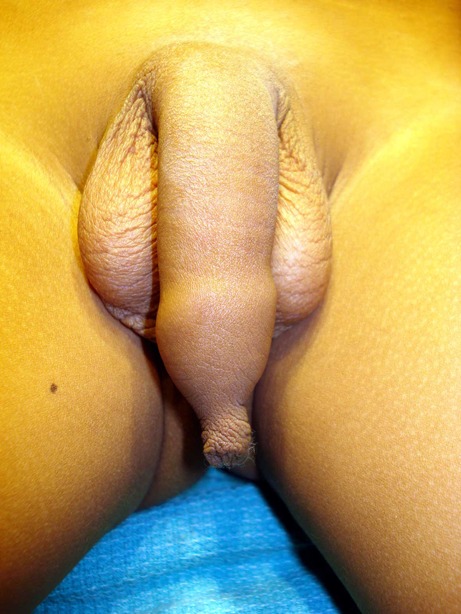
Clinical photograph of genitalia showing an abnormally long penis in a child with vesical calculus
Fig. 2.

Measurement of stretched penis length of the boy shown in Fig. 1 (The asterisk marks the pubic symphysis)
It is possible that penile length is influenced by the presence of a bladder stone. In vesical calculus, pain is often referred to the tip of the penis. Therefore, young boys with a bladder stone are known to repeatedly pull and squeeze the penis in a futile attempt of alleviating pain [3]. Physical stretching of the penis or tumescence caused by repeated massage could be responsible for lengthening of the penis. This hypothesis is supported by a recent publication [4] wherein prolonged semi-erection of high-flow priapism in a prepubertal boy was shown to increase penile size. This interesting clinical observation definitely warrants further scientific studies. Confirmation of any correlation between penile length and vesical calculus will be truly fascinating as it will not only aid clinical diagnosis but also will widen our understanding of penis-lengthening procedures.
References
- 1.Promodu K, Shanmughadas KV, Bhat S, Nair KR. Penile length and circumference: an Indian study. Int J Impot Res. 2007;19:558–563. doi: 10.1038/sj.ijir.3901569. [DOI] [PubMed] [Google Scholar]
- 2.Camurdan AD, Oz MO, Ilhan MN, Camurdan OM, Sahin F, Beyazova U. Current stretched penile length: cross-sectional study of 1040 healthy Turkish children aged 0 to 5 years. Urology. 2007;70:572–575. doi: 10.1016/j.urology.2007.04.051. [DOI] [PubMed] [Google Scholar]
- 3.Ho KLV, Segura JW. Lower urinary tract calculi. In: Wein AJ, editor. Campbell-Walsh urology. 9. Philadelphia: Saunders; 2007. pp. 2663–2673. [Google Scholar]
- 4.Awwad ZM. Does prolonged semi-erection in pre-pubertal high flow priapism result in increased penile size? Saudi Med J. 2005;26:481–483. [PubMed] [Google Scholar]