



Abstract
The benzene-based compound 2,4-dinitrophenol was developed in the late 19th century, and was used during World War I for manufacture of explosives.1 A number of cases of dinitrophenol poisoning were noted in French munitions plant workers. Acute inisxication caused hyperpyrexia, nausea, vomiting, and diarrhea; sympisms of subacute exposure included weight loss. Several workers died.1 The weight-loss observation led is widespread clinical use in the United States in the 1930s as an antiobesity drug, until reports of adverse effects prompted withdrawal from the consumer market in 1938 under pressure from the Food and Drug Administration. Dinitrophenol has continued to be available for industrial uses, including production of dyes, wood preservatives, and pesticides.
The benzene-based compound 2,4-dinitrophenol was developed in the late 19th century, and was used during World War I for manufacture of explosives.1 A number of cases of dinitrophenol poisoning were noted in French munitions plant workers. Acute intoxication caused hyperpyrexia, nausea, vomiting, and diarrhea; symptoms of subacute exposure included weight loss. Several workers died.1 The weight-loss observation led to widespread clinical use in the United States in the 1930s as an anti-obesity drug, until reports of adverse effects prompted withdrawal from the consumer market in 1938 under pressure from the Food and Drug Administration. Dinitrophenol has continued to be available for industrial uses, including production of dyes, wood preservatives, and pesticides.
Illicit use of dinitrophenol has resurfaced in recent years, initially among bodybuilders.2 We report a case of a 19-year-old woman who developed painful peripheral neuropathy after self-administration of dinitrophenol for weight loss.
Case report.
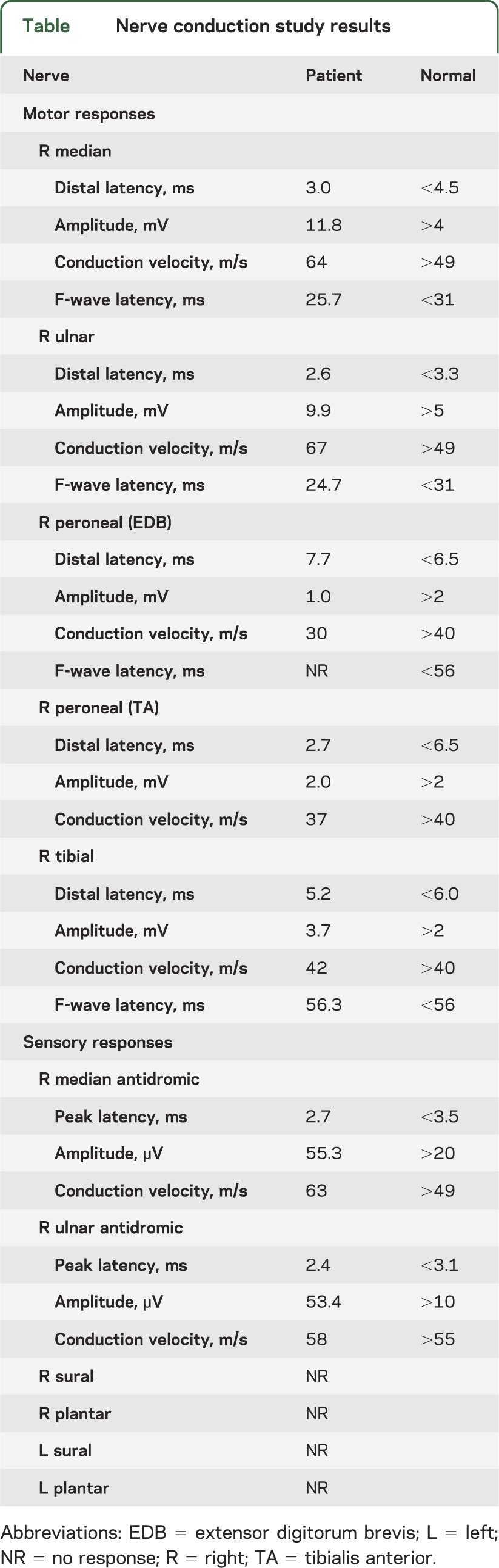
A 19-year-old woman with a history of anorexia, bulimia, and vegetarian diet was referred for a 1-year history of progressive dysesthesias. Symptoms began in her feet with debilitating pain and allodynia, ascending over several months to her pelvis and hands. Family medical history was significant for pernicious anemia in her sister. Physical examination demonstrated decreased pinprick sensation from her feet to her thighs and from her hands to her elbows, as well as loss of proprioception and vibration sensation at the toes. Her examination was otherwise normal. Gadolinium-enhanced MRI of the brain and complete spine was unremarkable. Extensive testing was negative, including CSF, complete blood count, electrolytes, 2-hour glucose tolerance test, vitamin B12, vitamin B6, thiamine, copper, heavy metals, and serologies for pernicious anemia, syphilis, HIV, Lyme, celiac, and rheumatologic disease. Electrophysiologic studies were consistent with a primarily axonal sensorimotor polyneuropathy, demonstrating severely decreased distal peroneal motor amplitude, and absent bilateral sural and plantar sensory responses (table). Needle EMG examination of the right tibialis anterior and gastrocnemius was normal. She subsequently revealed that she had taken dinitrophenol up to 1 g daily as a weight-loss agent for 6 months before the onset of her symptoms, and for 1 year afterward. Her weight approximately 1 month after symptom onset was 63.5 kg (body mass index 21.9 kg/m2), indicating a peak dose of approximately 15.7 mg/kg, and on presentation was 67.6 kg (body mass index 23.3 kg/m2). She discontinued dinitrophenol, and on follow-up over the next 2 years had moderate improvement in her symptoms.
Table.
Nerve conduction study results
Discussion.
Dinitrophenol is a potent uncoupler of oxidative phosphorylation, allowing protons to leak from the mitochondrial intermembrane space across the inner mitochondrial membrane, dissipating the proton gradient. Energy from cellular respiration that ordinarily would be stored as adenosine triphosphate instead is lost as heat. To meet energy requirements, the body utilizes reserves from adipose tissue, leading to weight loss.3
In 1933, low-dose dinitrophenol was reported to be effective as a weight-loss agent in humans. Nine obese patients were treated with 3 to 5 mg/kg dinitrophenol daily for up to 10 weeks, without complications. Their metabolic rate increased some 40% above baseline, and they lost an average of 2 to 3 pounds per week, even without dietary restrictions or exercise. Weight loss plateaued after several weeks of treatment, but resumed after a 2-week holiday from the drug. Elevated body temperature was noted at higher doses, and was considered a reliable indicator of impending toxicity.4
More than 20 companies began marketing dinitrophenol, and by 1934 more than 100,000 Americans were estimated to have taken it for weight loss.1 Within several years, various adverse effects were described, including hyperthermia, cataracts, agranulocytosis, renal failure, blood pressure fluctuations, rash, miscarriage, painful peripheral neuritis, and several deaths.1,5 These consequences contributed to passage of the landmark Food, Drug, and Cosmetic Act of 1938, and dinitrophenol-containing weight-loss agents were withdrawn from the US market.1
The pathophysiology of dinitrophenol-induced neuropathy remains unknown, but likely results from uncoupling of oxidative phosphorylation. Depletion of intracellular adenosine triphosphate levels may impair neuronal processes such as fast axonal transport, which is highly energy-dependent, or axonal Na+/K+ pump function, which utilizes approximately 50% of the axonal energy requirement.6
Dinitrophenol again has become readily available to the general public, via the Internet. A simple online search yields detailed instructions for preparation into capsules and use in weight loss. Correspondingly, several deaths from acute intoxication were reported recently.2,3,7 With the rising incidence of obesity and distorted body-image perceptions in the developed world, physicians increasingly are likely to encounter neurologic manifestations of subacute toxicity as well.
Footnotes
Author contributions: Dr. Singer, Dr. Phillips: study concept and design, acquisition of data, analysis and interpretation, critical revision of the manuscript for important intellectual content. Dr. Singer: study supervision.
Disclosure: The authors report no disclosures relevant to the manuscript. Go to Neurology.org for full disclosures.
References
- 1.Colman E. Dinitrophenol and obesity: an early twentieth-century regulatory dilemma. Regul Toxicol Pharmacol 2007;48:115–117 [DOI] [PubMed] [Google Scholar]
- 2.Miranda EJ, McIntyre IM, Parker DR, Gary RD, Logan BK. Two deaths attributed to the use of 2,4-dinitrophenol. J Anal Toxicol 2006;30:219–222 [DOI] [PubMed] [Google Scholar]
- 3.Bartlett J, Brunner M, Gough K. Deliberate poisoning with dinitrophenol (DNP): an unlicensed weight loss pill. Emerg Med J 2010;27:159–160 [DOI] [PubMed] [Google Scholar]
- 4.Cutting WC, Mehrtens HG, Tainter ML. Actions and uses of dinitrophenol: promising metabolic applications. JAMA 1933;101:193–195 [Google Scholar]
- 5.Epstein E, Rosenblum H. Peripheral neuropathy and abortion following dinitrophenol therapy: report of a case. J Lab Clin Med 1935;20:1118–1121 [Google Scholar]
- 6.Lin CS, Krishnan AV, Lee MJ, et al. Nerve function and dysfunction in acute intermittent porphyria. Brain 2008;131:2510–2519 [DOI] [PubMed] [Google Scholar]
- 7.Tewari A, Ali T, O'Donnell J, Butt MS. Weight loss and 2,4-dinitrophenol poisoning. Br J Anaesth 2009;102:566–567 [DOI] [PubMed] [Google Scholar]