



Abstract
Non-recurrent laryngeal nerve (NRLN) is a rare anomaly which is reported in 0.3%-0.8% of people on the right side and in 0.004% (extremely rare) on the left side. Damage to this nerve during the surgical procedure may lead to severe iatrogenic morbidity and should therefore be prevented from being damaged. The best way to avoid this damage to the nerve is to identify the nerve with a systematic diligent dissection based on usual anatomical landmarks and awareness about the possibility of their existence. Hereby, we are going to present a 26-year-old woman, a case of NRLN on the right side which was identified during thyroidectomy. The nervous anomaly was accompanied with vascular abnormality which was confirmed by computerized tomography (CT) angiography, post-operatively.
Keywords: Inferior laryngeal nerve, non-recurrent, thyroidectomy
INTRODUCTION
The recurrent (inferior) laryngeal nerve is a branch of the vagus nerve that supplies motor function and sensation of the larynx (voice box).
There are some theories discussing on why this nerve has a recurrent nature. Considering the location of the heart in the fish-like ancestors of the modern tetrapods, and the extreme detour of this nerve (over fifteen feet in giraffes), an evolutionist, Richard Dawkins, suggested that over the course of evolution, as the neck extended and the heart became lower in the body, the laryngeal nerve was caught on to the wrong side of the heart. Natural selection gradually lengthened the laryngeal nerve by tiny increments to accommodate, resulting in the circuitous route now observed.[1] But sometimes, the inferior laryngeal nerve has observed not to be circuitous and recurrent.
Non-recurrent laryngeal nerve (NRLN) is a rare anomaly which is reported in 0.3%-0.8% of people on the right side,[2–4] and in 0.004% (extremely rare) on the left side.[5] The right NRLN is associated with a right subclavian artery arising directly from the aortic arch.[5]
This anatomical variation is clinically important when an invasive procedure is planned to be implemented in the head and neck region.
Overlooking its possibility may lead to severe iatrogenic morbidity.[6] The ipsilateral damage to the nerve could result in permanent hoarseness and the bilateral damage could lead to aphonia or life threatening dyspnea.[7]
We are going to report and discuss a case of NRLN which was identified during thyroidectomy in a patient with thyroid papillary cell cancer.
CASE REPORT
A 26-year-old Caucasian woman was referred to the Head and Neck surgery outpatient clinic at Imam Khomeini training Hospital in Urmia. Two years ago, she was noticed to have a cervical mass on the right side. A thyroid nodule was diagnosed and followed-up by a physician, but subsequently, the nodule was enlarged rapidly since five months, so she was referred to the endocrinologist. A fine needle aspiration (FNA) puncture was performed and the result was compatible with thyroid papillary cell carcinoma, then she was referred to the surgeon. She had no surgical history before. She was received medical therapy with levothyroxin for a while, but the preoperative thyroid function tests, all of them were in normal ranges. His physical examination was unremarkable and only a firm three to four cm nodule was palpated in the right lobe of thyroid without any adhesion to the environment. No other enlarged mass or lymphadenopathy was observed in the neck in the first exam in the surgery clinic.
According to the result of FNA, the surgeon decided that she should undergo total thyroidectomy, which was the 270th thyroidectomy of the surgeon.
Under general endotracheal anesthesia, a three to five inch low collar incision is made perpendicular to the length of the neck and carried down through the subcutaneous tissue and platysma muscle. Superior and inferior subplatysmal flaps were developed and the strap muscles are divided vertically in the midline and retracted laterally.
The skin and subcutaneous tissue was dissected and the thyroid gland and blood vessels were exposed. Blood supply to the thyroid gland was clamped off and ligated by two 2-0 and 3-0 silk sutures.
First, the left lobe of thyroid was resected in association with isthmus. Then the right lobectomy was done by dissecting the superior peduncle of the right lobe.
The right inferior thyroid artery was identified. Careful dissection was done to find the right recurrent laryngeal nerve in the area between inferior thyroid artery and mid-cervical (mid-tracheal) line, but despite diligent dissection, no recurrent nerve was observed.
So with suspect to have the anatomical variation (non-recurrent laryngeal nerve), the area above the inferior thyroid artery was dissected. The inferior laryngeal nerve usually penetrates the cricothyroid muscle to enter the larynx. The nerve was founded where penetrating the cricothyroid muscle and was followed in a retrograde manner [Figure 1].
Figure 1.

Non-recurrent laryngeal nerve found during thyroidectomy
The nerve emanated from the right vagus nerve and entered the larynx three to four cm after its origin without showing any recurrent course. The left recurrent laryngeal nerve was observed too, and it was in normal recurrent fashion.
The surgery and postoperative period was uneventful and no change on the voice of patient (any hoarseness) was observed.
Given the invariably association of NRLN with vascular abnormality (right clavian artery originated directly from the aortic arch), the computerized tomography (CT) angiography imaging was performed which confirmed the presence of vascular anomaly [Figure 2]. Because of being asymptomatic, as usual, no extra measure was considered in this regard.
Figure 2.
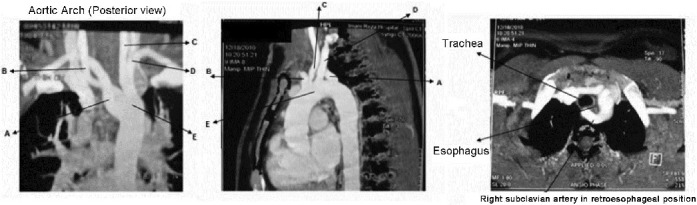
The axial and coronal view of computerized tomography angiography revealing the arterial malformation A: Right subclavian artery originated directly from the aortic arch B: Right common carotid artery C: Left common carotid artery D: Left subclavian artery E: Aortic arch
DISCUSSION
An aberrant, non-recurrent pathway for the inferior laryngeal nerve imposes a major surgical risk during thyroidectomy or any other invasive procedure on the neck.
This anomaly has an embryological basis. It is due to the impaired embryological development of aortic arch and supra-aortic vessels.[8]
The vascular disorder which the nervous anatomical variation resulted from, named arteria lusoria, in which the fourth right aortic arch is abnormally absorbed, therefore being unable to drag the right recurrent laryngeal nerve downward when the heart descends and the neck elongated during embryologic development.[2,9]
Considering the probability of damaging the nerve during surgery, some guidelines were developed to prevent this major surgical risk intra-operatively.
The best way to avoid the damage to the nerve during thyroidectomy is to identify the nerve with a systematic diligent dissection based on usual anatomical landmarks and keeping always in mind the possibility of an anatomic variation.
Liu et al., suggested that any transverse bond should not be cut between vascular and laryngeal except middle thyroid vein, unless the recurrent laryngeal nerve is identified.[10]
Regarding the preoperative measures to identify the NRLN, Lee et al. reviewed the CT scans of 20 patients with NRLN retrospectively and revealed that vascular anomalies could be identified on the scans of all patients.[11] Of course, to take more precise images, newly developed techniques such as CT angiography (CTA) are needed.[12] Some invasive procedures such as catheter angiography could identify the presence of arterial variation preoperatively. But preoperative CTA is much safer and less time consuming than catheter angiography.[12] Also the diagnostic accuracy of magnetic resonance (MR)-angiography was emphasized in the study of Marchesi et al.[4]
The arterial abnormalities associated with this nervous anomaly (absence of brachiocephalic trunk and arteria lusoria) can be identified by ultrasonography too.
The study of Iacobone et al. reported 100% accuracy for ultrasonography in detecting NRLN. Also they revealed that preoperative ultrasonography can correctly identify non-recurrent ILN, allowing earlier nerve identification and prevention of injuries (P < 0.05).[13]
Although the preoperative diagnosis of NRLN is possible theoretically with imaging studies,[14] but the systematic preoperative use of them was not recommended yet.
However, cases of NRLN without any vascular anomaly in association was reported too[15] which poses some more doubts on the preoperative application of imaging methods.
CONCLUSION
The presence of non-recurrent variant of inferior laryngeal nerve is a major risk during surgical procedures in the neck region which should be prevented to be damaged. The best way to avoid this damage to the nerve is to identify the nerve with a systematic diligent dissection based on usual anatomical landmarks and awareness about the possibility of their existence.
Footnotes
Source of Support: Nil
Conflict of Interest: None declared
REFERENCES
- 1.Dawkins R. Chapter 11. History written all over us. In: Dawkins R, editor. The greatest show on Earth. New York: Free Press; 2009. pp. 360–2. [Google Scholar]
- 2.Defechereux T, Albert V, Alexandre J, Bonnet P, Hamoir E, Meurisse M. The inferior non recurrent laryngeal nerve: A major surgical risk during thyroidectomy. Acta Chir Belg. 2000;100:62–7. [PubMed] [Google Scholar]
- 3.Henry JF, Audiffret J, Plan M. The nonrecurrent inferior laryngeal nerve. Apropos of 19 cases including 2 on the left side. J Chir (Paris) 1985;122:391–7. [PubMed] [Google Scholar]
- 4.Marchesi M, Biffoni M, Faloci C, Nobili Benedetti R, Notari P, Mariotti F, et al. The inferior nonrecurrent laryngeal nerve: A report of 7 cases observed since 1987. G Chir. 2000;21:25–8. [PubMed] [Google Scholar]
- 5.Uludag M, Isgor A, Yetkin G, Citgez B. Anatomic variations of the non-recurrent inferior laryngeal nerve. BMJ Case Reports. 2009 doi: 10.1136/bcr.10.2008.1107. [DOI] [PMC free article] [PubMed] [Google Scholar]
- 6.Abboud B, Aouad R. Non-recurrent inferior laryngeal nerve in thyroid surgery: Report of three cases and review of the literature. J Laryngol Otol. 2004;118:139–42. doi: 10.1258/002221504772784603. [DOI] [PubMed] [Google Scholar]
- 7.Lee MS, Lee UY, Lee JH, Han SH. Relative direction and position of recurrent laryngeal nerve for anatomical configuration. Surg Radiol Anat. 2009;31:649–55. doi: 10.1007/s00276-009-0494-y. [DOI] [PubMed] [Google Scholar]
- 8.Pisanu A, Pili S, Uccheddu A. Non-recurrent inferior laryngeal nerve. Chir Ital. 2002;54:7–14. [PubMed] [Google Scholar]
- 9.Attmann T, Brandt M, Müller-Hülsbeck S, Cremer J. Two-stage surgical and endovascular treatment of an aneurysmal aberrant right subclavian (Lusoria) artery. Eur J Cardiothorac Surg. 2005;27:1125–7. doi: 10.1016/j.ejcts.2005.02.029. [DOI] [PubMed] [Google Scholar]
- 10.Liu LX, Wu LF, Xue DB, Meng XZ, Zhang WH, Jiang HC. The importance of nonrecurrent laryngeal nerve in thyroid surgery. Zhonghua Wai Ke Za Zhi. 2006;44:904–6. [PubMed] [Google Scholar]
- 11.Lee YS, Son EJ, Chang HS, Chung WY, Nam KH, Park CS. Computed tomography is useful for preoperative identification of nonrecurrent laryngeal nerve in thyroid cancer patients. Otolaryngol Head Neck Surg. 2011;145:204–7. doi: 10.1177/0194599811406670. [DOI] [PubMed] [Google Scholar]
- 12.Choi HS, Shin DH, Kim KR, Park YA. Preoperative three-dimensional CT angiography to distinguish between an aberrant subclavian artery and a double aortic arch in thyroid surgery: Report of 2 cases. Auris Nasus Larynx. 2011;38:127–32. doi: 10.1016/j.anl.2010.05.009. [DOI] [PubMed] [Google Scholar]
- 13.Iacobone M, Viel G, Zanella S, Bottussi M, Frego M, Favia G. The usefulness of preoperative ultrasonographic identification of nonrecurrent inferior laryngeal nerve in neck surgery. Langenbecks Arch Surg. 2008;393:633–8. doi: 10.1007/s00423-008-0372-9. [DOI] [PubMed] [Google Scholar]
- 14.Abboud B. Preoperative diagnosis of right nonrecurrent inferior laryngeal nerve by CT scan: Report of a case and review of the literature. J Med Liban. 2007;55:46–9. [PubMed] [Google Scholar]
- 15.Tateda M, Hasegawa J, Sagai S, Nakanome A, Katagiri K, Ishida E, et al. Nonrecurrent inferior laryngeal nerve without vascular anomaly as a genuine entity. Tohoku J Exp Med. 2008;216:133–7. doi: 10.1620/tjem.216.133. [DOI] [PubMed] [Google Scholar]