



Abstract
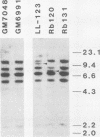
A candidate DNA sequence with many of the properties predicted for the retinoblastoma susceptibility (RB1) locus has been cloned (S. H. Friend, R. Bernards, S. Rogelj, R. A. Weinberg, J. M. Rapaport, D. M. Albert, and T. P. Dryja, Nature [London] 323:643-645, 1986). The large size of this gene (ca. 200 kilobases [kb]) and its multiple dispersed exons (Wiggs et al., N. Engl. J. Med. 318:151-157, 1988) complicate molecular screening strategies important in prenatal and presymptomatic diagnosis and in carrier detection. Here we used field inversion gel electrophoresis (FIGE) to construct a restriction map of approximately 1,000 kb of DNA surrounding the RB1 locus and to detect the translocation breakpoints in three retinoblastoma patients. DNA probes from either the 5' or 3' end of the gene were used to detect a 250-kb EagI restriction fragment in DNA from unaffected individuals. Both probes identified an additional hybridizing fragment in the DNA from each patient, permitting the breakpoints in all three to be mapped within the cloned RB1 gene. Analysis of the breakpoint in one translocation cell line allowed the RB1 gene to be oriented with its 5' end toward the centromere. The 5' end of the gene also appeared to be associated with a clustering of sites for several infrequently cleaving restriction enzymes, indicating the presence of an HpaII tiny fragment island. The detection and mapping of the translocation breakpoints of all three retinoblastoma patients to within the putative RB1 gene substantiated the authenticity of this candidate sequence and demonstrated the utility of FIGE in detecting chromosomal rearrangements affecting this locus.
Full text
PDF


Images in this article


Selected References
These references are in PubMed. This may not be the complete list of references from this article.
- Abramson D. H., Ellsworth R. M., Kitchin F. D., Tung G. Second nonocular tumors in retinoblastoma survivors. Are they radiation-induced? Ophthalmology. 1984 Nov;91(11):1351–1355. doi: 10.1016/s0161-6420(84)34127-6. [DOI] [PubMed] [Google Scholar]
- Bird A. P. CpG-rich islands and the function of DNA methylation. Nature. 1986 May 15;321(6067):209–213. doi: 10.1038/321209a0. [DOI] [PubMed] [Google Scholar]
- Blanquet V., Turleau C., Créau-Goldberg N., Cochet C., de Grouchy J. De novo t(2;13)(p24.3;q14.2) and retinoblastoma. Mapping of two 13q14 probes by in situ hybridization. Hum Genet. 1987 May;76(1):102–105. doi: 10.1007/BF00283059. [DOI] [PubMed] [Google Scholar]
- Bookstein R., Lee E. Y., To H., Young L. J., Sery T. W., Hayes R. C., Friedmann T., Lee W. H. Human retinoblastoma susceptibility gene: genomic organization and analysis of heterozygous intragenic deletion mutants. Proc Natl Acad Sci U S A. 1988 Apr;85(7):2210–2214. doi: 10.1073/pnas.85.7.2210. [DOI] [PMC free article] [PubMed] [Google Scholar]
- Carle G. F., Frank M., Olson M. V. Electrophoretic separations of large DNA molecules by periodic inversion of the electric field. Science. 1986 Apr 4;232(4746):65–68. doi: 10.1126/science.3952500. [DOI] [PubMed] [Google Scholar]
- Cavenee W. K., Dryja T. P., Phillips R. A., Benedict W. F., Godbout R., Gallie B. L., Murphree A. L., Strong L. C., White R. L. Expression of recessive alleles by chromosomal mechanisms in retinoblastoma. 1983 Oct 27-Nov 2Nature. 305(5937):779–784. doi: 10.1038/305779a0. [DOI] [PubMed] [Google Scholar]
- Douglass E. C., Valentine M., Etcubanas E., Parham D., Webber B. L., Houghton P. J., Houghton J. A., Green A. A. A specific chromosomal abnormality in rhabdomyosarcoma. Cytogenet Cell Genet. 1987;45(3-4):148–155. doi: 10.1159/000132446. [DOI] [PubMed] [Google Scholar]
- Draper G. J., Sanders B. M., Kingston J. E. Second primary neoplasms in patients with retinoblastoma. Br J Cancer. 1986 May;53(5):661–671. doi: 10.1038/bjc.1986.110. [DOI] [PMC free article] [PubMed] [Google Scholar]
- Dryja T. P., Rapaport J. M., Epstein J., Goorin A. M., Weichselbaum R., Koufos A., Cavenee W. K. Chromosome 13 homozygosity in osteosarcoma without retinoblastoma. Am J Hum Genet. 1986 Jan;38(1):59–66. [PMC free article] [PubMed] [Google Scholar]
- Duncan A. M., Morgan C., Gallie B. l., Phillips R. A., Squire J. Re-evaluation of the sublocalization of esterase D and its relation to the retinoblastoma locus by in situ hybridization. Cytogenet Cell Genet. 1987;44(2-3):153–157. doi: 10.1159/000132361. [DOI] [PubMed] [Google Scholar]
- Feinberg A. P., Vogelstein B. A technique for radiolabeling DNA restriction endonuclease fragments to high specific activity. Anal Biochem. 1983 Jul 1;132(1):6–13. doi: 10.1016/0003-2697(83)90418-9. [DOI] [PubMed] [Google Scholar]
- Fitchett M., Griffiths M. J., Oscier D. G., Johnson S., Seabright M. Chromosome abnormalities involving band 13q14 in hematologic malignancies. Cancer Genet Cytogenet. 1987 Jan;24(1):143–150. doi: 10.1016/0165-4608(87)90091-4. [DOI] [PubMed] [Google Scholar]
- Friend S. H., Bernards R., Rogelj S., Weinberg R. A., Rapaport J. M., Albert D. M., Dryja T. P. A human DNA segment with properties of the gene that predisposes to retinoblastoma and osteosarcoma. Nature. 1986 Oct 16;323(6089):643–646. doi: 10.1038/323643a0. [DOI] [PubMed] [Google Scholar]
- Friend S. H., Horowitz J. M., Gerber M. R., Wang X. F., Bogenmann E., Li F. P., Weinberg R. A. Deletions of a DNA sequence in retinoblastomas and mesenchymal tumors: organization of the sequence and its encoded protein. Proc Natl Acad Sci U S A. 1987 Dec;84(24):9059–9063. doi: 10.1073/pnas.84.24.9059. [DOI] [PMC free article] [PubMed] [Google Scholar]
- Fung Y. K., Murphree A. L., T'Ang A., Qian J., Hinrichs S. H., Benedict W. F. Structural evidence for the authenticity of the human retinoblastoma gene. Science. 1987 Jun 26;236(4809):1657–1661. doi: 10.1126/science.2885916. [DOI] [PubMed] [Google Scholar]
- Goddard A. D., Balakier H., Canton M., Dunn J., Squire J., Reyes E., Becker A., Phillips R. A., Gallie B. L. Infrequent genomic rearrangement and normal expression of the putative RB1 gene in retinoblastoma tumors. Mol Cell Biol. 1988 May;8(5):2082–2088. doi: 10.1128/mcb.8.5.2082. [DOI] [PMC free article] [PubMed] [Google Scholar]
- Hansen M. F., Koufos A., Gallie B. L., Phillips R. A., Fodstad O., Brøgger A., Gedde-Dahl T., Cavenee W. K. Osteosarcoma and retinoblastoma: a shared chromosomal mechanism revealing recessive predisposition. Proc Natl Acad Sci U S A. 1985 Sep;82(18):6216–6220. doi: 10.1073/pnas.82.18.6216. [DOI] [PMC free article] [PubMed] [Google Scholar]
- Herrmann B. G., Barlow D. P., Lehrach H. A large inverted duplication allows homologous recombination between chromosomes heterozygous for the proximal t complex inversion. Cell. 1987 Mar 13;48(5):813–825. doi: 10.1016/0092-8674(87)90078-x. [DOI] [PubMed] [Google Scholar]
- Johnson D. D., Dewald G. W., Pierre R. V., Letendre L., Silverstein M. N. Deletions of chromosome 13 in malignant hematologic disorders. Cancer Genet Cytogenet. 1985 Nov;18(3):235–241. doi: 10.1016/0165-4608(85)90088-3. [DOI] [PubMed] [Google Scholar]
- Knudson A. G., Jr Mutation and cancer: statistical study of retinoblastoma. Proc Natl Acad Sci U S A. 1971 Apr;68(4):820–823. doi: 10.1073/pnas.68.4.820. [DOI] [PMC free article] [PubMed] [Google Scholar]
- Lalande M., Dryja T. P., Schreck R. R., Shipley J., Flint A., Latt S. A. Isolation of human chromosome 13-specific DNA sequences cloned from flow sorted chromosomes and potentially linked to the retinoblastoma locus. Cancer Genet Cytogenet. 1984 Dec;13(4):283–295. doi: 10.1016/0165-4608(84)90073-6. [DOI] [PubMed] [Google Scholar]
- Lalande M., Noolandi J., Turmel C., Rousseau J., Slater G. W. Pulsed-field electrophoresis: application of a computer model to the separation of large DNA molecules. Proc Natl Acad Sci U S A. 1987 Nov;84(22):8011–8015. doi: 10.1073/pnas.84.22.8011. [DOI] [PMC free article] [PubMed] [Google Scholar]
- Lee W. H., Bookstein R., Hong F., Young L. J., Shew J. Y., Lee E. Y. Human retinoblastoma susceptibility gene: cloning, identification, and sequence. Science. 1987 Mar 13;235(4794):1394–1399. doi: 10.1126/science.3823889. [DOI] [PubMed] [Google Scholar]
- Lee W. H., Shew J. Y., Hong F. D., Sery T. W., Donoso L. A., Young L. J., Bookstein R., Lee E. Y. The retinoblastoma susceptibility gene encodes a nuclear phosphoprotein associated with DNA binding activity. Nature. 1987 Oct 15;329(6140):642–645. doi: 10.1038/329642a0. [DOI] [PubMed] [Google Scholar]
- Lundberg C., Skoog L., Cavenee W. K., Nordenskjöld M. Loss of heterozygosity in human ductal breast tumors indicates a recessive mutation on chromosome 13. Proc Natl Acad Sci U S A. 1987 Apr;84(8):2372–2376. doi: 10.1073/pnas.84.8.2372. [DOI] [PMC free article] [PubMed] [Google Scholar]
- Morgan R., Hecht F. Deletion of chromosome band 13q14: a primary event in preleukemia and leukemia. Cancer Genet Cytogenet. 1985 Nov;18(3):243–249. doi: 10.1016/0165-4608(85)90089-5. [DOI] [PubMed] [Google Scholar]
- Motegi T., Komatsu M., Nakazato Y., Ohuchi M., Minoda K. Retinoblastoma in a boy with a de novo mutation of a 13/18 translocation: the assumption that the retinoblastoma locus is at 13q141, particularly at the distal portion of it. Hum Genet. 1982;60(2):193–195. doi: 10.1007/BF00569711. [DOI] [PubMed] [Google Scholar]
- Motomura K., Nishisho I., Takai S., Tateishi H., Okazaki M., Yamamoto M., Miki T., Honjo T., Mori T. Loss of alleles at loci on chromosome 13 in human primary gastric cancers. Genomics. 1988 Feb;2(2):180–184. doi: 10.1016/0888-7543(88)90101-2. [DOI] [PubMed] [Google Scholar]
- Pankau R., Johannson W., Grote W., Dörner K., Tolksdorf M. Interstitial deletion of chromosome 13 involving the region 13q14. Hum Genet. 1987 Nov;77(3):292–293. doi: 10.1007/BF00284490. [DOI] [PubMed] [Google Scholar]
- Sparkes R. S., Sparkes M. C., Kalina R. E., Pagon R. A., Salk D. J., Disteche C. M. Separation of retinoblastoma and esterase D loci in a patient with sporadic retinoblastoma and del(13)(q14.1q22.3). Hum Genet. 1984;68(3):258–259. doi: 10.1007/BF00418397. [DOI] [PubMed] [Google Scholar]
- Squire J., Dryja T. P., Dunn J., Goddard A., Hofmann T., Musarella M., Willard H. F., Becker A. J., Gallie B. L., Phillips R. A. Cloning of the esterase D gene: a polymorphic gene probe closely linked to the retinoblastoma locus on chromosome 13. Proc Natl Acad Sci U S A. 1986 Sep;83(17):6573–6577. doi: 10.1073/pnas.83.17.6573. [DOI] [PMC free article] [PubMed] [Google Scholar]
- Turleau C., de Grouchy J., Chavin-Colin F., Junien C., Séger J., Schlienger P., Leblanc A., Haye C. Cytogenetic forms of retinoblastoma: their incidence in a survey of 66 patients. Cancer Genet Cytogenet. 1985 Apr 15;16(4):321–334. doi: 10.1016/0165-4608(85)90240-7. [DOI] [PubMed] [Google Scholar]
- Ward P., Packman S., Loughman W., Sparkes M., Sparkes R., McMahon A., Gregory T., Ablin A. Location of the retinoblastoma susceptibility gene(s) and the human esterase D locus. J Med Genet. 1984 Apr;21(2):92–95. doi: 10.1136/jmg.21.2.92. [DOI] [PMC free article] [PubMed] [Google Scholar]
- Wiggs J., Nordenskjöld M., Yandell D., Rapaport J., Grondin V., Janson M., Werelius B., Petersen R., Craft A., Riedel K. Prediction of the risk of hereditary retinoblastoma, using DNA polymorphisms within the retinoblastoma gene. N Engl J Med. 1988 Jan 21;318(3):151–157. doi: 10.1056/NEJM198801213180305. [DOI] [PubMed] [Google Scholar]
- Yunis J. J., Ramsay N. Retinoblastoma and subband deletion of chromosome 13. Am J Dis Child. 1978 Feb;132(2):161–163. doi: 10.1001/archpedi.1978.02120270059012. [DOI] [PubMed] [Google Scholar]
- den Dunnen J. T., Bakker E., Breteler E. G., Pearson P. L., van Ommen G. J. Direct detection of more than 50% of the Duchenne muscular dystrophy mutations by field inversion gels. Nature. 1987 Oct 15;329(6140):640–642. doi: 10.1038/329640a0. [DOI] [PubMed] [Google Scholar]