



Abstract
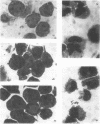
Myeloid differentiation in vitro is characterized by the sequential appearance of morphological, functional, and biochemical markers of maturation. We examined the effect of agents that increased the intracellular concentration of adenosine 3′5′-cyclic monophosphate on the expression of these markers by human promyelocytic leukemia cells (HL60). Cells treated with 500 μM N6,O2-dibutyryl adenosine 3′5′-cyclic monophosphate expressed formyl peptide and complement receptors, reduced nitroblue tetrazolium, adhered to substrate, demonstrated chemotaxis and stimulated lysosomal enzyme release, rapidly ceased proliferation, and assumed the morphology of myelocytes and metamyelocytes. Prostaglandin E2 (100 nM) and theophyllin (500 μM) induced similar functional changes but the cells did not mature beyond the myelocyte stage. Cholera toxin (1 or 50 nM) induced formyl-peptide receptor expression and adherence, but the cells did not reduce nitroblue tetrazolium, continued to proliferate, and were unchanged morphologically. Formyl-peptide receptor expression was the earliest marker of these modified programs of maturation. The receptor appeared within 2 h after treatment and increased linearly for 72 h. Receptor expression was dependent on new protein synthesis. At 48 h, Scatchard analysis demonstrated 2.4 × 10⁵ receptors/ cell with a KD of 1.3 nM.
In contrast to induction of HL60 differentiation by dimethyl sulfoxide, retinoic acid, or phorbol myristate acetate, the developmental programs initiated by agents that raised intracellular adenosine 3′5′-cyclic monophosphate shared several unique features: (a) plasma membrane maturation was dissociated from morphological maturation; (b) no latent period was evident following induction—the earliest membrane marker was expressed within 2 h; (c) commitment to terminal differentiation was delayed.
Full text
PDF


Images in this article
Selected References
These references are in PubMed. This may not be the complete list of references from this article.
- Brandt S. J., Barnes K. C., Glass D. B., Kinkade J. M., Jr Glucocorticoid-stimulated increase in chemotactic peptide receptors on differentiating human myeloid leukemia (HL-60) cells. Cancer Res. 1981 Dec;41(12 Pt 1):4947–4951. [PubMed] [Google Scholar]
- Breitman T. R., Collins S. J., Keene B. R. Terminal differentiation of human promyelocytic leukemic cells in primary culture in response to retinoic acid. Blood. 1981 Jun;57(6):1000–1004. [PubMed] [Google Scholar]
- Breitman T. R., Selonick S. E., Collins S. J. Induction of differentiation of the human promyelocytic leukemia cell line (HL-60) by retinoic acid. Proc Natl Acad Sci U S A. 1980 May;77(5):2936–2940. doi: 10.1073/pnas.77.5.2936. [DOI] [PMC free article] [PubMed] [Google Scholar]
- Brennan J. K., Abboud C. N., DiPersio J. F., Barlow G. H., Lichtman M. A. Autostimulation of growth by human myelogenous leukemia cells (HL-60). Blood. 1981 Oct;58(4):803–812. [PubMed] [Google Scholar]
- Chen Z., Banks J., Rifkind R. A., Marks P. A. Inducer-mediated commitment of murine erythroleukemia cells to differentiation: a multistep process. Proc Natl Acad Sci U S A. 1982 Jan;79(2):471–475. doi: 10.1073/pnas.79.2.471. [DOI] [PMC free article] [PubMed] [Google Scholar]
- Collins S. J., Gallo R. C., Gallagher R. E. Continuous growth and differentiation of human myeloid leukaemic cells in suspension culture. Nature. 1977 Nov 24;270(5635):347–349. doi: 10.1038/270347a0. [DOI] [PubMed] [Google Scholar]
- Collins S. J., Ruscetti F. W., Gallagher R. E., Gallo R. C. Normal functional characteristics of cultured human promyelocytic leukemia cells (HL-60) after induction of differentiation by dimethylsulfoxide. J Exp Med. 1979 Apr 1;149(4):969–974. doi: 10.1084/jem.149.4.969. [DOI] [PMC free article] [PubMed] [Google Scholar]
- Collins S. J., Ruscetti F. W., Gallagher R. E., Gallo R. C. Terminal differentiation of human promyelocytic leukemia cells induced by dimethyl sulfoxide and other polar compounds. Proc Natl Acad Sci U S A. 1978 May;75(5):2458–2462. doi: 10.1073/pnas.75.5.2458. [DOI] [PMC free article] [PubMed] [Google Scholar]
- Douer D., Koeffler H. P. Retinoic acid. Inhibition of the clonal growth of human myeloid leukemia cells. J Clin Invest. 1982 Feb;69(2):277–283. doi: 10.1172/JCI110450. [DOI] [PMC free article] [PubMed] [Google Scholar]
- Fontana J. A., Wright D. G., Schiffman E., Corcoran B. A., Deisseroth A. B. Development of chemotactic responsiveness in myeloid precursor cells: studies with a human leukemia cell line. Proc Natl Acad Sci U S A. 1980 Jun;77(6):3664–3668. doi: 10.1073/pnas.77.6.3664. [DOI] [PMC free article] [PubMed] [Google Scholar]
- Fox I. H., Kelley W. N. Human phosphoribosylpyrophosphate synthetase. Kinetic mechanism and end product inhibition. J Biol Chem. 1972 Apr 10;247(7):2126–2131. [PubMed] [Google Scholar]
- Friedman D. L. Role of cyclic nucleotides in cell growth and differentiation. Physiol Rev. 1976 Oct;56(4):652–708. doi: 10.1152/physrev.1976.56.4.652. [DOI] [PubMed] [Google Scholar]
- Furmanski P., Silverman D. J., Lubin M. Expression of differentiated functions in mouse neuroblastoma mediated by dibutyryl-cyclic adenosine monophosphate. Nature. 1971 Oct 8;233(5319):413–415. doi: 10.1038/233413a0. [DOI] [PubMed] [Google Scholar]
- Gazitt Y., Reuben R. C., Deitch A. D., Marks P. A., Rifkind R. A. Changes in cyclic adenosine 3':5'-monophosphate levels during induction of differentiation in murine erythroleukemia cells. Cancer Res. 1978 Nov;38(11 Pt 1):3779–3783. [PubMed] [Google Scholar]
- Koeffler H. P., Golde D. W. Humoral modulation of human acute myelogenous leukemia cell growth in vitro. Cancer Res. 1980 Jun;40(6):1858–1862. [PubMed] [Google Scholar]
- Kurland J. I., Bockman R. S., Broxmeyer H. E., Moore M. A. Limitation of excessive myelopoiesis by the intrinsic modulation of macrophage-derived prostaglandin E. Science. 1978 Feb 3;199(4328):552–555. doi: 10.1126/science.304600. [DOI] [PubMed] [Google Scholar]
- Kurland J. I., Broxmeyer H. E., Pelus L. M., Bockman R. S., Moore M. A. Role for monocyte-macrophage-derived colony-stimulating factor and prostaglandin E in the positive and negative feedback control of myeloid stem cell proliferation. Blood. 1978 Aug;52(2):388–407. [PubMed] [Google Scholar]
- Kurland J. I., Hadden J. W., Moore M. A. Role of cyclic nucleotides in the proliferation of committed granulocyte-macrophage progenitor cells. Cancer Res. 1977 Dec;37(12):4534–4538. [PubMed] [Google Scholar]
- Li C. Y., Lam K. W., Yam L. T. Esterases in human leukocytes. J Histochem Cytochem. 1973 Jan;21(1):1–12. doi: 10.1177/21.1.1. [DOI] [PubMed] [Google Scholar]
- Masui H., Garren L. D. Inhibition of replication in functional mouse adrenal tumor cells by adrenocorticotropic hormone mediated by adenosine 3':5'-cyclic monophosphate. Proc Natl Acad Sci U S A. 1971 Dec;68(12):3206–3210. doi: 10.1073/pnas.68.12.3206. [DOI] [PMC free article] [PubMed] [Google Scholar]
- Michell R. H., Karnovsky M. J., Karnovsky M. L. The distributions of some granule-associated enzymes in guinea-pig polymorphonuclear leucocytes. Biochem J. 1970 Jan;116(2):207–216. doi: 10.1042/bj1160207. [DOI] [PMC free article] [PubMed] [Google Scholar]
- Moss J., Vaughan M. Activation of adenylate cyclase by choleragen. Annu Rev Biochem. 1979;48:581–600. doi: 10.1146/annurev.bi.48.070179.003053. [DOI] [PubMed] [Google Scholar]
- Newburger P. E., Chovaniec M. E., Greenberger J. S., Cohen H. J. Functional changes in human leukemic cell line HL-60. A model for myeloid differentiation. J Cell Biol. 1979 Aug;82(2):315–322. doi: 10.1083/jcb.82.2.315. [DOI] [PMC free article] [PubMed] [Google Scholar]
- Niedel J. E., Kahane I., Cuatrecasas P. Receptor-mediated internalization of fluorescent chemotactic peptide by human neutrophils. Science. 1979 Sep 28;205(4413):1412–1414. doi: 10.1126/science.472759. [DOI] [PubMed] [Google Scholar]
- Niedel J., Kahane I., Lachman L., Cuatrecasas P. A subpopulation of cultured human promyelocytic leukemia cells (HL-60) displays the formyl peptide chemotactic receptor. Proc Natl Acad Sci U S A. 1980 Feb;77(2):1000–1004. doi: 10.1073/pnas.77.2.1000. [DOI] [PMC free article] [PubMed] [Google Scholar]
- Niedel J., Wilkinson S., Cuatrecasas P. Receptor-mediated uptake and degradation of 125I-chemotactic peptide by human neutrophils. J Biol Chem. 1979 Nov 10;254(21):10700–10706. [PubMed] [Google Scholar]
- Pelus L. M., Broxmeyer H. E., Kurland J. I., Moore M. A. Regulation of macrophage and granulocyte proliferation. Specificities of prostaglandin E and lactoferrin. J Exp Med. 1979 Aug 1;150(2):277–292. doi: 10.1084/jem.150.2.277. [DOI] [PMC free article] [PubMed] [Google Scholar]
- Prasad K. N. Morphological differentiation induced by prostaglandin in mouse neuroblastoma cells in culture. Nat New Biol. 1972 Mar 15;236(63):49–52. doi: 10.1038/newbio236049a0. [DOI] [PubMed] [Google Scholar]
- Prasad K. N., Sahu S. K., Sinha P. K. Cyclic nucleotides in the regulation of expression of differentiated functions in neuroblastoma cells. J Natl Cancer Inst. 1976 Sep;57(3):619–631. doi: 10.1093/jnci/57.3.619. [DOI] [PMC free article] [PubMed] [Google Scholar]
- Prasad K. N., Vernadakis A. Morphological and biochemical study in x-ray- and dibutyryl cyclic AMP-induced differentiated neuroblastoma cells. Exp Cell Res. 1972 Jan;70(1):27–32. doi: 10.1016/0014-4827(72)90177-2. [DOI] [PubMed] [Google Scholar]
- Rovera G., Santoli D., Damsky C. Human promyelocytic leukemia cells in culture differentiate into macrophage-like cells when treated with a phorbol diester. Proc Natl Acad Sci U S A. 1979 Jun;76(6):2779–2783. doi: 10.1073/pnas.76.6.2779. [DOI] [PMC free article] [PubMed] [Google Scholar]
- Rubin C. S. Effects of cyclic AMP on the growth of differentiating and undifferentiated Friend erythroleukemic cells. J Cell Physiol. 1978 Jan;94(1):57–68. doi: 10.1002/jcp.1040940108. [DOI] [PubMed] [Google Scholar]
- Showell H. J., Freer R. J., Zigmond S. H., Schiffmann E., Aswanikumar S., Corcoran B., Becker E. L. The structure-activity relations of synthetic peptides as chemotactic factors and inducers of lysosomal secretion for neutrophils. J Exp Med. 1976 May 1;143(5):1154–1169. doi: 10.1084/jem.143.5.1154. [DOI] [PMC free article] [PubMed] [Google Scholar]
- Tabuse Y., Furusawa M., Eisen H., Shibata K. Prostaglandin E1, an inducer of erythroid differentiation of Friend erythroleukemia cells. Exp Cell Res. 1977 Aug;108(1):41–45. [PubMed] [Google Scholar]
- Taetle R., Koessler A. Effects of cyclic nucleotides and prostaglandins on normal and abnormal human myeloid progenitor proliferation. Cancer Res. 1980 Apr;40(4):1223–1229. [PubMed] [Google Scholar]
- Tarella C., Ferrero D., Gallo E., Pagliardi G. L., Ruscetti F. W. Induction of differentiation of HL-60 cells by dimethyl sulfoxide: evidence for a stochastic model not linked to the cell division cycle. Cancer Res. 1982 Feb;42(2):445–449. [PubMed] [Google Scholar]
- Tisdale M. J. The significance of cyclic AMP and cyclic GMP in cancer treatment. Cancer Treat Rev. 1979 Mar;6(1):1–15. doi: 10.1016/s0305-7372(79)80056-0. [DOI] [PubMed] [Google Scholar]
- Waymire J. C., Weiner N., Prasad K. N. Regulation of tyrosine hydroxylase activity in cultured mouse neuroblastoma cells: elevation induced by analogs of adenosine 3':5'-cyclic monophosphate. Proc Natl Acad Sci U S A. 1972 Aug;69(8):2241–2245. doi: 10.1073/pnas.69.8.2241. [DOI] [PMC free article] [PubMed] [Google Scholar]