



LETTER
The pharmacokinetics of daptomycin has been described in patients with normal renal function (1, 2) or under hemodialysis (3) but not in patients with severe impaired renal function who are not receiving hemodialysis.
A 48-year-old, 60-kg woman was treated within our institution for native aortic valve endocarditis due to methicillin-sensitive Staphylococcus aureus. Because of an allergy to penicillin, she initially received gentamicin and vancomycin, leading to renal failure. Consequently, daptomycin (MIC = 0.064 μg/ml) was started on day 16 at 10 mg/kg of body weight/24 h, concomitantly with levofloxacin (125 mg/24 h) and rifampin (600 mg/12 h). On day 17, the patient underwent emergent aortic valve replacement because of acute heart failure. Renal function worsened, with a creatinine clearance at 20.8 ml/min and creatine phosphokinase (CPK) within normal values (37 IU/liter) on day 25. Therefore, the daptomycin maintenance dose was reduced by half (10 mg/kg every 48 h). Clinical evolution was favorable, creatinine clearance was equal to 46.5 ml/min, and CPK was at 26 IU/liter at the end of the treatment on day 55.
Daptomycin pharmacokinetics was investigated on day 35 from blood and urine samples assayed by liquid chromatography-tandem mass spectrometry (LC-MS/MS) (4, 5). Although a 2-compartment model best describes daptomycin pharmacokinetics (1, 2), a 1-compartment model was selected here on visual inspection of the fit due to the limited number of data points, which may alter parameter estimates.
Although creatinine clearance was equal to only 23 ml/min on the day of pharmacokinetic investigation, 38% of the daptomycin dose was excreted in urine. Daptomycin total clearance (0.240 ± 0.016 liters/h or 4.00 ± 0.27 ml/h/kg) was reduced by approximately 2-fold compared to that with healthy volunteers (9.0 ± 0.9 ml/h/kg) and by almost 4-fold compared to the value (0.957 ± 0.461 liters/h) reported in patients with preserved renal function who were treated for bacteremia and endocarditis (2). Yet the clearance estimate in our patient was relatively close to the value (0.31 ± 0.17 liters/h) previously observed in patients with minimal kidney function (6). In order to prevent toxicity, the maintenance dose was reduced by half on day 25 by doubling the dosing interval. Since daptomycin elimination is linear, administering 5 mg/kg every 24 h or 10 mg/kg every 48 h would result in similar areas under the concentration-time curves (AUCs). The AUC-to-MIC ratio is currently considered the relevant pharmacodynamic target for daptomycin (3), but the optimal threshold AUC/MIC value is still unknown (6). In contrast, CPK elevation related to musculoskeletal adverse events is most likely to occur when the residual concentration (Cmin) is ≥24.3 mg/liter (2). Using pharmacokinetic parameters estimated in our patient, it was possible to predict that daptomycin steady-state plasma concentrations would fluctuate between 20.7 and 103 μg/ml when treated by 5 mg/kg every 24 h, compared with a range of 6.5 to 174 μg/ml after infusion of 10 mg/kg every 48 h (Fig. 1). Using the latter regimen, Cmins should be 3.7-fold lower than the 24.3-μg/ml toxicity target. In conclusion, this case report suggests that a dosing regimen of 10 mg/kg every 48 h for daptomycin might be appropriate in patients with severe renal impairment who are not under dialysis. However, this should now be confirmed in a larger number of patients.
Fig 1.
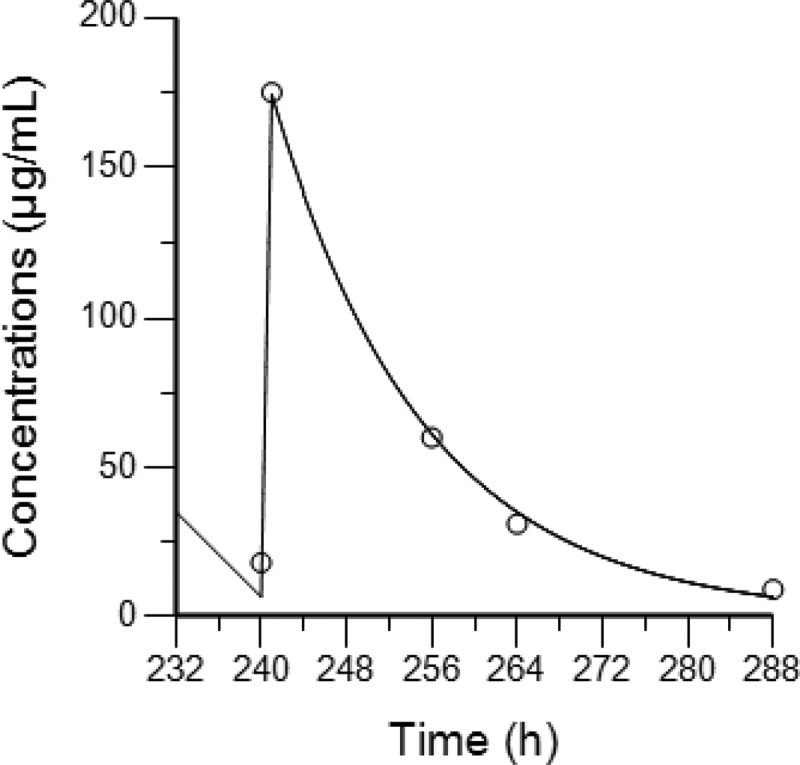
Daptomycin experimental (open squares) and predicted (solid line) concentrations 10 days (240 h) after adjusting the daptomycin dosing regimen to 10 mg/kg infused over 1 h every 48 h.
ACKNOWLEDGMENTS
This study was funded by Inserm U-1070.
We have no conflicts of interest to declare.
Footnotes
Published ahead of print 1 April 2013
REFERENCES
- 1. Kim A, Suecof LA, Sutherland CA, Gao L, Kuti JL, Nicolau DP. 2008. In vivo microdialysis study of the penetration of daptomycin into soft tissues in diabetic versus healthy volunteers. Antimicrob. Agents Chemother. 52:3941–3946 [DOI] [PMC free article] [PubMed] [Google Scholar]
- 2. Bhavnani SM, Rubino CM, Ambrose PG, Drusano GL. 2010. Daptomycin exposure and the probability of elevations in the creatine phosphokinase level: data from a randomized trial of patients with bacteremia and endocarditis. Clin. Infect. Dis. 50:1568–1574 [DOI] [PubMed] [Google Scholar]
- 3. Patel N, Cardone K, Grabe DW, Meola S, Hoy C, Manley H, Drusano GL, Lodise TP. 2011. Use of pharmacokinetic and pharmacodynamic principles to determine optimal administration of daptomycin in patients receiving standardized thrice-weekly hemodialysis. Antimicrob. Agents Chemother. 55:1677–1683 [DOI] [PMC free article] [PubMed] [Google Scholar]
- 4. Verdier MC, Bentue-Ferrer D, Tribut O, Collet N, Revest M, Bellissant E. 2011. Determination of daptomycin in human plasma by liquid chromatography-tandem mass spectrometry. Clinical application. Clin. Chem. Lab. Med. 49:69–75 [DOI] [PubMed] [Google Scholar]
- 5. Baietto L, D'Avolio A, De Rosa FG, Garazzino S, Michelazzo M, Ventimiglia G, Siccardi M, Simiele M, Sciandra M, Di Perri G. 2010. Development and validation of a simultaneous extraction procedure for HPLC-MS quantification of daptomycin, amikacin, gentamicin, and rifampicin in human plasma. Anal. Bioanal. Chem. 396:791–798 [DOI] [PubMed] [Google Scholar]
- 6. Cardone KE, Lodise TP, Patel N, Hoy CD, Meola S, Manley HJ, Drusano GL, Grabe DW. 2011. Pharmacokinetics and pharmacodynamics of intravenous daptomycin during continuous ambulatory peritoneal dialysis. Clin. J. Am. Soc. Nephrol. 6:1081–1088 [DOI] [PMC free article] [PubMed] [Google Scholar]