



Abstract
The fate of the interstitial atom of the nitrogenase cofactor during substrate turnover has remained a topic of interest since the discovery of this atom more than a decade ago. In this study, we labeled the interstitial carbide atom with 14C and 13C isotopes and traced the fate of the isotope under turnover conditions. Our results show that the interstitial carbide cannot be exchanged upon turnover, nor can it be used as a substrate and incorporated into the products. These observations point to a role of the interstitial carbide in stabilizing the cofactor structure, although a function of this atom in indirectly modulating the reactivity of cofactor or directly interacting with the substrate cannot be excluded.
Molybdenum (Mo) nitrogenase catalyzes the reduction of a wide range of substrates, such as N2, C2H2 and CO, at its iron-molybdenum cofactor (FeMoco) site.1,2 Arguably one of the most complex metalloclusters in biological systems, the FeMoco consists of two partial cubanes—a [MoFe3S3] subcluster and a [Fe4S3] subcluster—which are bridged by three μ2-sulfides and one μ6-carbide in between (Fig. 1).3,4 It also has an endogenous organic compound, homocitrate, attached to its Mo end (Fig. 1). The discovery of a μ6- coordinated carbide atom at the center of the metal-sulfur core of FeMoco has raised the interesting question of whether this interstitial atom participates in the substrate turnover of nitrogenase.4 However, there has been no effective means to monitor the flow of carbide until recently, when the methyl group of S-adenosyl-L-methionine (SAM) was identified as the source of this atom.5,6 Such a finding permits the specific labeling of the interstitial carbide7 by the [14C-methyl]- or [13C-methyl]-SAM and the subsequent tracing of the isotope in either the cofactor sample or the reaction products under turnover conditions.
Figure 1.
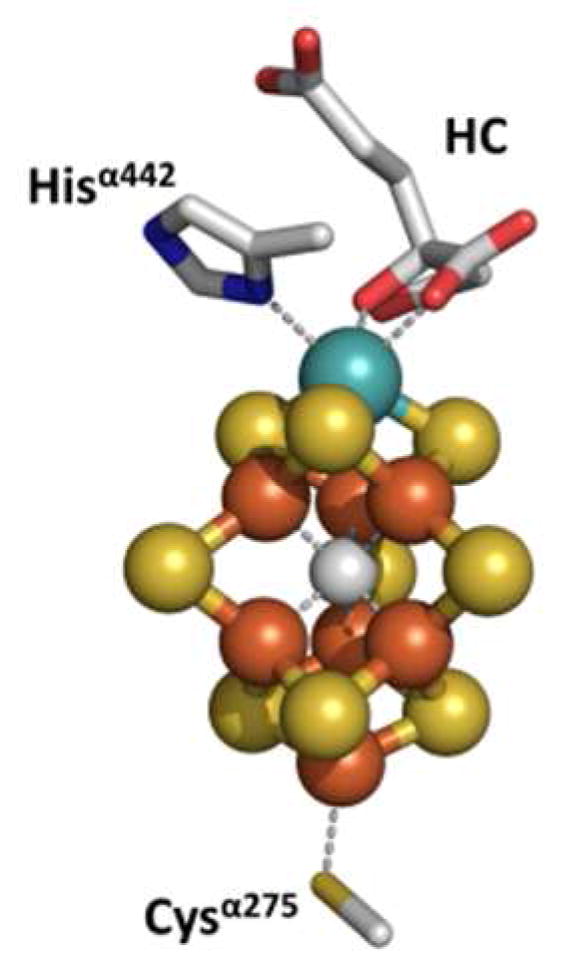
Structure of the FeMoco ([MoFe7S9Chomocitrate]). The cluster is shown as a ball-and-stick model, with the atoms colored as follows: Fe, orange; S, yellow; Mo, cyan; O, red; C, grey; and N, blue. PYMOL was used to generate this figure using PDB entry 3U7Q.
The fate of interstitial carbide was first examined by labeling it with 14C and determining whether the 14C label disappeared from the cofactor upon turnover. C2H2 and N2 were chosen as the substrates for this experiment, as they would be turned over rapidly by the Mo nitrogenase, thereby enabling a fast exchange of the interstitial carbide upon turnover. In addition, both substrates were allowed to undergo extended turnover process at large molar excess to the interstitial carbide, further ensuring the observation of a possible “dilution” of the 14C label in the cofactor during turnover. However, even under these conditions, the intensity of the 14C label in the cofactor sample remained unchanged after 3 hours of turnover with C2H2 and N2, suggesting that the interstitial carbide was not exchanged in these reactions (Fig. 2).
Figure 2.

Intensities of 14C labels in MoFe protein samples without turnover (A) or upon turnover of C2H2 (B) and N2 (C). Shown is the autoradiography detecting radiation of the 14C label in the MoFe protein-bound FeMoco. All MoFe protein samples contained an equivalent amount of 14C-labeled FeMoco.
The flow of the interstitial carbide was further traced by labeling it with 13C and determining whether the 13C label appeared in the products upon turnover. CO was chosen as the substrate for this experiment, as it would be turned over very slowly by the Mo nitrogenase, thereby preventing a quick dilution of the 13C label in the products in the case of fast-turnover substrates. In addition, the total amount of carbon in the products was kept at a sub-molar ratio to the amount of the interstitial carbide, further facilitating the enrichment of carbide in the hydrocarbon products. However, contrary to the observation of labeled products when 13CO was turned over by the unlabeled cofactor, no labeled product could be detected when 12CO was turned over by the 13Clabeled cofactor, suggesting that the interstitial carbide was not exchanged into the hydrocarbon products upon CO reduction (Fig. 3).
Figure 3.

GC-MS analysis of hydrocarbon products generated from the turnover of (A) 12CO by unlabeled FeMoco; (B) 13CO by unlabeled FeMoco; and (C) 12CO by 13C-labeled FeMoco. The relative intensity of each hydrocarbon product traced at a given mass is arbitrarily set at 100%.
The question of whether the interstitial atom is involved in substrate turnover was tackled even before this atom was identified as a carbide ion, and early ENDOR/ESEEM analyses demonstrated that this atom was not an exchangeable nitrogen atom.8 Here, we provide direct evidence that the interstitial carbide cannot be exchanged during turnover, nor can it be used as a substrate and incorporated into the products. These results point to a role of this interstitial atom in stabilizing the structure of the cofactor, providing certain “rigidity” to the metal-sulfur core through a symmetrical coordination of this atom to the six core Fe atoms of the cofactor (Fig. 1).
Interestingly, previous DFT calculations indicated that a more stable structure of FeMoco could be achieved by having an interstitial nitrogen or oxygen species rather than an interstitial carbon species.9,10 Consistent with these calculations, a recent study of N2 activation on iron metallaboratranes suggested that the presence of a carbide atom in the center of the FeMoco could allow variations of the Fe-C bond distances and adjustments of the overall geometry of the metal-sulfur core during the substrate turnover process.11 Thus, the possible function of this interstitial atom in nitrogenase catalysis—be it indirect in tuning the reactivity of the cofactor or direct in interacting with the substrates—cannot be excluded. The exact role of the interstitial carbide in nitrogenase mechanism merits further investigation.
Supplementary Material
Acknowledgments
This work was supported by National Institutes of Health grant GM-67626 (M.W.R.). We thank Prof. Joseph Jarrett (University of Hawaii at Manoa) for his generous supply of [13C-methyl] SAM.
Footnotes
Materials and Methods. This material is available free of charge via the Internet at http://pubs.acs.org.
References
- 1.Burgess BK, Lowe DJ. Chem Rev. 1996;96:2983–3012. doi: 10.1021/cr950055x. [DOI] [PubMed] [Google Scholar]
- 2.Hu Y, Lee CC, Ribbe MW. Dalton Trans. 2012;41:1118–1127. doi: 10.1039/c1dt11535a. [DOI] [PMC free article] [PubMed] [Google Scholar]
- 3.Kim J, Rees DC. Science. 1992;257:1677–1682. doi: 10.1126/science.1529354. [DOI] [PubMed] [Google Scholar]
- 4.Einsle O, Tezcan FA, Andrade SL, Schmid B, Yoshida M, Howard JB, Rees DC. Science. 2002;297:1696–1700. doi: 10.1126/science.1073877. [DOI] [PubMed] [Google Scholar]
- 5.Lancaster KM, Roemelt M, Ettenhuber P, Hu Y, Ribbe MW, Neese F, Bergmann U, DeBeer S. Science. 2011;334:974–977. doi: 10.1126/science.1206445. [DOI] [PMC free article] [PubMed] [Google Scholar]
- 6.Spatzal T, Aksoyoglu M, Zhang L, Andrade SL, Schleicher E, Weber S, Rees DC, Einsle O. Science. 2011;334:940. doi: 10.1126/science.1214025. [DOI] [PMC free article] [PubMed] [Google Scholar]
- 7.Wiig JA, Hu Y, Lee CC, Ribbe MW. Science. 2012;337:1672–1675. doi: 10.1126/science.1224603. [DOI] [PMC free article] [PubMed] [Google Scholar]
- 8.Lee HI, Benton PM, Laryukhin M, Igarashi RY, Dean DR, Seefeldt LC, Hoffman BM. J Am Chem Soc. 2003;125:5604–5605. doi: 10.1021/ja034383n. [DOI] [PubMed] [Google Scholar]
- 9.Hinnemann B, Norskov JK. J Am Chem Soc. 2003;125:1466–1467. doi: 10.1021/ja029041g. [DOI] [PubMed] [Google Scholar]
- 10.Xie H, Wu R, Zhou Z, Cao Z. J Phys Chem B. 2008;112:11435–11439. doi: 10.1021/jp803616z. [DOI] [PubMed] [Google Scholar]
- 11.Moret ME, Peters JC. J Am Chem Soc. 2011;133:18118–18121. doi: 10.1021/ja208675p. [DOI] [PMC free article] [PubMed] [Google Scholar]
Associated Data
This section collects any data citations, data availability statements, or supplementary materials included in this article.