



Abstract
Necrotising fasciitis (NF) is a rare infection of the fascial planes, which is less common in head and neck, because of the rarity and higher vascularity in the region. We report a case of necrotising fasciitis in a 43-year-old man, arising from a dental infection treated successfully by early diagnosis, prompt surgical management, antibiotic therapy and adjunctive hyperbaric oxygen (HBO) therapy. The diagnosis of descending NF must always be considered in a patient who presents with a history of oropharyngeal infection with evidence of neck swelling, chest pain, and dyspnea or respiratory distress. Aggressive surgical debridement of all involved tissue along with intravenous antibiotic therapy should be initiated before aerobic and anaerobic cultures are obtained. HBO may also be of some benefit in the treatment of this potentially fatal infection.
Background
Necrotising fasciitis (NF) is a rare, usually multimicrobial infection of the deep dermis and subcutaneous tissues, characterised by rapid invasion of soft connective tissue.1 Patients with immunocompromised status such as diabetes mellitus, cancer, alcoholism, vascular insufficiencies, organ transplants, HIV or neutropenia are prone to this type of infection.2 It affects predominantly the tissues of the abdominal wall, the perineum or the extremities.3 Localisation in the neck is very rare and usually occurs secondary to dental infection. Once initiated, the disease progresses rapidly through contiguous facial spaces causing necrosis of fascia and the overlying skin which is the hallmark of this condition. Necrosis of muscle, gland tissue and bone can also lead to considerable destruction.4 These infections can be difficult to recognise in their early stages, but they progress rapidly and require aggressive treatment to combat the associated high morbidity and mortality.
Case presentation
A 43-year-old man presented with a tender neck and chest swelling, dyspnoea, fever and chest pain on inspiration preceded by toothache of 1 month duration. He stated that about 1 week earlier, his right jaw began to swell with associated tenderness and erythema. He denied history of drug abuse (except alcohol), diabetes mellitus or dental extraction. The patient has mild respiratory distress, no stridor or wheezing. The head and neck examinations were remarkable for tender, erythematous, crepitant swelling over the neck extending from the right submandibular region. There was sloughing of epidermis tissue over the involved area with no fistula or drainage noted. The examination of the oral cavity was remarkable for a foul, putrid odour with multiple carious teeth and mild trismus. There was a grossly carious right second mandibular molar with purulence at the gingival border. Chest radiograph revealed no mediastinal widening or infiltration.
Investigations
The blood picture is normal apart from elevated leucocyte count. CT scan showed multiple air-filled and pus-filled pockets in the neck and there is no involvement of mediastinum.
The culture revealed predominance of aerobic and anaerobic streptococci and staphylococci along with Gram-negative species. Gentamycin was added to the existing regimen.
Treatment
The patient was taken for surgery for incision and drainage of the submandibular region and submental region. Grey, foul-smelling, necrotic fascia and brown-grey, dishwater-coloured fluid were found. After removal of apparent necrotic tissue, high-pressure irrigation was used throughout the surgical site. The patient was started on ampicillin/sulbactam 3 gm and metronidazole 500 mg, intravenously every 8 h. Postoperatively, the patient developed an area of necrosis of overlying skin and was scheduled to return to the operating department after 3 days for further debridement (figure 1). Postoperative hyperbaric oxygen therapy (HBO) was started twice daily, lasting 1.5 h at 2.5 atmospheres for 7 days.
Figure 1.
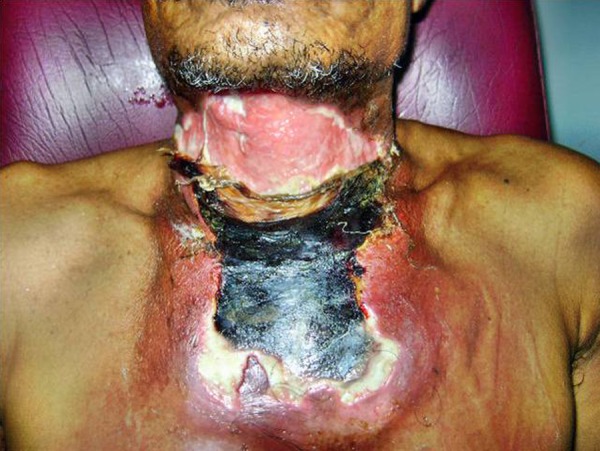
Necrosis of platysma muscle and superficial fascia of the neck.
Outcome and follow-up
The general condition of the patient improved after commencement of HBO therapy and the resultant well-granulated wound (figure 2) is covered by split skin graft.
Figure 2.
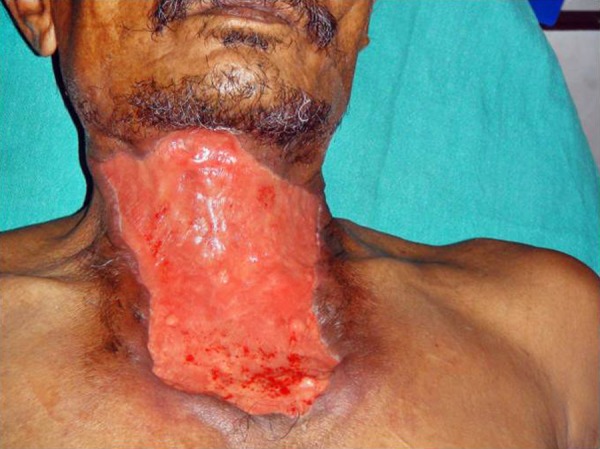
Well-granulated wound after hyperbaric oxygen therapy.
Discussion
Dental pathology is responsible for most cases of NF in the head and neck and has also been reported after penetrating and blunt trauma, burns, insect bites and as a result of peritonsillar abscess.5 During the early stages, pain can be the presenting symptom; cutaneous necrosis owing to thrombosis of nutrient vessels becomes apparent by the fourth or fifth day. Eventually, the necrotic tissue begins to separate by suppuration by the eighth day.6 As the necrotising process continues to spread, soft tissue components below and above the affected fascia may become involved. Complications such as airway obstruction, mediastinitis, pleural empyema, large vessel thrombosis and septic shock may be fatal.7
Four factors that contribute significantly to morbidity and mortality of NF are (1) delayed treatment, often owing to difficulty in recognising the condition; (2) inappropriate treatment; (3) host debilitation and (4) a polymicrobial infection.8 The mortality rate for NF is significant, approaching 73% despite the treatment with appropriate antibiotics. A delay in diagnosis is speculated to be the most likely reason for the significant mortality.9 Adjunctive HBO therapy might decrease the mortality and limit the extent of debridement in patients with NF, but the results have been conflicting. HBO reinstates the defense against infection by increasing free radicals, which helps neutrophil-mediated killing of some common bacteria. In addition, HBO therapy acts as a bactericide for certain anaerobes. HBO reduces the mortality, shortens the duration of hospitalisation and decreases the required number of surgical debridements.10
Learning points.
Diagnosis of descending necrotising fasciitis must always be considered in a patient who presents with a history of oropharyngeal infection with evidence of neck swelling, chest pain and dyspnea or respiratory distress.
Delay in diagnosis is speculated to be the most likely reason for the significant mortality.
Aggressive surgical debridement of all involved tissue along with intravenous antibiotic therapy should be initiated before aerobic and anaerobic cultures are obtained.
Hyperbaric oxygen may also be of some benefit in the treatment of this potentially fatal infection.
Footnotes
Competing interests: None.
Patient consent: Obtained.
Provenance and peer review: Not commissioned; externally peer reviewed.
References
- 1.Shimizu T, Tokuda Y. Necrotizing fasciitis. Inter Med 2010;2013:1051–7 [DOI] [PubMed] [Google Scholar]
- 2.Lanisnik B, Cizmarevic B. Necrotizing fasciitis of the head and neck: 34 cases of a single institution experience. Eur Arch Otorhinolaryngol 2010;2013:415–21 [DOI] [PubMed] [Google Scholar]
- 3.Seyhan T, Ertas NM, Borman H. Necrotizing fasciitis of the chest wall with a retropharyngeal abscess: case report and literature review. Ann Plast Surg 2008;2013:544–8 [DOI] [PubMed] [Google Scholar]
- 4.Malik V, Gadepalli C, Agrawal S, et al. An algorithm for early diagnosis of cervicofacial necrotizing fasciitis. Eur Arch Otorhinolaryngol 2010;2013:1169–77 [DOI] [PubMed] [Google Scholar]
- 5.Nyako EA, Nartery NO. Necrotizing fasciitis of the submandibular region. Ghana Med J 2006;2013:65–8 [DOI] [PMC free article] [PubMed] [Google Scholar]
- 6.Muto T, Sato K, Kanazawa M. Necrotizing fasciitis of the neck and chest: report of a case. Int J Oral Maxillofac Surg 1992;2013:236–8 [DOI] [PubMed] [Google Scholar]
- 7.Oguz H, Demirci M, Arslan N, et al. Necrotizing fasciitis of the head and neck: report of two cases and literature review. Ear Nose Throat J 2010;2013:E7–10 [PubMed] [Google Scholar]
- 8.Edwards JD, Sadeghi N, Najam F, et al. Craniocervical necrotizing fasciitis of odontogenic origin with mediastinal extension. Ear Nose Throat J 2004;2013:579–82 [PubMed] [Google Scholar]
- 9.Taviloglu K, Yanar H. Necrotizing fasciitis: strategies for diagnosis and management. World J Emerg Surg 2007;2013:19. [DOI] [PMC free article] [PubMed] [Google Scholar]
- 10.Flanagan CE, Daramola OO, Maisel RH, et al. Surgical debridement and adjunctive hyperbaric oxygen in cervical necrotizing fasciitis. Otolaryngol Head Neck Surg 2009;2013:730–4 [DOI] [PubMed] [Google Scholar]