



Abstract
A 62-year-old Caucasian woman, with remote history of painful skin blistering and hypertrichosis, recent history of travel to Mexico and increased alcohol consumption, presented with progressively worsening jaundice and fatigue. Physical examination was remarkable for severe generalised jaundice, scleral icterus and erythematous facial blistering and scarring. Laboratory workup revealed markedly elevated total and direct bilirubin, mildly elevated transaminases, severe iron overload and increased urine coproporphyrin. Porphyria cutanea tarda was diagnosed, and she was treated with supportive measures including hydration and alcohol cessation. Pathology of her liver demonstrated mild iron overload and severe fatty infiltration. Hospital follow-up revealed complete resolution of jaundice and fatigue and near-normalisation of liver function tests.
Background
Porphyria cutanea tarda (PCT) is a complex and multifactorial disease that most often manifests clinically with skin lesions and is also associated with significant metabolic and histopathological abnormalities in the liver. Hepatic pathology in PCT may include siderosis, steatosis, fibrosis, cirrhosis, acute inflammation and dysplasia. This case illustrates that in a patient with underlying PCT, additional insults to the liver such as alcohol and excess iron can cause severe injury, even leading to acute liver failure. It is imperative for clinicians to recognise the multiple genetic and environmental factors that may uncover or worsen PCT, because this disease is easily treated and may lead to severe liver damage if neglected.
Case presentation
A 62-year-old Caucasian woman presented with progressively worsening jaundice and fatigue. She had come directly to the hospital after returning home from a week-long trip to Mexico. While in Mexico, she had developed rapidly worsening jaundice and debilitating fatigue. She reported having been confined to a wheelchair for the past 2 days due to weakness. She recalled having recurrent episodes of scleral icterus accompanied by fatigue over the past year, but these episodes were self-limited. Prior to departing for Mexico, her friends and husband had mentioned that she seemed to be turning more yellow. During her time in Mexico, she reported sunbathing several hours daily and consuming two to three vodka drinks per day. She revealed that she and her husband have taken thrice-annual vacations in Mexico for the past 5 years.
A review of systems revealed decreased appetite, darkening of her urine and worsening lower extremity oedema over the past 2 months.
Her history revealed greater than 10 years of painful blistering of her sun-exposed upper and lower extremities. During a prior evaluation by a dermatologist for this rash and hypertrichosis, phlebotomy was recommended, but the patient declined. She denied any history of infectious hepatitis or HIV.
At the time of admission, her vital signs were stable within normal limits. Examination of her skin revealed severe generalised jaundice most notable in the face and upper chest, scleral icterus, multiple dark red punctate eschars over the upper lip and forehead, several small blisters on the tip of her nose (figure 1) and 1+ pitting oedema of the lower legs bilaterally. Gross examination of her urine demonstrated a red–brown hue compared to normal (figure 2). She had no abdominal pain, organomegaly, ascites, palmar erythema, spider angiomata, telangiectasias or asterixis.
Figure 1.
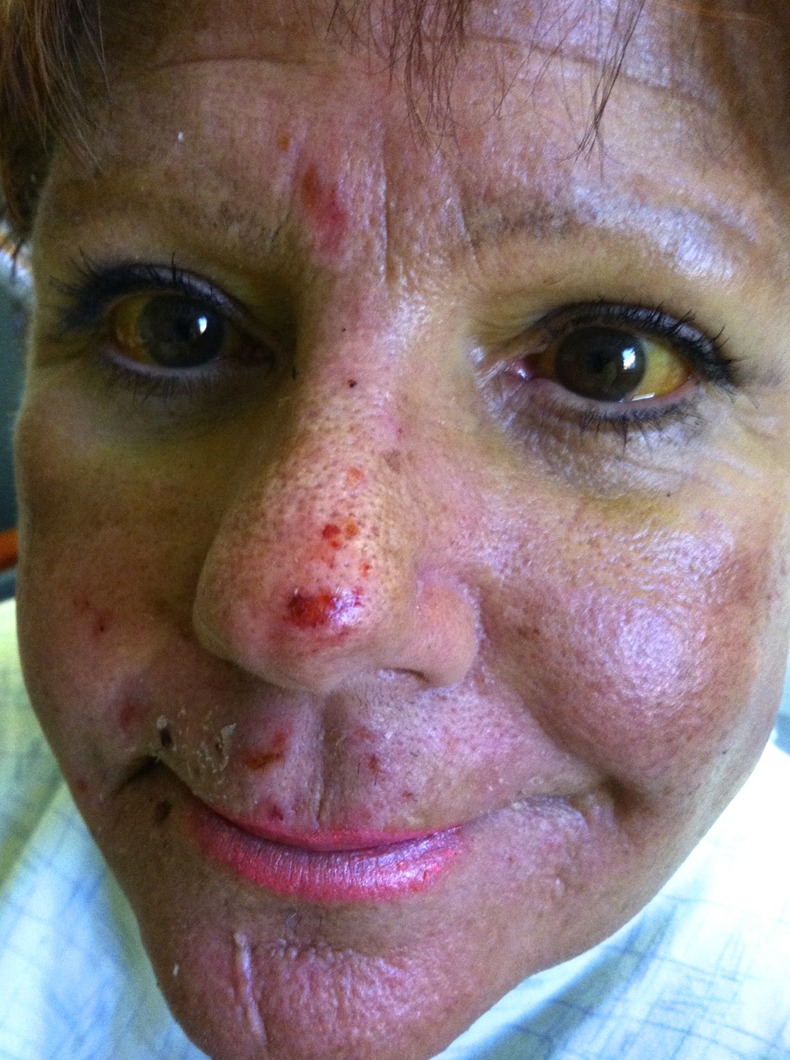
The patient's face, showing hyperpigmentation, periorbital jaundice and multiple stages of vesicular skin lesions on the forehead, nose and lips.
Figure 2.
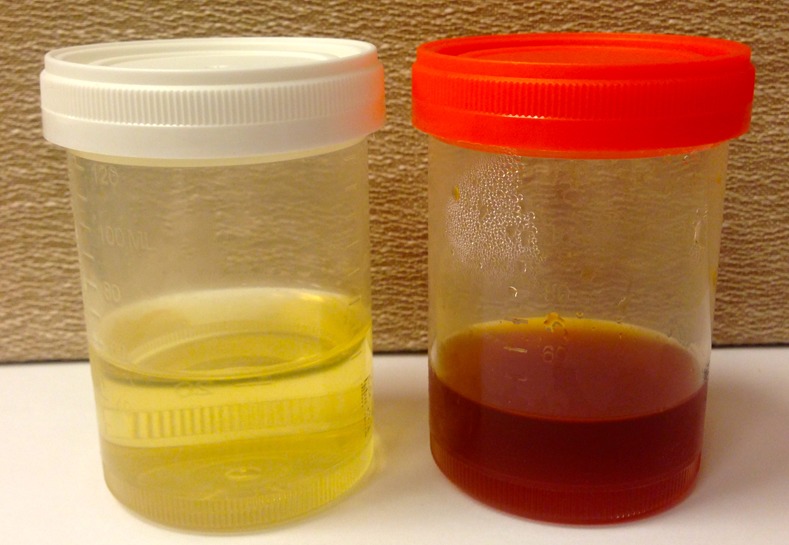
The patient's urine (right) after several hours of natural light exposure, showing the reddish brown colour characteristic of porphyria cutanea tarda. Compare to normal urine on the left.
Investigations
Laboratory results at this time revealed a haemoglobin 10.2 g/dL (12–16 g/dL), mean corpuscular volume 105.6 fL (80–99 fL), sodium 126 mEq/L (135–153 mEq/L), potassium 2.1 (3.5–5.3 mEq/L), aspartate aminotransferase (AST) 142 IU/L (9–33 IU/L), alanine aminotransferase (ALT) 71 IU/L (2–38 IU/L), alkaline phosphatase (ALP) 327 IU/L (38–110 IU/L), total bilirubin 26.2 mg/dL (0.2–1.1 mg/dL), direct bilirubin 14.9 mg/dL (0.0–0.4 mg/dL), albumin 2.6 g/dL (3.4–4.6 g/dL), ferritin 1 803 ng/mL (27–300 ng/mL), iron saturation 96% (15–50%) and an international normalised ratio (INR) 1.2.
The patient was admitted for the evaluation of jaundice and fatigue. Her hepatitis panel, HIV test and autoimmune antibodies (antinuclear, antimitochondrial and antismooth muscle) were negative. Abdominal ultrasound and CT both demonstrated an enlarged liver with diffuse steatosis without significant ductal dilation (figure 3). Genetic testing for hereditary haemochromatosis (HH) was performed by PCR and was negative for C282Y, H63D and S65C gene mutations.
Figure 3.
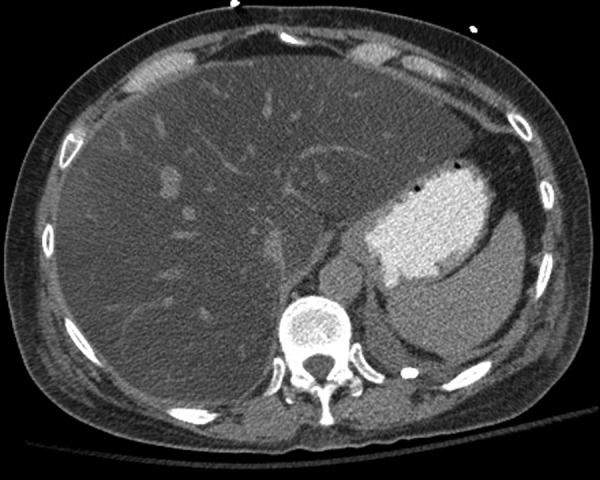
CT of the patient's abdomen, demonstrating a homogenously hypodense liver parenchyma representing fatty infiltration and which is consistent with diffuse hepatic steatosis.
A liver biopsy was performed to further characterise the pattern of injury, and revealed widespread steatohepatitis with extensive fibrosis in the portal zones, suggestive of cirrhosis. Acute neutrophilic inflammation was superimposed on chronic lymphocytic inflammation. Visualised canalicular plugging suggested bile stasis. Additionally, there was moderately increased intracellular iron; a quantitative iron assay was normal at 1424 μg/g (400–1600 μg/g) and hepatic iron index was normal at 0.4 μmol/g/year (<1.0 μmol/g/year; figures 4 and 5). A 24 h urine porphyrin screen demonstrated mild elevation of coproporphyrin at 172 μg (<168 μg), but a normal level of uroporphyrin at 9 μg (<45 μg) and all other intermediate porphyrins.
Figure 4.
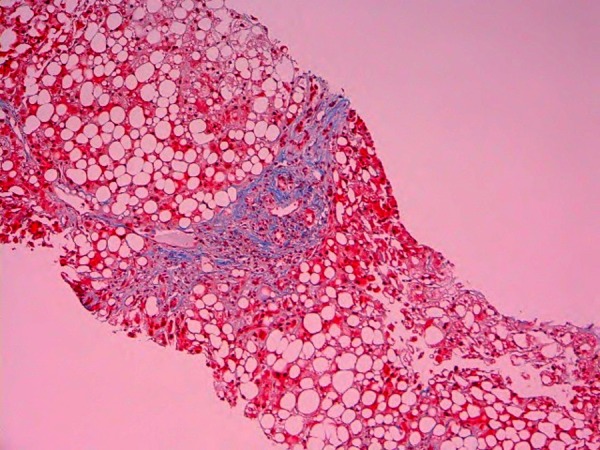
Liver biopsy specimen, using trichrome stain under ×10 magnification, demonstrating widespread steatosis (unstained fat lobules), pericellular fibrosis (blue) around individual hepatocytes and portal fibrosis with bridging consistent with cirrhosis.
Figure 5.
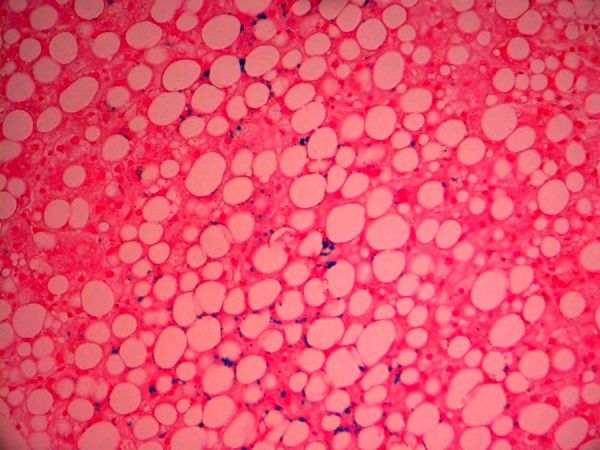
Liver biopsy specimen, using Perls’ Prussian blue stain under ×20 magnification, showing 2+ (moderate) hepatocellular iron deposition (blue).
Differential diagnosis
The clinical evaluation of jaundice begins with the investigation of serum bilirubin levels. In our patient, both her total and conjugated bilirubin were significantly elevated, so our broad differential diagnosis on admission included hepatocellular disease and impaired bile excretion. Because she had no abdominal pain and no imaging evidence of ductal dilation, extrahepatic biliary obstruction was considered unlikely.
Liver function tests revealed significant elevation in ALP (327 IU/L) relative to elevation of transaminases (AST 142 and ALT 71 IU/L), suggesting primarily cholestatic disease rather than direct hepatocellular injury. However, chronic liver disease with later-stage cirrhosis may present with normal or only mild elevations in transaminase levels.
It is well known that an AST:ALT ratio of 2:1 or greater strongly correlates with alcoholic liver disease.1 The degree of elevation of our patient's transaminases also fits with alcoholic liver disease, and her chronic consumption of alcohol as well as the fatty changes seen on liver biopsy further supports this diagnosis.
Given her frequent travel to Mexico, viral hepatitis was also initially high on the differential diagnosis. Hepatitis A has an intermediate prevalence and hepatitis B has a low prevalence in Mexico according to the Centers for Disease Control.2 3 Our patient gave no history of intravenous drug abuse, blood transfusions, high-risk sexual behaviour or tattooing to provoke concern for hepatitis C. Furthermore, we would expect her transaminases to be more elevated (>1000) in viral hepatitis. Antibody and antigen testing for hepatitis A, B and C were negative.
With an iron saturation of 96% and a ferritin level of 1803 ng/mL on admission, iron overload was another contributing factor to our patient's liver disease. There was no history of HH, and testing for the three most common mutations in the HFE gene (C282Y, H63D and S65C) was negative. Histopathological examination of her liver revealed only mildly increased iron, and a quantitative iron assay was within normal limits. Her ferritin may have been somewhat artificially elevated due to acute inflammation within the liver, and we were unable to determine whether an inborn error of iron metabolism was present. Notably, high ferritin levels are common in alcoholic liver disease, which may explain this finding.
Given that patients with autoimmune hepatitis can present in a variety of different ways, we sought to rule out this diagnosis. Generally, elevated aminotransferase levels predominate, and like viral hepatitis values may be >1000 IU/L.4 Initial workup includes serum protein electrophoresis, antinuclear antibodies, antismooth muscle antibodies and antiliver–kidney type 1 antibodies,5 all of which were negative in our patient.
With a picture of intrahepatic cholestasis and female gender, primary biliary cirrhosis and primary sclerosing cholangitis were considered on our differential. Antimitochondrial antibodies were negative, imaging showed no biliary dilation and histopathological examination was incongruent with these disorders.
PCT and HH are both associated with an increased risk for developing hepatocellular carcinoma (HCC), but it is unclear whether these relationships are independent of one another. Our patient had lost weight unintentionally, so we did have concerns of possible malignancy. We considered HCC, as well as cholangiocarcinoma, pancreatic adenocarcinoma and ampullary carcinoma. Fortunately, imaging and pathology results showed no evidence of dysplasia.
Treatment
Therapeutic phlebotomy is the standard of care for PCT and was considered in our patient. Our patient's jaundice and fatigue improved rapidly with supportive treatment, including intravenous hydration and cessation of alcohol use. On hospital discharge, we recommended a complete cessation of alcohol consumption.
Outcome and follow-up
Over the next several days, our patient's jaundice and fatigue improved dramatically with supportive treatment. She had neither asterixis nor encephalopathy throughout her stay. Her haemoglobin remained stable and her bilirubin levels declined. She was discharged to an acute rehabilitation facility, where she resided for 8 days before returning home. She was counselled to avoid prolonged sun exposure, wear protective clothing and zinc oxide sunscreen, abstain from alcohol and tobacco and avoid taking oestrogen supplements, as these are all known to exacerbate her disease. Two weeks following discharge, total and direct bilirubin levels remained elevated but continued to trend downward (9.7 and 5.4 mg/dL, respectively). At a 1-month follow-up appointment, she reported feeling much more energetic and her jaundice had completely subsided. At that time, AST was only mildly elevated at 54 IU/L and ALT was within normal limits at 28 IU/L. Mild anaemia continued to limit therapeutic phlebotomy, but was recommended when her haemoglobin normalised.
Discussion
This case exemplifies the complexity involved in the workup of unknown hepatic disease and demonstrates that an injury to the liver may be multifactorial and insults may be additive. Our patient carried a presumptive diagnosis of PCT based on clinical history alone, but this disease was clinically unapparent for many years before she presented with worsening jaundice and fatigue. We propose that her acute hepatic failure was caused by multiple insults to her probable underlying PCT. We will discuss the disease in general and describe its associations with alcohol, iron overload, HH, hepatitis C and sunlight exposure.
Originally deemed ‘chronic hematoporphyria’ by Günther in 1911, the name ‘porphyria cutanea tarda’ was adopted in 1937 by Waldenström to emphasise its cutaneous manifestations and late onset.6 PCT is caused by the impaired activity of one of the enzymes involved in the biosynthesis of the haem molecule, uroporphyrinogen decarboxylase (UROD). UROD catalyses the conversion of uroporphyrinogen to coproporphyrinogen (figure 6). Therefore, the impairment of UROD leads to the accumulation of uroporphyrin and other porphyrins in various organs, including the skin and liver.7 Increased porphyrins cause skin fragility and hepatocellular damage. PCT is the only type of porphyria that is not exclusively inherited as a monogenetic trait, as acquired and hereditary forms have been described.8
Figure 6.
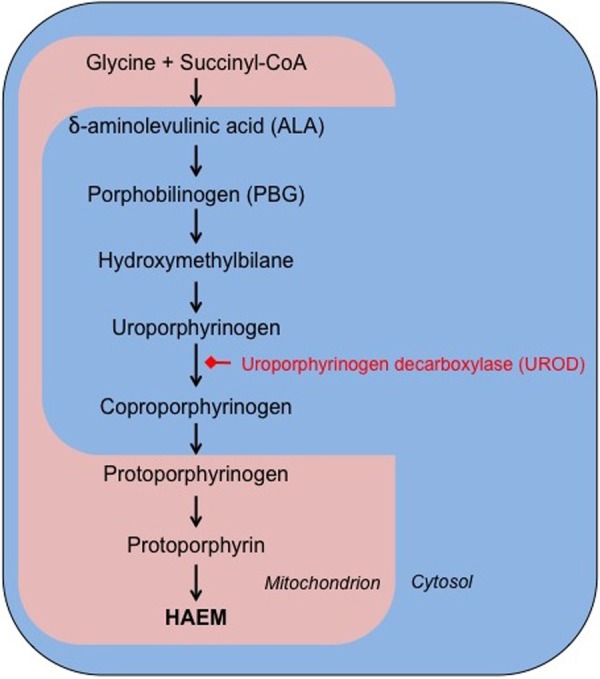
Diagram of haem biosynthesis, with uroporphyrinogen decarboxylase (UROD), the enzyme affected in porphyria cutanea tarda, highlighted in red. UROD catalyses the transformation of uroporphyrinogen into coproporphyrinogen.
The prevalence of symptomatic PCT has been cited as between 1 in 10 000 and 25 000 patients.9 10 The sex ratio is approximately equal, and the onset is typically greater than age 30.
Genetic factors may predispose certain individuals to developing some forms of PCT. However, over 100 mutations in the UROD gene have been identified, and genetic testing is generally not performed.11 In addition, HH is a known susceptibility factor for developing PCT. HH is most often caused by mutations in the HFE gene, so individuals with suspected HH or PCT are often tested for three mutations in this gene: C282Y, H63D and S65C.12 13
PCT most often manifests in the skin and is frequently identified by dermatologists. Cutaneous findings include blisters, bullae, skin fragility, changes in pigmentation and photosensitivity that typically occur on the dorsum of the hands, forearms and face. Hirsutism is also common, especially involving the cheeks, temples and forearms.11 Our patient exhibited several of these features, although temporal variability made the initial diagnosis difficult.
The liver is the second most commonly affected organ in PCT. Hepatic manifestations vary, but PCT is typically associated with at least mild elevations in transaminase levels. Hepatic injury in PCT can result from the accumulation of porphyrins, which damage hepatocytes or from the variety of other susceptibility factors in developing the disease, including iron overload, alcohol intake and hepatitis C infection. Pathology may include steatosis, siderosis, fibrosis, cirrhosis, acute inflammation and dysplasia.
The most interesting aspect of our case is that it displays several of the common associations and complications that provoke or exacerbate PCT.
First, alcohol intake is a well-established susceptibility factor in the development and presentation of PCT.7 Ethanol is an inducer of early enzymes in haem biosynthesis and an inhibitor of UROD.14 15 Furthermore, chronic alcoholism inhibits erythropoiesis, thereby increasing the absorption of dietary iron and contributing to the iron overload associated with PCT.16
Iron overload itself is known to exacerbate PCT, and evidence of hepatic iron overload is present in nearly all clinically overt cases of PCT.11 Much research has been dedicated to the relationship between iron overload, HH and PCT, but the exact physiological mechanisms are not well described.17 One recent review proposes that like ethanol, iron induces early enzymes in haem biosynthesis and inhibits UROD.18 These authors suggest that while iron overload contributes to PCT, iron alone is not sufficient to cause porphyrin overproduction in the absence of other factors. Indeed, most literature suggests that PCT is particularly common when chronic alcoholism and iron overload occur synergistically.11
With its propensity to overload the liver with iron, HH is another well-known susceptibility factor for the development of PCT. One study suggests that up to two-thirds of patients with PCT have mutations in the HFE gene.19 Accordingly, genetic testing for HFE gene mutations is reasonable for all patients with PCT.
Hepatitis C is yet another known contributor to the development of PCT. Fargion et al first described this strong association in 1992, identifying hepatitis C infection in over 75% of PCT patients in a small Italian cohort.20 The pathophysiology provoking PCT may involve oxidative stress of hepatocytes and increased iron absorption by dysregulating hepcidin production in the liver.21 22
Other known exacerbants and contributors to the development of PCT include tobacco use, HIV infection, supplemental oestrogen use and hexachlorobenzene exposure.23–25
Diagnosis of PCT was previously based on dermatological clues and on the examination of the patient's urine under a Wood's lamp. Owing to increased excretion of porphyrins, urine turns reddish brown in natural light (figure 2) and fluoresces pink under Wood's lamp.7 However, these observations are neither sensitive nor specific, and the current recommendations for diagnosis of PCT involve specific biochemical analyses. Increases in porphyrin levels can be demonstrated in the plasma, urine or faeces. In plasma and urine, there is predominance of uroporphyrin, heptacarboxylated porphyrins and coproporphyrin, and in the faeces, coproporphyrin and isocoproporphyrin predominate.11 Erythrocyte porphyrins are often normal in PCT, in contrast to the marked elevations in several other porphyrias. The measurement of erythrocyte UROD activity may help identify UROD mutations, but molecular studies are more accurate.26
Of note, liver biopsy with histopathological examination is not necessary to diagnose PCT.11 With presumptive clinical findings and confirmation using biochemical investigations, the diagnosis of PCT is confirmed. Furthermore, liver biopsy is not without complications, especially in patients with known hepatic coagulopathy. When liver biopsy is considered, the risk of complication from external trauma should be weighed against the possible benefit of identifying specific hepatic pathology.
Non-medical therapy for PCT includes the avoidance of sunlight and cessation of alcohol and tobacco use. The avoidance of UV light is both prophylactic and therapeutic, as blistering skin lesions can be very painful.11
Therapeutic phlebotomy to remove excess iron has long been the mainstay of medical treatment of PCT. Most protocols recommend either biweekly removal of 500 mL or weekly removal of 300 mL of blood. The therapeutic goal is normalisation of serum ferritin levels, but anaemia should be avoided.11 With repeated phlebotomy, remission of skin lesions may occur in less than 4 months. Iron chelation therapy has also shown some benefit.27
Chloroquine and hydroxychloroquine are options available to patients who do not tolerate repeated phlebotomy. Proposed mechanisms include the inhibition of porphyrin synthesis and the acceleration of porphyrin excretion.11 Standard therapy is 125 mg of chloroquine twice weekly.28 Combination therapy with phlebotomy may induce remission faster than either modality alone.
Learning points.
Porphyria cutanea tarda (PCT) is a complex, multifactorial disease that most often manifests clinically with a variety of skin lesions, and is also associated with significant metabolic and histopathological abnormalities in the liver.
Alcohol and tobacco use, iron overload (alone or in conjunction with HH), hepatitis C infection and supplemental oestrogen use may all exacerbate or precipitate the onset of PCT.
Repeated phlebotomy remains the mainstay of treatment, but low-dose chloroquine is a valuable therapeutic alternative.
Physicians must recognise the clinical manifestations and complications of PCT because it is easily treated, yet can lead to severe hepatic damage if neglected.
Footnotes
Competing interests: None.
Patient consent: Obtained.
Provenance and peer review: Not commissioned; externally peer reviewed.
References
- 1.Cohen JA, Kaplan MM. The SGOT/SGPT ratio—an indicator of alcoholic liver disease. Dig Dis Sci 1979;2013:835–8 [DOI] [PubMed] [Google Scholar]
- 2.Sharapov UM, Hepatitis A. In: Brunette GW, Control CfD. eds. CDC Health information for international travel 2012: the yellow book. New York, NY: Oxford University Press, 2012:173–8 [Google Scholar]
- 3.Teshale EH, Hepatitis B. In: Brunette GW, Control CfD. eds. CDC Health information for international travel 2012: the yellow book. New York, NY: Oxford University Press, 2012:179–84 [Google Scholar]
- 4.Kessler WR, Cummings OW, Eckert G, et al. Fulminant hepatic failure as the initial presentation of acute autoimmune hepatitis. Clin Gastroenterol Hepatol 2004;2013:625–31 [DOI] [PubMed] [Google Scholar]
- 5.Krawitt EL. Autoimmune hepatitis. N Engl J Med 2006;2013:54–66 [DOI] [PubMed] [Google Scholar]
- 6.Waldenström J. Studien über porphyrie. Acta medica Scandinavica 1937;2013(Suppl):S84–90 [Google Scholar]
- 7.Bickers D, Frank J. The porphyrias. In: Wolff K, Goldsmith L, Katz S, Gilchrest B, Paller A, Leffell D. eds. Fitzpatrick's dermatology in general medicine. 7th edn. McGraw Hill, 2007:1228–56 [Google Scholar]
- 8.Lambrecht RW, Thapar M, Bonkovsky HL. Genetic aspects of porphyria cutanea tarda. Semin Liver Dis 2007;2013:99–108 [DOI] [PubMed] [Google Scholar]
- 9.Harber L, Bickers D. Photosensitivity diseases: principles of diagnosis and treatment. Philadelphia: WB Saunders, 1981:189 [Google Scholar]
- 10.Schanbacher CF, Vanness ER, Daoud MS, et al. Pseudoporphyria: a clinical and biochemical study of 20 patients. Mayo Clin Proc 2001;2013:488–92 [DOI] [PubMed] [Google Scholar]
- 11.Frank J, Poblete-Gutiérrez P. Porphyria cutanea tarda—when skin meets liver. Best Pract Res Clin Gastroenterol 2010;2013:735–45 [DOI] [PubMed] [Google Scholar]
- 12.Elder GH, Worwood M. Mutations in the hemochromatosis gene, porphyria cutanea tarda, and iron overload. Hepatology 1998;2013:289–91 [DOI] [PubMed] [Google Scholar]
- 13.Mura C, Raguenes O, Férec C. HFE mutations analysis in 711 hemochromatosis probands: evidence for S65C implication in mild form of hemochromatosis. Blood 1999;2013:2502–5 [PubMed] [Google Scholar]
- 14.Louis CA, Wood SG, Walton HS, et al. Mechanism of the synergistic induction of CYP2H by isopentanol plus ethanol: comparison to glutethimide and relation to induction of 5-aminolevulinate synthase. Arch Biochem Biophys 1998;2013:239–47 [DOI] [PubMed] [Google Scholar]
- 15.McColl KE, Thompson GG, Moore MR, et al. Acute ethanol ingestion and haem biosynthesis in healthy subjects. Eur J Clin Invest 1980;2013:107–12 [DOI] [PubMed] [Google Scholar]
- 16.Hourihane DO, Weir DG. Suppression of erythropoiesis by alcohol. BMJ 1970;2013:86–9 [DOI] [PMC free article] [PubMed] [Google Scholar]
- 17.Sampietro M, Fiorelli G, Fargion S. Iron overload in porphyria cutanea tarda. Haematologica 1999;2013:248–53 [PubMed] [Google Scholar]
- 18.Ryan Caballes F, Sendi H, Bonkovsky HL. Hepatitis C, porphyria cutanea tarda and liver iron: an update. Liver Int 2012;2013:880–93 [DOI] [PMC free article] [PubMed] [Google Scholar]
- 19.Teubner A, Richter M, Schuppan D, et al. Hepatitis C, hemochromatosis and porphyria cutanea tarda. Dtsch Med Wochenschr 2006;2013:691–5 [DOI] [PubMed] [Google Scholar]
- 20.Fargion S, Piperno A, Cappellini MD, et al. Hepatitis C virus and porphyria cutanea tarda: evidence of a strong association. Hepatology 1992;2013:1322–6 [DOI] [PubMed] [Google Scholar]
- 21.Korenaga M, Okuda M, Otani K, et al. Mitochondrial dysfunction in hepatitis C. J Clin Gastroenterol 2005;2013(4 Suppl 2):S162–6 [DOI] [PubMed] [Google Scholar]
- 22.Miura K, Taura K, Kodama Y, et al. Hepatitis C virus-induced oxidative stress suppresses hepcidin expression through increased histone deacetylase activity. Hepatology 2008;2013:1420–9 [DOI] [PubMed] [Google Scholar]
- 23.Jalil S, Grady JJ, Lee C, et al. Associations among behavior-related susceptibility factors in porphyria cutanea tarda. Clin Gastroenterol Hepatol 2010;2013:297–302 e1. [DOI] [PMC free article] [PubMed] [Google Scholar]
- 24.Drobacheff C, Derancourt C, Van Landuyt H, et al. Porphyria cutanea tarda associated with human immunodeficiency virus infection. Eur J Dermatol 1998;2013:492–6 [PubMed] [Google Scholar]
- 25.Can C, Nigogosyan G. Acquired toxic porphyria cutanea tarda due to hexachlorobenzene. Report of 348 cases caused by this fungicide. JAMA 1963;2013:88–91 [PubMed] [Google Scholar]
- 26.Aarsand AK, Boman H, Sandberg S. Familial and sporadic porphyria cutanea tarda: characterization and diagnostic strategies. Clin Chem 2009;2013:795–803 [DOI] [PubMed] [Google Scholar]
- 27.Rocchi E, Cassanelli M, Borghi A, et al. Liver iron overload and desferrioxamine treatment of porphyria cutanea tarda. Dermatologica 1991;2013:27–31 [DOI] [PubMed] [Google Scholar]
- 28.Ashton RE, Hawk JL, Magnus IA. Low-dose oral chloroquine in the treatment of porphyria cutanea tarda. Br J Dermatol 1984;2013:609–13 [DOI] [PubMed] [Google Scholar]