



Abstract
Background and Aims: The purpose of the study was to determine for the first time the effects of a weight loss diet with or without exercise on body fat levels and other anthropometrical characteristics in overweight and obese Cypriot adults.
Methods: Three hundred and thirty seven overweight and obese subjects were assigned randomly to either a diet only (DO) or diet and exercise group (DE) for an 18-week period. Both groups received an energy reduced diet of 1500 ± 200 Kcal. Furthermore, the DE group received specific dietary and activity guidelines involving a moderate intensity activity level included any of the following 3 criteria of ACSM guidelines and behavior modification consultation. All data analyses were performed by using the SPSS(v. 16.5) and the level of statistical significance was set at p < 0.05.
Results: No significant differences were observed in both DO and DE groups during baseline period. During the intervention period weight, BMI and WC decreased significantly in DO group (p<0.001). In addition, body fat levels were found to be significantly reduced (p<0.001) in the DE group compared with the DO group. In multiple regression analysis Body fat levels were independently associated with weight (Beta: 0.569, 95%CI: 0.157-1.296, P<0.001) BMI (Beta: 0.295, 95%CI:0.088-1.214, P<0.01) and WC (Beta:0.206, 95%CI:0.095-0.954, P<0.001) after adjustment of age and gender.
Conclusions: Despite the reduced effects of diet alone on body weight, BMI and WC, combining a reduced diet with exercise improves also BF levels which may have important benefits on several diseases later in life.
Keywords: obesity, diet, exercise, weight loss, body fat, intervention, Cyprus
The prevalence of obesity throughout the world continues to increase. An estimated 1.2 billion people in the world are overweight with almost 300 million of them being obese1. Research studies over the last decades shows that regular activity and appropriate energy intake can play critical roles in preventing and managing the negative health consequences of obesity, diabetes and other cardiovascular diseases2-3.Weight loss programs focused on restricting energy intake, but sharp reductions in energy intake have been shown to result in fat-free mass reductions and negatively impact metabolic rate4. In addition, a growing body of evidence demonstrates that in comparison with a dietary restriction intervention alone, exercise, accompanied with or without weight loss, can lead to favorable changes in body composition including a reduction in abdominal adiposity5-6.
Exercise has been found to be associated with better results in dieting subjects7. Furthermore, improvement of diet as well as regular physical activity of at least 60 min/d may also protect obese individuals of cardiovascular disease, regardless of whether the healthier lifestyle leads to weight loss8.
The behavior modifications in the period of 60s improved the short-term treatment of obesity. Most of the behavioral weight-loss programs provide weekly instructions for small groups (10 to 20 persons). In addition, the length of treatment is specified in advance and usually lasts from 10 to 25 weeks. Thus, patients receive regular and intensive supervision9.
To our knowledge this is the first Cypriot study to investigate the effects of an intervention weight loss diet with and without exercise for 18 weeks on anthropometric indices such as body weight(BW), waist circumference (WC), body mass index (BMI), body fat (BF) and lean body mass (LBM), on 337 overweight and obese healthy subjects from Cyprus.
Patients and Methods
Patients
A sample of 337 overweight and obese individuals aged 19-51 y with a BMI of 30.2 ± 5.1 and body fat levels > 30% was randomly selected to participate in the study.
The figures of obesity were the most valid at the time of the beginning of this study as those were adopted by the Cyprus Ministry of Health. For the sample of this size the statistical error is 5.5%. %. Given this information the obese population in Cyprus is 70.000 (average 20%). The sample was representative from all main cities and suburbs in Cyprus (Nicosia, Limassol, Pafos, Larnaca and Famagusta). All subjects were healthy according to the results of a medical examination. Written consent were obtained by all subjects participated in the study.
Anthropometrical data
The bodyweight was measured with portable scales (Seca) with precision ±0.1 Kg, with the maximum indication of weight being 200Kg. The weighing was done by requiring the individuals to be at fasting stage before the breakfast, dressed lightly, without shoes and after emptying the urinary bladder. The recording of weight became in the nearest tenth of the kilo. The height of body was measured with the individual being in standing position, without shoes, with a height measurement attached at the wall. The WC was measured with a tape in the level of the smaller region of waist. Body fat levels and lean body mass were measured by bioelectrical impedance analysis (BIA), (Tanita TBF-215, England). The BMI was calculated by the quotient of body weight in kilos, via the height of body, in meters raised in the square. Individuals with excess weight were considered having BMI from 25 until 29.9 Kg/m² and above the 20% of Ideal Body Weight (IBW), while obese individuals were considered having BMI above 30 Kg/m².
Diet and Exercise
The study consisted of 2 groups. The inclusion criteria were that the person should be overweight or obese with BF level above 30%. The subjects matched on the basis for their weight, BMI and % BF levels and randomly assigned to either a diet only (DO) or diet and exercise group (DE) for an 18-week period.
Both groups received an energy reduced diet of 1500 ± 200 Kcal, with a breakdown of macronutrients as follows: Carbohydrates (CHO) 50%, FAT 30% and Protein (PRO) 20%. Furthermore, the DE group received specific activity guidelines involving a moderate intensity activity level (5 or more days of moderate-intensity activity and/or walking of at least 30 minutes per day, ACSM) and behavior modification consultation. The initial consultation session as well as the group sessions lasted one hour for the first visit and the follow up sessions 20-30 minutes each every two weeks. The bi-weekly sessions focused on behavior-modification techniques and educating subjects how to implement a healthy well-balanced eating plan designed for loss of body mass. Participants kept and analyzed daily, detailed food records for the duration of the study period and a registered dietitian also reviewed these records.
RMR and TEE
Resting Metabolic Rate and Total Energy Expenditure was calculated based on The Harris-Benedict equation and by multiplying by 1.2 for the D group and 1.6 for the DE group to adjust for the activity level. For men: (13.75 x w) + (5 x h) - (6.76 x a) + 66 For women: (9.56 x w) + (1.85 x h) - (4.68 x a) + 655
Statistics
Data for continuous variables are expressed as mean values ± standard deviation. Categorical variables are expressed as absolute numbers and percentages. In order to remove the influence of starting levels (baseline measurements) from the parameters variance, analysis of covariance was also performed. Mixed between-within subjects analysis of variance was used in order to assess the presence of significant differences between groups. Groups were divided by intervention follow (DO and DE group) and by time of assessment (baseline, 18-weeks). Correlation between variables was analyzed by Pearson's method. Multiple regression analysis was performed to estimate the relationship between body fat levels with weight, BMI, WC, LBM and BMR. All data analyses were performed by using the SPSS statistical package (version 16.5; SPSS, Chicago, IL), and the level of statistical significance was set at p < 0.05.
Results
No significant differences were observed in both DO and DE groups during baseline period for weight, BF, WC and BMI (Table 1).
Table 1. Initial caracteristics of both groups.

Data presented as mean ±SD *Statistically significantly difference P<0.05 WC=waist circumference; BF=body fat; LBM=lean body mass; TBW= Total body water ; BMR=basal metabolic rate; BMI=body mass index, TEE=Total Energy Expenditure
During the intervention period weight, BMI and WC decreased significantly in DO group. In addition, body fat levels were found to be significantly reduced (p<0.001) in the DE group compared with the DO group (Table 2).
Table 2. Characteristics of all subjects (n=337) in baseline and after 18 weeks for both groups**.

Data presented as mean ±SD *Statistically significantly difference (P<0.05) **Adjusted for Energy Intake
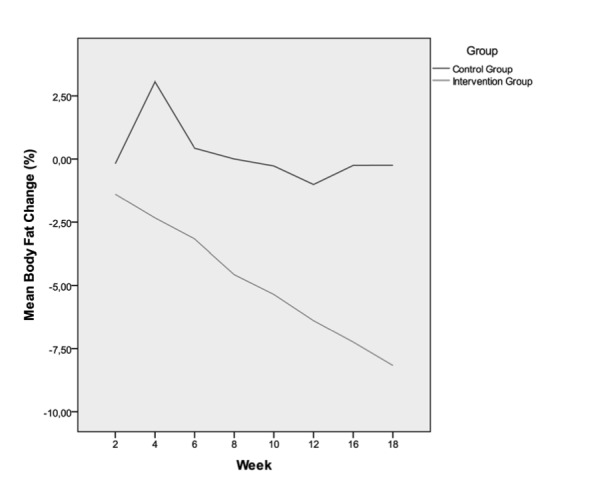
Weight loss and % body fat loss were statistically significantly decreased in DE group compared to DO group while reduction in FFM was significantly less in the DE group (Table 3,Figure 1,Figure 2).
Table 3. Weight loss, fat loss and loss of fat-free mass after 18 weeks of diet alone (DO) or diet with exercise (DE).

Data presented as mean ±SD * Statistically significantly difference P<0.05
Figure 1. Changes in Body Weight during the 18 week period for both control and intervention group.
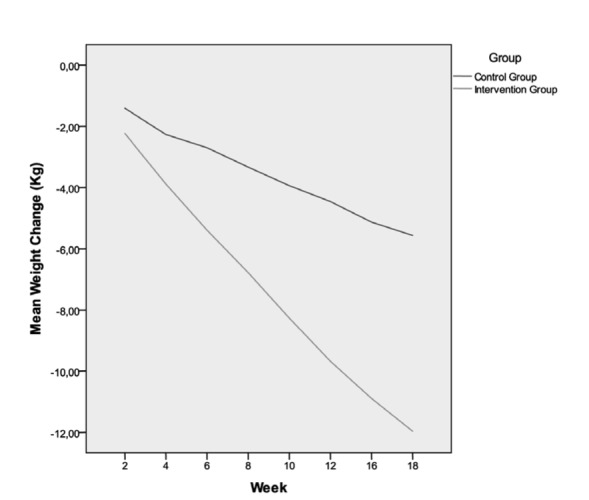
Figure 2. Changes in percentage Body Fat during the 18 week period for both control and intervention group.
Body fat levels were positively correlated with weight, BMI and WC (Table 4).
Table 4. Correlates of body fat (N=337).

WC=waist circumference; LBM=lean body mass; BMR=basal metabolic rate; BMI=body mass index
In multiple regression analysis BF levels were independently significantly associated with weight BMI and WC after adjustment of age, gender and energy intake (Table 5).
Table 5. Parameters associated with body fat levels by multiple regression analysis after adjusted for age, gender and energy intake.

* Statistical significant difference (P<0.05) BMI= Body Mass Index; WC=Waist Circumference; BMR= Basal Metabolic Rate
Discussion
We report data from the first randomized controlled study, to our knowledge, to investigate the effects of a reduced diet on body weight, body composition and measures of central adiposity in overweight and obese individuals from Cyprus. While both groups experienced reductions in total body mass and visceral abdominal mass, the caloric restricted plus exercise group experienced greater improvement in fat mass compared by the diet alone group. Our results strongly suggest that inclusion of regular exercise in a weight loss program reduced BF levels which may yields possible future health benefits beyond those of weight loss alone.
It is well known that physical activity is associated with loss of body fat and visceral fat which has been found to positively correlate with cardiovascular disease10-11. Increased fatness has been also found to associate with increased ectopic fat deposition in skeletal muscle and liver12 which may influence the insulin signaling cascade12 and impact circulating lipids13. The most important finding of our study was the reduction of body fat levels observed in the DE group. The average body weight loss for DO and DE group was 5.5 kg and 12 kg, respectively. However, the DE group reduced body fat mass by 10.5 kg compared with only 2.6 kg in the DO group. Because fat is more calorically dense than FFM, exercising subjects had a much greater loss of body energy than non-exercising subjects. This suggests that exercise can have favorable effects on body composition when used in a weight-reduction program.
A second important finding of the study was the reduction of waist circumference in both DO and DE groups. The importance of central body fat as an independent risk factor for cardiovascular disease, type 2 diabetes mellitus, and hypertension is well established14-15. Similar studies in severely obese patients have been reported that a low calorie diet in combination with exercise may successfully reduce body weight, body fat and waist circumference16-17. Since diet induced weight loss is also associated with a disproportionately large visceral fat loss, it is possible that caloric deficit will create similar visceral fat losses whether the restriction is induced by diet or exercise.
Exercise appears to contribute to body weight reduction in two ways: 1) the energy expended in exercise contributes directly to the negative energy balance and 2) exercise produces a more favorable composition of weight loss during food restriction.
One way exercise has been thought to be beneficial in A food restriction program is by preventing the decline in RMR which occurs when humans diet18. In this study RMR declined in both groups with food restriction. Although the decline in RMR was not significantly different for the two groups, these results do not rule out the possibility that exercise affected RMR as others have reported19. Exercise did not return RMR to predict levels in the present study. However, work with rats suggests that RMR declines in proportion to the magnitude of the caloric deficit if the caloric deficit is produced by food restriction20. Exercising subjects in this study had a greater caloric deficit than non-exercising subjects (from energy cost of the exercise) but no greater decline in RMR. This may have been because the extra deficit was produced by increasing energy expenditure rather than by further reducing food intake.
By comparing the 2 groups, there was an indication that DE group resulted in a greater increase in lean body mass compared with DO group. This finding would have significant ramifications, suggesting that exercise determines not only total body weight change and fat mass loss but also a gain in lean body mass tissue. This is in accordance with a meta-analysis that shows that exercise training preserves FFM during diet-induced weight loss21.
Despite the overall success of this intervention program the study has some limitations which include the error of estimating RMR and TEE using the equation, the collection of dietary intakes of the individuals, blood profile as well as cardio metabolic factors. Also, right now we are in the process of re-evaluating these subjects and very soon we will publish the outcomes of the follow up 18- week maintenance period. Nevertheless, it is very important that we report for the first time data of 337 overweight and obese subjects from Cyprus regarding the effects of a weight loss program with or without exercise.
Conclusions:
Despite the reduced effects of diet only on body weight, BMI and WC, combining a reduced diet with exercise improves also BF levels which may have other important benefits on several diseases later in life. More intervention studies are needed to confirm these results in larger population groups.
References
- 1.Wilborn C, Beckham J, Campbell B, Harvey T, Galbreath M, La Bounty P, et al. Prevalence, Theories, Medical Consequences, Management, and Research Directions. J of the Intern Society of Sports Nutrit. 2005;2:4–31. doi: 10.1186/1550-2783-2-2-4. [DOI] [PMC free article] [PubMed] [Google Scholar]
- 2.Volek JS, Gomez AL, Love DM, Weyers AM, Hesslink R Jr, Wise JA, et al. Effects of an 8-week weight-loss program on cardiovascular disease risk factors and regional body composition. Eur J of Clin Nutr. 2002;56:585–592. doi: 10.1038/sj.ejcn.1601362. [DOI] [PubMed] [Google Scholar]
- 3.Fox AA, Thompson JL, Butterfield GE, Gylfadottir U, Moynihan S, Spiller G. Effects of diet and exercise on common cardiovascular disease risk factors in moderately obese older women. Am J of Clin Nutr. 1996;63:225–233. doi: 10.1093/ajcn/63.2.225. [DOI] [PubMed] [Google Scholar]
- 4.Stiegler P, Cunliffe A. The role of diet and exercise for the maintenance of fat-free mass and resting metabolic rate during weight loss. Sports Med. 2006;36:239–262. doi: 10.2165/00007256-200636030-00005. [DOI] [PubMed] [Google Scholar]
- 5.Giannopoulou I, Ploutz-Snyder LL, Carhart R, Weinstock RS, Fernhall B, Goulopoulou S, et al. Comparison between the essential fatty acid status of preterm and full-term infants, measured in umbilical vessel walls. Exercise is required for visceral fat loss in postmenopausal women with type 2 diabetes. 2005;90:1511–1518. doi: 10.1210/jc.2004-1782. [DOI] [PubMed] [Google Scholar]
- 6.Ross R, Dagnone D, Jones PJ, Smith H, Paddags A, Hudson R, et al. Reduction in obesity and related co morbid conditions after diet-induced weight loss or exercise-induced weight loss in men. A randomized, controlled trial. Ann of Intern Med. 2000;133:92–103. doi: 10.7326/0003-4819-133-2-200007180-00008. [DOI] [PubMed] [Google Scholar]
- 7.Weinsier RL, Hunter GR, Desmond RA, Byrne NM, Zuckerman PA, Darnell BE. Free-living activity energy expenditure in women successful and unsuccessful in maintaining a normal body weight. Am J of Clin Nutr. 2002;75:499–504. doi: 10.1093/ajcn/75.3.499. [DOI] [PubMed] [Google Scholar]
- 8.Gaesser GA, Angadi SS, Sawyer BJ. Exercise and diet, independent of weight loss, improve cardiometabolic risk profile in overweight and obese individuals. Phys Sports Med. 2011;39:87–97. doi: 10.3810/psm.2011.05.1898. [DOI] [PubMed] [Google Scholar]
- 9.Brownell KD. Obesity: understanding and treating a serious, prevalent, and refractory disorder. J of Consulting Clin Psych. 1982;50:820–840. doi: 10.1037//0022-006x.50.6.820. [DOI] [PubMed] [Google Scholar]
- 10.Hunter GR, Bryan DR, Wetzstein CJ, Zuckerman PA, Bamman MM. Resistance training and intra-abdominal adipose tissue in older men and women. Med Sci of Sports and Exerc. 2002;34:1023–1028. doi: 10.1097/00005768-200206000-00019. [DOI] [PubMed] [Google Scholar]
- 11.Kohrt WM, Obert KA, Holloszy JO. Exercise training improves fat distribution patterns in 60- to 70-year old men and women. J of Gerontol. 1992;47:M99–M105. doi: 10.1093/geronj/47.4.m99. [DOI] [PubMed] [Google Scholar]
- 12.Larson-Meyer DE, Heilbronn LK, Redman LM, Newcomer BR, Frisard MI, Anton S, et al. Effect of calorie restriction with or without exercise on insulin sensitivity, beta-cell function, fat cell size, and ectopic lipid in overweight subjects. Diab Care. 2006;29:1337–1344. doi: 10.2337/dc05-2565. [DOI] [PMC free article] [PubMed] [Google Scholar]
- 13.Shulman GI. Cellular mechanisms of insulin resistance. J of Clin Invest. 2000;106:171–176. doi: 10.1172/JCI10583. [DOI] [PMC free article] [PubMed] [Google Scholar]
- 14.National Institutes of Health. Clinical guidelines on the identification, evaluation, and treatment of overweight and obesity in adults: the evidence report. In: Panel E, ed. NHLBI Obesity Education Initiative Expert Panel on the Identification, Evaluation, and Treatment of Overweight and Obesity in Adults. Bethesda, Md: Nat Instit of Health. 1998 [Google Scholar]
- 15.Despres JP, Lemieux I, Prud'homme D. Treatment of obesity: need to focus on high risk abdominally obese patients. BMJ. 2001;322:716–720. doi: 10.1136/bmj.322.7288.716. [DOI] [PMC free article] [PubMed] [Google Scholar]
- 16.Arrebola E, Gómez-Candela C, Fernández-Fernández C, Loria V, Muñoz-Pérez E, Bermejo LM. Evaluation of a lifestyle modification program for treatment of overweight and nonmorbid obesity in primary healthcare and its influence on health-related quality of life. Nutr Clin Pract. 2011;26:316–321. doi: 10.1177/0884533611405993. [DOI] [PubMed] [Google Scholar]
- 17.Meckling KA, Sherfey R. A randomized trial of a hypocaloric high-protein diet, with and without exercise, on weight loss, fitness, and markers of the Metabolic Syndrome in overweight and obese women. Appl Physiol Nutr Metab. 2007;32:743–752. doi: 10.1139/H07-059. [DOI] [PubMed] [Google Scholar]
- 18.Ravussin E, Burnand B, Schulz Y, Jéquier E. Energy expenditure before and during energy restriction in obese patients. AmeJ of Clin Nutr. 1985;41:753–759. doi: 10.1093/ajcn/41.4.753. [DOI] [PubMed] [Google Scholar]
- 19.Lennon D, Nagle F, Stratman F, Shrago E, Dennis S. Diet and exercise training effects on resting metabolic rate. Intern J of Obes. 1985;9:39–47. [PubMed] [Google Scholar]
- 20.Hill JO, Latiff A, DiGirolamo M. Effects of variable caloric restriction on the utilization of ingested energy in rats. Am J of Phys. 1985;248:R549–559. doi: 10.1152/ajpregu.1985.248.5.R549. [DOI] [PubMed] [Google Scholar]
- 21.Wei M, Kampert JB, Barlow CE, Nichaman MZ, Gibbons LW, Paffenbarger RS Jr, et al. Relationship between low cardiorespiratory fitness and mortality in normal-weight, overweight, and obese men. JAMA. 1999;282:1547–1555. doi: 10.1001/jama.282.16.1547. [DOI] [PubMed] [Google Scholar]