



Abstract
The purpose of this study was to examine the impact of parenting styles on emotional intelligence of HIV-affected children in Thailand. This study uses data from 205 HIV-affected children in northern and northeastern Thailand. Correlation and regression analyses were used to examine the predictors of emotional intelligence. Children reporting higher levels of stress reported less caring parenting style (Standardized beta [B] = −0.18, p=0.050). Children with higher self-esteem were also more likely to perceive their parents as caring (B = 0.48, p = 0.002). Children who scored lower on their self-esteem reported their parents to be more overprotective (B = −0.30, p = 0.030), and children reporting higher levels of stress reported their parents to be more overprotective (B = 0.12, p = 0.010). Children reporting caring parenting style were significantly more likely to report higher emotional intelligence (B = 0.66, p = 0.001). Parenting styles play an important role in the emotional intelligence. Identifying and testing interventions to help parents improve their parenting styles, while helping their HIV-affected children cope with stress and self-esteem, are essential in promoting mental health of HIV-affected children in Thailand.
Keywords: Emotional Intelligence, Parenting Styles, HIV-affected Children, Thailand
INTRODUCTION
In Thailand, human immunodeficiency virus (HIV) infection, once an acute fatal illness, is transitioning into a chronic illness as more treatment options are becoming available (Carpenter et al., 1998; Valdiserri et al., 1999; Siegel & Lekas, 2002; Barlett et al., 2004; Ivers et al., 2005; Vijayaraghavan et al., 2007). As a result, growing numbers of children in Thailand are living longer with an infected parent. Various factors from parents living with HIV (PLH) may influence the wellbeing of HIV-affected children (those whose parents are infected with HIV).
Much of the strong evidence on psychosocial vulnerabilities of the HIV-affected children comes from low prevalence, Western, industrialized countries (Franco et al., 2009), suggesting that HIV-affected children face multiple stressors, including anxiety disorders; emotional distress; behavioral problems; and feelings of shame, worry, and stress (Brandt, 2005; Hough, Brummitt, & Templin, 2003; Jianhua, Chun, & Kangmai, 2006; Lester, Rotheram-Borus, & Lee, 2006; Loudon et al., 2007; Murphy et al., 2006, 2009; Nostlinger et al., 2006; Pelton & Forehand, 2005). HIV-affected children may also deal with parental depression (Ciesla & Roberts), putting them at greater risk of disruptive behavioral disorders (Pilowsky et al., 2003).
Recently, emotional intelligence has been increasingly receiving attention as a crucial factor for predicting child's behaviors (Petrides et al., 2004). Emotional intelligence is defined as an ability to regulate emotion related to problem-solving and is divided into four levels: emotional perception, emotional facilitation, emotional understanding, and emotional management (Mayer, Caruso, & Salovey, 1999). Emotional intelligence has been found to influence important life outcomes as emotional well-being (Baron, 2000), academic achievement (Schute et al., 1998), success in life (Goleman, 1995), general positive outcomes (Mayer & Salovey, 1997), better emotional regulation, higher life satisfaction, and less stress (Gannon & Ranzijn, 2005; Ciarrochi, Chan, & Caputi, 2000).
One of the key factors influencing children's emotional development is parenting styles. Past studies suggest that parenting styles influence children's self control (Baumrind, 1995), stress (Ridhitrairatana, 2001), sociability (van den Boom, 1994), social competence (Kuczyinski & Kochanska, 1995), conduct problems (Webster-Stratton, 1998), optimism (Hassan & Power, 2002), self-esteem (Poomsawat, 1996), peer competence (Pearson & Rao, 2003), and coping strategies (Meesters & Muris, 2004). For studies on HIV-affected children, past studies provided moderate evidence HIV-affected children receive lower levels of affection and protective support from their parents (Brandt, 2005).
Despite the extensive research on parenting styles, no studies exist to investigate their relation to HIV-affected children's emotional intelligence. The goal of this study is to examine the relationship between HIV-affected children's emotional intelligence, their perception of parenting styles and other child factors such as self-esteem and stress. For this study, three factors were selected to be tested for their effect on emotional intelligence of HIV-affected children in Thailand. These were children's perception of parenting styles, children's everyday stressors, and self-esteem. Two parental factors assessed from parents that may influence HIV-affected children were considered in this study. They were parental depression and parental happiness.
The hypothesized path model of predictors of emotional intelligence of HIV-affected children is presented in Figure 1. It is hypothesized that children's everyday stressors and self-esteem will be significantly associated with their perception of their HIV-infected parent's parenting styles, which in turn will have significant association with children's emotional intelligence. It is also hypothesized that parental depression and happiness will be significantly associated with children's perception of parenting styles, which in turn will influence their children's emotional intelligence.
FIGURE 1.
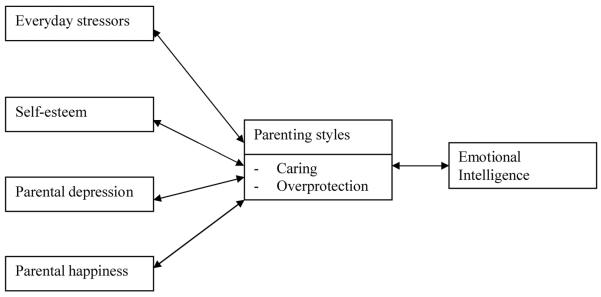
The hypothesized path model of predictors of emotional intelligence of HIV-affected children.
METHODS
Participants and Setting
This study uses data from a randomized controlled family intervention trial in Thailand (Li et al., 2010; Li et al., 2012). Initial screenings of children of PLH were conducted in the district hospitals by healthcare workers and research staff. Following informed consent and parental assent, a trained interviewer administered the assessment to children aged 12–17 using Computer Assisted Personal Interview (CAPI). Children were asked about their demographics, including gender and age. Children were asked about their perception of their parents' parenting styles, their level of stress, their self-esteem, and their emotional intelligence. A total of 205 children aged 12–17 were included in this study. We extracted parental depression and happiness data from HIV-infected parents of the 205 children, assessed in the original family intervention trial (Li et al., 2010; Li et al., 2012).
Approval of this study was obtained from Institutional Review Boards from the University of California at Los Angeles, and the Thailand Ministry of Public Health Ethical Review Committee for Research in Human Subjects. All participants received 300 Baht (equivalent to $10) for their assessment participation.
Measures
Emotional intelligence for HIV-affected children was assessed with the Thai Emotional Quotient (EQ) Test (Thai Bureau of Mental Health Technical Development, 2003), consisting of 36 items, resulting in a summative emotional quotient scale that captured the following dimensions: Satisfaction, empathy, relationship, emotional regulation, self-control and responsibility. In this study, higher emotional quotient reflected higher emotional intelligence. The summative score had a satisfactory internal consistency for our sample (Cronbach's alpha=0.84).
Children's Perception of Parenting Styles were measured using the Parental Bonding Instrument (PBI; Parker, Tupling, & Brown, 1979). The PBI is a 25-item questionnaire that assesses two dimensions of perceived parental bonding: care (12 items) and overprotection (13 items). Each item is rated on a 4-point scale ranging from 0 (very unlikely) to 3 (very likely). Among the 25 items, there are six negative items on each dimension, whose scores are reversed and added to those of the others forming a summary score ranging from 0–36 for the care dimension and 0–39 for the overprotection dimension. The alpha coefficient of the PBI in this sample of HIV-affected children was 0.77 for the care dimension and 0.72 for the overprotection dimension.
Everyday stressors for children were measured using the Everyday Stressors Index Adolescent version (ESI-A). The ESI-A is a 26-item scale that assesses common problems faced on a daily basis by adolescents in school. The scale consists of seven items that measure family problems, nine items that measure problems with friends, including boy (girl) friends, and nine items that measure problems with school and study. Children are asked to rate how each problem worries, upsets, or bothers them from day-to-day on a 4-point scale ranging from 0 (not at all) to 3 (bothered a great deal). A summary score is computed; the higher the score, the more stress they experience. Cronbach's alphas for the original ESI ranged from 0.81 to 0.86 (Hall, Gurley, Sachs, & Kryscio, 1991; Hall, Williams, & Greenberg, 1985; Peden, Rayens, Hall, & Grant, 2004). The Cronbach's alpha in our adolescent sample was 0.80.
Self-esteem for children was measured using the ten-item Rosenberg Self-Esteem Scale (Rosenberg, 1965). The RSE consists of five negative items and five positive items. Participants are asked to rate each item on a 4- point scale ranging from 1 (strongly disagree) to 4 (strongly agree). The scores of the five negative items are reversed and summed with five positive items, forming a summary score ranging from 10 to 40. The alpha coefficient of the RSE in an adolescent sample was 0.86 (Hudson, Elek, & Campbell-Grossman, 2000). The Cronbach's alpha in our adolescent sample was 0.82.
Parental Depression was assessed from children's HIV-infected parents with a 15-item depressive symptomatology screening test that was developed and used previously in Thailand (Thai Department of Mental Health, 2004). These questions were asked about problems that had bothered participants in the past week (e.g., feeling depressed most of the time; feelings of hopelessness or worthlessness; loss of self-confidence), with response categories from 0 (not at all) to 3 (usually [5–7 days a week]). A summative composite scale was developed, with a range of 0 to 45 and an excellent internal consistency (Cronbach's α = 0.91).
Parental Happiness was assessed from children's HIV-infected parents with the Thai Happiness Indicator, a 15-item scale to measure the level of happiness (Thai Department of Mental Health, 2001), with response categories from 0 (not at all) to 3 (extremely). A summative composite scale was developed, with a range of 0 to 45 and satisfactory internal consistency (Cronbach's α = 0.77).
Data Analysis
All analyses were performed using SAS statistical software version 9.2 (SAS Institute, Inc., Cary, NC). Descriptive statistics were used to describe HIV-affected children's profile of their perception of parenting styles, stress, self-esteem, and emotional intelligence, as well as parental depressive symptoms and happiness. Pearson correlation coefficients were generated to examine the relationships between the emotional intelligence, perception of parenting styles, stress, self-esteem, and parental depressive symptoms, and happiness. Multiple regression models were performed with the two domains of parenting styles (caring and overprotection) as the outcomes and children's stress, self-esteem, parental depressive symptoms and happiness as potential correlates. Next, a final multiple regression model was performed with emotional intelligence as the main outcome and the parenting style as the predictor. Standardized betas from multiple regression estimation and their significance levels (p-values) are reported.
RESULTS
Table 1 outlines the profiles of HIV-affected children. Over half of the children aged 12–17 were female (55%) with a mean age of 13.7 (Standard Deviation [S.D.] =1.53). All the measures used in our study had satisfactory internal consistency. Some of the characteristics of HIV-affected children in our sample were comparable to Thai children in the general population. For example, the emotional intelligence, measured by the Thai Emotional Quotient was 89.6 (S.D. =12.35), and this score represented “average” category for Thai children (Thai Department of Mental Health, 2004). In addition, the mean score of Everyday Stress Index score of 11.2 (S.D. =6.77) represented “moderate” stress (Thai Department of Mental Health, 2009). Self-esteem score of 17.4 (S.D. = 2.31) fell within the normal range between 15–25 (Rosenberg, 1965). Other characteristics, however, were poorer, compared to Thai children in the general population. For instance, the care dimension of the parental bonding index was 26.5 (S.D. = 5.08), representing “poor” category, as defined by the caring cut-off score of 27.0 (Parker, Tupling, & Brown, 1979). Similarly, the overprotection dimension score of 17.1 (S.D. = 4.51) reflected “overly protective” category, as defined by the overprotection cut-off score of 13.5. (Parker, Tupling, & Brown, 1979; Parker, 1983). The mean scores of parental happiness and depression were 26.3 (S.D. = 5.56) and 12.6 (S.D. = 8.50), respectively. The depression score for PLH in our sample fell in the “moderate” category (Thai Department of Mental Health, 2004), and the parental happiness score fell in the “poor” category (Thai Department of Mental Health, 2001).
TABLE 1.
Profiles of HIV-affected Children (n=205)
| Characteristics | Frequency (%); Mean (S.D.) |
|---|---|
|
| |
| Gender (Female) | 113 (55%) |
| Age: mean (SD) | 13.7 (1.53) |
| Emotional Intelligence (α = 0.84) | 89.6 (12.35) |
| Parenting Style – Caring (α = 0.77) | 26.5 (5.08) |
| Parenting Style – Overprotection (α = 0.72) | 17.1 (4.51) |
| Everyday Stress Index (α = 0.80) | 11.2 (6.77) |
| Self Esteem (α = 0.82) | 17.4 (2.31) |
| Parental happiness (α = 0.77) | 26.3 (5.56) |
| Parental depression (α = 0.92) | 12.6 (8.50) |
The bivariate correlations between emotional intelligence, parenting styles, stress, self-esteem, parental depression and parental happiness among HIV-affected children are presented in Table 2. In terms of demographic correlations, significant positive correlations were observed among child's age and emotional intelligence (r = 0.21, p = 0.002). This is expected, since there is evidence to suggest that emotional intelligence gets better with age (Shiota & Levenson, 2009). Several factors were significantly correlated with children's emotional intelligence. Significant positive correlation was observed between emotional intelligence and caring parenting style (r = 0.27, p<0.0001). Conversely, significant negative correlations were observed between emotional intelligence and overprotective parenting style (r = −0.16, p = 0.019). These findings are consistent with previous studies examining parenting styles and emotional intelligence (Alegre, 2011). Consistent with the existing literature (Gannon & Ranzijn, 2005), emotional intelligence was also positively correlated with children's self-esteem (r = 0.16, = 0.021). However, contrary to our hypotheses, we did not find significant correlations between emotional intelligence and parents' depression or happiness. In addition, contrary to existing literature (Ciarrochi, Chan, & Caputi, 2000), we did not find significant correlations between emotional intelligence and stress.
TABLE 2.
Bivariate Correlations between Emotional Intelligence, Parenting Styles, Stress, Self-esteem, Parental Happiness and Parental Depression.
| 1 | 2 | 3 | 4 | 5 | 6 | 7 | 8 | 9 | |
|---|---|---|---|---|---|---|---|---|---|
| 1. Emotional Intelligence | 1 | ||||||||
| 2. Parenting style: Caring | .27** | 1 | |||||||
| 3. Parenting style: Overprotection | −.16* | −.40** | 1 | ||||||
| 4. Stress | .02 | −.28** | .20* | 1 | |||||
| 5. Self esteem | .16* | .27** | −.17* | −.20* | 1 | ||||
| 6. Parental happiness | .10 | .06 | −.01 | .08 | −.04 | 1 | |||
| 7. Parental depression | .06 | −.06 | −.04 | −.03 | −.18* | −.11 | 1 | ||
| 8. Gender | .07 | .16* | .02 | −.01 | .07 | −.01 | .01 | 1 | |
| 9. Age | .21* | −.03 | −.15* | .08 | −.04 | .03 | .13 | .15* | 1 |
p<.05
p<.0001
p<.0001
Consistent with previous studies (Ridhitrairatana, 2001; Poomsawat, 1996), we also observed several factors significantly correlated with parenting styles. Significant positive correlations were observed between caring parenting style and self-esteem (r = 0.27, p<0.0001). Similarly, a significant negative correlation was observed between caring parenting style and children's stress (r = − 0.28, p<0.001). Being female was also positively associated with caring parenting style (r = 0.16, p = 0.02). As expected, we found between overprotective parenting style had a significant positive correlation with children's stress (r = 0.20, p<0.0001) and negative correlation with their self-esteem (r = − 0.17, p<0.05). We also observed significant negative correlations between stress and self esteem (r = − 0.20, p= 0.004), as well as negative correlation between self-esteem and parental depression (r = −0.18, p=0.011).
Table 3 outlines the multiple regression models examining factors associated with parental perception reported by HIV-affected children. We found a significant negative association between children's stress level and their perception of caring parenting style. Consistent with previous studies (Ridhitrairatana, 2001; Poomsawat, 1996), children reporting higher levels of stress reported their parents to be less caring (Standardized beta [B] = −0.18, p=0.05). Children who scored higher on their self-esteem were also more likely to perceive their parents as more caring (B = 0.48, p = 0.002). Consistent with bivariate correlations (Table 2), we found that female children were significantly more likely to perceive their parents to be caring (B = 1.51, p = 0.026).
TABLE 3.
Multiple Regression Models Examining Correlates and Mediators of Emotional Intelligence.
| Parenting Styles |
||||||
|---|---|---|---|---|---|---|
| Caring | Overprotection | Emotional Intelligence | ||||
|
|
||||||
| Correlates | Standardized B | P-value | Standardized B | P-value | Standardized B | P-value |
| Gender | 1.51 | 0.026 | 0.56 | 0.366 | −0.42 | 0.805 |
| Age | −0.08 | 0.721 | −0.51 | 0.014 | 1.67 | 0.003 |
| Parenting style | ||||||
| - Caring | -- | -- | -- | -- | 0.66 | 0.001 |
| - Overprotection | -- | -- | -- | -- | −0.05 | 0.793 |
| Self-esteem | 0.48 | 0.002 | −0.30 | 0.030 | 0.72 | 0.058 |
| Stress | −0.18 | 0.050 | 0.12 | 0.010 | 0.20 | 0.122 |
| Parental happiness | 0.08 | 0.060 | −0.03 | 0.645 | 0.19 | 0.196 |
| Parental depression | −0.01 | 0.875 | −0.02 | 0.540 | 0.12 | 0.223 |
We observed similar associations between children self-esteem, stress, and overprotective parenting style. Children who scored lower on their self-esteem reported their parents to be more overprotective (B = −0.30, p = 0.030), and children reporting higher levels of stress reported their parents to be more overprotective (B = 0.12, p = 0.010). Children reporting caring parenting style were significantly more likely to report higher emotional intelligence (B = 0.66, p = 0.001). However, we found no association between children's emotional intelligence and overprotective parenting style. Contrary to our hypotheses, we did not find significant associations between children's emotional intelligence and parental depression or parental happiness.
DISCUSSION
To our knowledge, this is one of the first studies that provided empirical evidence on the important associations between parenting styles and children's stress and self-esteem among HIV-affected children in Thailand. Children who reported low self-esteem were more likely to report less caring parenting styles and more overprotective parenting style. Similarly, children who reported higher stress were more likely to report less caring and more overprotective parenting styles.
We observed a significant association between caring parenting style and higher emotional intelligence. Our findings support our initial hypothesis that parenting styles will mediate the effects of HIV-affected children's self-esteem and stress on their emotional intelligence. Past studies on emotional intelligence found that children with higher emotional intelligence have better emotional regulation than others, and are more likely to have higher life satisfaction, higher self-esteem, less stress, and general positive outcomes (Gannon & Ranzijn, 2005; Ciarrochi et al., 2000; Mayer & Salovey, 1997). Therefore, in addition to addressing the needs of the infected parent, it is critical to address the emotional needs of their children.
Our findings support the notion that parenting styles play an important role on children's self-esteem and stress. This finding is particularly important because it calls for interventions to involve the HIV-positive parent and provide them with effective resources to help them improve their parenting styles. By designing interventions to help PLH with their parenting skills, we can address children's needs such as their level of stress and self-esteem.
As with other studies, several limitations of this study should be noted. First, the findings of this study have limited generalizability. The sample was drawn from HIV-affected families from two provinces and does not represent all HIV-affected children in Thailand. Second, given the cross-sectional nature of the study design, our findings do not support any causal inferences. Third, contrary to our hypotheses, we did not find significant associations between parental depression/happiness and their parenting styles. In addition, parental depression and happiness did not have significant associations with children's emotional intelligence. One plausible explanation could be these children may have access to their other parent and extended family members, and these additional familial relationships could act to mitigate the impact of depression of the infected parents. We also found a significant association between caring parenting style and female children. While there are studies that examined gender differences in the relationships among parenting styles (Barton & Kirtley, 2012), there is no consensus on why there are such gender differences in the relationships. One plausible explanation for our study could be that mothers interact with their daughters in a more caring manner, compared to their sons. There is some evidence from our data to support this. We had significantly more female parents living with HIV (67%), compared to men in our original study (Li et al, 2010). Therefore, this gender difference observed in our study could be due to the fact that we had more female parents, compared to male parents.
Despite these limitations, our findings underscore that parenting styles play an important role in the emotional intelligence of HIV-affected children in Thailand. Identifying and testing interventions to help PLH improve their parenting styles, while helping their HIV-affected children cope with their stress and self-esteem, are essential in promoting mental health of HIV-affected children in Thailand. Interventions aimed at reducing stress and promoting self-esteem, and those that promote positive parental bonding between the child and the parent, especially parental caring, are recommended. Interventions that reduce stress and boost self-esteem for children could be integrated since they both are targeted at the individual child level. Interventions that promote positive parental bonding could be implemented at a family level. Future interventions could target both the parent (e.g., providing parenting skills) and HIV-affected children themselves (e.g., providing emotional regulation skills).
One of the ways in which such interventions could be implemented in Thailand is through healthcare providers. We have used this strategy of involving healthcare providers to assist families living with HIV in northern and northeastern Thailand (Li et al., 2010, 2012). The standard of care of providing monthly support groups for PLH in the district hospitals in Thailand facilitates healthcare providers to interact with PLH on a regular basis, and they can play a key role in assisting and supporting PLH with parenting skills. If PLH have disclosed their status to their children, their children could accompany them to the monthly support groups, and children can obtain skills from qualified healthcare providers around emotional regulation.
Acknowledgement
This article was completed with the support of the National Institute of Nursing Research (grant NINR R01-NR009922), and the National Institute of Mental Health (grant NIMH 5K01MH085503). We thank all individuals who participated in the study, as well as the research coordinators, hospital directors, provincial health officers, and interviewers and facilitators in Chiang Rai and Nakhon Ratchasima provinces.
REFERENCES
- Alegre A. Parenting styles and children's emotional intelligence :What do we know? The Family Journal. 2011;19:56–62. [Google Scholar]
- Barlett JG, Cheever LW, Johnson MP, Paauw DS. Barlett JG, Cheever LW, Johnson MP, Paauw DS, editors. Primary care as chronic care. A guide to primary care of people with HIV/AIDS. 2004 Available at: http://hab.hrsa.gov/tools/primarycareguide/PCGchap1.htm Retrieved November 29, 2012.
- Barton AL, Kirtley MS. Gender differences in the relationships among parenting styles and college student mental health. Journal of American College Health. 2012;60:21–26. doi: 10.1080/07448481.2011.555933. [DOI] [PubMed] [Google Scholar]
- Baumrind D. Child Maltreatment and Optimal Caregiving in Social Contexts. Garland Publishing, Inc; New York and London: 1995. [Google Scholar]
- Brandt R. Centre for Social Science Research Working Paper No. 135. University of Cape Town; Cape Town, South Africa: 2005. Maternal well-being and childcare and adjustment in the context of AIDS : What does the psychological literature say? [Google Scholar]
- Carpenter CC, Fischl MA, Hammer SM, et al. Antiretroviral therapy for HIV infection in 1998: updated recommendations of the International AIDS Society-USA panel. JAMA. 1998;280:78–86. doi: 10.1001/jama.280.1.78. [DOI] [PubMed] [Google Scholar]
- Ciarrochi JV, Chan AYC, Caputi P. A critical evaluation of the emotional intelligence construct. Personality and Individual Differences. 2000;28:539–61. [Google Scholar]
- Ciesla JA, Roberts JE. Meta-analysis of the relationship between HIV infection and the risk of depressive disorders. Am J Psychiatry. 2001;158:725–730. doi: 10.1176/appi.ajp.158.5.725. [DOI] [PubMed] [Google Scholar]
- Franco LM, Burkhalter B, de Wagt A, Jennings L, Kelley AG, Hammink M. Evidence base for children affected by HIV and AIDS in low prevalence and concentrated epidemic countries: applicability to programming guidance from high prevalence countries. AIDS Care. 2009;21:49–59. doi: 10.1080/09540120902923089. [DOI] [PMC free article] [PubMed] [Google Scholar]
- Gannon N, Ranzjin R. Does emotional intelligence predict unique variance in life satisfaction beyond IQ and personality? Personality and Individual Differences. 2005;38:1353–64. [Google Scholar]
- Goleman D. Intelligencia Emocional (Emotional Intelligence) Editorial Kairos; Barcelona, Spanin: 1996. [Google Scholar]
- Hall LA. Unpublished doctoral dissertation. University of North Carolina; Chapel Hill, NC: 1983. Social supports, everyday stressors, and maternal mental health. [Google Scholar]
- Hall LA. Psychometric evaluation of the Everyday Stressors Index (ESI) 1987 Unpublished manuscript. [Google Scholar]
- Hall LA, Gurley DN, Sachs B, Kryscio RJ. Psychosocial predictors of maternal depressive symptoms, parenting attitudes, and child behavior in single parent families. Nursing Research. 1991;40:214–220. [PubMed] [Google Scholar]
- Hall LA, Williams CA, Greenberg RS. Supports, stressors, and depressive symptoms in low-income mothers of young children. American Journal of Public Health. 1985;75:518–522. doi: 10.2105/ajph.75.5.518. [DOI] [PMC free article] [PubMed] [Google Scholar]
- Hasan N, Power TG. Optimism and pessimism in children: a study of parenting correlates. International Journal o Behavior Development. 2002;26:185–191. [Google Scholar]
- Hough E, Brumitt G, Templin T. A model of mother-child coping and adjustment to HIV. Social Science & Medicine. 2003;56:643–655. doi: 10.1016/s0277-9536(02)00061-8. [DOI] [PubMed] [Google Scholar]
- Hudson DB, Elek SM, Campbell-Grossman C. Depression, self-esteem, loneliness, and social support among adolescent mothers participating in the new parents' project. Adolescence. 2000;35:445–466. [PubMed] [Google Scholar]
- Ivers LC, Kendrick D, Doucette K. Efficacy of antiretroviral therapy programs in resource-poor settings: a meta-analysis of the published literature. Clin Inf Dis. 2005;41:217–224. doi: 10.1086/431199. [DOI] [PubMed] [Google Scholar]
- Jianhua Y, Chun C, Kangmai L. The assessment impacts of HIV and AIDS on children in China. UNICEF; New York: 2006. [Google Scholar]
- Kuczynski L, Kochanska G. Function and content of maternal demands: development significance on early demands for competent action. Child Development. 1995;66:616–628. doi: 10.1111/j.1467-8624.1995.tb00893.x. [DOI] [PubMed] [Google Scholar]
- Lester P, Rotheram-Borus M, Lee S-J, et al. Rates and predictors of anxiety and depressive disorders in adolescents of parents with HIV. Vulnerable Children and Youth Studies. 2006;1:81–101. [Google Scholar]
- Loudon M, Bhaskar M, Bhutia Y. Barriers to service for children with HIV positive parents in 5 high prevalence states of India. UNICEF India, National HIV and AIDS Control Organization, Government of India Ministry of Women and Child Development; New Delhi, India: 2007. [Google Scholar]
- Li L, Lee S-J, Thammawijaya P, Jiraphongsa C, Rotheram-Borus MJ. Stigma, social support, and depression among people living with HIV in Thailand. AIDS Care. 2009;21:1007–1013. doi: 10.1080/09540120802614358. [DOI] [PMC free article] [PubMed] [Google Scholar]
- Li L, Lee S-J, Jiraphongsa C, Khumtong S, Iamsirithaworn S, Thammawijaya P, Rotheram-Borus MJ. Improving Health and Mental Health for People Living with HIV/AIDS: 12-month Assessment of a Behavioral Intervention in Thailand. American Journal of Public Health. 2010;100:2418–25. doi: 10.2105/AJPH.2009.185462. [DOI] [PMC free article] [PubMed] [Google Scholar]
- Li L, Liang LJ, Lee S-J, Iamsirithaworn S, Wan D, Rotheram-Borus MJ. Efficacy of an Intervention for Families Living with HIV in Thailand: A Randomized Controlled Trial. AIDS and Behavior. 2012;16:1276–85. doi: 10.1007/s10461-011-0077-x. [DOI] [PMC free article] [PubMed] [Google Scholar]
- Mayer JD, Caruso DR, Salovey P. Emotional intelligence meets traditional standards for an intelligence. Intelligence. 1999;27:267–298. [Google Scholar]
- Mayer JD, Salovey P. What is Emotional Intelligence? In: Salovey P, Sluyter DJ, editors. Emotional Development and Emotional Intelligence. Basic Books; New York: 1997. pp. 3–31. [Google Scholar]
- Meesters C, Muris P. Perceived parental rearing behaviors and coping in young adolescents. Personality and Individual Differences. 2004;37:513–522. [Google Scholar]
- Murphy DA, Greenwell L, Mouttapa M, Brecht M-L, Schuster MA. Physical health of mothers with HIV/AIDS and the mental health of their children. J Dev Behav Pediatr. 2006;27:386–395. doi: 10.1097/00004703-200610000-00004. [DOI] [PMC free article] [PubMed] [Google Scholar]
- Murphy DA, Marelich WD, Amaro H. Maternal HIV/AIDS and adolescent depression: A covariance structure analysis of the “Parents and Adolescents Coping Together” (PACT) model. Vulnerable Children and Youth Studies. 2009;4:67–82. doi: 10.1080/17450120802385729. [DOI] [PMC free article] [PubMed] [Google Scholar]
- Nostlinger C, Bartoli G, Gordillo V, Roberfroid D, Colebunders R. Children and adolescents living with HIV positive parents: Emotional and behavioural problems. Vulnerable Children and Youth Studies. 2006;1:29–43. [Google Scholar]
- Parker G, Tupling H, Brown LB. A parental bonding instrument. British Journal of Medical Psychology. 1979;52:1–10. [Google Scholar]
- Pearson E, Rao N. Socialization goals, parenting practices and peer competence in Chinese and English preschoolers. Early Child Development & Care. 2003;173:131–146. [Google Scholar]
- Peden AR, Rayens MK, Hall LA, Grant E. Negative thinking and the mental health of low-income single mothers. Journal of Nursing Scholarship. 2004;4:337–344. doi: 10.1111/j.1547-5069.2004.04061.x. [DOI] [PubMed] [Google Scholar]
- Pelton J, Forehand R. Orphans of the AIDS epidemic: An examination of clinical level problems of children. Journal of the American Academy of Child and Adolescent Psychiatry. 2005;44:585–591. doi: 10.1097/01.chi.0000157551.71831.57. [DOI] [PubMed] [Google Scholar]
- Petrides KV, Frederickson N, Furnham A. The role of emotional intelligence in academic performance and deviant behavior at school. Personality and Individual Differences. 2004;36:277–93. [Google Scholar]
- Pilowsky DJ, Zybert PA, Hsieh PW, Vlahove D, Susser E. Children of HIV-positive drug-using parents. J. Am. Acad. Child Adolesc. Psychiatry. 2003;42:950–956. doi: 10.1097/01.CHI.0000046888.27264.17. [DOI] [PubMed] [Google Scholar]
- Poomsawat O. Unpublished thesis. Chulalongkorn University; Bangkok, Thailand: 1996. A comparison of self-esteem of adolescents with different patterns of child-rearing practices as perceived by themselves. [Google Scholar]
- Ridhitrairatana S. Unpublished master's thesis. Chulalongkorn University; Bangkok, Thailand: 2001. Prevalence and factors of depression in high school students in Petchaburi province. [Google Scholar]
- Rosenberg M. Society and the adolescent self-image. Princeton University Press; Princeton, NJ: 1965. [Google Scholar]
- Schute NS, Malouff JM, Hall JM, et al. Development and validation of a Measure of Emotional Intelligence. Personality and Individual Differences. 1998;25:167–177. [Google Scholar]
- Shiota MN, Levenson RW. Effects of aging on experimentally instructed detached reappraisal, positive reappraisal, and emotional behavior suppression. Psychol Aging. 2009;24:890–900. doi: 10.1037/a0017896. [DOI] [PMC free article] [PubMed] [Google Scholar]
- Siegel K, Lekas HM. AIDS as a chronic illness: Psychosocial implications. AIDS. 2002;16(4 suppl):S69–S76. doi: 10.1097/00002030-200216004-00010. [DOI] [PubMed] [Google Scholar]
- Thai Bureau of Mental Health Technical Development . Emotional Intelligence Questionnaire for Children. Ministry of Public Health; Thailand: 2003. [Accessed July 23, 2011]. Available at: http://203.157.56.11/download/185.pdf. [Google Scholar]
- Thai Department of Mental Health . Thai Happiness Indicator. Ministry of Public Health; Thailand: 2001. [Accessed September 12, 2011]. Available at: http://www.dmh.go.th/test/qtest. [Google Scholar]
- Thai Department of Mental Health . Depression screening test. Ministry of Public Health; Thailand: 2004. [Accessed May 12, 2012]. Available at: http://www.dmh.go.th/test/depress/asheet.asp?qid=1. [Google Scholar]
- Thai Department of Mental Health . Emotional quotient questionnaire from Department of health mental 2004. Thailand: 2004. [Accessed May 28, 2012]. Available at: http://www.dmh.moph.go.th/ebook/s.asp?code=3. [Google Scholar]
- Valdiserri RO, Holtgrave DR, West GR. Promoting early HIV diagnosis and entry into care. AIDS. 1999;13:2317–2330. doi: 10.1097/00002030-199912030-00003. [DOI] [PubMed] [Google Scholar]
- Weissman MM, Warner V, Wickramaratne P, Moreau D, Olfson M. Offspring of depressed parents, 10 years later. Arch Gen Psychiatry. 1997;54:932–940. doi: 10.1001/archpsyc.1997.01830220054009. [DOI] [PubMed] [Google Scholar]
- van den Boom DC. The influence of temperament and mothering on attachment and exploration: an experimental manipulation of sensitive responsiveness among lower-class mothers with irritable infants. Child Development. 1994;65:1457–1477. doi: 10.1111/j.1467-8624.1994.tb00829.x. [DOI] [PubMed] [Google Scholar]
- Vijayaraghavan A, Efrusy MB, Mazonson PD, Ebrahim O, Sanne IM, Santas CS. Cost effectiveness of alternative strategies for initiating and monitoring highly active antiretroviral therapy in the developing world. AIDS. 2007;46:91–100. doi: 10.1097/QAI.0b013e3181342564. [DOI] [PubMed] [Google Scholar]
- Webster-Stratton C. Preventing conduct problems in Head Start children: strengthening Parenting Competencies. Journal of Consulting and Clinical Psychology. 1998;66:715–730. doi: 10.1037//0022-006x.66.5.715. [DOI] [PubMed] [Google Scholar]