



Abstract
Objective
Developments in assistive technology such as handcycling provide attractive possibilities to pursue a healthy lifestyle for patients with spinal cord injury. The objective of the study is to evaluate physical stress and strain of handcycling against training guidelines as defined by the American College of Sports Medicine (ACSM).
Design
Seven able-bodied males conducted an incremental peak exercise handcycling test on a treadmill. In addition, two indoor treadmill (1.3 m/second with an inclination of 0.7% and 1.0 m/second with an inclination of 4.8%) and three outdoor over ground exercise bouts were performed (1.7, 3.3, and 5.0 m/second). One individual handcycled a representative 8-km-distance outdoors.
Outcome measures
Physical stress and strain were described in terms of absolute and relative power output, oxygen uptake (VO2), gross efficiency (GE), and heart rate (HR). Also, local perceived discomfort (LPD) was determined.
Results
Relative handcycling exercise intensities varied between 23.3 ± 4.2 (below the ACSM lower limit of 46%VO2peak) and 72.5 ± 15.1%VO2peak (well above the ACSM lower limit), with GE ranging from 6.0 ± 1.5% at the lower to 13.0 ± 2.6% at the higher exercise intensities. Exercise intensities were performed at 49.8 ± 4.2 to 80.1 ± 10.5%HRpeak. LPD scores were low to moderate (<27 ± 7).
Conclusion
Handcycling is relatively efficient and exercise intensities > 46%VO2peak were elicited. However, exercise load seems to be underestimated using %HRpeak. LPD was not perceived as limiting. Physiological stress and strain in able-bodied individuals appear to be comparable to individuals with a paraplegia. To understand individualize and optimize upper-body training, different training programs must be evaluated.
Keywords: Spinal cord injuries, Paraplegia, Tetraplegia, Exercise regimens, Treadmill training, Wheelchair, Assistive technology, Handcycling, Training, Rehabilitation, Upper body exercise, Health
Introduction
Assistive technology can be of great use in pursuing a healthy lifestyle for those with a spinal cord injury (SCI). The development of handcycling technology is of particular interest, since this exercise mode is less straining and more efficient than wheelchair propulsion. In addition, higher cardiorespiratory peak values can be reached compared to using a wheelchair.1–3 Recent studies provided evidence indicating that handcycling could be a promising exercise mode of upper-body training in the context of a healthy lifestyle.4–18 Handcycling is theoretically a very appealing training mode because risks of overuse injuries are very low. In contrast to the straining hand rim wheelchair propulsion, where incidence of shoulder complaints is high,19 the muscles are alternatingly active (front and back) through the full circular movement of handcycling. Consequently, the task load during handcycling is spread over time and muscle groups, and no high peak loads occur.15,16 The popularity of handcycling increased rapidly over the last decade and gave individuals with SCI the opportunity to join their able-bodied cycling and/or inline skating friends. In addition, handcycling has been an important sport in the Paralympic Games since 2004.17 Altogether, handcycling seems to have great potential as an alternative training mode for a healthy lifestyle and optimal performance in daily life.
In using available assistive technology (in this case the handcycle) optimally, not only wheelchair design and technology per se are important, but also the ‘user-interface’ and ‘user’. For optimal performance, the wheeled device must be adapted to its user and adequate training should be provided.20 This study focuses on this ‘user’ side of handcycling, i.e. the evaluation of the physical stress and strain of simulated daily life handcycling in able-bodied individuals. So far, research on the use of handcycling by individuals with SCI in daily life10,14 as well as in competition5–7 is scarce and largely descriptive. In addition, not much reference data in healthy able-bodied subjects are available. Reference data are necessary to better understand the physiology of the upper body in relation to exercise and training using handcycling, and to facilitate the interpretation of data from the range of patients/disabilities.
Able-body data and general training guidelines, prescribed by the American College of Sports Medicine (ACSM),21–23 do exist for endurance sports such as running and cycling, which involve the large muscle groups of the lower body. Although not fully applicable to handcycling and SCI, these guidelines can be used as a starting point for developing training guidelines more specific for upper-body exercise and SCI. Three important ingredients of training are defined: frequency, intensity, and duration. To evoke a training response, it is important to elicit a certain level of cardiovascular strain (i.e. exercise intensity). According to ACSM, exercise should be performed at intensities > 46% of peak rate of oxygen consumption (VO2peak), >64% of peak heart rate (HRpeak), and >3 metabolic equivalents (METs) with a frequency of five times per week for a duration of 30 minutes.21,22 According to the Harvard alumni study, regular exercise exceeding moderate intensities of 6 METs has been associated with longevity.24 During activities such as commuter cycling, it was shown that able-bodied cyclists commute at exercise intensities >75%VO2peak corresponding with >6.8 METs, and are thereby exercising according to ACSM guidelines.25 Also with electronically assisted cycling, required exercise intensities >3 METs were elicited.26
For handcycling, no specific training guidelines exist, and physiological stress and strain are expected to differ from activities that exercise the large muscle groups of the lower body. This study evaluates physiological stress and strain of handcycling in a reference group of healthy able-bodied subjects under different (simulated) circumstances encountered in daily living: different velocities, slopes, indoors vs. outdoors and peak exercise. Data are compared to ACSM training guidelines, and related to the limited data that are available on training of individuals with SCI. Exercising in individuals with relatively small and inexperienced muscle mass might cause discomfort in the upper body, which is also evaluated.
Methods
Participants
Seven healthy men participated in this study (body mass: 74 ± 7 kg, height: 1.84 ± 0.04 m, age: 24 ± 2 years). They were inexperienced in handcycling. Only men <1.90 m could participate, due to the size of the standard handcycle. After screening with the Physical Activity Readiness Questionnaire,27 participants gave written informed consent. Experiments were performed according to the declaration of Helsinki and with permission of the local ethical committee of the Center for Human Movement Sciences of the University Medical Center Groningen, University of Groningen.
Protocol and equipment
An incremental test on an instrumented handcycle was performed, followed by various submaximal handcycling trials on a treadmill (Mill-track, Enraf Nonius, the Netherlands; 1.20 × 2.50 m) with different velocities and slopes indoors (INs) and outdoors with different velocities (OUT). IN and OUT tests were performed on 2 separate days, randomly assigned. The instrumented handcycle (Fig. 1) consisted of an add-on system (Tracker Challenger, Alois Praschberger, Austria) coupled to a regular wheelchair (Double Performance, RGK, RGK Wheelchairs Inc., England). To measure power output, it was equipped with an instrumented wheel hub in the front wheel (Powertap SL, CycleOps, USA; 1.5% accuracy between 0 and 1999 W, sample frequency 0.2 Hz).
Figure 1.
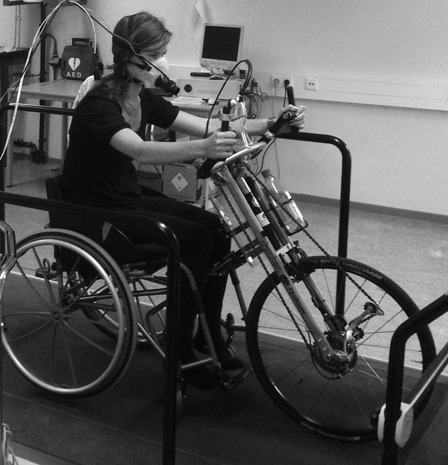
Instrumented add-on handbike, coupled to a regular wheelchair, equipped with an instrumented wheel hub in the front wheel.
Physical stress and strain were described in terms of absolute and relative power output (PO), VO2, heart rate (HR), and compared to ACSM guidelines.21–23 Respiratory gas exchange was measured breath-by-breath during all handcycling sessions using open-circuit spirometry (indoors: Oxycon Delta, Jaeger, Hoechberg, Germany; outdoors: K4b,2 Cosmed, Italy). For both systems, the gas analyzer was calibrated for every session with a 3-l syringe (Jaeger, room air, and a standard gas mixture of 18.0% O2 and 5.0% CO2). METs were calculated as done in Ainsworth et al.'s study.28 HR was recorded beat by beat (Accurex Plus, Polar, Sweden).
Directly after each test, Local Perceived Discomfort (LPD) was assessed. The upper body was divided into 20 regions (hands, lower extremities, upper extremities, shoulder region, neck/back/belly/chest, all received scores for left and right and front and back) as done in the field of ergonomics to determine local physiological discomfort. This method was used in handcycling by Abbasi Bafghi in 2007.29 Subjects were asked to rate their perceived discomfort for the 20 upper-body regions on a scale of 0 to 10 (no discomfort = 0, moderate discomfort = 4, high discomfort = 7, extreme discomfort = 10) and summed to a total LPD-score, with a maximum summed score of 200. The sub-totals for hands, lower extremities, upper extremities, shoulder region (left + right + back + front) and neck/back/belly/chest were summed as well, resulting in 5 sub-scores with a maximum possible score of 40.
Gross-efficiency (GE)
Gross mechanical efficiency was calculated for all submaximal steady state intensities by dividing the measured mechanical PO by the metabolic power input (Pmet):
 |
Pmet was calculated in the last minute (from second 20 to 50) by multiplying oxygen consumption with the oxygen equivalent: Pmet = VO2 * ((4940 * RER + 16040)/60).30 For all measured parameters, means and standard deviations were calculated.
ACSM guidelines and MET scores
MET scores were calculated by dividing VO2 scores of all exercise conditions by a standard resting metabolism of 3.5 ml/kg/minute.28,31 Scores were related to the lower limit of healthy physical exercise prescribed by ACSM guidelines >3 MET.22 Mean VO2 and HR were also related to the recommended level of healthy exercise intensity of >64%HRpeak or >46% VO2peak.21
Incremental testing
The incremental peak exercise handcycle test (IT) was performed indoors on the treadmill, to determine peak oxygen consumption, HR and power output. Velocity was set at 1.94 m/second, with 80 rpm. Subjects started at an inclination of 0%. Every minute, the inclination was increased by 1%. Subjects cycled until voluntary exhaustion, or until rpm dropped below 60 rpm. PO, HR, and respiratory gas exchange were measured and peak values were calculated over the last 30 seconds of the test. Directly after conclusion of the incremental peak exercise test, local perceived discomfort (LPD) scores were filled out.
Sub maximal indoor testing
The incremental test was preceded by a standard warm-up of 5 minutes of handcycling and two submaximal IN trials. Between all exercise bouts, 5 minutes of rest was taken. The first IN bout consisted of 3 minutes handcycling at 1.3 m/second at an incline of 0.7% (IN1), the second bout consisted of 3 minutes of handcycling at 1.0 m/s at 4.8% (IN2). Both trials were cycled at an rpm of 60; 30 seconds of the last minute (20–50 seconds) were used for calculations. These velocities and inclinations were chosen based on pilot experiments, and aimed to represent the sub-maxima intensities of daily handcycling.
Sub maximal outdoor testing
On a separate day, with a minimum of 2 days in between the indoor and outdoor testing sessions, subjects were instructed to cycle for three outdoor bouts of 3 minutes in the instrumented handcycle: handcycling at 1.7 m/second (OUT1); handcycling at 3.3 m/second (OUT2); handcycling at 5.0 m/second (OUT3), all at 60 rpm. Velocities were displayed to the subjects, to be able to cycle the required velocities. These velocities were chosen based on pilot experiments, and aimed to represent velocities of daily handcycling at submaximal intensities in ‘real life’ handcycling. Subjects cycled at the Zernike University Campus (asphalt, no curves), on days without rain, and a side-wind of ¾ Bft.
Field data (n = 1)
Finally, field data were collected in one of seven men. This participant handcycled a representative distance of 8 km from Groningen City to the rehabilitation center ‘Beatrixoord’ in Haren (CASE). Mean cardiorespiratory and power data were collected.
Statistics
Descriptive statistics (means and standard deviations) are given for all measured variables to compare against worldwide exercise guidelines of healthy physical activity.21 Values for PO, HR, VO2, LPD, and GE were compared between different intensities with a repeated measures analysis of variance (P < 0.05).
Results
Parameters characterizing physical stress and strain, as well as summed LPD scores are presented in Table 1. PO, VO2, and HR differed between conditions (P < 0.001). Gross efficiency (P < 0.001) increased with intensity (from a GE of 6.0 ± 1.5% at 23.3 ± 4.2%VO2peak to a GE of 13.0 ± 2.6% at 72.5 ± 15.1%VO2peak).
Table 1.
Parameters characterizing physical stress and strain and LPD scores*
| Trial (N = 7) | PO (W) | %POpeak (%) | VO2 (l/min) | %VO2peak (%) | HR (bpm) | %HRpeak (%) | RER | LPD | GE (%) | MET |
|---|---|---|---|---|---|---|---|---|---|---|
| IN1 | 24.3 ± 5.4 | 17.2 ± 4,6 | 0.92 ± 0.08 | 36.3 ± 5.1 | 93 ± 11 | 54.9 ± 5.5 | 0.88 ± 0.04 | 2 ± 2 | 7.8 ± 1.6 | 2.6 ± 0.2 |
| IN2 | 44.9 ± 5.3 | 31.7 ± 4.9 | 1.25 ± 0.17 | 48.8 ± 5.8** | 104 ± 7 | 61.7 ± 4.8 | 0.91 ± 0.07 | 5 ± 4 | 10.6 ± 1.3 | 3.6 ± 0.5** |
| OUT1 | 11.8 ± 1.7 | 8.4 ± 1.6 | 0.60 ± 0.11 | 23.3 ± 4.2 | 84 ± 8 | 49.8 ± 4.2 | 0.87 ± 0.11 | 4 ± 4 | 6.0 ± 1.5 | 1.7 ± 0.4 |
| OUT2 | 34.4 ± 4.4 | 24.3 ± 4.4 | 1.08 ± 0.15 | 43.1 ± 9.8 | 97 ± 9 | 57.6 ± 5.7 | 0.93 ± 0.10 | 7 ± 9 | 9.4 ± 2.0 | 3.1 ± 0.5** |
| OUT3 | 83.5 ± 12.8 | 58.8 ± 9.2 | 1.83 ± 0.30 | 72.5 ± 15.1**,*** | 135 ± 17 | 80.1 ± 10.5**,*** | 1.09 ± 0.10 | 19 ± 6 | 13.0 ± 2.6 | 5.2 ± 0.9** |
| IT | 143.0 ± 18.0 | 100 ± 0 | 2.56 ± 0.32 | 100 ± 0**,*** | 169 ± 12 | 100 ± 0**,*** | 1.23 ± 0.07 | 27 ± 7 | – | 7.5 ± 0.9**,*** |
| CASE | 72.7 | 49.9 | 1.34 | 50.8 | 118 | 68.4 | 1.07 | – | – | 3.8 |
*Mean (±SD) absolute and relative PO, VO2, HR, RER, LPD and gross mechanical efficiency for the different exercise conditions indoors (IN1: 1.3 m/second at 0.7% IN2: 1.0 m/second at 4.8%), outdoors (OUT1: 1.7 m/second; OUT2: 3.3 m/second; OUT3: 5.0 m/second), the IT and individual values of an individual cycling a representative 8-km distance from the city to the rehabilitation center (CASE). Metabolic equivalent (MET) scores are represented as well, calculated based on a standard rest metabolism of 3.5 ml/kg/minute.30
** > Moderate exercise as defined by ACSM.21
*** > Vigourous exercise as defined by ACSM.21
In addition, scores on five sub-regions are presented in Table 2. Scores of the upper extremity (11.5 ± 5) and shoulder region (11.5 ± 6) were highest, representing a moderate perceived discomfort. Exercise conditions (P < 0.001) as well as upper-body regions (P = 0.008) differed significantly. Pairwise comparisons with a Bonferroni correction showed that values for IT were higher compared to all other conditions, except OUT3. OUT3 differed from both IN trials.
Table 2.
Scores on five sub-regions*
| Trial (N = 7) | H | LE | UE | SR | NBBB |
|---|---|---|---|---|---|
| IN1 | 0 ± 0 | 1 ± 2 | 0 ± 0 | 0 ± 1 | 1 ± 2 |
| IN2 | 0 ± 0 | 1 ± 2 | 2 ± 3 | 1 ± 2 | 0 ± 1 |
| OUT1 | 0 ± 0 | 0 ± 0 | 0 ± 1 | 4 ± 5 | 0 ± 1 |
| OUT2 | 0 ± 0 | 0 ± 1 | 2 ± 5 | 5 ± 5 | 0 ± 1 |
| OUT3 | 2 ± 4 | 3 ± 3 | 8 ± 4 | 5 ± 6 | 1 ± 2 |
| IT | 3 ± 6 | 1 ± 2 | 11 ± 5 | 11 ± 6 | 2 ± 3 |
*Mean (±SD) LPD scores for the regions hands (H), lower-extremities (LE), upper-extremities (UE), shoulder region (SR), and neck/back/brest/belly (NBBB) were given for the different exercise conditions indoors (IN1: 1.3 m/second at 0.7%; IN2: 1.0 m/second at 4.8%) and outdoors (OUT1:1.7 m/second; OUT2: 3.3 m/second; OUT3: 5.0 m/second), and the IT. Possible maximal score for each region (summation of four separate regions) was 40.
Mean values for CASE were presented in Table 1. One of the subjects cycled a representative distance of 8 km from the city to the rehabilitation center, with a velocity of 15.2 km/hour (4.2 m/second) at a mean rpm of 79.9 rpm, for 23 minutes. The peak cardiorespiratory values of the CASE-subject measured during the incremental test were: VO2peak: 2.65 l/minute, HRpeak: 171 bpm, POpeak: 144.6 W.
Discussion
This study is the first to study the relative stress (PO) and strain (HR,VO2) of handcycling on different indoor and outdoor intensities, slopes and velocities, related to ACSM guidelines for healthy physical activity. This provides insight into the potential use of handcycling for rehabilitation of wheelchair users. Based on the results of this study expressed as %VO2peak, handcycling seems to be a promising exercise mode for training the upper body in rehabilitation, with the possibility to acquire the relative exercise intensities as prescribed by ACSM guidelines. Exercise intensities seem to be underestimated when related to %HRpeak. Related to this observation, Valent et al.12 and Goosey-Tolfrey et al.32 found that the HR–VO2 ratio differed in patients with SCI compared to their expectations based on lower-body training literature. This deviation was related to the SCI. Although we cannot conclude anything about linearity based on this study, it seems that handcycling per se results in a different relationship between relative HR and relative VO2 compared to cyclic lower-body exercise. This stresses the importance of developing training guidelines specifically for upper-body exercise. In real life, relative HR and relative VO2 at a certain exercise intensity differ even more due to traffic stops, accelerations/decelerations, different undergrounds etc. Under these circumstances, no steady state level can be attained, and mean HR and VO2 values differ from those during controlled bouts of square wave exercise (see Table 1).
In addition, peak cardio respiratory values (HRpeak and VO2peak) in handcycling appear relatively low compared to able-bodied cycling. The maximum HRs for cycling (∼190 bpm in comparable able-bodied subjects)33 were not achieved in handcycling (169 bpm). This suggests that factors other than cardiorespiratory strain are limiting handcycling performance, such as peripheral limitations and the muscle coordination of inexperienced users. LPD scores (Table 2) did not seem limiting for able-bodied handcycling. LPD scores were at a low-to-moderate level, and all submaximal intensities showed lower LPD scores than LPD at peak performance. In SCI, reduced muscle function in the trunk and extremities, as well as a lack of sympathetic innervation that derives from T1 to T4,34 are additional factors affecting performance. These factors are expected to affect LPD scores and should be evaluated in individuals with SCI as well.
Besides expressing exercise intensity as a %VO2peak or %HRpeak, exercise intensity can also be expressed by METs. In the literature, values for able-bodied cycling are approximately 5–7 METs,28 whereas in this study, values for handcycling were 2–8 METs. Although the vigorous intensities >6 METs, as associated with longevity in the Harvard study,24 can also be reached in handcycling, these were reached at fairly high relative exercise intensities of >70%VO2peak. This finding might indicate that high-intensity training could be beneficial in handcycling during which the required vigorous intensities can be elicited intermittently with rest intervals. In general, more research on exercise and training physiology of the upper-body is a necessity to create understanding and applications in adequate training of patients and elite (wheelchair/handcycling) athletes. This study is a first step in developing a reference base for physiological stress and strain in able-bodied handcycling under various conditions in relation to training possibilities.
For individuals with SCI, it has to be kept in mind that their resting metabolic rate is relatively low due to loss of muscle mass: 1 MET corresponds with 2.7 ml/kg/minute31 instead of the typical 3.5 ml/kg/minute in able-bodied individuals. Optimal metabolic function might be reduced due to alterations in body composition, cardiorespiratory physiology and the varying severity of muscle paralysis.35 In addition, HR responses appeared to be blunted in patients with SCI.12 HR thus seems a less adequate training monitoring parameter for persons with SCI. Recent studies investigated using rate of perceived exertion (RPE) for prescribing training intensities in persons with SCI. Although RPE seems a valid tool to regulate exercise intensity for persons with SCI,36 caution is advised because the well-accepted physiological relationships of RPE, HR, and VO2 differ in persons with SCI.37
Finally, physiological stress and strain are important components of training adequate to support healthy and mobile lifestyles. This study showed that these components appeared to differ for upper-body exercise compared to lower body exercise. Training guidelines for the upper body must be developed. Actual training studies are required to evaluate training effects in the context of health, as well as of optimal performance. One handcycling training study has been performed in a small sample of individuals with paraplegia. Aerobic capacity increased after rehabilitation training (once a week) at velocities comparable to those used in this study, indicating the possible applications for handcycling training in rehabilitation of individuals with SCI.13
Limitations and recommendations
Although this study provided knowledge on physical stress and strain of the relatively novel activity of handcycling, it was performed in able-bodied subjects, so results cannot be directly translated one-to-one to individuals with SCI. However, peak cardiorespiratory data for able-bodied persons in this study seemed not much higher than data for individuals with SCI as presented in Hettinga et al.'s study.18 Differences in VO2peak between able-bodied individuals and individuals with paraplegia were ∼0.4 l/minute.18 Peak values for HR and VO2 in an elite Paralympic athlete (VO2peak of 2.5 l/minute and a HRpeak of 157 bpm)5 also approached the data for the able-bodied. Thus, looking at cardiorespiratory peak values and training possibilities, it seems that data for the able-bodied are relatively close to those of individuals with paraplegia, and can be a good first step in defining training guidelines. For persons with tetraplegia, differences are larger, and adapted (intermittent) training programs need to be developed.18 (Longitudinal) measurements in large groups of individuals with SCI are advised, to gain insight into individual differences due to levels of injury, use of medication, and concomitant conditions.
Another limitation is that the handcycle could not be adapted to the individuals optimally. Although they were quite homogeneous and no major inconveniences were reported, for training purposes, we advise optimizing handbike–user interfaces in rehabilitation practice.
Finally, this study also showed that GE increased with exercise intensity from 6% to 13%, probably caused by the decrease of the relative fraction of basal metabolism contributing to energy expenditure with intensity.38 At the highest sub-maximal intensity, respiratory exchange coefficient values exceeded 1.0, and thus, GE was slightly overestimated due to additional anaerobic energy production. However, handcycling was still shown to be relatively efficient compared to wheelchair performance, with the potential to be a training mode for the upper body.
Conclusion
Handcycling seems a promising exercise mode for training the upper body, being relatively efficient and able to elicit the required relative exercise intensities (expressed as %VO2peak) as prescribed by ACSM guidelines. Exercise load seems to be underestimated when related to %HRpeak. LPD was not perceived as limiting. Physiological stress and strain in these able-bodied subjects appeared comparable to that for individuals with paraplegia, and lower than in individuals with tetraplegia. To understand, individualize and optimize upper-body training, different training programs must be evaluated in the able-bodied, as well as in individuals with SCI.
References
- 1.van der Woude LH, de Groot G, Hollander AP, van Ingen Schenau GJ, Rozendal RH. Wheelchair ergonomics and physiological testing of prototypes. Ergonomics 1986;29(12):1561–73 [DOI] [PubMed] [Google Scholar]
- 2.Dallmeijer AJ, Ottjes L, de Waardt E, van der Woude LH. A physiological comparison of synchronous and asynchronous hand cycling. Int J Sports Med 2004;25(8):622–6 [DOI] [PubMed] [Google Scholar]
- 3.Dallmeijer AJ, Zentgraaff ID, Zijp NI, van der Woude LH. Submaximal physical strain and peak performance in handcycling versus handrim wheelchair propulsion. Spinal Cord 2004;42(2):91–8 [DOI] [PubMed] [Google Scholar]
- 4.Abel T, Rojas Vega S, Bleicher I, Platen P. Handbiking: Physiological responses to synchronous and asynchronous crank montage. Eur J Appl Physiol Occup Physiol 2003;3(4):1–9 [Google Scholar]
- 5.Abel T, Schneider S, Platen P, Struder HK. Performance diagnostics in handbiking during competition. Spinal Cord 2006;44(4):211–16 [DOI] [PubMed] [Google Scholar]
- 6.Abel T, Burkett B, Schneider S, Lindschulten R, Struder HK. The exercise profile of an ultra-long handcycling race: the Styrkeproven experience. Spinal Cord 2010;48(12):894–8 [DOI] [PubMed] [Google Scholar]
- 7.Abel T, Kroner M, Rojas Vega S, Peters C, Klose C, Platen P. Energy expenditure in wheelchair racing and handbiking – a basis for prevention of cardiovascular diseases in those with disabilities. Eur J Cardiovasc Prev Rehabil 2003;10(5):371–6 [DOI] [PubMed] [Google Scholar]
- 8.Verellen J, Brent G, Van de Vliet P, Vanlandewijck Y. Consistency of the within cycle torque distribution pattern during handcycling: a pilot study. Eur Bull APA; http://www.bulletin-apacom 2004;3(2). Available from: http://www.eufapa.eu/index.php/.../60-van-der-woude-lucas-hv-2-.html [Google Scholar]
- 9.Verellen J, Theisen D, Vanlandewijck Y. Influence of crank rate in hand cycling. Med Sci Sports Exerc 2004;36(10):1826–31 [DOI] [PubMed] [Google Scholar]
- 10.Valent LJ, Dallmeier AJ, Houdijk H, Slootman HJ, Janssen TW, Post MW, et al. Effects of hand cycle training on physical capacity in individuals with tetraplegia: a clinical trial. Phys Ther 2009;89(10):1051–60 [DOI] [PubMed] [Google Scholar]
- 11.Valent LJ, Dallmeier AJ, Houdijk H, Slootman HJ, Janssen TW, Post MW, et al. Effects of hand cycle training on wheelchair capacity during clinical rehabilitation in persons with spinal cord injury. Disabil Rehabil 2010;32(26):2191–200 [DOI] [PubMed] [Google Scholar]
- 12.Valent LJ, Dallmeier AJ, Houdijk H, Slootman HJ, Janssen TW, Post MW, et al. The individual relationship between heart rate and oxygen uptake in people with a tetraplegia during exercise. Spinal Cord 2007;45(1):104–11 [DOI] [PubMed] [Google Scholar]
- 13.Valent LJ, Dallmeier AJ, Houdijk H, Slootman HJ, Janssen TW, Post MW, et al. Influence of hand cycling on physical capacity in the rehabilitation of persons with a spinal cord injury: a longitudinal cohort study. Arch Phys Med Rehabil 2008;89(6):1016–22 [DOI] [PubMed] [Google Scholar]
- 14.Valent LJ, Dallmeier AJ, Houdijk H, Talsma E, van der Woude LH. The effects of upper body exercise on the physical capacity of people with a spinal cord injury: a systematic review. Clin Rehabil 2007;21(4):315–30 [DOI] [PubMed] [Google Scholar]
- 15.Arnet U, van Drongelen S, Scheel-Sailer A, van der Woude LH, Veeger DH. Shoulder load during synchronous handcycling and handrim wheelchair propulsion in persons with paraplegia. J Rehabil Med 2012;44(3):222–8 [DOI] [PubMed] [Google Scholar]
- 16.Arnet U, Van Drongelen S, Van Der Woude LHV, Veeger HEJ. Shoulder load during handcycling at different incline and speed conditions. Clin Biomech 2012;27(1):1–6 [DOI] [PubMed] [Google Scholar]
- 17.Hettinga F, Valent L, Groen W, van Drongelen S, de Groot S, van der Woude L. Handcycling: an active form of wheeled mobility, recreation and sports. Phys Med Rehabil Clin N Am 2010;21(1):127–40 [DOI] [PubMed] [Google Scholar]
- 18.Hettinga FJ, Valent L, van der Woude LHV. Optimal upper body exercise training: Handcycling. In: Everyday technology for independence and care – AAATE (2011). Volume 29 ed. Maastricht, The Netherlands: Assistive Technology Research Series; 2011. pp. 751–7 [Google Scholar]
- 19.van Drongelen S, de Groot S, Veeger HEJ, Angenot ELD, Dallmeire AJ, Post MWM, et al. Upper extremity musculoskeletal pain during and after rehabilitation in wheelchair-using persons with a spinal cord injury. Spinal Cord 2006;44(3):152–9 [DOI] [PubMed] [Google Scholar]
- 20.van der Woude LHV, Veeger D, Dallmeijer AJ, Janssen TW, Rozendaal LA. Biomechanics and physiology in active manual wheelchair propulsion. Med Eng Phys 2001;23(10):713–33 [DOI] [PubMed] [Google Scholar]
- 21.Garber CE, Blissmer B, Deschenes MR, Franklin BA, Lamonte MJ, Lee IM, et al. American College of Sports Medicine Position Stand: Quantity and quality of exercise for developing and maintaining cardiorespiratory, musculoskeletal and neuromotor fitness in apparently healthy adults: guidance for prescribing exercise. Med Sci Sports Exerc 2011;43(7):1334–59 [DOI] [PubMed] [Google Scholar]
- 22.Haskell WL, Lee I, Pate RR, Powell KE, Blair SN, Franklin BA, et al. Physical activity and public health: updated recommendation for adults from the American College of Sports Medicine and the American Heart Association. Med Sci Sports Exerc 2007;39(8):1423–34 [DOI] [PubMed] [Google Scholar]
- 23.ACSM Position Stand The recommended quantity and quality of exercise for developing and maintaining cardiorespiratory and muscular fitness and flexibility in healthy adults. MedSci Sports Exerc 1998;30(6):975–91 [DOI] [PubMed] [Google Scholar]
- 24.Lee IM, Hsieh CC, Paffenberger RS., Jr. Exercise intensity and longevity in men, the Harvard alumni study. JAMA 1995;273(15):1179–84 [PubMed] [Google Scholar]
- 25.de Geus B, De Smet S, Nijs J, Meeusen R. Determining the intensity and energy expenditure during commuter cycling. Br J Sports Exerc. 2007;41(1):8–12 [DOI] [PMC free article] [PubMed] [Google Scholar]
- 26.Simons M, van Es E, Hendriksen I. Electrically assisted cycling: a new mode for meeting physical activity guidelines? Med Sci Sports Exerc 2009;41(11):2097–102 [DOI] [PubMed] [Google Scholar]
- 27.Cardinal BJ, Esters J, Cardinal MK. Evaluation of the revised Physical Activity Readiness Questionnaire in older adults. Med Sci Sports Exerc 1996;28(4):468–72 [DOI] [PubMed] [Google Scholar]
- 28.Ainsworth BE, Haskell WL, Whitt MC, Irwin ML, Swartz AM, Strath SJ, et al. Compendium of Physical Activities: an update of activity codes and MET intensities. Med Sci Sports Exerc 2000;32(9 suppl) S498–516 [DOI] [PubMed] [Google Scholar]
- 29.Abbasi Bafghi H, de Haan A, Horstman A, van der Woude L. Biophysical aspects of submaximal handcycling. Int J Sports Med 2008;29:630–8 [DOI] [PubMed] [Google Scholar]
- 30.Garby L, Astrup A. The relationship between the respiratory quotient and the energy equivalent of oxygen during simultaneous glucose and lipid oxidation and lipogenesis. Acta Physiol Scand 1987;129:443–4 [DOI] [PubMed] [Google Scholar]
- 31.Collins EG, Gater D, Kiratli J, Butler J, Hanson K, Langbein WE. Energy cost of physical activities in persons with spinal cord injury. Med Sci Sports Exerc. 2010;42(4):691–700 [DOI] [PubMed] [Google Scholar]
- 32.Goosey-Tolfrey V, Tolfrey K. The oxygen uptake-heart rate relationship in trained female wheelchair athletes. J Rehabil Res Dev 2004;41(3):415–20 [DOI] [PubMed] [Google Scholar]
- 33.Hettinga FJ, de Koning JJ, Broersen FT, van Geffen P, Foster C. Pacing strategy and the occurrence of fatigue in 4000-m cycling time trials. Med Sci Sports Exerc 2006;38(8):1484–91 [DOI] [PubMed] [Google Scholar]
- 34.Glaser RM. Arm exercise training for wheelchair users. Med Sci Sports Exerc 1989;21(5 Suppl):S149–57 [PubMed] [Google Scholar]
- 35.Lassau-Wray ER, Ward GR. Varying physiological response to arm-crank exercise in specific spinal injuries. J Physiol Anthropol 2000;19(1):5–12 [DOI] [PubMed] [Google Scholar]
- 36.Goosey-Tollfrey V, Lenton J, Goddard J, Oldfield V, Tolfrey K, Eston R. Regulating exercise intensity using perceived exertion in spinal cord-injured patients. Med Sci Sports Exerc 2010;42(3):608–13 [DOI] [PubMed] [Google Scholar]
- 37.Lewis JE, Nash MS, Hamm LF, Martins SC, Groah LH. The relationship between perceived exertion and physiologic indicators of stress during graded arm exercise in persons with spinal cord injuries. Arch Phys Med Rehabil 2007;88(9):1205–11 [DOI] [PubMed] [Google Scholar]
- 38.Moseley L, Jeukendrup AE. The reliability of cycling efficiency. Med Sci Sports Exerc 2001;33(4):621–7 [DOI] [PubMed] [Google Scholar]