



Abstract
Background
Simultaneous treatment of multilevel aortic disease is controversial due to the theoretic increase in morbidity. This study was conducted to define the outcomes in patients treated electively with simultaneous thoracic endovascular aortic aneurysm repair (TEVAR) and abdominal aortic endovascular endografting for synchronous aortic pathology.
Methods
Patients treated with simultaneous TEVAR and endovascular aneurysm repair (T&E) at the University of Florida were identified from a prospectively maintained endovascular aortic registry and compared with those treated with TEVAR alone (TA). The study excluded patients with urgent or emergency indications, thoracoabdominal or mycotic aneurysm, and those requiring chimney stents, fenestrations, or visceral debranching procedures. Demographics, anatomic characteristics, operative details, and periprocedural morbidity were recorded. Mortality and reintervention were estimated using life-table analysis.
Results
From 2001 to 2011, 595 patients underwent TEVAR, of whom 457 had elective repair. Twenty-two (18 men, 82%) were identified who were treated electively with simultaneous T&E. Mean ± standard deviation age was 66 ± 9 years, and median follow-up was 8.8 months (range, 1–34 months). Operative indications for the procedure included dissection-related pathology in 10 (45%) and various combinations of degenerative etiologies in 12 (55%). Compared with TA, T&E patients had significantly higher blood loss (P < .0001), contrast exposure (P < .0001), fluoroscopy time (P < .0001), and operative time (P < .0001). The temporary spinal cord ischemia rate was 13.6% (n = 3) for the T&E group and 6.0% for TA (P = .15); however, the permanent spinal cord ischemia rate was 4% for both groups (P = .96). The 30-day mortality for T&E was 4.5% (n = 1) compared with 2.1% (n = 10) for TA. Temporary renal injury (defined by a 25% increase over baseline creatinine) occurred in two T&E patients (9.1%), with none requiring permanent hemodialysis; no significant difference was noted between the two groups (P = .14). One-year mortality and freedom from reintervention in the T&E patients were 81% and 91%, respectively.
Conclusions
Acceptable short-term morbidity and mortality can be achieved with T&E compared with TA, despite longer operative times, greater blood loss, and higher contrast exposure. There was a trend toward higher rates of renal and spinal cord injury, so implementation of strategies to reduce the potential of these complications or consideration of staged repair is recommended. Short-term reintervention rates are low, but longer follow-up and greater patient numbers are needed to determine procedural durability and applicability.
Although multiple reports have highlighted the safety and efficacy of endovascular repair of the thoracic (TEVAR) and infrarenal abdominal (EVAR) aorta,1–6 the application of these technologies simultaneously in patients harboring multilevel aortic disease (MLAD) is controversial due to a theoretical concern for increased morbidity. Synchronous, proximal degenerative thoracic aortic pathology is present in 5% to 13% of patients with abdominal aortic aneurysms,7 and abdominal aneurysms are present in 10% to 29% of patients with thoracic aortic aneurysms.8 Descriptions of patients with mixed aortic pathologies, including aneurysm along with dissection, penetrating ulcers, complex atheromatous disease, or postsurgical pseudoaneurysm, have been reported and further define a unique subset of patients with MLAD.9,10
Noncontinuous aortic pathology in the chest and abdomen provides an opportunity for staged management in many patients. Historically, treatment of these patients has been undertaken with staged open repair, when possible. However, several reports have demonstrated the safety of simultaneous repair in selected patients.11–14 The integration of endoluminal therapies into the surgical management of this unique cohort of patients has resulted in the description of various permutations of staged or simultaneous hybrid treatment strategies.10,12,15
Another subset of patients with MLAD who warrant specific consideration are those with complex type B aortic dissection (cTBAD). TEVAR has been shown to be safe in the management of acute and chronic aortic dissection16,17; however, some patients may have infrarenal aortic aneurysmal degeneration, distal aortic fenestrations, or secondary entry tears that require management in conjunction with the proximal entry tear. Staged, nearly total exclusion of TBAD (acute or chronic) has been reported in small series,18 but despite these encouraging early results, the overall reported experience with simultaneous management remains largely anecdotal.
Elective simultaneous TEVAR and EVAR (T&E) treatment of patients with MLAD has the potential of increased morbidity due to increased aortic coverage during a single surgical encounter, as well as longer operative times, increased blood loss, and greater contrast exposure. Conversely, simultaneous T&E provides the benefit of preventing the need for two operative interventions, potentially reduces future access site complications, and obviates interval aortic complications that may occur with a staged strategy.11 Our practice at the University of Florida has generally been to address thoracic and aortic pathologies concomitantly with simultaneous T&E, when clinically indicated. With this study, we sought to define our experience with elective T&E.
METHODS
Database
A dedicated, prospectively maintained endovascular aortic registry is kept at the University of Florida containing all patients who have undergone endovascular aortic repair. This database contains >50 patient-specific and procedure-specific variables that are entered by the operating surgeon for each patient at the time of the operation. The database undergoes scheduled quality-control audits by study coordinators working within the division. In addition, data within the registry are routinely updated and augmented by complete review of the medical record. Any additional data required for this analysis were obtained by data abstraction from the patient’s electronic medical record. The University of Florida Institutional Review Board approved this study.
Patients
All patients who presented to the University of Florida between January 1, 2001, and July 31, 2011, for endovascular management of thoracic and aortic pathology were reviewed. Patients who had documented, combined, isolated thoracic and abdominal aortic pathology were identified and further studied. This analysis was intended to focus on patients with discontinuous MLAD who could be managed electively (without visceral adjunctive therapies, such as chimney stents, graft fenestrations or branches, or visceral debranching) along with patients with cTBAD undergoing elective T&E. Patients requiring the aforementioned adjunctive therapies were intentionally excluded from the analysis, but those who underwent proximal thoracic aortic debranching or carotid-to-subclavian bypass were included. Also excluded were patients with an emergency or urgent indication and mycotic etiologies.
Because no patients were identified who had undergone a planned, staged TEVAR and EVAR, T&E patients were compared with those treated with elective TEVAR alone (TA) in an attempt to provide comparative procedure-related benchmark analysis and safety metrics according to the Society for Vascular Surgery reporting guidelines.19 Elective TA patients were treated for complicated cTBAD as well as for degenerative aortic pathology, including descending thoracic aortic aneurysm and nonurgent or emergency penetrating ulceration. Patients with postsurgical anastomotic pseudoaneurysm, traumatic aortic transection, coarctation, or any emergency/rupture indication for TA were excluded. Patients who underwent fenestrated branched or chimney TEVAR were also excluded from the study population (Supplementary Fig, online only).
All demographic and clinical data were obtained through review of electronic medical records. Preoperative thin-cut (1- to 2-mm), arterial-phased spiral computed tomography angiography (CTA) scans and operative records were reviewed to delineate anatomic pathology, lesion extent, location, size, and access-vessel morphology. Operative records were reviewed to record procedure-related variables. Postoperative discharge summaries and office visits were analyzed to capture periprocedural morbidity.
Imaging protocol and surveillance
Preoperative and postoperative imaging consisted exclusively of CTA. Aortic treatment zones, postoperative endoleak or false lumen perfusion, and graft migration were assessed with the assistance of three-dimensional reconstruction of axial imaging (TeraRecon Inc, San Mateo, Calif). Postoperative aortic treatment length for the simultaneous T&E patients was measured with centerline measurements from the sinotubular junction to the aortic bifurcation (total aortic length [TAL]) per published reporting standards.19 The percentage of aortic coverage was calculated by dividing the additive total of the stented aortic segments by TAL (% aortic coverage = [TEVAR covered + EVAR covered]/TAL × 100). The indications for postoperative office visits or imaging studies were based on a predefined CTA imaging protocol that included delayed venous-phased imaging at 1, 6, and 12 months, and annually thereafter, unless radiographic abnormalities, endoleak, or graft integrity dictated otherwise. Reintervention was defined as any secondary procedure that was performed to treat the initial intended synchronous aortic pathologies.
Endovascular technique
The endovascular technique and sequence of graft implantation was left to the judgment of the operating surgeon, as was the use of spinal drainage. Postoperative management of the spinal drain was based on a previously published standardized protocol.20,21 Most frequently, procedural conduct was characterized by TEVAR, followed by EVAR deployment using standard device-specific instructions for use. All patients undergoing elective repair were systemically heparinized to achieve an activated clotting time of ≥250 seconds. Each surgeon determined the need for preoperative or intraoperative adjuncts, such as carotid-to-subclavian bypass or open or endovascular access vessel conduit. Technical success was defined as successful thoracic and abdominal endograft deployment into the intended aortic segments, with angiographic documentation of primary degenerative pathology exclusion or sluggish flow in the false lumen in cases of dissection. Intravascular ultrasound imaging was used universally in dissection patients and selectively in others.
Postoperative management
All patients treated with a thoracic endograft at the institution are admitted postoperatively to a Thoracic and Cardiovascular Surgery intensive care unit (ICU) for serial neurologic assessment, as well as monitoring of heart rate and blood pressure. Patients with a spinal drain were managed using a previously published protocol.20 Hourly neurologic assessment by ICU staff is performed in all patients for the initial 48 to 72 hours after the operation, depending on presence or absence of a spinal drain and findings of serial neurologic examinations. Any change in neurologic status prompted further neurologic examination and imaging as clinically dictated. Volume resuscitation and vasopressor support, with or without manipulation of the spinal drain height/drainage volume, was predicated on the institutional protocol. After recovery in the Thoracic and Cardiovascular Surgery ICU, patients were transferred to a dedicated cardiovascular surgery nursing ward and discharged at the operating surgeon’s discretion.
Data analysis and statistical methods
Periprocedural data, morbidity, and 30-day mortality rates were analyzed. Postoperative imaging was reviewed for successful aneurysm exclusion, size change, and presence of endoleak. Any deaths were verified through record review and query of the Social Security Death Index. Statistical analyses were performed using STATA 9.2 software (StataCorp, College Station, Tex). Categoric factors are summarized using frequencies and percentages, and continuous measure distributions are described using means ± standard deviations and median (range). Categoric patient characteristics were compared between groups using the Pearson χ2 test or Fisher exact test when indicated. Continuous measures were compared using two-sampled t-tests or Wilcoxon rank sum tests, as appropriate. Kaplan-Meier estimates of survival and re-intervention were performed. A significance level of 0.05 was assumed for all tests.
RESULTS
From 2000 to 2011, 595 patients underwent TEVAR, of whom 457 underwent elective repairs. Simultaneous T&E was used to treat 62 patients, and after those with emergency indications and those undergoing repair with fenestrated/branched grafts, chimney stents, or visceral debranching procedures were excluded, 22 patients (18 men, 82%) were identified who underwent elective T&E (Supplementary Fig, online only).
Patients were a mean age of 66 ± 9 years (Table I). The most common comorbidities were hypertension (100%) and chronic obstructive pulmonary disease (64%). The median follow-up time was 8.8 months (range, 1–34 months). Four patients (18%) had a history of previous open aortic surgery before the index endovascular procedure. The study design and operative indications for the procedure included dissection-related pathology in 10 (45%), and various combinations of degenerative etiologies in 12 (55%), including aneurysm, penetrating ulcer, post-surgical pseudoaneurysm, and atheromatous disease (Fig 1). Mean initial aortic diameters for patients whose indications were not dissection-related were 63.4 ± 17.1 mm and 55 ± 10.7 mm in the thoracic and infrarenal aortic segments, respectively. Of the 10 patients who underwent T&E for dissection-related indications, the mean thoracic and abdominal aortic diameters were 56.5 ± 9.9 mm and 55.8 ± 4.4 mm.
Table I.
Patient demographics
| Variable | N = 22 |
|---|---|
| Male, No. (%) | 18 (81.8) |
| Age, mean ± SD, years | 66 ± 9 |
| Hypertension, % | 100 |
| COPD, % | 63.6 |
| Dyslipidemia, % | 54.5 |
| PVAOD/CVAOD, % | 29.2 |
| CAD/myocardial infarction, % | 27.0 |
| Prior open aortic operation, % | 18.1 |
| Congestive heart failure, % | 13.6 |
| CRI (Cr >1.8 mg/dL), % | 9.1 |
| Diabetes, % | 0 |
CAD, Coronary artery disease; COPD, chronic obstructive pulmonary disease; Cr, creatinine; CRI, chronic renal insufficiency; CVAOD, cerebrovascular arterial occlusive disease; PVAOD, peripheral vascular arterial occlusive disease; SD, standard deviation.
Fig. 1.
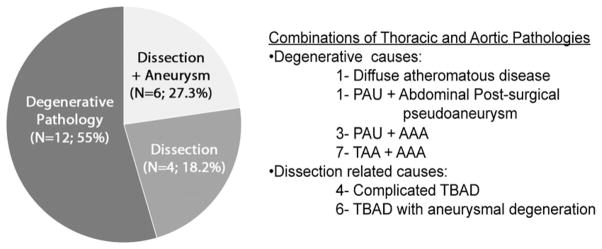
Figure demonstrates the various combinations of aortic pathologies that were the indications for patients undergoing simultaneous thoracic endovascular aortic repair (TEVAR) and endovascular aneurysm repair (EVAR). AAA, Abdominal aortic aneurysm; PAU, penetrating aortic ulcer; TAA, thoracic aortic aneurysm; TBAD, type B aortic dissection.
A total of 14 preoperative adjunctive procedures were performed in 11 patients (50%) and included elephant trunk (n = 3), arch debranching (n = 5), left carotid-subclavian bypass (n = 4), hypogastric bypass with concomitant iliofemoral bypass (n = 1), and renal stent graft (n = 1). These procedures occurred at a median of 10 days (range, 1–1805 days) before T&E. Technical success in T&E deployment was 100%. No patients required conversion to open repair. Two patients (9%) had intraprocedural complications, both of which were mild to moderate according to SVS/Rutherford grading severity22 and related to access management: one brachial artery thrombosis requiring open thrombectomy, and one iliac dissection necessitating iliac stent placement.
A variety of graft types were used to complete the thoracic and aortic repairs, including thoracic aorta: Cook TX2 (Cook Medical Inc, Bloomington, Ind; n = 16), Gore TAG (W. L. Gore and Associates, Flagstaff, Ariz; n = 5), TX2-TAG (n = 1); infrarenal aorta: Zenith (Cook Medical Inc; n = 16), Cook Renu (Cook Medical Inc, n = 3), Excluder (W. L. Gore; n = 1), Excluder cuff plus Wall graft (Boston Scientific, Natick, Mass; n = 1), or Wall graft (n = 1). Intraoperative technical details regarding TEVAR landing zones and total aortic treatment lengths are further delineated in Fig 2.
Fig. 2.

A, Various landing zones for thoracic endovascular aortic repair (TEVAR) are depicted, along with the different types of thoracic and aortic stent graft devices used to complete the repair. B, The total extent of aortic coverage as a function of dissection and aneurysm-related indications is shown. The error bars show the standard deviation.
The average number of TEVAR devices used to complete repair was 2.1 ± 0.8 for all patients (nondissection: 1.8 ± 0.8; dissection: 2.3 ± 0.7). With respect to centerline measured and aortic coverage data for the entire cohort, the percentage of total aortic stent graft exclusion was 61.3% ± 15.1% for all patients (nondissection: 56.2% ± 15.6%; dissection: 65.6% ± 13.7%) and total aortic coverage was 342 ± 88 mm (nondissection: 312 ± 87 mm; dissection: 368 ± 83 mm). The contribution of TEVAR resulted in an average treatment length of 226 ± 83 mm for all patients (nondissection: 190 ± 68 mm; dissection: 251 ± 85 mm), whereas EVAR accounted for an average exclusion measurement of 117 ± 37 mm (nondissection: 118 ± 25 mm; dissection: 117 ± 45 mm).
A comparative summary for commonly reported procedural-related details are outlined in Table II. Compared with TA patients, T&E patients had significantly higher blood loss (P < .0001), contrast exposure (P < .0001), fluoroscopy time (P < .0001), and operative time (P < .0001). Preoperative spinal drain placement was required in 17 T&E patients (77.3%) and in 250 TA patients (54.7%), which was a significant difference (P = .05). The rate of any spinal cord ischemia was 13.6% for the T&E group (n = 3) and 6.0% for the TA group (P = .15); however, the permanent spinal cord ischemia (SCI) rate was 4% for both groups (P = .96).
Table II.
Comparative statistics of commonly reported perioperative outcomes for elective thoracic endovascular aortic repair (TEVAR) alone and simultaneous TEVAR and endovascular aneurysm repair (EVAR)a
| Variableb | TEVAR-EVAR N = 22 | TEVAR alone N = 435 | OR (95% CI) | Pc |
|---|---|---|---|---|
| Male sex, % | 86.4 | 67.0 | .4 | |
| Age, years | 66 ± 9 | 67 ± 13 | .9 | |
| Preoperative procedure, %d | 45.4 | 23.0 | 3.4 (1.4–8.0) | .004 |
| Preoperative spinal drain, % | 77.3 | 55.0 | 2.8 (1–7.8) | .04 |
| Estimated blood loss, mL | 350 (150–2000) | 250 (50–4500) | NA | <.0001 |
| Contrast, mL | 238 (90–420) | 125 (0–305) | NA | <.0001 |
| Fluoroscopy time, minutes | 58 (27–143) | 20 (0–230) | NA | <.0001 |
| Procedure time, minutes | 209 (110–552) | 100 (37–594) | NA | <.0001 |
| Outcomes | ||||
| Median LOS (95% CI), days | 5 (5–12) | 5 (6–7) | NA | .06 |
| Reintervention at 12 months, % | 9.1 | 11.0 | 0.38 (0.2–2.0) | .6 |
| Renal injury, %e | ||||
| Any | 9.1 | 3.0 | 3.5 (0.7–17.0) | .1 |
| Hemodialysis | 0 | 0.9 | Inestimable | >.99 |
| Spinal chord ischemia, %f | ||||
| Any | 13.6 | 6.0 | 2.5 (0.7–9.0) | .2 |
| Permanent | 4.5 | 4.4 | 1.2 (0.2–10.0) | .6 |
| 30-day mortality, % | 4.5 | 2.1 | 1.8 (0.2–15.0) | .4 |
CI, Confidence interval; LOS, length of stay; NA, not applicable; OR, odds ratio.
No significant differences exist between the two patient cohorts with respect to preoperative comorbidities such as coronary artery disease, congestive heart failure, chronic obstructive pulmonary disease, renal insufficiency (preoperative creatinine ≥1.8 mg/dL), and diabetes mellitus, cerebrovascular, or peripheral arterial occlusive disease.
Continuous variables are shown as mean ± standard deviation and mean (range), unless otherwise indicated.
Determined using the Fisher exact or t-test, when appropriate.
Included carotid-to-subclavian bypass, embolization, arch debranching, elephant trunk, or access vessel procedure.
Defined as a change in baseline creatinine of ≥25%.
Defined as any decrease in baseline ambulatory ability.
The three patients in the T&E group who developed SCI were treated for degenerative aortic pathology, and their respective aortic coverage lengths were 41%, 45%, and 78%. All three patients had patent or revascularized aortic arch vessels. None of these patients had undergone prior aortic operations. Two of the three patients had patent bilateral internal iliac arteries, whereas one patient (with 41% aortic coverage) underwent right internal iliac artery embolization with EVAR extension into the right internal iliac artery (with a remaining patent left internal iliac artery).
The 30-day mortality was 4.6% for T&E (n = 1) compared with 2.1% for TA (n = 10; P = .56), and in-hospital mortality was 9.1% for T&E (n = 2) compared with 2.5% for TA (n = 11; P = .07). A total of 21 complications occurred in nine T&E patients (41%) compared with 191 complications in 131 TA patients (28.7%; P = .28). Temporary renal injury (defined by a 25% increase over baseline creatinine) occurred in two T&E patients (9.1%), with none requiring permanent hemodialysis; no significant difference was noted between the two groups (P = .14). Other T&E complications (Table III) included bleeding in one patient (4.5%), who required re-exploration for retroperitoneal bleeding; ischemia in two (9.1%), with one patient requiring left carotid subclavian bypass 2 weeks postoperatively for arm fatigue, and one with lower extremity peripheral embolization who was managed expectantly; and gastrointestinal-related complications in three patients (13.6%), comprising two with prolonged ileus and one who developed necrotizing pancreatitis requiring necrosectomy.
Table III.
Postoperative complications in patients undergoing elective, simultaneous thoracic endovascular aortic repair (TEVAR) and endovascular aneurysm repair (EVAR)
| Variable | No. (%) (N = 22) |
|---|---|
| Death | |
| Within 30 days | 2 (9.1) |
| Within hospital stay | 1 (4.5) |
| Spinal cord ischemia | |
| Any | 3 (13.6) |
| Permanent | 1 (4.5) |
| Pulmonary | 2 (9.1) |
| Renal | |
| Any | 2 (9.1) |
| Permanent | 1 (4.5) |
| Gastrointestinal | 3 (13.6) |
| Colon ischemia | 1 (4.5) |
| Pancreatic necrosis | 1 (4.5) |
| Ileus | 1 (4.5) |
| Wound | 2 (9.1) |
| Bleeding requiring pRBC/OR | 1 (4.5) |
| Genitourinary | |
| Urinary tract infection | 1 (4.5) |
| Retention | 1 (4.5) |
OR, Operation; pRBC, packed red blood cells.
Survival analysis and reintervention
For the T&E cohort, the overall 12-month survival and 10-month freedom from reintervention rates were 81% and 91%, respectively (Fig 3). One patient died, for a 30-day mortality of 4.5%; however, in-hospital mortality was 9.1% (n = 2). One patient died postoperatively secondary to multiorgan failure (MOF) after developing colon ischemia. The other patient had a protracted course resulting in MOF after early (postoperative day 2) false lumen rupture (detailed below).
Fig. 3.

A, Kaplan-Meier curves show (A) survival and (B) freedom from reintervention after elective simultaneous thoracic endovascular aortic repair (TEVAR) and endovascular aneurysm repair (EVAR). **The dotted lines indicate >10% standard error mean beyond those intervals.
None of the patients with degenerative pathologies required reintervention. Three T&E patients (13%) required reintervention, all of whom had complex cTBAD with aneurysmal degeneration and persistent false lumen perfusion, and they warrant specific discussion. One patient had persistent false lumen perfusion with aneurysmal degeneration of the thoracic aorta requiring distal thoracic endograft extension at 1.4 months postoperatively. Subsequent imaging at 3 and 6 months demonstrated a thrombosed false lumen with stabilization of aortic diameters.
Another patient received a renal stent graft at 13.1 months after the index procedure for a secondary entry tear, with continued paravisceral aortic false lumen expansion. This intervention was initially successful, and follow-up imaging demonstrated thrombosis of the abdominal portion of the dissection. The patient subsequently required ascending and transverse arch replacement at 16.5 months after simultaneous T&E due to new development of false lumen perfusion at the proximal aspect of the graft, with resultant aneurysmal degeneration of the transverse arch.
The final patient required urgent distal open aortic replacement 2 days after the index procedure due to false lumen rupture. MOF developed after that operation, and the patient died during the postoperative hospitalization (in-hospital late death; 4.2 months).
Endoleaks
Postoperative imaging noted endoleaks in three nondissection patients (25%). In one patient a small type Ia endoleak was noted at 12 months postoperatively, without subsequent intervention to date. In two patients type II endoleaks were noted, one at 2 months and one at 6 months, neither requiring reintervention. Persistent false lumen flow was noted in four dissection patients (40%), two requiring reintervention as noted above. The other two patients had complete thrombosis of their false lumen flow on subsequent cross-sectional imaging.
DISCUSSION
The existing literature has few data to provide clear recommendations about the appropriate applicability, safety, and durability of elective simultaneous endovascular management of synchronous aortic pathology. Our practice has been to treat both levels of disease in the same setting when clinically indicated. Consequently, we undertook this study to determine our short-term surgical outcomes of patients treated electively with T&E for synchronous thoracic and abdominal aortic disease. This experience, not unexpectedly, demonstrates that when compared with TA, simultaneous T&E has longer procedure times, greater blood loss, and larger amounts of contrast and radiation exposure. Despite these differences, 30-day mortality, permanent paraplegia rates, frequency of renal injury, and short-term reintervention rates are comparable in both aneurysm and dissection patients.
Historically, when only open operative techniques were available, high operative mortality and perioperative morbidity of combined thoracotomy and laparotomy led surgeons to stage repair in patients with MLAD. The most pressing pathology was treated first, and the second operation was performed after recovery. However, experienced surgeons reported comparable outcomes with a combined approach. Crawford and Cohen23 reported that of 191 patients with MLAD treated with combined open thoracic and abdominal aortic replacement, 90% survived long-term with a combined repair, and 84% survived when the operations were staged. When only the symptomatic aneurysm was treated, only 80% survived long-term. Their most compelling argument for a single-staged operation was that most of the early postoperative deaths in the staged and isolated symptomatic repair were secondary to rupture of the untreated aneurysm.
The advent of much less invasive endovascular techniques has decreased the morbidity and mortality surrounding thoracic1,24 and abdominal aortic repair.25,26 Because of the minimally invasive nature of these procedures, it is tempting to repair both thoracic and abdominal pathologies concomitantly to prevent future morbidity and mortality that might be associated with two separate operations. This is especially true given that the approach for both procedures is the same (transfemoral or conduit access) and the procedures can often be completed in the same setting without much additional technical complexity.
Despite the minimally invasive nature of TEVAR and EVAR, there is a known rate of associated major morbidity, especially with TEVAR. Major complications, including stroke, SCI, and renal failure, are reported in up to 12% to 17% of TEVAR patients.9,27 Much lower rates are seen with EVAR-alone patients, with composite major morbidity rates of 5% to 7%.27,28 For this reason, and the lack of a true staged comparison group in our experience, we chose TA patients as our comparison group in this study. We did not intend this to be interpreted as a side-by-side comparison of TA vs T&E outcomes because the groups are too heterogeneous for this type of analysis. Rather, the description of perioperative outcomes of TA was only introduced to provide a benchmark of safety (complications, mortality, and reintervention) and to highlight the significantly increased procedural complexity (operative/fluoroscopy times, contrast exposure, blood loss). Incorporation of this analysis provided the most stringent endovascular “control group” comparison for short-term perioperative outcome variables given a lack of available data on staged EVAR at our institution.
Because of the concern for increased morbidity with simultaneous endovascular management of MLAD, many authors have reported staged approaches using various permutations of hybrid and total endovascular techniques. Hybrid approaches, especially those combining TEVAR with open abdominal aortic repair, have been reported in an attempt to obviate the morbidity of thoracotomy.12,29,30 Even when anatomic and patient-specific variables are optimal, periprocedural morbidity and mortality are substantial, with a major morbidity of 30% to 40% and mortality rate of 8% to 10%.10,11
Possible advantages of a combined approach include obviating the need of a second operation in a high-medical-risk patient, avoidance of potential future access complications, and achieving simultaneous management of both aortic pathologies, thus reducing risk of interval aortic complications. Earlier notable publications regarding TEVAR and EVAR together include Lucas et al,10 with an experience in 49 patients, 39 of which were classified as having MLAD. A total of 21 patients were treated with TEVAR and EVAR; however, only two patients were truly comparable to our study with simultaneous thoracic and aortic endografting for patients with discontinuous MLAD. Despite these differences with our series, encouraging similarities were reported, including a 30-day mortality rate of 4% (6% in-hospital). They reported no paraplegia events with respect to a multistaged or single-staged management strategy for complex multilevel aortic pathology. Also of note, the renal injury rate (requiring permanent hemodialysis) was 9.5% (n = 2) and similar to the 9.1% in our experience (n = 2).
Further, Kirkwood et al15 reported eight patients who underwent simultaneous T&E. Four of these patients were treated emergently, but no mortality or permanent paraplegia events were reported. Only one patient in their series had a temporary paraparesis, which was resolved with blood pressure augmentation. Their findings further support the feasibility and potential safety of a single-staged treatment strategy for MLAD.
Our study has several limitations, including the retrospective nature and the inherent bias that exists because of our practice pattern of repairing both levels of disease in a single setting. Because of this, we do not have a comparable group of elective, staged T&E patients for analysis. The natural history of patients with MLAD is poorly defined, so the surgical decision-making and eventual outcome of patients treated medically or surgically cannot be readily derived from this type of analysis. In addition, because of the mixed aortic pathologies in our patients, it is difficult to provide a true control group from our data or the existing literature. We included the two groups (dissection and degenerative aortic pathology) in an attempt to understand the effect of procedural complexity and aortic coverage length on perioperative safety and outcome after simultaneous T&E. Indeed, as we accumulate more patients, a more meaningful analysis would be separation of the two groups.
CONCLUSIONS
Although this represents the largest reported experience for simultaneous T&E, it is a small sample size with limited follow-up. The potential of type II error underscores the inherent risk of extrapolating these data to general practice when considering simultaneous endovascular repair of MLAD. The odds ratio for renal injury for T&E compared with TA was 3.5, and although not statistically significant, there is a 17-fold higher risk of renal injury when comparing T&E with TA patients. Because there was a trend toward higher SCI, renal injury, and 30-day mortality, practitioners should be circumspect before using a combined strategy without a good clinical indication.
We have shifted our practice toward a staged approach in the elective setting based on these data. If combined repair is planned, we recommend measures to decrease the possibility of SCI and renal injury, such as preemptive spinal fluid drainage, and hydration/bicarbonate infusion, as well as measures to decrease contrast use. Finally, one should note that the intervening “normal” segment of aorta may provide an adequate landing zone based on diameter and existing commercially available devices, but it is clearly at risk for aneurysmal degeneration in the future, and close follow-up is recommended.
Supplementary Material
Footnotes
Author conflict of interest: none.
Presented at the Fortieth Annual Symposium of the Society for Clinical Vascular Surgery, Las Vegas, Nev, March 13–17, 2012.
Additional material for this article may be found online at www.jvascsurg.org.
The editors and reviewers of this article have no relevant financial relationships to disclose per the JVS policy that requires reviewers to decline review of any manuscript for which they may have a conflict of interest.
AUTHOR CONTRIBUTIONS
Conception and design: SS, AB
Analysis and interpretation: SS, RF, CC, AB
Data collection: SS
Writing the article: SS, RF, AB
Critical revision of the article: SS, RF, CC, DS, PG, PN, TH, AB
Final approval of the article: SS, RF, CC, DS, PG, PN, TH, AB
Statistical analysis: SS, AB
Obtained funding: Not applicable
Overall responsibility: SS
SS and RF participated equally and share first authorship.
References
- 1.Makaroun MS, Dillavou ED, Kee ST, Sicard G, Chaikof E, Bavaria J, et al. Endovascular treatment of thoracic aortic aneurysms: results of the phase II multicenter trial of the GORE TAG thoracic endoprosthesis. J Vasc Surg. 2005;41:1–9. doi: 10.1016/j.jvs.2004.10.046. [DOI] [PubMed] [Google Scholar]
- 2.EVAR trial participants. Endovascular aneurysm repair versus open repair in patients with abdominal aortic aneurysm (EVAR trial 1): randomised controlled trial. Lancet. 2005;365:2179–86. doi: 10.1016/S0140-6736(05)66627-5. [DOI] [PubMed] [Google Scholar]
- 3.Sicard GA, Zwolak RM, Sidawy AN, White RA, Siami FS Society for Vascular Surgery Outcomes Committee. Endovascular abdominal aortic aneurysm repair: long-term outcome measures in patients at high-risk for open surgery. J Vasc Surg. 2006;44:229–36. doi: 10.1016/j.jvs.2006.04.034. [DOI] [PubMed] [Google Scholar]
- 4.Aarts F, van Sterkenburg S, Blankensteijn JD. Endovascular aneurysm repair versus open aneurysm repair: comparison of treatment outcome and procedure-related reintervention rate. Ann Vasc Surg. 2005;19:699–704. doi: 10.1007/s10016-005-6861-1. [DOI] [PubMed] [Google Scholar]
- 5.Lederle FA. Abdominal aortic aneurysm– open versus endovascular repair. N Engl J Med. 2004;351:1677–9. doi: 10.1056/NEJMe048258. [DOI] [PubMed] [Google Scholar]
- 6.Morales JP, Greenberg RK, Morales CA, Cury M, Hernandez AV, Lyden SP, et al. Thoracic aortic lesions treated with the zenith tx1 and tx2 thoracic devices: intermediate- and long-term outcomes. J Vasc Surg. 2008;48:54–63. doi: 10.1016/j.jvs.2008.02.028. [DOI] [PubMed] [Google Scholar]
- 7.Panneton JM, Hollier LH. Nondissecting thoracoabdominal aortic aneurysms: part I. Ann Vasc Surg. 1995;9:503–14. doi: 10.1007/BF02143869. [DOI] [PubMed] [Google Scholar]
- 8.Panneton JM, Hollier LH. Dissecting descending thoracic and thoracoabdominal aortic aneurysms: part II. Ann Vasc Surg. 1995;9:596–605. doi: 10.1007/BF02018836. [DOI] [PubMed] [Google Scholar]
- 9.Hiratzka LF, Bakris GL, Beckman JA, Bersin RM, Carr VF, Casey DE, Jr, et al. ACCF/AHA/AATS/ACR/ASA/SCA/SCAI/SIR/STS/ SVM guidelines for the diagnosis and management of patients with thoracic aortic disease: a report of the American College of Cardiology Foundation/American Heart Association Task Force on Practice Guidelines, American Association for Thoracic Surgery, American College of Radiology, American Stroke Association, society of cardiovascular anesthesiologists, society for cardiovascular angiography and interventions, society of interventional radiology, society of thoracic surgeons, and society for vascular medicine. Circulation. 2010;2010:e266–369. doi: 10.1161/CIR.0b013e3181d4739e. [DOI] [PubMed] [Google Scholar]
- 10.Aguiar Lucas L, Rodriguez-Lopez JA, Olsen DM, Diethrich EB. Endovascular repair in the thoracic and abdominal aorta: no increased risk of spinal cord ischemia when both territories are treated. J Endovasc Ther. 2009;16:189–96. doi: 10.1583/08-2506.1. [DOI] [PubMed] [Google Scholar]
- 11.Gloviczki P, Pairolero P, Welch T, Cherry K, Hallett J, Toomey B, et al. Multiple aortic aneurysms: the results of surgical management. J Vasc Surg. 1990;11:19–27. doi: 10.1067/mva.1990.16620. discussion: 27–8. [DOI] [PubMed] [Google Scholar]
- 12.Meguid AA, Bove PG, Long GW, Kirsch MJ, Bendick PJ, Zelenock GB. Simultaneous stent-graft repair of thoracic and infrarenal abdominal aortic aneurysms. J Endovasc Ther. 2002;9:165–9. doi: 10.1177/152660280200900205. [DOI] [PubMed] [Google Scholar]
- 13.Saccani S, Nicolini F, Beghi C, Marcato C, Uccelli M, Larini P, et al. Thoracic aortic stents: a combined solution for complex cases. Eur J Vasc Endovasc Surg. 2002;24:423–7. doi: 10.1053/ejvs.2002.1687. [DOI] [PubMed] [Google Scholar]
- 14.Crawford ES, Crawford JL, Safi HJ, Coselli JS, Hess KR, Brooks B, et al. Thoracoabdominal aortic aneurysms: preoperative and intraoperative factors determining immediate and long-term results of operations in 605 patients. J Vasc Surg. 1986;3:389–404. doi: 10.1067/mva.1986.avs0030389. [DOI] [PubMed] [Google Scholar]
- 15.Kirkwood ML, Pochettino A, Fairman RM, Jackson BM, Wang GJ, Szeto WY, et al. Simultaneous thoracic endovascular aortic repair and endovascular aortic repair is feasible with minimal morbidity and mortality. J Vasc Surg. 2011;54:1588–91. doi: 10.1016/j.jvs.2011.05.112. [DOI] [PubMed] [Google Scholar]
- 16.Parker JD, Golledge J. Outcome of endovascular treatment of acute type B aortic dissection. Ann Thorac Surg. 2008;86:1707–12. doi: 10.1016/j.athoracsur.2008.06.074. [DOI] [PubMed] [Google Scholar]
- 17.Mastroroberto P, Onorati F, Zofrea S, Renzulli A, Indolfi C. Outcome of open and endovascular repair in acute type B aortic dissection: a retrospective and observational study. J Cardiothorac Surg. 2010;5:23. doi: 10.1186/1749-8090-5-23. [DOI] [PMC free article] [PubMed] [Google Scholar]
- 18.Dias Perera A, Willis AK, Fernandez JD, Garrett HE, Jr, Wolf BA. Staged total exclusion of the aorta for chronic type B aortic dissection. J Vasc Surg. 2010;52:1339–42. doi: 10.1016/j.jvs.2010.06.077. [DOI] [PubMed] [Google Scholar]
- 19.Fillinger MF, Greenberg RK, McKinsey JF, Chaikof EL Society for Vascular Surgery Ad Hoc Committee on TEVAR Reporting Standards. Reporting standards for thoracic endovascular aortic repair (TEVAR) J Vasc Surg. 2010;52:1022–33. 1033, e1015. doi: 10.1016/j.jvs.2010.07.008. [DOI] [PubMed] [Google Scholar]
- 20.Feezor RJ, Martin TD, Hess PJ, Jr, Daniels MJ, Beaver TM, Klodell CT, et al. Extent of aortic coverage and incidence of spinal cord ischemia after thoracic endovascular aneurysm repair. Ann Thorac Surg. 2008;86:1809–14. doi: 10.1016/j.athoracsur.2008.09.022. discussion: 1814. [DOI] [PubMed] [Google Scholar]
- 21.Lee WA, Daniels MJ, Beaver TM, Klodell CT, Raghinaru DE, Hess PJ., Jr Late outcomes of a single-center experience of 400 consecutive thoracic endovascular aortic repairs. Circulation. 2011;123:2938–45. doi: 10.1161/CIRCULATIONAHA.110.965756. [DOI] [PubMed] [Google Scholar]
- 22.Chaikof EL, Blankensteijn JD, Harris PL, White GH, Zarins CK, Bernhard VM, et al. Reporting standards for endovascular aortic aneurysm repair. J Vasc Surg. 2002;35:1048–60. doi: 10.1067/mva.2002.123763. [DOI] [PubMed] [Google Scholar]
- 23.Crawford ES, Cohen ES. Aortic aneurysm: a multifocal disease. Presidential address Arch Surg. 1982;117:1393–400. doi: 10.1001/archsurg.1982.01380350001001. [DOI] [PubMed] [Google Scholar]
- 24.Zeeshan A, Woo EY, Bavaria JE, Fairman RM, Desai ND, Pochettino A, et al. Thoracic endovascular aortic repair for acute complicated type b aortic dissection: superiority relative to conventional open surgical and medical therapy. J Thorac Cardiovasc Surg. 2010;140:S109–115. doi: 10.1016/j.jtcvs.2010.06.024. discussion: S142–6. [DOI] [PubMed] [Google Scholar]
- 25.Malas MB, Freischlag JA. Interpretation of the results of over in the context of EVAR trial, DREAM, and the EUROSTAR registry. Semin Vasc Surg. 2010;23:165–9. doi: 10.1053/j.semvascsurg.2010.05.009. [DOI] [PubMed] [Google Scholar]
- 26.Fonseca R, Rockman C, Pitti A, Cayne N, Maldonado TS, Lamparello PJ, et al. Intermediate-term EVAR outcomes in octogenarians. J Vasc Surg. 2010;52:556–60. doi: 10.1016/j.jvs.2010.03.051. discussion: 560–1. [DOI] [PubMed] [Google Scholar]
- 27.Feezor RJ, Huber TS, Martin TD, Beaver TM, Hess PJ, Klodell CT, et al. Perioperative differences between endovascular repair of thoracic and abdominal aortic diseases. J Vasc Surg. 2007;45:86–9. doi: 10.1016/j.jvs.2006.09.012. [DOI] [PubMed] [Google Scholar]
- 28.D’Elia P, Tyrrell M, Azzaoui R, Sobocinski J, Koussa M, Valenti D, et al. Zenith abdominal aortic aneurysm endovascular graft: a literature review. J Cardiovasc Surg (Torino) 2009;50:165–70. [PubMed] [Google Scholar]
- 29.Moon MR, Mitchell RS, Dake MD, Zarins CK, Fann JI, Miller DC. Simultaneous abdominal aortic replacement and thoracic stent-graft placement for multilevel aortic disease. J Vasc Surg. 1997;25:332–40. doi: 10.1016/s0741-5214(97)70355-0. [DOI] [PubMed] [Google Scholar]
- 30.Arya N, Rao M, Lee B, Hannon RJ, Soong CV. Treatment of coexisting thoracic and abdominal aortic aneurysms using combined endoluminal stent grafts and conventional surgery. Ulster Med J. 2003;72:126–8. [PMC free article] [PubMed] [Google Scholar]
Associated Data
This section collects any data citations, data availability statements, or supplementary materials included in this article.