



Abstract
Developmental and life course studies of young adult identities have focused on two dimensions, subjective age and psychosocial maturity. This study examines the developmental synchrony of these two processes. In a longitudinal sample of young adults from Add Health (18 to 22), a person-centered analysis of indicators of these dimensions identified four identity profiles. Two depict early and late patterns of identity; the others represent contrasting types of discordance, “pseudo-adult”, subjective age more advanced than maturation level and “anticipatory”, with subjective age less advanced than maturational level. The profiles vary by gender, socioeconomic status, and race-ethnicity as well as by adolescent (ages12–16) pubertal maturation, psychosocial adjustment, and family context. These results provide support for a more holistic, interdisciplinary understanding of adult identity, and show that young adult identities in the Add Health sample follow differentiated paths into the adult years, with largely unknown consequences for the subsequent life course.
Keywords: transition to adulthood, identity, maturation, psychosocial adjustment
Introduction
Developmental scholars have long been interested in how youth acquire a coherent sense of self (Eccles, Brown, & Templeton, 2008; Erikson, 1968), but in recent years, they have turned their attention to identity development in the phase of life following adolescence called emerging or young adulthood (Arnett, 2000; Settersten, Furstenberg & Rumbaut, 2005). During this period of life, young people experience rapid changes at the time they are acquiring autonomy and building a sense of self. Today, social norms guiding the transition to adulthood have weakened considerably, producing greater variability in pathways to adulthood that are often prolonged (Shanahan, 2000). Due to the less structured pathways of this period, social support and social psychological resources are more important than ever before in facilitating youths’ transition to adulthood that now extends to the 30s.
Studies are beginning to investigate how youth develop identities in this contemporary context, although empirical work tends to focus on one of two strands of perceived developmental status: age and psychosocial maturation. The first strand, based largely on sociological research, takes an age-graded approach to identity. It is based on social comparisons and self-perceptions, such as how old youth perceive themselves to be in comparison with peers of the same chronological age and whether they identify with a certain age group (Shanahan et al., 2005; Johnson et al., 2007). The other strand, based largely on developmental research, focuses on intra-individual development and examines the psychosocial maturation aspects of identity, such as independence, confidence, and responsibility (Arnett, 2000).
Both approaches provide important insights about young adult development, yet they each leave noteworthy questions unanswered. Sociological research on subjective age identity shows how social contexts of development impact the aging process through reflected and internalized perceptions of self. This body of work, however, has not fully considered the developmental meaning of age identities and the individual resources (i.e. coping and adaptation) that accompany them. Research on psychosocial maturation highlights the importance of individual development, but fails to fully account for how social structure and context shapes this process (Liefbroer & Toulemon, 2010).
The present longitudinal study investigates the synchrony of two perceived dimensions of identity development in the young adult transition, subjective age and psychosocial maturation. Using data from the National Longitudinal Study of Adolescent Health, the study employs a person-centered approach with a cluster analytic method to assess the profile typology of young adult identities. This approach is well suited for identifying holistic patterns of development across domains (Bergman & Andersson, 2010). Two questions are addressed. First, do these dimensions jointly produce different profiles of young adult identity? Second, do status attributes and adolescent processes influence or differentiate pathways that are linked to the observed types?
With this framework in mind, we first review the research literature on young adult identities and their precursors, and then provide a description of the study and its sample, the results and their discussion.
A Holistic Perspective on Young Adult Identity
This study employs a holistic, developmental model to young adult identity (Cairns, Elder, & Costello, 1996). We bring together two different strands of developmental research (sociological and psychological) that represents the interplay of age-graded self-perceptions and psychosocial development. Scholars have long stressed the need for an interdisciplinary perspective on development and identity (Hill, 1973; Erikson, 1968). For example, Neugarten and Datan (1973), pioneers in the field of aging and human development, argue that developmental research needs to recognize “the complex interplay between maturational sequences and social-cultural forces” (p. 111). Though studies of young adult development have tended to separate these processes, we bring them together to identify holistic identities in the young adult years.
Young adult identity as subjective age is constructed through interaction with significant others and their contexts (Stryker & Serpe, 1994). This formative process involves a continuous assessment of the consistency between what the roles mean to actors and how others believe they appear in these roles (Burke, 1996). This social comparison process is age-graded and is regulated both formally and informally by norms and expectations (Settersten, 1999; George, Mutran, & Pennypacker, 1980). Age norms represent internalized mental maps that are acquired through interaction with significant others, organizations, and institutions; thus, an identity of subjective age is not determined by chronological age but rather by age norms and social clocks that are part of the social and cultural contexts in which individuals are embedded (Kaufman & Elder, 2003).
This social component of age identity is particularly powerful, and research shows that self-conceptions of age are better predictors of psychological and physical functioning than chronological age (Neugarten & Hagestad, 1976). Consistent with previous research (Johnson et al., 2007), we view this identity in terms of how individuals perceive their own aging in comparison with same-aged peers or how individuals identify with a certain age or status group. An example of this would be the extent to which individuals perceive themselves as older or younger than their same-aged peers. Studies in this line of work demonstrate how age identity and perceptions of self as an adult are linked to social status (race-ethnicity, gender, social class) and role transitions such as full-time work and parenthood (Burton, 2007; Johnson et al., 2007). The missing element is an examination of the components of psychosocial maturation that develop alongside these age-graded identities.
Young adult identity as a level of psychosocial maturation focuses on the psychological task of establishing a stable and viable identity through the capacity to adapt to changing demands (Schwartz, Cote, & Arnett, 2005). According to Greenberger’s model (1984), psychosocial maturity during adolescence is achieved through the development of autonomy and social responsibility. Although this model focuses on the adolescent years, studies show that these capacities are particularly important for young adult development as well, especially in the contemporary context of weak institutional and social support. Psychosocial traits enable youth to successfully manage and adapt to the demands of adult roles and responsibilities and form a sense of self as an adult (Arnett, 2000; Schwartz, Cote, & Arnett, 2005). This focus on intra-individual traits has received much attention in recent years (i.e. Arnett’s “Emerging Adulthood” model), but the influence of social context on individual development has been neglected (Bynner, 2005).
Drawing on a holistic model of development (Magnusson & Cairns, 1996), we propose a multi-dimensional model of young adult age identity, one formed by the relationship of age identity and level of psychosocial maturation. Research on younger adolescents shows these processes may evolve at different rates (Statin & Magnusson, 1990; Alsaker, 1995). On the one hand, adolescents who age and mature earlier than their peers, typically due to accelerated pubertal maturation and/or responsibilities, often do not have the psychosocial skills to cope successfully with the demands of the new roles and responsibilities that accompany this status. This results in maladaptive behavior and stress (Greenberger & Steinberg, 1986; Galambos et al., 1999). On the other hand, youth who develop age identities later rather than earlier are often times among the first to attain psychosocial maturity (Newcomb & Benter, 1988). In what follows, we extend this developmental model to young adulthood where we expect to find patterns of both synchrony and asynchrony in subjective age and level of psychosocial maturation.
Developmental Precursors of Adult Identity
Identity is a life-long process that is shaped by earlier life experiences and development, but research has not fully addressed how adolescent contexts influence perceptions of self in young adulthood. This study uses a multi-level approach shown in Figure 1 to investigate how social statuses (race-ethnicity, socioeconomic status, and gender) and adolescent influences (pubertal development, psychosocial adjustment, and adolescent-parent relationships) shape the formation of young adult identity. Finally, because contexts and development during adolescence differ by social location, social status variations are likely to be mediated, in part, by these developmental processes.
Figure 1.
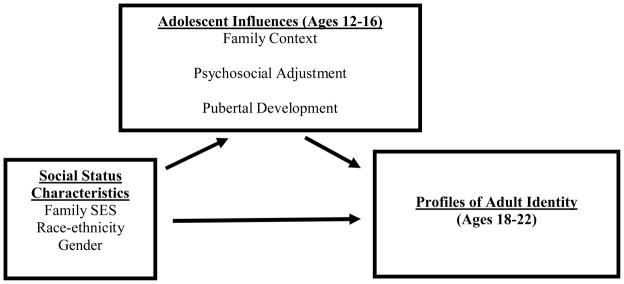
Conceptual Model of Social Status and Adolescent Influences on Adult Identity Formation
Adolescents who grow up in economically deprived families are more likely than their more advantaged counterparts to experience accelerated subjective aging (Foster, Hagan, & Brooks-Gunn, 2008; Benson & Furstenberg, 2007). Youth from poor and working-class backgrounds are also more likely to take on greater household and financial responsibilities and have more adult-like interactions with adults than their more advantaged peers (Elder, 1999). This “downward extension of adult responsibilities to children” occurs in response to economic deprivation (Elder, 1999). Although these tasks may promote psychosocial development among children in more advantaged families, when they occur in the context of poverty, they often do so without the support and guidance from adults and parents (Burton, 2007).
Young men and women follow different bio-psychosocial trajectories from adolescence to adulthood. Young women generally report older age identities than their same-aged male peers (Johnson et al, 2007). The evidence is not as clear on psychosocial maturation. Adolescent girls develop social-cognitive maturity much earlier than males do, and they are given more responsibilities and decision-making opportunities, on average, than their male counterparts (Benson & Johnson, 2009; Haynie, 2003). However, they are also more closely monitored and tend to have less autonomy within the family than their same age male peers. Based on this research, it is unclear whether young women will exhibit more advanced psychosocial maturation than their male peers during young adulthood.
Previous research on both strands of identity--- subjective age and psychosocial functioning-- consistently reports race-ethnic differences. In the same age category, African Americans tend to perceive themselves as older and more like an adult than Latinos, Asians, and Whites (Johnson et al., 2007). In addition, this research finds that Asians and Latinos tend to perceive themselves as younger and less like an adult than Whites do. Studies also show that the development of individual autonomy varies by cultural background. Latin and Asian cultures have stronger hierarchical relationships between parent and child and individual autonomy is less important than family cohesion and solidarity (Fuligni, 1998). Fuligni (1998) and Feldman and Rosenthal (1991) also find that Asian adolescents expect to experience activities associated with individual autonomy at a later age than European Americans. Thus, the development of individual autonomy is likely to be more delayed among Asian and Latino youth when compared to their White and Black counterparts.
Turning to adolescent experiences, physical changes during puberty signal to the outside social world (family, peers, and society) as well as to the self that a person is prepared to take on more adult roles and responsibilities. Physical maturity, especially precocious development, is associated with an accelerated process of adult identity formation and subjective aging (Foster et al., 2008). Youth who develop earlier are perceived and treated as older, and tend to internalize this view of self in their identity as a mature adult. Thus, we expect to observe this life pattern in the Add Health sample.
Since emotional and cognitive levels of maturity do not develop at the same rate as pubertal changes, this asynchrony can be especially problematic for early developers. These young people are often thrust into adult-like roles and responsibilities without the psychosocial capacities to cope with the emotional and physical demands of their new roles, resulting in both delinquency and maladaptive behavior (Galambos et al., 1999; Moffit, 1993). Based on this research, early pubertal maturation is likely to be associated with delayed psychosocial maturation coupled with an older age identity.
In addition to pubertal timing, psychosocial adjustment has consequences for adult identity. Social psychological resources, such as self-esteem, are particularly important for helping youth cope and manage the increasingly unstructured nature of emerging adulthood (Mortimer, 1996). While no studies to date have specifically examined the relationship between subjective social age in young adulthood and self-esteem, Foster et al. (2008) find that adolescent stress is positively associated with the perception of being older than one’s age. Thus, the resourcefulness of high self-esteem may slow the pace of subjective aging.
Studies of adolescent delinquency also show that engaging in maladaptive behavior (such as drugs, violence, early sexual experience) is associated with feeling older and more mature (Newcomb & Bentler, 1988; Moffit, 1993). Galambos and her colleagues (Galambos & Tilton-Weaver, 2000; Galambos et al., 2003) report a strong relationship between problem behavior, low maturity, and older subjective age among early adolescents in their sample. Since these results are based on cross-sectional studies of white youth, it is difficult to know the causal direction of the effects observed and whether these results apply to other race-ethnic groups.
Turning to family roles, young people in families without two biological parents are more likely to consider themselves adults than those reared by two biological parents (Benson & Furstenberg, 2007; Johnson et al., 2007). These differences are explained in part by increased household responsibilities, which are also associated with accelerated subjective aging and economic deprivation (Benson & Johnson, 2009). Single-parent families tend to have fewer financial and emotional resources compared to two-parent families. Thus, they may be less equipped to foster the development of psychosocial maturation than two-parent families.
As developmental research suggests, the level of warmth and conflict within the parent-adolescent relationship may signify the type of attachment adolescents have with parents. Conflicted parent-adolescent relationships often lead to premature separation from parental figures (Chen & Dornbusch, 1998). This detachment can offer a pathway to self-reliance, although it may be through potentially negative pathways such as involvement in age-inappropriate behaviors. Thus, young adults with more distant relationships in the Add Health sample are apt to perceive themselves as adults. It is difficult to predict, however, whether a lack of closeness will lead to higher or lower levels of psychosocial maturation because research on how conflict influences autonomy development is inconsistent.
Adult identities may also develop out of the status of adolescents’ within the household vis-à-vis their parental figure. Studies show that peer-like, parent-adolescent relationships tend to accelerate self-sufficiency and subjective aging because adolescents are typically given more independence and called on to contribute more to the household than those growing up in more hierarchical families (Nock, 1988; Benson & Johnson, 2009). These peer-like relationships, however, may not promote psychosocial maturation because they often result when children assume quasi-spouse and -parent roles within distressed family contexts (Burton, 2007).
Method
Participants
This research is based on survey data from Wave I and Wave III of the National Longitudinal Study of Adolescent Health (Add Health), a nationally representative study of U.S. adolescents in grades 7–12 from 134 middle and high schools in 80 communities (Bearman, Jones, & Udry, 1997). Participants were selected using a multi-stage, clustered sampling technique. First, schools were selected from a complete list of high schools (Quality Education Database) based on region, urbanicity, and school type (public vs. private, racial composition, and size). Each of the selected high schools was matched to a feeder school (typically a middle school), with the probability of the feeder school being selected proportional to its contribution to the high school’s student body. Second, a random sample of about 200 students from each school and a linked feeder school was drawn to obtain a sample for in-home survey interviews. The in-home survey interviews began during the 1995–1996 school year (Wave I), and participants were re-interviewed between April and August 1996 (Wave II) and again between August 2001 and April 2002 (Wave III). The total Wave I in-home sample size, including special over-samples based on various ethnic and genetic characteristics, is 20,745. We weight all analyses and use survey analysis techniques to adjust for the clustering and unequal probability of selection in the sample design (see Chantala & Tabor, 1999).
We use data collected in Waves I and III and the study sample consists of respondents who were interviewed in both Waves (n=15,197). Our analyses are restricted further in three ways. First, we include only those respondents who were assigned a sampling weight and had complete data on all variables in the analysis (n=13,248). Second, we include only respondents who were between the ages of 12 and 16 at the first interview (n=7,093). We do this because we are interested in capturing variability in adolescent development, which is greatest during pubertal maturation. Third, we exclude those who identify as Native American or other race due to the small number of these individuals in our sample (n=6772)i.
A unique advantage of Add Health’s panel design is that it enables us to examine the implications of early adolescent development on identity formation in young adulthood. Data on the independent variables (pubertal development, psychological adjustment, family context, and social status characteristics) were collected in Wave I when the respondents were between the ages of 12 and 16. Information used to create our dependent variable, adult identity profile, was collected in Wave III when respondents were between the ages of 18 and 22. Table 1 describes all study measures and presents descriptive statistics.
Table 1.
Description and Summary Statistics (weighted) of Study Measures (n=6772)
| Variable | Range | Prop/Mean | s.d | α |
|---|---|---|---|---|
| Young Adult Identity Indicators | ||||
| Perceived age | 0–4 | 2.70 | 0.82 | |
| Social maturity | 1–3 | 2.29 | 0.92 | |
| Adult responsibilities | 1–3 | 2.36 | 0.89 | |
| Adult status | 0–4 | 2.96 | 1.03 | |
| Independence | 0–3 | 2.36 | 0.72 | |
| Confidence | 0–3 | 2.32 | 0.75 | |
| Considerateness | 0–3 | 2.51 | 0.63 | |
| Identity Profile Types | ||||
| Late Adult | 0,1 | 0.20 | ||
| Anticipatory Adult | 0,1 | 0.23 | ||
| Pseudo-adult | 0,1 | 0.27 | ||
| Early Adult | 0,1 | 0.31 | ||
| Independent Variables | ||||
| Male | 0,1 | 0.49 | ||
| Race-ethnicity | ||||
| Non-Hispanic White | 0,1 | 0.71 | ||
| African American | 0,1 | 0.14 | ||
| Latino | 0,1 | 0.11 | ||
| Asian | 0,1 | 0.03 | ||
| Family income (log) | 0–6.91 | 3.58 | 0.79 | |
| Missing family income | 0,1 | 0.17 | ||
| Two biological parent family | 0,1 | 0.58 | ||
| Age at Wave 1 | 12–16 | 14.61 | 1.11 | |
| Pubertal Development | 1–5 | 2.89 | 0.93 | |
| Psychological Maladjustment | ||||
| Self esteem | 1–5 | 3.14 | 0.59 | 0.84 |
| Early sexual experience | 0,1 | 0.24 | ||
| Delinquency | 0–0.95 | 0.15 | 0.16 | 0.86 |
| Family Processes | ||||
| Parent-adolescent closeness | 0–4 | 3.27 | 0.72 | 0.89 |
| Peer-like communication | 0,1 | 0.60 | ||
| Household responsibility | 0–4 | 2.09 | 0.86 | |
Note: All independent variables are measured at Wave 1.
Source: National Longitudinal Study of Adolescent Health
Measures
Profile Indicators
We use a person-centered approach to create adult identity profiles at Wave III from measures that index dimensions of perceived age and psychosocial maturity (Cairns, Elder, & Costello 1996). Following prior research on perceived age (Johnson et al., 2007), we measure age identity with four items that ask youth to rate their own adult age development in comparison to same aged peers -perceived age, level of social maturity, adult responsibilities, and adult status. Perceived age is based on a question asking “How old do you feel compared with others your age? (0=younger all of the time to 4= older all of the time). For social maturity and taking on adult responsibilities, respondents were asked to rate how fast they grew up in regard to their same aged peers: faster, at about the same rate, or slower. Finally, adult status is based on a question asking respondents, “How often do you think of yourself as an adult?” (0=Never to 4=all of the time).
Based on Greenberger’s model, (Greenberger 1984; Greenberger & Steinberg, 1986), we conceptualize perceived psychosocial maturity in terms of autonomy and social responsibility. To tap into these two dimensions, we include indicators of independence, confidence, and considerateness in young adulthood. Each item is based on self-reports of how well each trait describes the participant (1=not at all to 4=very).
Social Status as Predictors
To test how social status shaped identity formation in young adulthood, we include several demographic characteristics in our analysis. Race-ethnicity is measured by self-report and includes four categories: Hispanic American, non-Hispanic white, non-Hispanic black, and Asian American. Gender is dichotomous variable coded “1” for male and “0” for female. To index family socioeconomic context (SES), we use the natural log of family income, a continuous measure based on parents’ self-reports. Listwise deletion is used to handle missing data on all variables except family income, which 17% missing cases. In the case of income, we use mean substitution and include a dummy variable for missing family income as a control in the models. Family structure is a dichotomous measure coded “1” for two biological parents, otherwise “0”. In addition, all models control for chronological age, as measured in years at Wave 1.
Adolescent Influences as Predictors
Based on Petersen and colleagues’ (1988) pubertal development scale (PDS), we created a scale for pubertal status that is comprised of items reported to be the most relevant for each gender. For women, this was breast size and body curviness, and for men, this included hair growth (face and body) and voice change. All items ranged from 1 to 4, with higher scores indicating more advanced pubertal development.
We assess psychological adjustment with three measures: self-esteem, delinquency, and early sexual debut. Self-esteem is based on six positively worded questions from the Rosenberg Self-Esteem scale (Simmons, Rosenberg, & Rosenberg, 1973). On a five-point scale ranging from “strongly disagree” (1) to “strongly agree” (5) adolescents were asked to indicate whether they have a lot of good qualities, have a lot to be proud of, like themselves the way they are, feel like they are doing everything just right, feel socially accepted, and feel loved and wanted (cronbach’s alpha = 0.84).
Delinquency is indexed by adolescents’ self-reports of engaging in 20 different types of problem behavior in the last year, including substance abuse, rowdy behavior, and criminal activity (alpha = 0.86). We also include early onset of sexual intercourse as an indicator of psychosocial maladjustment. It is a dichotomous variable that is coded “1” if the respondent reported having sexual intercourse during Wave 1 when adolescents were between the ages of 12 and 16. According to the Center for Disease Control, less than 15% of youth under early the age of 15 engage in sexual intercourse (Abma et al., 2004). Because of their sensitive nature, questions about sexual activity and delinquent behavior were administered using audio-CASI (Computer Assisted Self-Administered Interview), allowing respondents to enter responses into a laptop computer without talking to the interviewer. This methodology provides greater confidence in the reliability of the self-reports of problem and risky behavior in this study.
Family process measures include parent-adolescent closeness, peer-like parent-adolescent communication, and household responsibilities. Parent-adolescent closeness is the mean response to five items (0=low to 4=high) that asked adolescents about the closeness, satisfaction, warmth, caring, and communication in relation with parents (alpha=0.83). We first created separate scales for closeness to residential mother and to residential father (using information for a non-residential parent only when information for the residential parent was missing). When measures of closeness to mother and father were both available, we focused on the least close parent because we anticipate that the presence of a poor relationship might affect family dynamics even if the adolescent also had a close relationship with another parent (Cooney & Mortimer, 1999).
Peer-like communication is a dichotomous measure based on whether adolescents report talking with at least one of their parents about intimate issues they would typically talk about with their peers, including personal problems, people they are dating, and/or parties they go to. We contend that adolescents in families with more hierarchical parent-child relationships would be less likely to freely discuss such intimate details of their lives. Finally, we use household chores as a proxy for shared responsibility within the household. Household responsibility is based on adolescents’ responses to the following question: “During the past week, how many times did you work around the house, such as cleaning, cooking, laundry, or caring for a pet?” (0=not at all to 4=5 or more times).
Procedures
The first step of our person-centered approach was to create adult identity profiles. To do so, we focused on configurations of variables within individuals (Magnusson & Cairns, 1996). Cluster-analytic techniques sorted the young adults into groups based on their configurations of the seven factors described above. We first standardized each of the seven cluster variables, and then used K-means clustering in STATA, a nonhierarchical partition clustering method that assigned observations to the appropriate cluster through an iterative procedure using z scores on the seven social age identity and social maturation items. We chose K-means, a partition cluster approach rather than a hierarchical technique, because of the large number of observations in our sample. Hierarchical methods are computationally intensive and cannot handle a sample of our size (Bergman, Magnusson, and El Khouri, 2003).
A cluster solution using partition cluster analysis entails an iterative process. First, we specified the number of cluster seeds. After the initial partitioning of observations, STATA calculated Euclidean distances and assigned observations to the nearest centroidii. Four clusters constitute an optimal solution for representing identity profiles based on two theoretical strands, subjective social age and social maturation. To obtain empirically the optimal number of profiles or clusters that represent homogenous groupings, we considered three to six cluster solutions, but ended up with a four-cluster solution.
This solution was robust across multiple sub-samples and techniques. For example, we attempted to replicate the four-cluster solution in random sub-samples of the full study sample as a test of reliability. With some slight variations in the mean level of identity items, the four-cluster solution for each sub-sample closely approximated that from the full study sample. In addition, the four-cluster solution closely resembled the typologies produced using both principle components factor analysis and mean cut-off point techniques. Thus, we are confident that the four-cluster solution represents four homogenous groups or adult identity profiles within the sample. We turn now to a comparison of the four young adult identity profiles, their distinguishing compositions and the notable factors that differentiates them.
Results
Young Adult Identity Profiles
Figure 2 graphically presents the four identity profiles generated from the cluster analysis of our seven identity items. Young adults who fit each profile type were similar on all seven factors, but the four profiles differed on the mean level of each factor (see Table 2). This figure shows that the identity profiles are uniquely characterized by levels of subjective age (patterned bars) and psychosocial maturation (solid bars), with two profiles exhibiting concordant development along these dimensions and two with discordant development.
Figure 2.

Four young adult identify profiles
Table 2.
Indicators of Subjective Age and Psychosocial Maturation by Identity Profile Type, in means (n=6772)
| Late | Anticipatory | Pseudo | Early | |
|---|---|---|---|---|
| Indicators of Subjective Age | ||||
| Perceived age | −0.66bcd | −0.53acd | 0.44ab | 0.49ab |
| Social maturity | −0.54bcd | −1.17acd | 0.63abd | 0.72abc |
| Adult responsibilities | −1.03bcd | −0.55acd | 0.57ab | 0.57ab |
| Adult Status | −0.93bcd | −0.06acd | 0.09abd | 0.36abc |
| Indicators of Psychosocial Maturation | ||||
| Confident | −0.70bcd | 0.47acd | −0.63abd | 0.66abc |
| Independent | −1.07bcd | 0.24acd | −0.29abd | 0.62abc |
| Considerate | −0.41bcd | 0.26acd | −0.57abd | 0.51abc |
Note: Means significantly different (p<.05) from
Late,
Anticipatory Adult,
Pseudo-Adult, and
Early.
The two concordant profiles, “early” and “late”, reflect the rate of development observed within each. Young adults who exhibited a low level of age identity and psychosocial maturation represent “late adults” (20%), whereas the “early adults” (31%) rank high on each domain. The two discordant profile types, “anticipatory adults” and “pseudo-adults”, feature maturational discrepancies among youth within each profile. “Anticipatory adults” (23%) exhibit a low level of subjective age but represent a relatively high level of psychosocial maturation. On the other hand, we refer to those who are advanced on age identity but also possess a low level of psychosocial maturation as “pseudo-adults” (27%), a term used in other research to represent this type of maturation discrepancy (Greenberger & Steinberg, 1986; Galambos et al., 2003). These youth lay claim to adult status but do not measure up to it on psychosocial maturity. It is important to note that the two profiles characterized by an older perceived age, “early adult” and “pseudo adult”, are the most prevalent types. This may reflect the exposure to media images of adult liberties unaccompanied by the experience of responsibilities. In self-definition, adult rights are not coupled with responsibilities, expectations, and positive regard from parents.
Next, logistic regression models were used to assess whether young adult identity profiles are differentiated by status characteristics and adolescent influencesiii. To make relevant observations, we recoded the four-profile measure into four separate dummy variables. They were each coded “1” if respondent fit in a particular profile, otherwise “0”. This enabled us to compare how young people in each identity category differed from all other members of the Add Health sample. Odds ratios are presented for ease of interpretation rather than logistic coefficients. To interpret odds ratios, subtract the value of 1 from the odds ratio and then multiply by 100. This procedure yields the percent change in the odds of fitting a profile with every one-unit change in the independent variable when compared to the remainder of the Add Health sample.
Table 3 displays odds ratios from binary logistic regression models for each identity profile. Model 1 presents a baseline model showing the effects of social status characteristics. Model 2 adds adolescent influences to test how earlier contexts of development impact young adult identity formationiv. We begin with identity profiles by different status characteristics. First, we describe the two concordant profile types, “late” and “early” adults, and then turn to “anticipatory” and “pseudo” adults, the two discordant profile types.
Table 3.
Influences on Adult Identity: Odds Ratios From Binary Logistic Regression Models
| Late Adult | Anticipatory Adult | Pseudo-Adult | Early Adult | |||||
|---|---|---|---|---|---|---|---|---|
| M1 | M2 | M1 | M2 | M1 | M2 | M1 | M2 | |
|
| ||||||||
|
Social Status Characteristics
|
||||||||
| Male | 1.11 | 1.06 | 1.40 *** | 1.05 | 0.67 *** | 0.84 | 1.01 | 0.09 |
| Race/ethnicity | ||||||||
| Non-Hispanic White (omitted) | - | - | - | - | - | - | - | - |
| African American | 0.93 | 1.10 | 1.52 ** | 1.35 * | 0.49 *** | 0.56 *** | 1.32 * | 1.15 |
| Latino | 1.10 | 1.09 | 0.94 | 0.95 | 1.10 | 1.06 | 0.88 | 0.92 |
| Asian | 2.23 *** | 2.02 *** | 0.73 | 0.68 | 0.92 | 0.96 | 0.60 * | 0.69 |
| Family income (log) | 1.21 ** | 1.25 *** | 1.03 | 1.03 | 0.91 | 0.91 | 0.93 | 0.91 * |
| Two biological parent family | 1.63 *** | 1.60 *** | 1.47 *** | 1.32 ** | 0.69 *** | 0.76 ** | 0.73 ** | 0.74 *** |
| Adolescent Influences | ||||||||
| Pubertal Maturation | 0.85 ** | 0.81 *** | 1.13 ** | 1.19 *** | ||||
| Psychosocial Adjustment | ||||||||
| Self esteem | 0.58 *** | 1.58 *** | 0.61 *** | 1.74 *** | ||||
| Early sexual experience | 0.58 *** | 0.82 | 1.12 | 1.41 *** | ||||
| Delinquency | 0.89 | 0.73 | 1.82 * | 0.75 | ||||
| Family Processes | ||||||||
| Parent-adolescent closeness | 1.14 * | 1.14 * | 0.89 * | 0.93 | ||||
| Peer-like communication | 0.98 | 0.78 ** | 1.21 * | 1.08 | ||||
| Household responsibility | 0.80 *** | 1.00 | 0.98 | 1.20 *** | ||||
| Log Likelihood | −3312.52 | −3194.99 | −3652.26 | −3543.13 | −3752.26 | −3664.30 | −4150.92 | −4024.90 |
| Likelihood ratio chi-square | 168.35(8df) | 403.40(15df) | 46.63(8df) | 264.90(15df) | 138.17(8df) | 385.55(15df) | 81.87(8df) | 333.92 (15df) |
Note: Odds ratios indicate how youth in each identity category differ from all other members of the Add Health sample.
All models control for missing family income and age (n=6772). Likelihood ratio chi-square test indicates that the overall fit signficantly improved between M1 and M2 for each outcome (p<0.001).
p<.1,
p<.05,
p<.01,
p<.001
Social Status Influences
“Late adults”, those with below average scores on age identity and psychosocial maturation, tend to come from Asian and relatively advantaged households. Asian youth are more likely to exhibit this profile type in young adulthood than youth from other race-ethnic groupsv. In addition, “late adults” tend to grow up in more advantaged family contexts compared with other youth. For each $1000 increase in household income (as logged), the odds of a “late adult” identity increased by 21 percent. Also, young people from two-parent families have a 63 percent greater odds of a “late adult” identity when compared to those in other family types. These race-ethnic and socioeconomic differences remain robust after accounting for all adolescent context factors as shown in Model 2. No gender differences in this profile type were observed.
By contrast, the “early adults”, those with above average scores on age identity and psychosocial maturation, tend to come from the most disadvantaged backgrounds. Young adults growing up with two-biological parent families have 26 percent lower odds of this identity type when compared to those from other family types. Moreover, the odds of an “early adult” identity decreased by a fourth for each $1000 increase in household income (as logged). Compared to other youth, African American youth are most likely to have this type of identity while Asian young adults are least likelyvi. These race-ethnic differences, however, are completely explained by adolescent influences (see Model 2), suggesting that they stem from early developmental processes. Finally, we observe no gender differences in this profile type.
Next, we turn to the two discordant types of profiles. “Anticipatory adults”, who rank below average on age identity and above average on psychosocial maturation, tend to be male, African American, and to come from intact, two-parent family types. African American youth are more likely than all other race-ethnic groups to exhibit this identity profile in young adulthoodvii. Young people in two-parent families also have a greater likelihood of this identity type when compared to youth in other family structures. Both of these differences remain robust after accounting for all adolescent influences. Finally, males have a 40 percent greater odds of an “anticipatory adult” identity compared to the opposite sex. This gender difference, however, is completely explained by adolescent influence factors, suggesting that gender disparities in early adolescent development account for such differences.
By comparison, “pseudo-adults” (below average age identity and above average maturation) represent a contrast on status characteristics. They tend to be female and come from non-intact families. While African Americans tend to have “anticipatory” or “early” adult profiles, they are less likely to adopt “pseudo-adult” identities than all other race-ethnic groupsviii. Race-ethnic and family structure differences remain robust after accounting for all adolescent influences as shown in Model 2. However, gender differences are completely accounted for by these factors.
Adolescent Influences
Model 2 tests whether developmental experiences during adolescence (ages 12–16) channel youth toward a particular identity type in young adulthood (ages 18–22). Identity profiles are differentiated by pubertal maturation rate and adjustment to this development. Young people with relatively advanced pubertal maturation tend to exhibit “early” and “pseudo“ adult identities while those with less advanced maturation are likely to display “anticipatory” and “late” identity profiles. Factors that clearly differentiate “early” from “pseudo” and “anticipatory” from “late” seem to reflect how well young people are adapting to these different rates of maturation. We consider first the two profiles associated with relatively advanced maturation, “pseudo” and “early”, and then turn to the profiles marked by less advanced maturation, “late” and “anticipatory”.
Adolescents who are relatively advanced on pubertal maturation but lack coping resources tend to develop “pseudo-adult” identities in young adulthood. As Model 2 shows, each unit increase in pubertal maturation is associated with a 13 percent increase in the odds of forming a “pseudo-adult” identity. In addition, adolescents with higher self-esteem are less likely to form a “pseudo-adult” identity than those with less positive feelings about oneself. Consistent with research on younger adolescents (Galambos et al., 2003), “pseudo-adults” report higher levels of maladaptive, delinquent behavior during adolescence than other youth. Early sexual experience, however, was not linked to this profile type. Finally, “pseudo-adults” tend to have parental relationships that are marked by a lack of closeness and blurred generational boundaries. In particular, close parental relationships decreased the odds of a “pseudo-adult” identity, while peer-like communication increased them. These results suggest that advanced maturation during adolescence may generate deleterious outcomes when coupled with low personal resources and a conflicted, unstructured family environment.
Compared to “pseudo-adults”, “early adults “ share a pattern of advanced pubertal maturation, but they also report high levels of self-esteem and “adult-like” responsibilities in adolescence. As Model 2 shows, each unit increase in pubertal maturation is associated with a substantial increase in the odds of forming an “early adult” identity. Youth with higher self-esteem are also more likely to possess an “early adult” identity. In addition, they report greater household responsibilities compared with their peers. We do not find, however, that delinquency is associated with an “early adult” profile. Psychosocial adjustment among these more physically developed adolescents may offset the tendency to engage in delinquency (Felson & Haynie, 2002). Finally, an early sexual experience tends to channel youth toward this view of themselves. Early sex is typically associated with maladaptive outcomes though it may not be the case for “early adults” since these youth also report relatively high levels of psychosocial adjustment. Taken together, these results suggest that early maturation and a sexual experience during adolescence are not necessarily detrimental to young adult development if youth also have a strong sense of self and an outlet for building responsibility.
Next, we turn to the “late” and “anticipatory” adults. Both profile types report less advanced pubertal maturation and closer parental relationship compared to other youth in the sample, but “late” adults are distinct from the “anticipatory” group in that they have low levels of self-esteem and “adult-like” responsibilities. Model 2 shows that each unit increase in pubertal maturation is associated with a notable decrease in the odds of a “late adult” identity. As adolescents, these youth also exhibit low levels of self-esteem compared to other youth in the sample. Close relationships with parents during adolescents also channel youth toward this profile type. Finally, “late adults” are distinct in that they are less likely to take on household responsibilities and engage in sexual intercourse in early adolescence compared to youth with other identity profiles. These results suggest that relatively delayed maturation coupled with low-self esteem and few outlets to build responsibility lead to the formation of a “late” adult identity.
On the other hand, less advanced pubertal maturation coupled with high self-esteem tends to channel youth toward an “anticipatory” adult identity. Compared with other profiles, “anticipatory adults” also report relatively close parental relationships marked by clear generational boundaries, as indicated by low levels of peer-like communication. Close parent-child relationships may also promote a “late” adult identities, but it also orients youth toward an “anticipatory” rather than a “late” identity profile types when coupled with structured generational boundaries. Thus, a supportive and structured family environment along with strong personal resources may well buffer youth against the potential adverse affects of delayed pubertal maturation.
Discussion
This study proposes a more holistic understanding of young adult identity that integrates subjective age and psychosocial maturation during the young adult years. Today, young adults acquire adult-like responsibilities at different rates, with those in the most vulnerable situations tending to move into adulthood earlier than their more advantaged counterparts (Settersten & Ray, 2010). The question remains whether young people have the necessary personal resources, such as confidence and maturity, to adapt to these changes given the weakening of sources of support and social norms in this transition (Shanahan, 2000). While research has tended to focus on either age identity or psychosocial maturity, this study moves beyond a one-dimensional approach by examining both strands together. In doing so, we show that the developmental consequences of age identity cannot be fully understood without also taking psychosocial maturation into account.
Studies of age identity provide relevant information about how social contexts affect the self-perception of youth, but they do not indicate what these identities mean developmentally for youth. For example, disadvantaged youth tend to develop precocious adult age identities through an earlier adoption of adult roles and responsibilities (Burton, 2007; Johnson et al., 2007; Johnson & Mollborn, 2009), but research has yet to examine whether these youth have the psychosocial resources to cope with the demands and responsibilities of this age. Research on younger adolescents indicates that these two processes do not always follow a synchronized pattern of development, and more importantly, that individuals whose subjective age outpaces their psychosocial maturation are often vulnerable to stress and maladaptive outcomes, such as substance abuse and criminal behavior (Greenberger & Steinberg, 1986; Galambos et al., 1999). While other research has examined the role of intra-individual resources in identity development (Galambos et al., 1999; Schwartz et al., 2005), this is the first study to employ a person-centered approach to examine how these processes develop together in young adulthood.
Using a nationally representative data, we find young adult age identities do not always develop in concert with psychosocial maturity. We identified patterns of congruence- “early” and “late” adult identities as well as types of discordance – “pseudo-adult” and “anticipatory adults”. “Early” and “late” profiles depict relatively advanced and delayed development on subjective age and maturation. Young adults with “pseudo-adult” profiles tend to claim an older age identity before their psychosocial maturity. “Anticipatory adults”, on the other hand, develop psychosocial maturity relatively early compared to their peers but tend to perceive themselves as younger and less adult like. Together, these profiles support the conclusion that young adults not only develop at different rates but also have different levels of personal resources for managing these varying rates of development.
This study also provides support for a developmental and life course model of young adult identity. Drawing on longitudinal panel data, we identified an array of developmental and social status precursors to the formation of young adult identity. Previous research has documented the relevance of social position and adolescent family context for this process (Johnson et al., 2007; Benson & Johnson, 2009). The present study adds to this knowledge by showing how multiple levels of adolescent development (psychosocial adjustment, pubertal maturation, and family processes) influence identity in young adulthood.
Beginning first with status characteristics, we find that family economic and emotional context is important for identity development in young adulthood. Growing up in an economically advantaged family is predictive of a “late” profile of adult identity whereas family disadvantage promotes an “early” adult pattern. While previous research finds that family SES is associated with accelerated aging partly through the earlier performance of adult roles and responsibilities (Johnson & Mollborn, 2009), we find that disadvantaged family contexts can lead to a “pseudo-adult” pattern of development when combined with peer-like and distant parent-child relationships. Consistent with “adultification” theory (Burton, 1997; Elder, 1999), “pseudo-adults” are called on to play adult-like emotional and financial roles within the family without the guidance and support necessary to develop psychosocial maturity.
Asian American young adults are more likely than individuals from other race-ethnic groups to acquire a “late” adult identity. Asian American adolescents develop secondary sex characteristics later than White, Black, and Latino youth (Adair & Gordon-Larson, 2001). These youth also tend to have lower self-esteem and more delayed autonomy than youth from the other race-ethnic groups (Fuligni 1998; Twenge & Crocker, 2002), but we are unable to adequately explain why they are more likely to acquire a “late adult” identity. It may be that we have not fully measured the cultural and context specific factors, such as degree of family obligation, that generate delays in maturation among Asian American children.
As expected, African American young adults tend to stand out in terms of an “early“ profile of adult identity. Previous research shows that they differ from their White, Asian and Latino counterparts in a number of ways that would explain their advanced development. On average, they take on more adult-like responsibilities and experience pubertal development and sexual events earlier than adolescents from other race-ethnic groups (Johnson et al., 2007; Stattin and Magnusson, 1990). In addition, African American adolescents have higher levels of self-esteem than whites and all other race-ethnic groups (Twenge & Crocker, 2002). This strong sense of self may buffer them from the potential adverse effects typically associated with early rates of development.
Research indicates that young women have older age identities than young men (Johnson et al., 2007), but gender differences mainly involve the two discordant types. Women are more likely than their male peers to have “pseudo-adult” identities. Their social claims on adult status exceed their psychosocial maturation. On the other hand, young men are more likely than women to report “anticipatory” identities. Their subjective age tends to lag behind their perception of self in terms of psychosocial maturity.
The “pseudo-adult” pattern observed among young women may stem from adolescent experiences that promote pre-mature engagement in adult-like behaviors. Girls experience pubertal development earlier than boys do (Susman, 1985). Precocious development among girls is associated with early sexual experience and involvement with older males, which in turn leads to negative psychological outcomes (Stattin & Magnusson, 1990). In addition, adolescent women tend to have more distant and conflict-ridden relations with parents compared to boys, and this may both hinder their development of psychosocial skills and accelerate the adoption of adult roles and an adult identity (Benson & Johnson, 2009; Cooney & Mortimer, 1999). Girls also exhibit lower self-esteem during adolescence than boys (Kling, Hyde, Showers, & Buswell, 1999). Without a strong sense of self and supportive parental relationships, adolescent women may have trouble building the confidence needed to successfully adapt to their accelerated development.
We also find important race-ethnic differences in the discordant profile types. African American young adults are most likely to exhibit an “anticipatory adult” identity and they are least likely to possess a “pseudo-adult” identity. This finding is quite striking since research consistently finds that African Americans tend to have older age identities in young adulthood compared to those in other race-ethnic groups (Johnson et al., 2007). As noted earlier, these young adults in the sample tended to exhibit an “early” adult profile, one marked by an advanced level of subjective age and psychosocial maturity. However, they are least likely to possess a “pseudo-adult” identity, the other identity type marked by advanced social age.
Why do African American young adults tend to develop identity profiles characterized by high levels of psychosocial maturity? This development may stem from growing up in rather disadvantaged social contexts, as “adultification theory” suggests (Burton, 2007). It may also be related to the fact that African American adolescents have higher self-esteem than youth from all other race-ethnic groups (Twenge & Crocker, 2002). This positive sense of self may enable African American youth to adapt to changing contexts of development and insulate them from the potential negative effects of early developmental patterns.
In addition, this study highlights the influential effects of adolescent developmental processes on young adult identity formation. Rate of pubertal development is central to later identity development, but pathways to identity formation result from a constellation of adolescent experiences rather than from pubertal development alone. For example, delayed pubertal development during adolescence can lead to the formation of an “anticipatory” adult identity when coupled with high self-esteem and parent-adolescent relationships marked by closeness and a fair degree of structure. On the other hand, it tends to result in a “late” adult identity when individuals possess low self-esteem and have few opportunities to acquire a sense of responsibility during adolescence.
The same is true of advanced pubertal maturity. During adolescence, this may contribute to the formation of a “pseudo-adult” or “early” adult identity. When advanced maturation is coupled with low self-esteem, high rates of delinquency, and distant parent-adolescent relationships, it often promotes the formation of a “pseudo-adult” identity in young adulthood. This pattern is consistent with survey research on younger adolescents (Galambos et al., 2003). On the other hand, advanced maturation is likely to favor an “early” adult identity when individuals also possess a positive sense of self and have opportunities to acquire competency and responsibility during adolescence.
Together, these results suggest that early pubertal maturation does not necessarily produce inconsistencies between age identity and psychosocial maturity. High self-esteem and warm, structured parental relationships provide adaptive resources that can protect adolescents from the distress that is typically associated with off-time pubertal development (Pearlin & Schooler, 1978). In line with other research, early pubertal development may have deleterious implications for later life when accompanied by other negative conditions and contexts. Research is needed on how adolescent developmental experiences and contexts interact to shape young adult development. For example, Felson and Haynie (2002) have shown that early pubertal development has a positive effect on later development for boys when accompanied by high levels of psychological adjustment, but produces a negative effect when accompanied by low levels of psychosocial adjustment.
The results of this study underscore the importance of a developmental and life course approach to identity formation. We find that experiences during the adolescent years have a lasting impact on the development of young adult identity, but the question remains whether identity profiles in young adulthood will influence subsequent development. Subsequent research is needed on the potential link between profile types of young adult identity and later adult development. Do developmental discordances continue into the young adult years and have implications for adult development? A recent study suggests that precocious maturation and identity development are linked with depression in young adulthood, but the study measures identity and depression at the same time point (Foster et al., 2008). Longitudinal data is required to disentangle the direction of the effects.
The Add Health data provide a unique opportunity to examine how adolescent experiences shape young adult identity, but it is important to acknowledge data limitations. For example, pubertal maturation in this study is limited by reliance on self-reports. In addition, more detail is needed on maturation processes. We could only narrowly assess the adult roles and responsibilities of youth within the household using peer-like communication and household work. Thus, we may not have fully captured the importance of this dimension. Finally, the study itself provides a new framework for thinking about identity as a two-dimensional typology, though survey data on individuals can only reveal so much about how social processes influence development. For example, this approach does not provide information about important dimensions of young adulthood, such as peer relations. In addition, qualitative research would enable us to unpack adolescent experiences and show how they influence adaptive resources and youth perceptions of self. For example, more work is needed to understand how cultural and social contexts influence the meaning of intra-individual resources, such as self-esteem and confidence. It may be that reports of low self-esteem among Asian American youth reflect the normative practices of modesty and self-criticism found within collectivist cultures rather than a poor self-image (Twenge and Crocker, 2002).
Demographers, sociologists, and developmental psychologists have documented important changes in the way young people experience the transition to adulthood, and research has offered thoughtful conceptual perspectives of identity development, such as the confluence and emerging adulthood models (Shanahan et al., 2005; Arnett, 2000). What is missing from this work, however, is an interdisciplinary, multi-level perspective on identity development that includes both social and psychosocial developmental components. This type of approach is particularly important in the contemporary world marked by deinstitutionalization and increasing individualization (Shanahan, 2000). The present study of young adult identities represents a step in this direction and provides a promising model for understanding human development at this and potentially other points of the life course.
Acknowledgments
This research uses data from the Add Health Study designed by J. Richard Udry, Peter S. Bearman, and Kathleen Mullan Harris and the Add Health Wave IV Program Project directed by Kathleen Mullan Harris (Grant 3P01 HD031921), funded by the Eunice Kennedy Shriver National Institute of Child Health and Human Development with cooperative funding from 17 other agencies. We gratefully acknowledge support from NICHD to Glen H. Elder, Jr. and Michael J. Shanahan through their subproject to the Add Health Wave IV Program Project (Grant 3P01 HD031921). We would also like to thank the Life Course Working Group at University of North Carolina at Chapel Hill and the Sio and Policy, Philosophy and Economics Research Groups at Colgate University for their feedback on earlier drafts of this paper.
Footnotes
The full Wave III sample (n=15,197) does not differ in regard to indicators of race-ethnicity, gender, or family of origin from the sample used in this study (n=6772).
The centroid of a cluster is the average point in the multidimensional space defined by the dimensions (Aldendererfer & Blashfield, 1984).
We initially used a multinomial logistic regression model to estimate contrasting odds between each of the four profile categories. However, a logistic regression model produced similar results, and thus, we chose this approach for efficiency and clarity of presentation.
In analyses not shown, we ran separate models for each type of adolescent influence characteristic. Findings from these additional nested models did not differ substantially from the two-nested approach. Thus, we chose the two-nested approach. Likelihood ratio chi-square tests indicate significant improvement in model fit between Model 1 and Model 2 (p<0.001).
Adjusted Wald tests between race coefficients show that the differences between race-ethnic group coefficients are statistically significant (F<0.05).
Adjusted Wald tests between race coefficients show that the differences between race-ethnic group coefficients are statistically significant (F<0.05).
Adjusted Wald tests between race coefficients show that the differences between race-ethnic group coefficients are statistically significant (F<0.05).
Adjusted Wald tests between race coefficients show that the differences between race-ethnic group coefficients are statistically significant (F<0.05).
Contributor Information
Janel E. Benson, Colgate University.
Glen H. Elder, University of North Carolina at Chapel Hill.
References
- Abma JC, Martinez GM, Mosher WD, Dawson BS. National Center for Health Statistics. 2004. Teenagers in the united states: Sexual activity, contraceptive use, and childbearing. [PubMed] [Google Scholar]
- Adair LS, Gordon-Larsen P. Maturation timing and overweight prevalence in US adolescent population girls. American Journal of Public Health. 2001;91:642–644. doi: 10.2105/ajph.91.4.642. [DOI] [PMC free article] [PubMed] [Google Scholar]
- Alsaker FD. Is puberty a critical period for socialization? Journal of Adolescence. 1995;18(4):427–444. [Google Scholar]
- Arnett Jeffrey Jensen. Emerging adulthood: A theory of development from the late teens through the twenties. American Psychologist. 2000;55:469–480. [PubMed] [Google Scholar]
- Benson Janel, Furstenberg Frank F. Entry into Adulthood: Are Adult Role Transitions Meaningful Markers of Adult Identity. In: MacMillan Ross., editor. Constructing Adulthood: Agency and Subjectivity in the Life Course. London: Elsevier Science, Ltd; 2007. pp. 199–224. [Google Scholar]
- Benson Janel, Johnson Monica Kirkpatrick. Adolescent Family Context and Adult Identity Formation. Journal of Family Issues. 2009;30(9):1265–1286. doi: 10.1177/0192513X09332967. [DOI] [PMC free article] [PubMed] [Google Scholar]
- Bergman LR, Magnusson D, El Khouri BM. Studying Individual Development in an Interindividual Context: A Person-Oriented Approach. Mahwah, New Jersey: Lawrence Erlbaum Associates; 2003. [Google Scholar]
- Bergman L, Andersson H. The person and the variable in developmental psychology. Journal of Psychology. 2010;218:155–165. [Google Scholar]
- Brynner J. Rethinking the youth phase of the life-course: the case for emerging adulthood? Journal of Youth Studies. 2005;8:367–384. [Google Scholar]
- Burke PJ. Identity Processes and Social Stress. American Sociological Review. 1996;56:836–49. [Google Scholar]
- Burton Linda. Childhood Adultification in Economically Disadvantaged Families: A Conceptual Model. Family Relations. 2007;56:329–345. [Google Scholar]
- Cairns RB, Elder GH, Costello EJ. The making of developmental science. Developmental Science. 1996:223–234. [Google Scholar]
- Chantala K, Tabor J. Strategies to perform a design-based analysis using the Add Health data. Chapel Hill: Carolina Population Center, Univ. North Carolina; 1999. [Google Scholar]
- Chen ZY, Dornbusch SM. Relating aspects of adolescent emotional autonomy to academic achievement and deviant behavior. Journal of Adolescent Research. 1998;13(3):293. [Google Scholar]
- Cooney Teresa M, Mortimer Jeylan T. Family structure differences in the timing of leaving home: Exploring mediating factors. Journal of Research on Adolescence. 1999;9:367–393. [Google Scholar]
- Côté James E, Schwartz Seth J. Comparing psychological and sociological approaches to identity: Identity status, identity capital, and the individualization process. Journal of Adolescence. 2002;25:571–586. doi: 10.1006/jado.2002.0511. [DOI] [PubMed] [Google Scholar]
- Eccles Jacquelynne, Brown Brett V, Templeton Janice. A developmental framework for selecting indicators of well-being during the adolescent and young adult years. In: Brown Brett., editor. Key indicators of child and youth well-being: Completing the picture. Mahwah, NJ: Lawrence Erlbaum Associates Publishers; 2008. pp. 197–236. [Google Scholar]
- Elder Glen H., Jr . 25th Anniversary Edition. Boulder, CO: Westview Press; 1999. Children of the Great Depression: Social Change in Life Experience. (Originally published in 1974, University of Chicago Press.) [Google Scholar]
- Erikson EH. Identity: Youth and Crisis. Oxford, England: Norton & Co; 1968. [Google Scholar]
- Fuligni Andrew J, Eccles Jacquelynne S. Perceived parent-child relationships and early adolescents’ orientation toward peers. Developmental Psychology. 1993;29:622–632. [Google Scholar]
- Furstenberg Frank F, Jr, Kennedy Sheela, McLoyd Vonnie C, Rumbaut Ruben G, Settersten Richard A., Jr Growing Up Is Harder to Do. Contexts. 2004;3:33–41. [Google Scholar]
- Galambos Nancy L, Barker Erin T, Tilton-Weaver Lauree C. Who gets caught at maturity gap? A study of pseudomature, immature and mature adolescents. International Journal of Behavioral Development. 2003;27:253–263. [Google Scholar]
- Galambos Nancy L, Tilton-Weaver Lauree C. Adolescents’ psychosocial maturity, problem behavior, and subjective age: In search of the adultoid. Applied Developmental Science. 2000;4:178–192. [Google Scholar]
- Greenberger Ellen. Defining psychosocial maturity in adolescence. Advances in Child Behavioral Analysis & Therapy. 1984;3:1–37. [Google Scholar]
- Greenberger E, Steinberg L. When teenagers work: The psychological and social costs of adolescent employment. New York, NY, US: Basic Books; 1986. [Google Scholar]
- Feldman SS, Rosenthal DA. Age expectations of behavioural autonomy in Hong Kong, Australian and American youth: The influence of family variables and adolescents’ values. International Journal of Psychology. 1991;26(1):1–23. [Google Scholar]
- Felson RB, Haynie DL. Pubertal Development, Social Factors, and Delinquency amon Adolescent Boys. Criminology. 2002;40(4):967–988. [Google Scholar]
- Foster H, Hagan J, Brooks-Gunn J. Growing up fast: Stress exposure and subjective “weathering” in emerging adulthood. Journal of Health and Social Behavior. 2008;49(2):162. doi: 10.1177/002214650804900204. [DOI] [PubMed] [Google Scholar]
- Fuligni AJ. Authority, autonomy, and parent-adolescent conflict and cohesion: A study of adolescents from Mexican, Chinese, Filipino, and European backgrounds. Developmental Psychology. 1998;34(4):782–792. doi: 10.1037//0012-1649.34.4.782. [DOI] [PubMed] [Google Scholar]
- George LK, Mutran EJ, Pennypacker MR. The meaning and measurement of age identity. Experimental Aging Research. 1980;6:283–298. doi: 10.1080/03610738008258364. [DOI] [PubMed] [Google Scholar]
- Hair JFJ, Black WC, Grimm LG, Yarnold PR. Reading and Understanding Multivariate Statistics. Washington, DC, US: American Psychological Association; 2000. Cluster analysis; pp. 147–205. [Google Scholar]
- Haynie Dana L. Contexts of Risk? Explaining the Link between Girls’ Pubertal Development and Their Delinquency Involvement. Social Forces. 2003;8:355–397. [Google Scholar]
- Hill JP. A report prepared for the Office of Child Development. U.S Department of Health, Education, and Welfare; Washington, DC: 1973. Some Perspectives on adolescence in American society. [Google Scholar]
- Johnson Monica Kirkpatrick, Berg Justin Allen, Sirotzki Toni. Differentiation in Self-Perceived Adulthood: Extending the Confluence Model of Subjective Age Identity. Social psychology quarterly. 2007;70:243–261. [Google Scholar]
- Johnson MK, Mollborn S. Growing up faster, feeling older: Hardship in childhood and adolescence. Social Psychology Quarterly. 2009;72(1):39. doi: 10.1177/019027250907200105. [DOI] [PMC free article] [PubMed] [Google Scholar]
- Kaufman Gayle Kaufman, Elder Glen H., Jr Grandparenting and age identity. Journal of Aging Studies. 2003;17:269–282. [Google Scholar]
- Liefbroer A, Toulemon L. Demographic perspectives on the transition to adulthood: An introduction. Advances in Life Course Research. 2010;15:53–58. [Google Scholar]
- Kling Kristen C, Hyde Janet Shibley, Showers Carolin J, Buswell Brenda N. Gender differences in self-esteem: A meta-analysis. Psychological Bulletin. 1999;125:470–500. doi: 10.1037/0033-2909.125.4.470. [DOI] [PubMed] [Google Scholar]
- Magnusson D, Cairns RB. Developmental science: Toward a unified framework. In: Cairns R, Elder G, Costello E, editors. Developmental Science. Cambridge: Cambridge University Press; 1996. pp. 7–30. [Google Scholar]
- Moffitt Terrie E. Adolescence-limited and life-course-persistent antisocial behavior: A developmental taxonomy. Psychological Review. 1993;100:674–701. [PubMed] [Google Scholar]
- Mortimer JT. Social psychological aspects of achievement. Generating Social Stratification: Toward a New Research Agenda. 1996:17–36. [Google Scholar]
- Neugarten BL, Datan N. Sociological perspectives on the life cycle. In: Neugarten D, editor. The Meanings of Age: Selected Papers of Bernice L. Neugarten. Chicago: The University of Chicago Press; 1973. pp. 96–113. [Google Scholar]
- Neugarten B, Hagestad GO. Handbook of Aging and the Social Sciences. New York: Van Nostrand Reinhold; 1976. Aging and the life course; pp. 35–55. [Google Scholar]
- Newcomb MD, Bentler PM. Impact of adolescent drug use and social support on problems of young adults: A longitudinal study. Journal of Abnormal Psychology. 1988;97(1):64–75. doi: 10.1037//0021-843x.97.1.64. Nock (1988) [DOI] [PubMed] [Google Scholar]
- Nock SL. The family and hierarchy. Journal of Marriage and the Family. 1988;50(4):957–966. [Google Scholar]
- Pearlin LI, Schooler C. The structure of coping. Journal of Health and Social Behavior. 1978;19(1):2–21. [PubMed] [Google Scholar]
- Petersen AC, Crockett L, Richards M, Boxer A. A self-report measure of pubertal status: Reliability, validity, and initial norms. Journal of Youth and Adolescence. 1988;17(2):117–133. doi: 10.1007/BF01537962. [DOI] [PubMed] [Google Scholar]
- Settersten R, Furstenberg FF, Rumbaut R. On the Frontier of Adulthood: Theory, Research, and Public Policy. Chicago: The University of Chicago Press; 2005. [Google Scholar]
- Settersten Richard A., Jr . Lives in time and place: The problems and promises of developmental science. Amityville, NY, US: Baywood Publishing Co; 1999. [Google Scholar]
- Settersten Richard, Ray B. What’s going on with young people today? The long and twisting path to adulthood. The Future of the Children. 2010;20:19–41. doi: 10.1353/foc.0.0044. [DOI] [PubMed] [Google Scholar]
- Shanahan Michael J. Pathways to Adulthood in Changing Societies: Variability and Mechanisms in Life Course Perspective. Annual Review of Sociology. 2000;26:667–692. [Google Scholar]
- Shanahan Michael J, Porfeli Erik J, Mortimer Jeylan T, Erickson Lance D. Subjective Age Identity and the Transition to Adulthood: When Do Adolescents Become Adults? In: Settersten RA Jr, Furstenberg Frank F Jr, Rumbaut RG, editors. On the Frontier of Adulthood: Theory, Research, and Public Policy. Chicago; United States: University of Chicago Press; 2005. pp. 225–255. [Google Scholar]
- Simmons RG, Rosenberg F, Rosenberg M. Disturbance in the self-image at adolescence. American Sociological Review. 1973;38(5):553–568. [PubMed] [Google Scholar]
- Stryker S, Serpe RT. Identity salience and psychological centrality: Equivalent, overlapping, or complementary concepts? Social Psychology Quarterly. 1994;57(1):16–35. [Google Scholar]
- Stattin Håkan, Magnusson David. Pubertal maturation in female development. Hillsdale, NJ, England: Lawrence Erlbaum Associates, Inc; 1990. [Google Scholar]
- Susman Elizabeth J. The relation of relative hormonal levels and physical development and social-emotional behavior in young adolescents. Journal of Youth and Adolescence. 1985;14:245–264. doi: 10.1007/BF02090322. [DOI] [PubMed] [Google Scholar]
- Schwartz SJ, Cote JE, Arnett JJ. Identity and agency in emerging adulthood: Two developmental routes in the vb process. Youth & Society. 2005;37(2):201. [Google Scholar]
- Twenge JM, Crocker J. Race and self esteem. Psychological Bulletin. 2002;128:371–408. doi: 10.1037/0033-2909.128.3.371. [DOI] [PubMed] [Google Scholar]