



Abstract
Background:
The study on natural substances especially, dietary components such as liquid oils affecting cholesterol can be important for therapeutic propose. Sesame seeds with various biomedical actions can be control the hypercholesterolemia. On the other hand, olive oil has a wide range of therapeutic effect on lipid profile in human. The aim of this study is to evaluate and compare lipid profile changes after olive and sesame oils consumption in hypercholesterolemia.
Methods:
This study was a clinical randomized trial that was performed via parallel design on 48 patients. The patients were randomly allocated in to two groups: A: olive oil and B: sesame oil. After 1 month prescription of Step I National Cholesterol Education Program diet, patients consumed 4 table spoons aprox. 60 g) of refined olive or sesame oil daily as an exchange of other oils, for 1 month. Lipid profiles The P < 0.05 was considered as significant difference.
Results:
Out of 48 patients, 24 (50%) were men. The mean age was 41.7 ± 8.3 years. The mean of total cholesterol, triglyceride (TG), low density lipoprotein (LDL), cholesterol, and high density lipoprotein (HDL) cholesterol, before oil consumption was 224.5 ± 22, 256 ± 132, 132.6 ± 9, and 44.5 ± 11 mg/dl. After olive oil consumption cholesterol, TG, LDL-C, weight, waist and BMI were decreased and HDL-C was increased. After sesame oil consumption cholesterol, TG, LDL-C were significantly decreased. Weight, waist were decreased and HDL-C was increased (P > 0.05).
Conclusions:
Sesame oil had equivalent effect on lipid profile in comparison olive oil and lipid profile improvement was better in sesame oil in LDL-C and TG.
Keywords: Hypercholesterolemia, olive oil, sesame oil
INTRODUCTION
The study on natural substances especially, dietary components affecting cholesterol can be important for therapeutic propose.
Sesame seed with various biomedical actions such as an effect on lipid metabolism in human and animal models according to trial can be and control of hypercholesterolemia.[1]
On the other hand, olive oil has a wide range on therapeutic effect on lipid profile in human.[2]
Olive oil is a major part of Mediterranean diet that is linked to reduced incidence of degenerative diseases particularly coronary heart disease and cancer of blood, skin, and colon.[2]
Despite the high-fat content of “Mediterranean diet” it has been suggested the type of fat is more important than the total amount consumed.
The major components of olive oil thought to contribute to its health benefits are: Oleic acid, phenolic compounds, and squalene.[2]
Dietary fat composition such as: Polyunsaturated fatty acid, mono unsaturated fatty acid (MUFA), and saturated fatty acid can effect on plasma lipids and lipoproteins that associated with the development of arthrosclerosis and ischemic heart diseases.
METHODS
This study was a clinical randomized trial that was performed via parallel design on 48 patients. The inclusion criteria were cholesterol >200 and ≤240 mg/dl and the patients who did not received any lipid lowering prescriptions.
The participants were prescribed step I diet (report of Adult panel III from National Cholesterol Education Program) for 1 month before oil prescription. After that, the patients consumed daily 4 table spoons; approximately 60 g, of refined olive or sesame oil that exchange for any oil in diet, over period of 1 month.
The patients were randomly allocated in to two groups: A - Olive oil and B - Sesame oil.
They were advised to followed step I diet during study.
Informed consent was obtains from all participants. This study was approved by ethic committee of Yazd medical university.
Plasma was isolated after 12 h overnight fasting period. Serum lipids (total cholesterol, high density lipoprotein-cholesterol [HDL-C], and triglyceride [TG]) were measured by laboratory method as described before[3] and Low density lipoprotein-cholesterol (LDL-C) was calculated by Fried Wald formula before and after oil prescriptions.
Statistics
We use paired t-test for comparing of serum level of lipid profile and other measures of biomarkers before and after oil consumption. Probability <0.05 was considered as significance level. 95% Confidence Interval (CI) of D (difference between percent of decrease in biomarkers in two treatment groups) was considered for non-inferiority hypothesis where D is the magnitude of pre-specified difference between outcome rates with the sesame oil as new and olive oil as standard treatments. The null hypothesis (H0) implies that the new and standard treatments have differing outcome rates. In this study, D = 1%.
RESULTS
Out of 48 patients, 24 (50%) were men. The mean age was 41.7 ± 8.3 years (44.7 ± 7.2 in men and 48.6 ± 8.4 in woman) (P = 0.01).
The mean of total cholesterol, TG, LDL-C, and HDL-C before oil consumption was 224.5 ± 22, 256 ± 132, 132.6 ± 9, and 44.5 ± 11 mg/dl.
The Base line data of patient were summarized in Table 1.
Table 1.
Baseline characteristics in participants
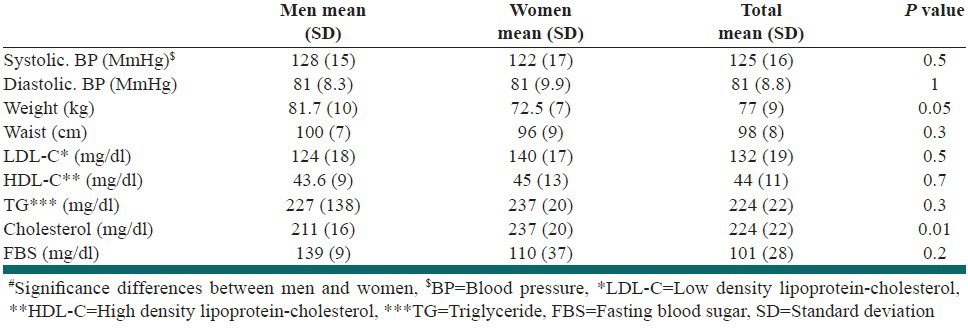
As Table 1; shows weight and cholesterol were significantly higher in women than the men (P < 0.05)
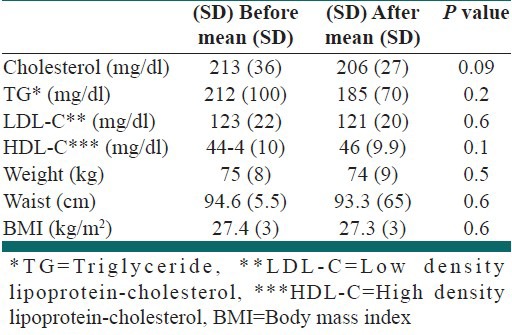
After olive oil consumption cholesterol, TG, LDL-C, weight, waist, and BMI were decreased and HDL-C was increased HDL-C (P > 0.05) [Table 2].
Table 2.
The lipid profile and weight and waist before and after of olive oil prescription
After sesame oil consumption cholesterol, TG, LDL-C, and were significantly decreased. Weight, waist were decreased, and HDL-C was increased (P > 0.05) [Table 3].
Table 3.
The mean of lipid profiles weight, waist and body mass index before and after of sesame oil consumption
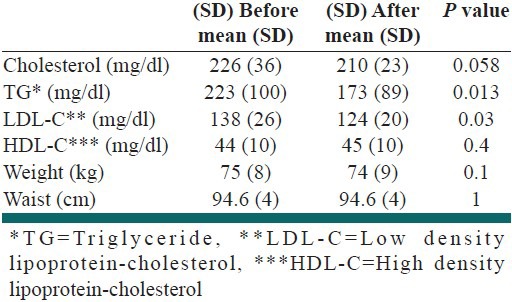
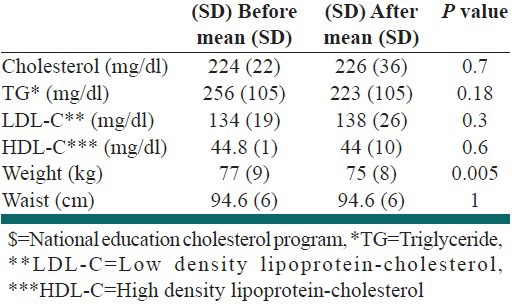
Table 4 shows lipid profiles before and after diet therapy (step I Adult panel III NCPE). Cholesterol, TG, LDL-C and HDL-C were unchanged and Weight was significantly decreased after diet therapy (P = 0.005) [Table 4].
Table 4.
Mean and standard deviations of lipid profiles before and after diet therapy (step I Adult panel III National education cholesterol program $)
In comparison of olive and sesame oils, sesame oil had better improvement effect on lipid profile and weight management [Table 5].
Table 5.
Lipid profiles before and weight changes in two treatment groups A (sesame) and B (olive) mean, SD, MIN and MAX of lipid profile changes in olive oil minus sesame oil
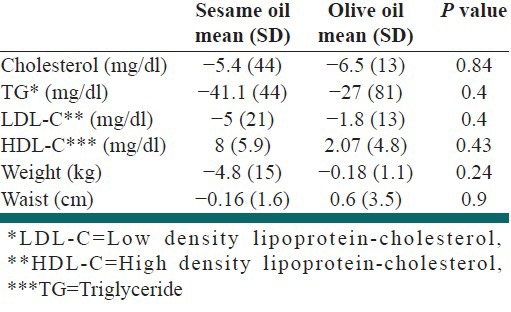
We evaluated non-inferiority analysis. Table 6 shows sesame oil had equivalent effect on lipid profile in comparison olive oil and lipid profile improvement was better in sesame oil in LDL-C and TG.
Table 6.
Mean, standard deviation, MIN and MAX of lipid profile changes in olive oil minus sesame oil

DISCUSSION
This study showed that vegetable oils such as olive and sesame can improve lipid profiles, but there is no difference observed between two oils. Sesamin, as a major lignan in sesame seeds has multiple functions such as cholesterol lowering, anti-hypertensive, anti-cancer, and lipid lowering effect. It induces expression of aldehyde dehydrogenase (an alcohol-metabolizing enzyme) gene, as a result the sesamin regulate metabolism of lipid, xenobiotics, and alcohol at level of mRNA.[4,5] A daily 25-mL dose of all types of olive oil, reduced lipid cardiovascular risk-factors, and improved glutathione antioxidant status. Daily consumption of high- and medium-polyphenol olive oil decreased oxidative damage on lipids. Consumption of olive oil with high phenolic content provided the greatest benefits by increasing HDL cholesterol levels and reducing the oxidative damage on lipids.[6] Very recently, MUFA-rich diets were reported to decrease plasma total cholesterol and LDL-C without decreasing HDL-C in humans. In contrast to some recent reports, a study indicates that a large amount of dietary MUFA may raise some fractions of plasma lipids in humans. The present study indicates that a large amount of dietary MUFA may raise plasma lipids, especially TGs. It is not known whether this effect is harmful, However, the possibility that MUFA may also increase liver cholesterol in humans may need consideration.[7] A study evaluated the metabolic effect of MUFA rich oils and P rich oils on the plasma lipid pattern of moderately hypercholesterolaemic subjects under controlled isocaloric condition. After a 30-day run-in diet, 44 healthy Caucasian subjects with moderate hypercholesterolaemia were randomly assigned to one of four different isocaloric diets, differing only regarding the oil used (corn oil, corn oil supplemented with vitamin E, extra-virgin olive oil or different self-selected oils), for 45 days. At the end of the study, when compared to the baseline value, LDL-cholesterolaemia was significantly lower only in patients taking corn oil (−13.9%; 95% CI = −5.9 to −20.1; P = 0.02) or corn oil with added vitamin E (−19.1%; 95% CI = −6.9 to −24.1; P = 0.03). Differences in plasma HDL-C and TG levels from baseline levels and between the four diets did not reach statistical significance.[8] Low sample size can be considered as a limitation of our study and hence we suggest to perform study with higher sample size in future.
Footnotes
Source of Support: Nil
Conflict of Interest: None declared
REFERENCES
- 1.Choudhury N, Tan L, Truswell AS. Comparison of palmolein and olive oil: Effects on plasma lipids and vitamin E in young adults. Am J Clin Nutr. 1995;61:1043–51. doi: 10.1093/ajcn/61.4.1043. [DOI] [PubMed] [Google Scholar]
- 2.Trevisan M, Krogh V, Freudenheim J, Blake A, Muti P, Panico S, et al. Consumption of olive oil, butter, and vegetable oils and coronary heart disease risk factors. The Research Group ATS-RF2 of the Italian National Research Council. JAMA. 1990;263:688–92. [PubMed] [Google Scholar]
- 3.Namayandeh S, Sadr S, Rafiei M, Modares-Mosadegh M, Rajaefard M. Hypertension in Iranian urban population, epidemiology, awareness, treatment and control. Iran J Public Health. 2011;40:63–70. [PMC free article] [PubMed] [Google Scholar]
- 4.Tsuruoka N, Kidokoro A, Matsumoto I, Abe K, Kiso Y. Modulating effect of sesamin, a functional lignan in sesame seeds, on the transcription levels of lipid- and alcohol-metabolizing enzymes in rat liver: A DNA microarray study. Biosci Biotechnol Biochem. 2005;69:179–88. doi: 10.1271/bbb.69.179. [DOI] [PubMed] [Google Scholar]
- 5.Namiki M. Nutraceutical functions of sesame: A review. Crit Rev Food Sci Nutr. 2007;47:651–73. doi: 10.1080/10408390600919114. [DOI] [PubMed] [Google Scholar]
- 6.Covas MI, Nyyssönen K, Poulsen HE, Kaikkonen J, Zunft HJ, Kiesewetter H, et al. The effect of polyphenols in olive oil on heart disease risk factors: A randomized trial. Ann Intern Med. 2006;145:333–41. doi: 10.7326/0003-4819-145-5-200609050-00006. [DOI] [PubMed] [Google Scholar]
- 7.Chang NW, Huang PC. Effects of dietary monounsaturated fatty acids on plasma lipids in humans. J Lipid Res. 1990;31:2141–7. [PubMed] [Google Scholar]
- 8.Cicero AG, D’Addato S, Fiorito A, Poli A, Gaddi A. Plasma lipid effects of corn oil and extra-virgin olive oil in hypercholesterolaemic subjects: A randomised, controlled trial. Mediterr J Nutr Metab. 2009;1:187–92. [Google Scholar]