



Abstract
There is not much information available on the distribution of the Sunda colugo (Galeopterus variegates) in Malaysia, despite it being one of only two known species in the order Dermoptera. Data on the presence of the Sunda colugo and the vernacular names used by various ethnic groups throughout Malaysia were collected and compiled from various primary and secondary sources. There were 27 locations from Peninsular, 11 locations from Sabah and 34 locations from Sarawak that reported the presence of the Sunda colugo throughout Malaysia. The various ethnic groups of Malaysia adopted 37 different vernacular names to describe the Sunda colugo. This baseline data can be useful for the management authorities in conducting periodic monitoring and will enhance our knowledge of the population dynamics of the Sunda colugo in Malaysia.
Keywords: Distribution, Vernacular Name, Galeopterus variegatus, Sunda Colugo, Malaysia
Abstract
Terdapat hanya sedikit maklumat mengenai Kubong [Sunda colugo] (Galeopterus variegates) di Malaysia walaupun kubong merupakan salah satu daripada dua spesis di dalam kumpulan Dermoptera. Maklumat kewujudan Kubong dan nama tempatan yang digunakan telah dikumpul dari pelbagai sumber utama dan sekunder. Terdapat 27 lokasi dari Semenanjung, 11 lokasi dari Sabah dan 34 lokasi dari Sarawak yang merekodkan kewujudan Kubong di seluruh Malaysia. Pelbagai kumpulan etnik dari seluruh Malaysia telah mengadaptasi sebanyak 37 nama tempatan untuk Kubong. Data ini adalah amat berguna kepada pihak pengurusan dalam menjalankan pemantauan berkala bagi meningkatkan ilmu pengetahuan mengenai kewujudan dan taburan Kubong di Malaysia.
INTRODUCTION
The two known species of Colugo are the Sunda colugo (Galeopterus variegatus) and the Philippine colugo (Cynocephalus volans) (Stafford 2005; Francis 2008). The species, Colugo, contains four known subspecies: G. v. variegatus found in Java, G. v. temminckii found in Sumatra, G. v. borneanus found in Borneo and G. v. peninsulae found in Peninsular Malaysia (Stafford & Szalay 2000). However, recent molecular and morphological data provide evidence that the Javan, the Borneo and the mainland Sunda colugo are recognised as three distinct species in the genus Galeopterus (Janecka et al. 2008). This species can be found throughout Southeast Asia ranging from southern Burma, Thailand, southern Vietnam, Peninsular Malaysia, Singapore, Sumatra, Java, Borneo (Corbet & Hill 1992; Stafford 2005), Laos (Ruggeri & Etterson 1998), Bali and many smaller Indonesian Islands (Francis 2008). C. volans can be found in southern parts of the Philippines (Stafford 2005). Wischusen (1990) stated that the rapid loss of forested habitat may threaten and endanger both the Philippine colugo (C. volans) and the Sunda colugo (G. variegatus) throughout this region. Boeadi and Steinmetz (2008) stated that the Sunda colugo is listed as Least Concern by the International Union for Conservation of Nature (IUCN), while Francis (2008) categorised the Sunda colugo as Near Threatened. Moreover, the lack of local knowledge on the Sunda colugo (e.g., distribution) may result in ineffective conservation enforcement and increased risk of local extinction.
In Malaysia, there are places where the name of the Sunda colugo, or known as Kubong, is adopted to Labu Kubung, Bukit Kubung or Tanjung Kubung. It is important to understand the presence of the Sunda colugo throughout Peninsular Malaysia, Sabah and Sarawak. However, the reports are scattered, not published and many are not formally documented (e.g., personal observations by visitors and local knowledge) making it difficult to obtain information on the distribution of this species.
The main objective of this study was to collect primary and secondary information to update the knowledge of the distribution of the Sunda colugo in Malaysia and to identify the locations where the Sunda colugo existed. In addition, the vernacular names used to identify the Sunda colugo from different ethnic communities were also collected and gathered to ease communication among various ethnic groups and for future surveying in Malaysia.
MATERIALS AND METHODS
The available information on the distribution of the Sunda colugo in various locations such as protected areas, non-protected areas, places of interest and other places throughout Peninsular Malaysia, Sabah and Sarawak was compiled through observations, personal interviews and secondary information (e.g., photographs, video, interviews, books, the internet, reports and research articles). During informal interviews, respondents were asked casually of their knowledge of the whereabouts of the Sunda colugo. In some cases, verification of the information obtained was impossible due to lack of time, resources and accessibility to the area.
All references on the distribution and vernacular names used for the Sunda colugo were documented and compiled. The references cited based on the internet (e.g., image galleries and blogs) and from interviews were cited as Dzulhelmi (2010) and noted as not verified by authors (NV) unless otherwise stated, because the future researchers might not be able to retrieve the same information from the internet or the same individual due to the dynamic nature of the internet and people, respectively. The authentic references based on the internet (e.g., image galleries and blogs) can be found in Dzulhelmi (2010). Nevertheless, proper documentation (e.g., journals, books) is needed for future reference.
RESULTS
Distribution
Peninsular Malaysia
All states, except Kuala Lumpur, reported the presence of the Sunda colugo in Peninsular Malaysia as shown in Table 1. Various sources have reported the presences of the Sunda Colugo in 27 locations in 11 states. The reports are from the following sources: Chasen and Kloss (1929), Lim (1967), World Wildlife Fund (1977), Medway (1978), Kemper (1988), Corbet and Hill (1992), Lim et al. (1999), Bowden (2000), Sahir and Lim (2000), Mohd-Nor et al. (2001), Lim and Chai (2002), Shahrul-Anuar and Ibrahim (2006), Ahmad (2007), Awdry (2007), Lim (2007), Dzulhelmi (2010) and by personal interviews. The distribution map of the Sunda colugo in Peninsular Malaysia is shown in Figure 1.
Table 1:
The locations of the Sunda colugo in Peninsular Malaysia.
| No. | States | Location | Status | References | Colugo |
|---|---|---|---|---|---|
| Peninsular | |||||
| 1 | Perlis | Perlis State Park | PA | Mohd-Nor et al. (2001) | √ |
| 2 | Kedah | Ulu Muda and Pedu Lake Forest Reserve | PA | Dzulhelmi (2010) | NV |
| 3 | Gunung Jerai State Park | PA | World Wildlife Fund (1977) | √ | |
| 4 | Gunung Raya Forest Reserve | PA | Dzulhelmi (2010) | NV | |
| 5 | Berjaya Langkawi Resort | PA | Dzulhelmi (2010) | NV | |
| 6 | Pulau Pinang | Penang National Park | PA | Shahrul-Anuar and Ibrahim (2006); Ahmad (2007) | √ |
| 7 | Telok Bahang Forest Park | PA | Dzulhelmi (2010) | NV | |
| 8 | Keracut Beach (Turtle hatching) | PA | Dzulhelmi (2010) | NV | |
| 9 | Perak | Kuala Kurau (Taiping) | NPA | Interview (UNIMAS student) | NV |
| 10 | Pangkor Islands | PA | Medway (1978); Interview (Lumut citizen) | √ | |
| 11 | Lenggong (Gerik) | NPA | Dzulhelmi (2010) | NV | |
| 12 | Selangor | Ulu Gombak Nature Reserve | PA | Lim (1967) | √ |
| 13 | Forest Research Institute Malaysia | NPA | Interview (Shahfiz Azman) | NV | |
| 14 | Negeri Sembilan | Pasoh Forest Reserve | PA | Kemper (1988) | √ |
| 15 | Malacca | Unidentified location | NPA | Awdry (2007) | NV |
| 16 | Johor | Aur Islands | PA | Chasen and Kloss (1929); Corbet and Hill (1992) | √ |
| 17 | Gunung Ledang Johor National Park | PA | Dzulhelmi (2010) | √ | |
| 18 | Endau-Rompin National Park | PA | Lim (2007) | √ | |
| 19 | Panti Forest Reserve | PA | Lim (2007) | √ | |
| 20 | Tioman Islands | PA | Lim et al. (1999) | √ | |
| 21 | Pahang | Taman Negara National Park | PA | Bowden (2000) | √ |
| 22 | Kerau Forest Reserve | PA | Sahir and Lim (2000) | √ | |
| 23 | Semangko | NPA | Corbet and Hill (1992) | √ | |
| 24 | Fraser Hill (Bukit Kutu) | PA | Dzulhelmi (2010) | √ | |
| 25 | Genting Highlands | PA | Lim and Chai (2002) | √ | |
| 26 | Kelantan | Tanah Merah | NPA | Interview (Kassim bin Yunus) | NV |
| 27 | Terengganu | Perhentian Islands | PA | Chasen and Kloss (1929) | √ |
Notes: NV: Not verified by author; NA: Data not available; √: Present; NPA: Non-protected areas or unknown status; PA: National or state parks, protected areas or reserves.
Figure 1:
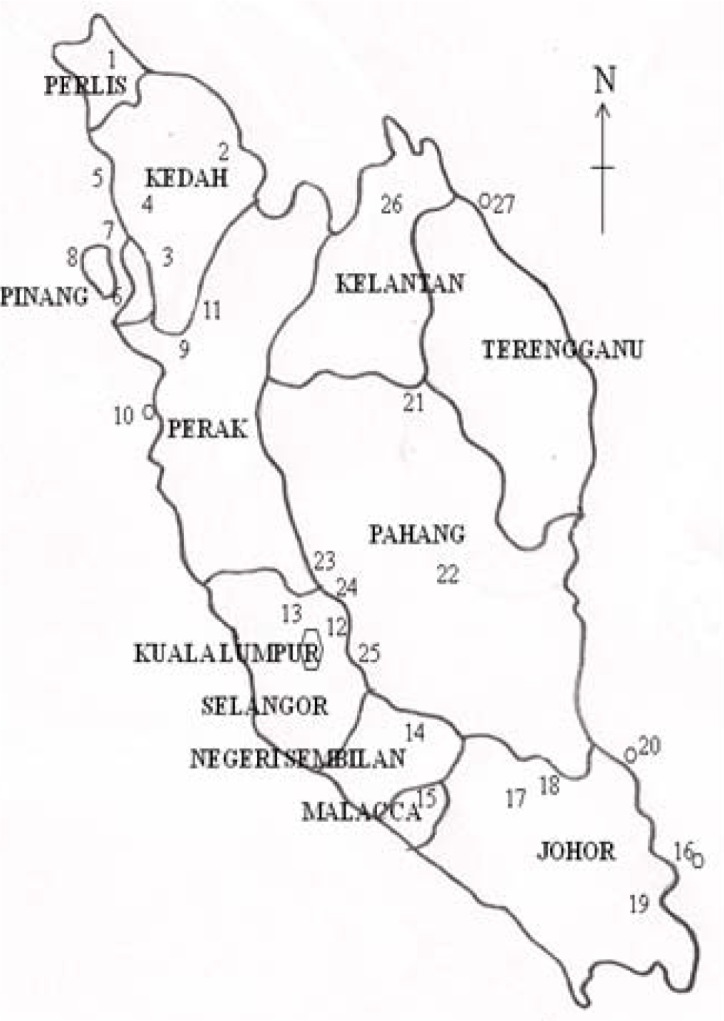
The distribution of the Sunda Colugo in states of Peninsular Malaysia.
Note: Figure not drawn to scale.
Sabah
Of the five main divisions in Sabah, four divisions, excluding the Interior Division, reported the presence of the Sunda colugo as shown in Table 2. There are 11 locations noted by various sources including: Chasen and Kloss (1929), Lim (1967), Yasuma and Andau (2000), Tuen et al. (2002), Lim (2007), Dzulhelmi (2010) and personal interviews. The distribution map of the Sunda colugo in Sabah is shown in Figure 2.
Table 2:
The location of the Sunda colugo in Sabah.
| No. | State | Location | Status | References | Colugo |
|---|---|---|---|---|---|
| Sabah | |||||
| 28 | West Coast | Kinabalu National Park | PA | Yasuma and Andau (2000) | √ |
| 29 | Poring Hot Spring Nature Reserve | PA | Lim (2007) | √ | |
| 30 | Ulu Papar (Kaiduan) | NPA | Yasuma and Andau (2000) | √ | |
| 31 | Tawau | Tawau Hills Park | PA | Yasuma and Andau (2000) | √ |
| 32 | Danum Valley Conservation area | PA | Lim (2007) | √ | |
| 33 | Tabin Wildlife Reserve | PA | Dzulhelmi (2010) | NV | |
| 34 | Quoin Hill | NPA | Lim (1967) | √ | |
| 35 | Kudat | Banggi Islands | PA | Chasen and Kloss (1929) | √ |
| 36 | Balambangan Islands | PA | Tuen et al., (2002) | √ | |
| 37 | Sandakan | Sepilok Forest Reserve | PA | Yasuma and Andau (2000) | √ |
| 38 | Kinabatangan River and Sukau | PA | Interview (Sarawak Park Guide) | NV |
Notes: NV: Not verified by author; NA: Data not available; √: Present; NPA: Non-protected areas or unknown status; PA: National or state parks, protected areas or reserves.
Figure 2:

The distribution of the Sunda colugo in the division of Sabah, Malaysia.
Note: Figure not drawn to scale.
Sarawak
A total of 34 locations from 7 divisions confirmed the presence of the Sunda colugo in Sarawak as shown in Table 3. There were no data obtained on the presence of the Sunda colugo from the four divisions of Sri Aman, Sibu, Betong and Sarikei. These sources were obtained from Davis (1958), Kool and Nawi (1995), Hazebroek and Abang Kashim (2002), Dagang (2005), Karim et al. (2004), Ketol et al. (2006), Mohd-Azlan and Fauzi (2006), Rambli and Gumal (2007), Anwarali-Khan et al. (2008), Beavitt and Tuen (2010), Dzulhelmi (2010) and through personal interviews. The distribution map of the Sunda colugo in Sarawak is shown in Figure 3.
Table 3:
The locations of the Sunda colugo in Sarawak.
| No. | State | Location | Status | References | Colugo |
|---|---|---|---|---|---|
| Sarawak | |||||
| 39 | Kuching | Bako National Park | PA | Ketol et al. (2006) | √ |
| 40 | Kubah National Park | PA | Dagang (2005) | √ | |
| 41 | Kuching Wetlands National Park | PA | Beavitt and Tuen (2010) | √ | |
| 42 | Samajaya Nature Reserve | PA | Dagang (2005) | √ | |
| 43 | Wind Cave Nature Reserve area | PA | Observation by M. T. Abdullah | √ | |
| 44 | Semenggoh Nature Reserve | PA | Interview (Sarawak Park Guide) | NV | |
| 45 | Fairy Cave area | NPA | Ketol et al. (2006) | √ | |
| 46 | Gold mine (Bau) | NPA | Ketol et al. 2006 | √ | |
| 47 | Bau Limestone area | NPA | Karim et al. (2004) | √ | |
| 48 | 6.5 mile Rock road | NPA | Kool and Nawi (1995) | √ | |
| 49 | 13th Mile | NPA | Kool and Nawi (1995) | √ | |
| 50 | Salak | NPA | Kool and Nawi (1995) | √ | |
| 51 | Sungai Sabun | NPA | Kool and Nawi (1995) | √ | |
| 52 | Mount Poi, Lundu | NPA | Kool and Nawi (1995) | √ | |
| 53 | Teluk Bandong | NPA | Kool and Nawi (1995) | √ | |
| 54 | Bongkissam, Santubong | NPA | Kool and Nawi (1995) | √ | |
| 55 | Tapuh | NPA | Kool and Nawi (1995) | √ | |
| 56 | Sadong River | NPA | Kool and Nawi (1995) | √ | |
| 57 | Long Luping | NPA | Kool and Nawi (1995) | √ | |
| 58 | Ulu Tutoh | NPA | Kool and Nawi (1995) | √ | |
| 59 | Sematan | NPA | Kool and Nawi (1995) | √ | |
| 60 | Samarahan | Kg. Malaban Lumut | PA | Ketol et al. (2006) | √ |
| 61 | Kg. Sebayur | PA | Ketol et al. (2006) | √ | |
| 62 | Kg. Bidak Plawan | PA | Mohd-Azlan and Fauzi (2006) | √ | |
| 63 | Mukah | Mukah | NPA | Kool and Nawi (1995) | √ |
| 64 | Bintulu | Purchidi (Sungai Serang) | NPA | Kool and Nawi (1995) | √ |
| 65 | Limbang | Kelabit | NPA | Davis (1958) | √ |
| 66 | Miri | Gunung Mulu National Park | PA | Hazebroek and Abang Kashim (2002) | √ |
| 67 | Niah National Park | PA | Anwarali-Khan et al. (2008) | √ | |
| 68 | Lambir Hill National Park | PA | Dzulhelmi (2010) | NV | |
| 69 | Loagan Bunut National Park | PA | Rambli and Gumal (2007) | √ | |
| 70 | Baram | NPA | Kool and Nawi (1995) | √ | |
| 71 | Subis (Niah Cave) | PA | Kool and Nawi (1995) | √ | |
| 72 | Kapit | Nanga Segenok | NPA | Mohd-Azlan and Fauzi (2006) | √ |
Notes: NV: Not verified by author; NA: Data not available; √: Present; NPA: Non-protected areas or unknown status; PA: National or state parks, protected areas or reserves.
Figure 3:

The distribution of the Sunda colugo at the division of Sarawak, Malaysia.
Note: Figure is not drawn to scale.
The Vernacular Names
The vernacular names given to the Sunda colugo varied greatly in Malaysia (Peninsular, Sabah and Sarawak) due to Malaysia being a multiracial country with various ethnicities and cultures. There are 37 local names used by various ethnic groups to describe the Sunda colugo according to Medway (1978), Yasuma and Andau (2000), Rambli and Gumal (2007) and also by personal interviews with locals as listed in Table 4.
Table 4:
The list of ethnic names used for the Sunda colugo in Malaysia (Peninsular, Sabah and Sarawak).
| Location | Ethnicity | Vernacular name |
|---|---|---|
| Peninsular Malaysia | North region Malay | Kabong |
| Centre and Southern Malay | Kubung Lumut, Kubung Pelanduk | |
| East coast Malay | Koluga | |
| Tioman Islands | Kujul | |
| Sabah | Bawo, Basap, Pasir, Banjar | Kung |
| Benuaq | Kuukng | |
| Bukit, Benuaq | Kuung | |
| Belait | Kamal | |
| Bisaya | Kagui | |
| Dusun | Kagu, Kuwungk | |
| Kadazan, Western Sabah, Central Sabah | Langah, Tagaut, Tagawat, Tangah | |
| Kadayan | Kubung | |
| Kayan, Punan, Sungai Tubu (East Kalimantan) | Kuvung | |
| Kenyah-Badung | Kubung Pelanuk | |
| Lun Dayek, Punan (Northern Sarawak, Brunei) | Kubung | |
| Ma’anyan | Kuwung | |
| Modan | Keuong | |
| Murut | Apuyut, Apuyut Palanuk, Opoyut | |
| Tidung | Kubung | |
| Tutong | Manuk Pasu | |
| Sarawak | Berawan | Niko |
| Bidayuh | Kubong Mayas, Kubung Pelanduk, Kubong | |
| Iban | Kubong Pelanduk, Ngukobong | |
| Sarawakian (Malay) | Kubong Pelanduk, Kubong Belias | |
| Kelabit | Kubong Badan, Kubong Palanok |
DISCUSSION
Distributions
The habitats used by the Sunda colugo are gardens, secondary forests (Payne et al. 1985), lowland and upland forests (Feldhamer et al. 2003), mountainous areas (Lim 1967), rubber and coconut plantations (Hill 1993), lowland dipterocarp forest and mangroves (Yasuma & Andau 2000). These diverse habitats allow for the possibility of the presence of the Sunda colugo in a multitude of areas including rural places. Sunda colugo have been sighted rooting in tree holes or on palm fronds (Medway 1978) and sometimes hanging beneath branches (Hill 1993; Dzulhelmi & Abdullah 2009a) during the day. Several factors that have been noted to influence the roosting selection include both environmental (Dzulhelmi & Abdullah 2009b; Dzulhelmi 2010) and behavioural factors (Dzulhelmi & Abdullah 2009a). The Sunda colugo are hunted by locals with shotguns or other equipment (e.g., spears) for food (Mohd-Azlan & Fauzi 2006) and fur to make hats and other decorations. Moreover, habitat loss is causing a decline in the population of the Sunda colugo (Francis 2008) that contributes to a drastic population decline of this species (Ketol et al. 2006). Predators, such as the Changeable Hawk-Eagle, were reported to attack the Sunda colugo (Lim 2007).
The Vernacular Names
The vernacular names used to describe the Sunda colugo may differ from one area to another although the ethnic communities are the same. Knowing the vernacular names used by the locals is important for conducting interviews, as many locals are not familiar with the common terminology used. Despite the common terminology used, the Sunda colugo can also be described and identified by showing and illustrating pictures to the locals (Fig. 4). However, the locals may know and have seen the species but may not know the right terminology used to describe the Sunda colugo in their native language. This is because urbanisation of a particular area may force the animal to leave, causing locals to be unfamiliar with that species. The future generations may not have the chance to use the exact terminology to describe the Sunda colugo in their native language if there is not proper documentation.
Figure 4:

A Sunda colugo (G. variegatus) with its young climbing a bole of a tree in Bako National Park, Sarawak, Malaysian Borneo.
CONCLUSION AND RECOMMENDATIONS
This study identifies the locations of the occurrence of the Sunda colugo in Malaysia (Peninsular, Sabah and Sarawak) even though field studies were not conducted to reconfirm and estimate the population and conservation status of the Sunda colugo. The information available on the presence of the Sunda colugo in 27 (Peninsular), 11 (Sabah) and 34 (Sarawak) locations from various states and divisions indicates the high probability that the Sunda colugo still remains as Not Threatened in Malaysia. However, the population estimation in Malaysia should be calculated from the distribution information available.
Currently, the conservation status of the Sunda calugo is categorised as Least Concern by the IUCN (Boeadi & Steinmetz 2008). Hill (1993) stated that the Sunda colugo is not endangered but may be threatened due to habitat destruction and deforestation and Francis (2008) categorised it as Near Threatened. However, the information does not represent concrete evidence for the Sunda colugo populations in Malaysia. It is known that habitat loss due to deforestation for human needs occasionally occurs especially in developing countries such as Malaysia.
Thus, for long term conservation, population estimation and population dynamics are urgently needed and should be a top priority (Wischusen 1990). This baseline data can be useful for management authorities in conducting periodic monitoring and would enhance information on the population dynamics of the Sunda colugo (Dzulhelmi 2010). Furthermore, in situ conservation measurements and long-term monitoring programs through periodic field surveys should be conducted to help preserve the potential habitats of the Sunda colugo and keep it from being destroyed by human intervention.
In Singapore, Lim (2007) successfully estimated the Sunda colugo. In addition, awareness programs on the presence of the Sunda colugo were also recently conducted (Lim 2007). Awareness programs should also be available in Malaysia by sharing information of the Sunda Colugo through media and conducting activities (e.g., Colugo watch) that would benefit the locals. One activity would be to train the locals to search for the Sunda colugo while visiting places of interest (e.g., recreation parks) during night walks. To initiate these programs, potential recommended locations are at The Bako National Park in Sarawak (Dzulhelmi & Abdullah 2009b), The Poring Hot Spring Nature Reserve in Sabah and The Langkawi Islands in Peninsular Malaysia (Lim 2007), as these are the known places where the Sunda colugo are easily found.
The documentation of the vernacular names used to describe the Sunda colugo is important for interviewing the locals of a particular area whether this species exists at their area or not. Sometimes the locals may have seen the Sunda colugo but may not know the specific terminology used to describe this species. In this circumstance, pictures and illustrations of the Sunda colugo can be useful tools for describing this species while interviewing the locals (Figure 4). In other instances, there are locations where the Sunda colugo was known to inhabit but no longer exists. This may be due to local extinction due to depletion of the habitat of the Sunda colugo.
REFERENCES
- Ahmad MK. Taman Negara Pulau Pinang: Sinar mutiara belantara. Kuala Lumpur: Jabatan Perhilitan; 2007. [Google Scholar]
- Anwarali-Khan FA, Bujang MH, Kassim MA, Yap SY, Ketol B, Marni W, Sait I, et al. Biodiversity assesment through transect survey in Niah National Park: Sarawak lowland dipterocarp rainforest. Journal of Tropical Biology and Conservation. 2008;4(1):23–37. [Google Scholar]
- Awdry WV. Early chapters in science. London: Willian Clowes and Sons Limited; 2007. [Google Scholar]
- Beavitt W, Tuen AA. Swamp: Kuching Wetlands National Park. Kuching, Sarawak: UNIMAS; 2010. [Google Scholar]
- Boeadi, Steinmetz R. Galeopterus variegatus. IUCN red list of threatened species. 2008. Version 2010.1. http://www.iucnredlist.org/apps/redlist/details/41502/0. (accessed on 8 April 2010).
- Bowden D. Visitor’s guide Taman Negara: Malaysia’s Premier National Park. London: New Holland Publishers Ltd; 2000. [Google Scholar]
- Chasen FN, Kloss CB. Notes on flying lemurs (Galeopterus) Bulletin of the Raffles Museum. 1929;2:12–22. [Google Scholar]
- Corbet GB, Hill JE. The mammals of the Indomalayan Region: A systematic review. Oxford: Oxford University Press; 1992. [Google Scholar]
- Dagang P. Small mammals of Samajaya Nature Reserve and Kubah National Park. Sarawak: Sarawak Forestry Corporation Sdn. Bhd; 2005. [Google Scholar]
- Davis DD. Mammals of the Kelabit Plateau Northern Sarawak. Chicago: Chicago Natural History Museum; 1958. [Google Scholar]
- Dzulhelmi MN. Behaviour, ecology and conservation status of the Sunda Colugo (Galeopterus variegatus) 2010. MSc. diss., Universiti Malaysia Sarawak.
- Dzulhelmi MN, Abdullah MT. An ethogram construction for the Malayan Flying Lemur (Galeopterus variegatus) in Bako National Park, Sarawak, Malaysia. Journal of Tropical Biology and Conservation. 2009a;5(1):31–42. [Google Scholar]
- Dzulhelmi MN, Abdullah MT. The foraging ecology of the Sunda Colugo (Galeopterus variegatus) in Bako National Park, Sarawak, Malaysia. Malayan Nature Journal. 2009b;61(4):285–294. [Google Scholar]
- Feldhamer GA, Drickamer LC, Vessey SH, Merritt JF. Mammalogy: Adaptation, diversity and ecology. 2nd ed. New York: McGraw-Hill Companies Inc.; 2003. [Google Scholar]
- Francis CM. A field guide to the mammals of South-East Asia. London: New Holland Publishers Ltd; 2008. [Google Scholar]
- Hazebroek HP, Abang Kashim AM. A guide to Gunung Mulu National Park: A world heritage site in Sarawak, Malaysian Borneo. Kota Kinabalu, Sabah, Malaysia: Natural History Publications Sdn. Bhd; 2006. [Google Scholar]
- Hill JE. Flying lemurs (in encyclopedia of animals) Singapore: Weldon Owen Pty Limited; 1993. [Google Scholar]
- Janecka JE, Helgen KM, Lim NTL, Baba M, Izawa M, Boeadi, Murphy WJ. Evidence for multiple species of Sunda Colugo. Current Biology. 2008;18(21):1001–1002. doi: 10.1016/j.cub.2008.09.005. [DOI] [PubMed] [Google Scholar]
- Karim C, Tuen AA, Abdullah MT. Mammals. In: Yong HS, Ng FSP, Yen EEL, editors. Sarawak Bau Limestone Biodiversity. Sarawak Museum Journal. 6. Vol. 80. 2004. pp. 221–234. [Google Scholar]
- Kemper C. The mammals of Pasoh Forest Reserve, Peninsular Malaysia. Malayan Nature Journal. 1988;42:1–19. [Google Scholar]
- Ketol B, Tedong S, Abdullah MT. Short notes: Distribution records of the rare flying lemur in Kota Samarahan and Kuching Area, Sarawak. Sarawak Museum Journal. 2006;83:237–241. [Google Scholar]
- Kool KM, Nawi Y. Catalogue of mammal skins in Sarawak Museum, Kuching, Sarawak. Kota Samarahan, Sarawak: Universiti Malaysia Sarawak; 1995. [Google Scholar]
- Lim BL. Observations on the food habits and ecological habitat of the Malaysian Flying Lemur. International Zoo Yearbook, Vol. 7. Scotland: Aberdeen University Press. 1967;7:196–197. [Google Scholar]
- Lim BL, Chai KS. A survey on the vertebrate fauna (small mammals, birds, amphibians and reptiles) at Genting Highlands, Pahang. Journal of Wildlife and Parks. 2002;20:59–65. [Google Scholar]
- Lim BL, Lim KKP, Yong HS. The terrestrial mammals of Pulau Tioman, Peninsular Malaysia, with a catalogue of specimens of the Raffles Museum, National University of Singapore. The Raffles Bulletin of Zoology. 1999;6:101–123. [Google Scholar]
- Lim N. Malayan Colugo: The Flying Lemur of South-East Asia. Singapore: Draco Publishing and Distribution Pte Ltd; 2007. [Google Scholar]
- Medway L. The wild mammals of Malaya (Peninsular Malaysia) and Singapore. Kuala Lumpur: Oxford University Press; 1978. [Google Scholar]
- Mohd-Azlan J, Fauzi MF. Ethnozoological survey in selected areas in Sarawak. Sarawak Museum Journal. 2006;83:185–200. [Google Scholar]
- Mohd-Nor S, Mohd-Sah MS, Baharuddin MH, Ahmad Y, Ganesan M, Kamili MZ. Tinjauan mamalia kecil di tasik meranti, taman negeri Perlis. In: Faridah Hanum I, Osman K, Latif A, editors. Kepelbagaian biologi dan pengurusan taman negeri Perlis: Persekitaran fizikal dan biologi wang kelian. Perlis, Malaysia: Jabatan Perhutanan Negeri Perlis; 2001. [Google Scholar]
- Payne J, Francis CM, Phillipps K. A field guide to the mammals of Borneo. Kota Kinabalu, Sabah, Malaysia: The Sabah Society; 1985. [Google Scholar]
- Rambli A, Gumal M. Visitors’ guide to Loagan Bunut National Park, Sarawak, Malaysian Borneo. Kuching: UNDP/GEF Funded Peat Swamp Forest Project; 2007. [Google Scholar]
- Ruggeri N, Etterson M. The first record of Colugo (Cynocephalus variegatus) from the Lao P. D. R. Mammalia. 1998;62:450–451. [Google Scholar]
- Sahir O, Lim BL. Non-volant small mammals. Journal of Wildlife and Parks. 2000;18:57–75. [Google Scholar]
- Shahrul-Anuar MS, Ibrahim J. Terrestrial vertebrate species of Penang National Park: Potential for ecotourism. Kuala Lumpur: Percetakan Nasional Berhad; 2006. [Google Scholar]
- Stafford BJ. Order Dermoptera. In: Wilson DE, Reeder DM, editors. Mammals species of the world, taxonomic and geographic reference. 3rd ed. Washington DC: Smithsonian Institution Press; 2005. [Google Scholar]
- Stafford BJ, Szalay FS. Craniodental functional morphology and taxonomy of Dermopterans. Journal of Mammalogy. 2000;81(2):360–385. [Google Scholar]
- Tuen AA, Abdullah MT, Laman CJ, Rahman MA, Sim EUH, Ketol B, Sait I, Marni W. Mammals of Balambangan Island, Sabah. Journal of Wildlife and Parks. 2002;20:75–82. [Google Scholar]
- Wischusen EW. The foraging ecology and natural history of the Philippine Flying Lemur (Cynocephalus volans) 1990. PhD diss, Cornell University.
- World Wildlife Fund . Gunung Jerai State Park, Kedah: It’s natural resource and its future role. Kuala Lumpur: World Wildlife Fund Malaysia; 1977. [Google Scholar]
- Yasuma S, Andau M. Mammals of Sabah Part 2: Habitat and ecology. Sabah, Malaysia: Sabah Wildlife Department; 2000. [Google Scholar]