



Oncolytic virotherapy (OV) is the manipulation of replication-competent virus to selectively infect and lyse malignant cells while leaving normal cells untouched. Effective therapy depends on successfully reaching tumor deposits, possessing the correct tropism for infection, and then disseminating throughout the tumor. Major limiting factors include evading host antiviral immunity while reaching the tumor at titers high enough to infect as well as producing enough progeny to spread intratumorally and mediate significant lysis. Carrier cells provide a clever means of overcoming these obstacles. Rather than systemically or intratumorally inoculating with free virus and leaving the virus exposed to antibody- or complement-mediated neutralization, a cell carrier with appropriate tropism can migrate to tumor deposits while shielding the virus from antiviral immunity and acting as a host for replication to boost viral titers. However, infection of carriers is complicated by toxicity from innate cellular antiviral immunity.
In this issue of Molecular Therapy, Kim et al.1 show that glioma-tropic neural stem cells (NSCs) with oxidative stress (OS) inhibition via N-acetylcysteine amide (NACA) are able to deliver higher levels of oncolytic adenovirus to orthotopic glioma xenografts in vivo with greater intratumoral viral spread and longer median survival compared with carrier NSCs without NACA. This study is significant to the field of OV because it identifies OS signaling as a salient limitation within infected carrier cells and shows that combinatorial therapy with NACA induces these cells to deliver increased viral payloads and significantly enhances the OV-mediated lysis of malignant cells.
OV represents a novel, tumor-targeted therapy for a variety of cancers intractable to current multimodality standards of care. Glioblastoma (GBM) is the most aggressive of brain tumors, and, despite radiation therapy, temozolomide, and bevacizumab, overall survival remains short.2,3 GBM is infrequently multifocal and rarely metastasizes, but it is highly invasive locally, with tumor infiltration extending past poorly defined tumor margins. This phenotype makes complete surgical resection improbable, and the ability of future therapies to target and eradicate these diffuse tumor cells will be key to preventing recurrence. Several glioma-tropic viruses have shown preclinical efficacy against glioma xenografts in immune-deficient murine models; however, translation to early-phase clinical studies has shown excellent safety but only intermittent clinical responses.4,5,6 Most of these trials administered virus intratumorally, and a lack of efficacy could be due to an inability to reach diffuse infiltrating tumor deposits as well as inefficient infection and replication in the context of an immune-competent environment.
Previous work by Kim and colleagues has been focused on overcoming the therapeutic deficits of limited viral delivery and inadequate viral spread throughout a tumor by leveraging NSCs as viral carrier cells. NSCs possess the inherent capacity to migrate across the brain and target gliomas,7 deliver virus to the tumor cells, and actually suppress the neuroinflammation induced by innate antiviral immunity.8 Building on these discoveries in order to investigate how to maximize NSC viability after CRAd-S-pk7 infection, Kim et al. utilized a US Food and Drug Administration–approved human immortalized NSC line, HB1.F3.CD, along with the glioma-specific CRAd-S-pk7 oncolytic adenovirus modified with the tumor-specific survivin promoter.9 Although NSCs can deliver CRAd-S-pk7 to glioma and extend survival in preclinical models, infection with 50 IU results in a 50% loss of viability after 72 hours,1 and reducing the toxicity of infection with CRAd-S-pk7 on NSCs may increase both the migration of NSCs to the tumor and the degree of viral replication within NSCs. It is known that reactive oxygen species (ROS) and oxidative stress are part of the inflammatory response to viral infection in many cell types,10 and that ROS induction in NSCs can result in reduced proliferation and increased apoptosis.11 Working from this premise, the authors found that addition of the antioxidant NACA to infected NSCs significantly increased viability, resulted in a striking 61% increase in viral release, and engendered a further 35% loss of glioma cell viability when U87MG tumor cells were infected with supernatant from NSCs treated with NACA vs. control.
Examination of NACA-treated NSCs infected with CRAd-S-pk7 revealed that NACA reduced the consequent dose-dependent increase of ROS from infection and that expression of pro-apoptotic p53 and phosphorylated Akt and p38 were all reduced. Importantly, NACA is a lipophilic compound that bypasses the restrictive blood–brain barrier. When athymic mice bearing established U87MG tumors were intratumorally inoculated with infected NSCs, concomitant systemic NACA administration significantly increased median survival in comparison to mice without NACA, and examination of tumors revealed more extensive intratumoral infection in recipients receiving OS inhibition. Given that NACA improves the efficacy of NSC-delivered OV through enhanced viral delivery and increased infection throughout the malignant mass, Kim et al. show that antioxidant therapy addresses the major limitations facing OV (limited viral delivery and infectious spread) and identify OS as a novel therapeutic target (Figure 1).
Figure 1.
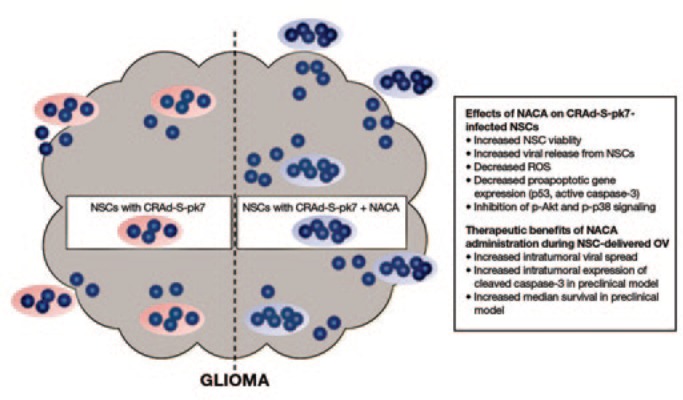
The antioxidant N-acetylcysteine amide (NACA) reduces oxidative stress within CRAd-S-pk7 infected neural stem cells to enhance oncolytic virotherapy of glioma. Glioma-tropic neural stem cells (NSCs) are infected with oncolytic virus (CRAd-S-pk7) and used as carriers for viral delivery to the tumor. Cell carriers in oncolytic virotherapy (OV) can protect virus from host immune-mediated clearance and permit viral replication to boost titers, resulting in improved viral delivery and intratumoral spread. However, infection triggers reactive oxygen species (ROS) in NSCs, with consequent expression of proapoptotic proteins and signaling pathways associated with oxidative stress. NACA reduces ROS within NSCs, with consequent increases in NSC viability, viral release, intratumoral viral spread, and enhanced median survival in a preclinical model of orthotopic glioma. Thus, oxidative stress has been identified as a novel therapeutic target in cell carrier–mediated OV.
Although NACA improved intratumoral infection and therapeutic efficacy in this study, there are understandable caveats to a human NSC line and virus in a murine model with deficient cellular immunity. NSCs, however, are poorly immunogenic12 and have been shown to suppress virally induced inflammation;8 these factors should permit them to effectively shield virus from the immune-mediated clearance that may have limited the efficacy of virus delivery in the early-phase trials undertaken thus far. However, it is also possible that HB1.F3.CD NSCs themselves induce an allogeneic response in humans. Understandably, these factors cannot be adequately assessed in a xenograft model system. Additionally, preclinical experiments confirming that systemic NACA administration does not affect the migratory capacity and glioma-tropic state of NSCs will be important for demonstrating that virally infected NSCs during NACA administration can successfully reach the diffuse and infiltrative tumor deposits that make GBM such a difficult malignancy to eradicate.
GBM is fundamentally a disease of intratumoral and interpersonal heterogeneity, and, as Kim and colleagues have noted before, it is known that different tumor mutations can influence susceptibility to OV.7 Although it is tempting to hope that a single virus could serve as an off-the-shelf treatment for all cases of GBM, realistically, tumor mutations influencing OV-mediated lysis may need to be identified and individual tumors may need to be matched to particular oncolytic viruses more efficacious for those genomic phenotypes. Furthermore, even with optimized delivery of virus and widespread infection, not all tumor cells may be successfully infected and subject to direct viral cytotoxicity. One of the key tenets of the OV paradigm is that the widespread death of tumor cells in the context of the inflammatory response may induce immune specificity to newly exposed tumor antigen, resulting in the priming of virally induced antitumor immunity.4 Although discovering the means to augment antitumor immunity induced by OV is an important direction for this modality, it is critical to first maximize the direct viral-mediated lysis of tumor cells not only to eradicate malignancy but also to optimize the inflammatory conditions and exposure of tumor antigen that will engender antitumor immunity. The work of Kim et al. demonstrates a substantial improvement in the OV of glioma, and we look forward to the translation of this work to the clinic.
References
- Kim CK, Ahmed AU, Auffinger B, Ulasov IV, Tobias AL, Moon K-S.et al. (2013N-acetylcysteine amide augments the therapeutic effect of neural stem cell-based antiglioma oncolytic virotherapy Mol Ther 212063–2073. [DOI] [PMC free article] [PubMed] [Google Scholar]
- Stupp R, Mason WP, van den Bent MJ, Weller M, Fisher B, Taphoorn MJ.et al. (2005Radiotherapy plus concomitant and adjuvant temozolomide for glioblastoma N Engl J Med 352987–996. [DOI] [PubMed] [Google Scholar]
- Vredenburgh JJ, Desjardins A, Herndon JE, Marcello J, Reardon DA, Quinn JA.et al. (2007Bevacizumab plus irinotecan in recurrent glioblastoma multiforme J Clin Oncol 254722–4729. [DOI] [PubMed] [Google Scholar]
- Russell SJ, Peng KW., and, Bell JC. Oncolytic virotherapy. Nat Biotechnol. 2012;30:658–670. doi: 10.1038/nbt.2287. [DOI] [PMC free article] [PubMed] [Google Scholar]
- Alvarez-Breckenridge C, Kaur B., and, Chiocca EA. Pharmacologic and chemical adjuvants in tumor virotherapy. Chem Rev. 2009;109:3125–3140. doi: 10.1021/cr900048k. [DOI] [PMC free article] [PubMed] [Google Scholar]
- Tobias A, Ahmed A, Moon KS., and, Lesniak MS. The art of gene therapy for glioma: a review of the challenging road to the bedside. J Neurol Neurosurg Psychiatry. 2013;84:213–222. doi: 10.1136/jnnp-2012-302946. [DOI] [PMC free article] [PubMed] [Google Scholar]
- Ahmed AU, Thaci B, Tobias AL, Auffinger B, Zhang L, Cheng Y.et al. (2013A preclinical evaluation of neural stem cell–based cell carrier for targeted antiglioma oncolytic virotherapy J Natl Cancer Inst 105968–977. [DOI] [PMC free article] [PubMed] [Google Scholar]
- Ahmed AU, Thaci B, Alexiades NG, Han Y, Qian S, Liu F.et al. (2011Neural stem cell–based cell carriers enhance therapeutic efficacy of an oncolytic adenovirus in an orthotopic mouse model of human glioblastoma Mol Ther 191714–1726. [DOI] [PMC free article] [PubMed] [Google Scholar]
- Ulasov IV, Zhu ZB, Tyler MA, Han Y, Rivera AA, Khramtsov A.et al. (2007Survivin-driven and fiber-modified oncolytic adenovirus exhibits potent antitumor activity in established intracranial glioma Hum Gene Ther 18589–602. [DOI] [PubMed] [Google Scholar]
- Nathan C., and, Cunningham-Bussel A. Beyond oxidative stress: an immunologist's guide to reactive oxygen species. Nat Rev Immunol. 2013;13:349–361. doi: 10.1038/nri3423. [DOI] [PMC free article] [PubMed] [Google Scholar]
- Kim J., and, Wong PK. Loss of ATM impairs proliferation of neural stem cells through oxidative stress–mediated p38 MAPK signaling. Stem Cells. 2009;27:1987–1998. doi: 10.1002/stem.125. [DOI] [PubMed] [Google Scholar]
- Akesson E, Wolmer-Solberg N, Cederarv M, Falci S., and, Odeberg J. Human neural stem cells and astrocytes, but not neurons, suppress an allogeneic lymphocyte response. Stem Cell Res. 2009;2:56–67. doi: 10.1016/j.scr.2008.06.002. [DOI] [PubMed] [Google Scholar]