



Abstract
The integration of research into dental education is necessary to ensure that evidence-based practice reaches the clinical setting and that dentistry remains a scientifically driven health profession. Consequently, dental accreditation standards in the United States and Canada require dental schools to integrate research components into curricula. Organizations (e.g., NIDCR, ADEA, AADR, IADR, and NSRG) provide some opportunities for dental students to experience research. Assessment of the integration of research into dental curricula suggests that US students are interested in learning and utilizing evidence-based practice, but lack adequate time for research participation. Records show limited student involvement in research organizations internationally (i.e., AADR and IADR). Vague accreditation standards and limited research opportunities outside of dental schools may be barriers. We lack an understanding of the status of integration of research into dental curricula internationally, but predict that similar issues exist. We propose that dental institutions consider implementing the following: (1) curriculum components to assess the use of evidence-based practice, (2) faculty and student seminars for discussing evidence-based practice, (3) subsidization of student membership in dental research organizations (e.g., AADR and IADR), and (4) sponsorship of students as institutional representatives at annual research meetings (e.g., IADR, AADR, ADA, and ADEA meetings), with subsequent school-wide dissemination of knowledge attained from attendance.
Keywords: dental education, evidence-based dentistry, dental research, professional education, curriculum, society
Advances in dental materials and treatments are currently emerging at unprecedented rates. The incoming information deluge must be scrutinized alongside traditional materials and treatments to identify those which are the most effective and efficient for patient care and to maintain dentistry’s status as a scientifically driven health profession. At a minimum, to ensure both the integration of evidence-based services into the clinical setting and the viability of the profession, faculty and students must be “sophisticated consumers of research” who are able to recognize and use scientifically proven materials and methods in their practices (Iacopino, 2007). As a consequence, the integration of research into dental education is a necessity.
As a result, dental schools in the United States and Canada have recognized the importance of integrating research components into their curricula and are working to adopt a culture of evidence-based care and to promote the common goal of training the dentists of tomorrow as research-savvy dental professionals (Iacopino, 2007; DePaola, 2008; Haden et al., 2010). The American Dental Association (ADA) has revised its Accreditation Standards for Dental Education Programs to include the integration of research and provisions for quality assessment and assurance, outlining that students should have support available to receive career information and guidance for research opportunities (ADA, 2013). Similarly, the Accreditation Requirements for DDS or DMD programs from the Canadian Dental Association’s Commission on Dental Accreditation of Canada (2010) require a faculty commitment to research and scholarly activity with student involvement.
National and international organizations affiliated with dentistry aid dental schools in their efforts by providing dental students with supplemental opportunities to engage in research. Opportunities include, but are not limited to, the following: The National Institute of Dental and Craniofacial Research (NIDCR) provides a variety of extramural funding mechanisms for dental students that includes graduate (PhD and DDS/PhD) and post-doctoral research training and summer and year-long research fellowships. The American Dental Association holds the annual Student Clinician Research Program to promote “today’s research [becoming] tomorrow’s oral health care solutions” and to mentor students to reach their full potential as clinician-scientists (SCADA, 2007). The American Dental Education Association (ADEA), American Association for Dental Research (AADR), and International Association for Dental Research (IADR) offer scholarships and fellowships for dental students pursuing scholarly activity. The IADR has recently developed the international Student Training and Research (STAR) Network to recruit and maintain student trainees in oral health research around the world. These organizations (i.e., NIDCR, ADA, ADEA, AADR, and IADR) also host annual meetings that provide students with a platform to participate in research at the national and international levels.
Furthermore, the National Student Research Group (NSRG), a student-run organization within the AADR, strives to “foster an environment in every dental school whereby students interested in enriching their dental education through research are encouraged to do so” (Rogér et al., 2007). In addition to offering students resources with which to develop research activities within dental schools, the NSRG provides opportunities targeted to students at the AADR and joint IADR/AADR/CADR annual meetings, to attract them and augment their experience: The NSRG hosts the AADR DENTSPLY/Caulk Student Research Group Competition; sponsors social events that allow students to network; and organizes seminars and workshops focusing on mentorship, careers in dental research, and evidence-based dentistry.
Beyond acting in its supporting role, the NSRG has recognized the importance of assessing the current state and progress of the integration of research into US dental curricula from the student perspective. Recently, members of the NSRG Board of Directors collaborated with the American Student Dental Association (ASDA) to conduct the first national survey of dental students’ attitudes toward the importance of research and its integration into the US dental curriculum. Specifically, the NSRG sought to determine students’ perceptions of the importance of research in dentistry, barriers to becoming involved in scholarly activity, and exposure to research in the dental curriculum (Holman et al., 2013). The results suggest that US dental students appreciate the benefits of a research experience, past or present: As a whole, dental students are in favor of learning and utilizing evidence-based dentistry. Additionally, dental students who participated in research activities prior to dental school were significantly more likely to perform research during dental school. Despite the encouraging findings, lack of time in the curriculum represented a consistent barrier for students’ pursuit of scholarly activity (Holman et al., 2013).
As an additional means of assessing the current status of student engagement in research at an international level, the authors utilized NSRG’s affiliation with the AADR and IADR and looked at student membership data from AADR and IADR. We observed that the total number of IADR student members has more than doubled over the past decade, whereas the total number of AADR student members has remained consistent (Fig., A). Currently, both the IADR and AADR feature their greatest percentages of student membership to date, 32% and 28%, respectively (Fig., B). Both the percentage and total number of IADR student members vary considerably by year (Fig., B), with larger participation corresponding to years in which the IADR/AADR/CADR meetings are held jointly.
Figure.
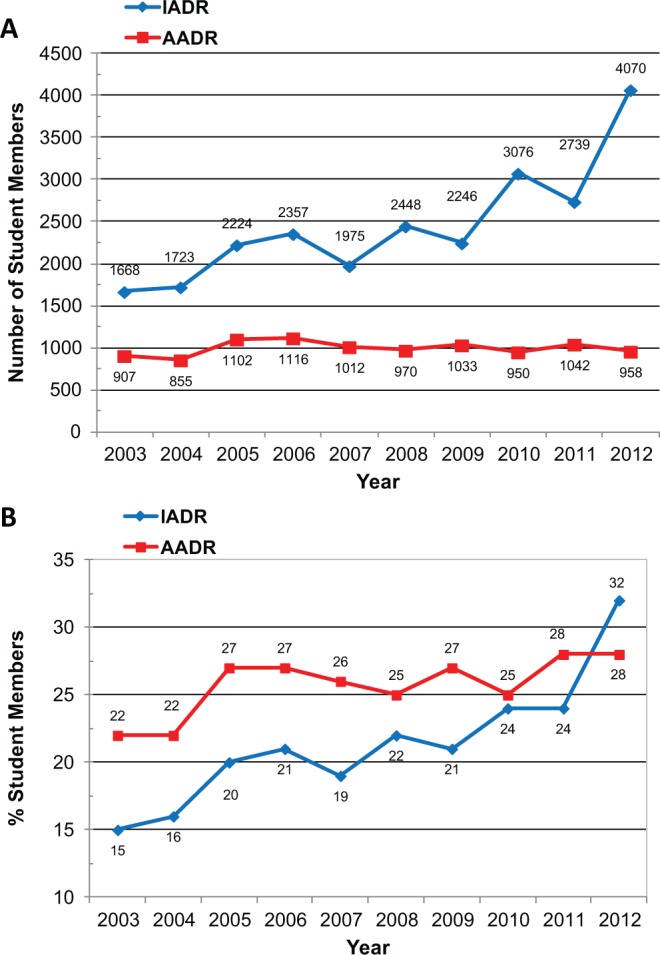
Student membership in IADR and AADR. (A) Total number of student members of IADR and AADR. (B) Student membership as a percentage of total IADR and AADR membership.
Critical examination of the AADR and IADR student membership data reveals key issues:
(1) The percentage of student membership in AADR is the greatest to date, but the overall number of student members has remained relatively static over time. The increase in the percentage of student membership in AADR is more likely the result of a decrease in non-student membership.
(2) NSRG membership—which includes dental, graduate, and post-doctoral students who are AADR members—was 958 in 2012. Even by the most conservative estimate, assuming that NSRG membership was comprised solely of dental students, and based on the ADA’s reported dental school enrollment from 2010 to 2011, NSRG student members represent less than 4.7% of the 20,352 US dental students (ADA Survey of Dental Education, 2012).
(3) IADR student membership includes AADR student membership. AADR student members account for roughly 25% of IADR student members, despite the fact that US dental schools account for only 65 of the 550 (11.8%) reported dental schools internationally (Zillén and Mindak, 2000).
The authors believe that the percentage of student membership in AADR may serve as a crude indicator of relatively low student involvement in research activity and abstract submission to the annual meetings and, taken with results of the NSRG/ASDA survey, may reflect issues relating to the integration of research into US dental education: Critical evaluation of the dental accreditation standards for the US reveals loosely defined requirements for the inclusion of research, which, if left unchanged, will likely result in inadequate fulfillment. In fact, as cited from the ASDA/NSRG survey, lack of time in the curriculum was found to be a consistent barrier to the pursuit of scholarly activity (Holman et al., 2013). Furthermore, although some research opportunities are supported by organizations outside of dental institutions (e.g., AADR, IADR, NIDCR, ADEA, and NSRG), the overall number of opportunities is few compared with the total number of dental students: Dental institutions cannot rely on outside support to provide research experiences to students.
A similar evaluation of dental accreditation standards for Canada also reveals loosely defined requirements for the inclusion of research. Looking beyond the United States and Canada, we find a dearth of evidence in the literature for international efforts aimed at reaching out to dental students to encourage analytical and evidence-based dentistry, despite potentially low participation. We also lack an understanding of the attitudes of international dental students toward research and the underlying rationale for and outcomes of their participation in research activities. If trends in the United States and Canada, coupled with IADR membership data, are any indication, similar issues surrounding the integration of research into dental education throughout the world are present and must be addressed.
To counteract these deficiencies directly and further the integration of research into dental curricula, it is essential that dental institutions consider implementing one or more of the following: (1) curriculum components to assess the use of evidence-based practices, (2) student and faculty seminars for the discussion of evidence-based practices, (3) subsidization of school-wide student membership in dental research organizations (e.g., AADR and IADR) emulating the current practice for US dental student membership in non-research organizations (i.e., ASDA), and (4) sponsorship of students as institutional representatives at annual research meetings (e.g., IADR, AADR, ADA, and ADEA meetings), with subsequent school-wide dissemination of knowledge attained from attending.
Acknowledgments
The authors recognize Marissa Naspinski, Senior Manager of Membership Value, and Denise Streszoff, Associate Executive Director at the IADR Global Headquarters, for procuring the data displayed in the Fig. and extend their sincere gratitude to Dr. Christopher H. Fox, Shaina Holman, and Mateusz Wietecha for their careful review and invaluable feedback during the preparation of this publication.
Footnotes
The authors of this project received funding for their training from the National Institute of Dental and Craniofacial Research (grant F30 DE023476 to J.J.E. and grant F30 DE021945 to A.G.). The views expressed in this publication are solely the opinions of the authors. Joshua J. Emrick, D.D.S., is the 2013-2014 President of the AADR NSRG. Angela Gullard served as President of the AADR NSRG from 2012 to 2013.
The authors declare no other potential conflicts of interest with respect to the authorship and/or publication of this article.
References
- American Dental Association (2012). 2010-2011 Survey of Dental Education – Volume 1: Academic Programs, Enrollment, and Graduates. URL accessed on 9/19/2013 at: http://www.ada.org/sections/professionalResources/pdfs/survey_ed_vol1.pdf.
- American Dental Association (2013). Accreditation standards for dental education programs. URL accessed on 9/19/2013 at: http://www.ada.org/sections/educationAndCareers/pdfs/predoc_2013.pdf.
- Canadian Dental Association’s Commission on Dental Accreditation of Canada (2010). Accreditation requirements for Doctor of Dental Surgery (DDS) or Doctor of Dental Medicine (DMD) Programs. URL accessed on 9/19/2013 at: http://www.cda-adc.ca/cdacweb/_files/DDSDMDRequirements.doc.
- DePaola DP. (2008). The revitalization of U.S. dental education. J Dent Educ 72(2 Suppl):28S-42S. [PubMed] [Google Scholar]
- Haden NK, Hendricson WD, Kassebaum DK, Ranney RR, Weinstein G, Anderson EL, et al. (2010). Curriculum change in dental education, 2003-09. J Dent Educ 74:539-557. [PubMed] [Google Scholar]
- Holman SD, Wietecha M, Gullard A, Petersen J. (2013). Research experiences impact U.S. dental students’ positive attitudes toward research and science. J Dent Educ (in press). [PubMed] [Google Scholar]
- Iacopino AM. (2007). The influence of “new science” on dental education: current concepts, trends, and models for the future. J Dent Educ 71:450-462. [PubMed] [Google Scholar]
- Rogér JM, Javarone JA, Ealba EL, Markiewicz MR, Morlandt AB. (2007). The National Student Research Group of the AADR – an introduction. J Dent Res 86:388-391. [DOI] [PubMed] [Google Scholar]
- SCADA (2007). The International Association of Student Clinicians – American Dental Association. URL accessed on 9/18/2013 at: http://www.scadaresearch.org/.
- Zillén PA, Mindak M. (2000). World dental demographics. Int Dent J 50:194-234. [DOI] [PubMed] [Google Scholar]