



Abstract
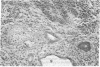
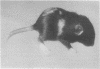
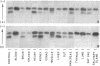
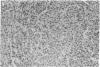
Mouse teratocarcinoma cells from the OTT6050 ascites tumor were established in tissue culture and selected for 5-bromodeoxyuridine (BrdUrd) resistance. The embryonal carcinoma cells grew without a feeder layer, remained deficient for thymidine kinase (EC 2.7.1.75), and differentiated like the original tumor into various tissues after subcutaneous injection into 129 mice. We fused the BrdUrd-resistant mouse teratocarcinoma cells with HT1080-6TG human diploid fibrosarcoma cells deficient in hypoxanthine phosphoribosyltransferase (EC 2.4.2.8) and selected for hybrid cells in hypoxanthine/aminopterin/thymidine medium. The resulting hybrid cells segregated human chromosomes quickly and retained one to three human chromosomes including chromosome 17 that carries the human genes for thymidine kinase and galactokinase (EC 2.7.1.6). Single hybrid cells from five independent clones containing human chromosome 17 were injected into mouse blastocysts bearing several genetic markers that affect the coat color phenotype and strain-specific enzyme variants in order to detect tissue differentiation derived from the injected cells. After the injection of single hybrid cells into a total of 103 experimental blastocysts that had been surgically transferred to pseudopregnant foster mothers, 49 mice were born and 2 of them clearly revealed coat mosaicism. In 2 of 17 mice thus far analyzed, the injected hybrid cells proved to be capable of participating substantially in development of seven different organs. However, human gene products have not yet been detected unequivocally in those tissues and weak human-specific galactokinase activity could be recovered only from two mosaic tissues.
Our results demonstrate that, after in vitro culture and selection, at least some of the human-mouse hybrid cells still retain their in vivo potential to differentiate and become functionally integrated in the living organism. It now seems feasible to cycle mouse teratocarcinoma cells carrying human genetic material through mice via blastocyst injection to study human gene expression during differentiation.
Keywords: mouse teratocarcinoma, thymidine kinase deficiency, human fibrosarcoma, blastocyst injection, genetic mosaicism
Full text
PDF


Images in this article
Selected References
These references are in PubMed. This may not be the complete list of references from this article.
- Brinster R. L. The effect of cells transferred into the mouse blastocyst on subsequent development. J Exp Med. 1974 Oct 1;140(4):1049–1056. doi: 10.1084/jem.140.4.1049. [DOI] [PMC free article] [PubMed] [Google Scholar]
- Champlin A. K., Dorr D. L., Gates A. H. Determining the stage of the estrous cycle in the mouse by the appearance of the vagina. Biol Reprod. 1973 May;8(4):491–494. doi: 10.1093/biolreprod/8.4.491. [DOI] [PubMed] [Google Scholar]
- Croce C. M., Aden D., Koprowski H. Somatic cell hybrids between mouse peritoneal macrophages and simian-virus-40-transformed human cells: II. Presence of human chromosome 7 carrying simin virus 40 genome in cells of tumors induced by hybrid cells. Proc Natl Acad Sci U S A. 1975 Apr;72(4):1397–1400. doi: 10.1073/pnas.72.4.1397. [DOI] [PMC free article] [PubMed] [Google Scholar]
- Croce C. M., Koprowski H., Eagle H. Effect of environmental pH on the efficiency of cellular hybridization. Proc Natl Acad Sci U S A. 1972 Jul;69(7):1953–1956. doi: 10.1073/pnas.69.7.1953. [DOI] [PMC free article] [PubMed] [Google Scholar]
- Croce C. M. Loss of mouse chromosomes in somatic cell hybrids between HT-1080 human fibrosarcoma cells and mouse peritioneal macrophages. Proc Natl Acad Sci U S A. 1976 Sep;73(9):3248–3252. doi: 10.1073/pnas.73.9.3248. [DOI] [PMC free article] [PubMed] [Google Scholar]
- Dewey M. J., Martin D. W., Jr, Martin G. R., Mintz B. Mosaic mice with teratocarcinoma-derived mutant cells deficient in hypoxanthine phosphoribosyltransferase. Proc Natl Acad Sci U S A. 1977 Dec;74(12):5564–5568. doi: 10.1073/pnas.74.12.5564. [DOI] [PMC free article] [PubMed] [Google Scholar]
- Eppig J. J., Kozak L. P., Eicher E. M., Stevens L. C. Ovarian teratomas in mice are derived from oocytes that have completed the first meiotic division. Nature. 1977 Oct 6;269(5628):517–518. doi: 10.1038/269517a0. [DOI] [PubMed] [Google Scholar]
- Hoppe P. C., Pitts S. Fertilization in vitro and development of mouse ova. Biol Reprod. 1973 May;8(4):420–426. doi: 10.1093/biolreprod/8.4.420. [DOI] [PubMed] [Google Scholar]
- Illmensee K., Mintz B. Totipotency and normal differentiation of single teratocarcinoma cells cloned by injection into blastocysts. Proc Natl Acad Sci U S A. 1976 Feb;73(2):549–553. doi: 10.1073/pnas.73.2.549. [DOI] [PMC free article] [PubMed] [Google Scholar]
- KLEINSMITH L. J., PIERCE G. B., Jr MULTIPOTENTIALITY OF SINGLE EMBRYONAL CARCINOMA CELLS. Cancer Res. 1964 Oct;24:1544–1551. [PubMed] [Google Scholar]
- LITTLEFIELD J. W. SELECTION OF HYBRIDS FROM MATINGS OF FIBROBLASTS IN VITRO AND THEIR PRESUMED RECOMBINANTS. Science. 1964 Aug 14;145(3633):709–710. doi: 10.1126/science.145.3633.709. [DOI] [PubMed] [Google Scholar]
- Martin G. R. Teratocarcinomas as a model system for the study of embryogenesis and neoplasia. Cell. 1975 Jul;5(3):229–243. doi: 10.1016/0092-8674(75)90098-7. [DOI] [PubMed] [Google Scholar]
- Matsuya Y., Green H., Basilico C. Properties and uses of human-mouse hybrid cell lines. Nature. 1968 Dec 21;220(5173):1199–1202. doi: 10.1038/2201199a0. [DOI] [PubMed] [Google Scholar]
- Mintz B., Illmensee K. Normal genetically mosaic mice produced from malignant teratocarcinoma cells. Proc Natl Acad Sci U S A. 1975 Sep;72(9):3585–3589. doi: 10.1073/pnas.72.9.3585. [DOI] [PMC free article] [PubMed] [Google Scholar]
- Orkwiszewski K. G., Tedesco T. A., Croce C. M. Assignment of the human gene for galactokinase to chromosome 17. Nature. 1974 Nov 1;252(5478):60–62. doi: 10.1038/252060a0. [DOI] [PubMed] [Google Scholar]
- Orkwiszewski K. G., Tedesco T. A., Mellman W. J., Croce C. M. Linkage relationship between the genes for thymidine kinase and galactokinase in different primates. Somatic Cell Genet. 1976 Jan;2(1):21–26. doi: 10.1007/BF01539239. [DOI] [PubMed] [Google Scholar]
- Papaioannou V. E., McBurney M. W., Gardner R. L., Evans M. J. Fate of teratocarcinoma cells injected into early mouse embryos. Nature. 1975 Nov 6;258(5530):70–73. doi: 10.1038/258070a0. [DOI] [PubMed] [Google Scholar]
- Pierce G. B. Teratocarcinoma: model for a developmental concept of cancer. Curr Top Dev Biol. 1967;2:223–246. doi: 10.1016/s0070-2153(08)60289-6. [DOI] [PubMed] [Google Scholar]
- Seabright M. A rapid banding technique for human chromosomes. Lancet. 1971 Oct 30;2(7731):971–972. doi: 10.1016/s0140-6736(71)90287-x. [DOI] [PubMed] [Google Scholar]
- Stevens L. C. Teratocarcinogenesis and spontaneous parthenogenesis in mice. Symp Soc Dev Biol. 1975;(33):93–106. doi: 10.1016/b978-0-12-612979-3.50011-x. [DOI] [PubMed] [Google Scholar]