



Abstract
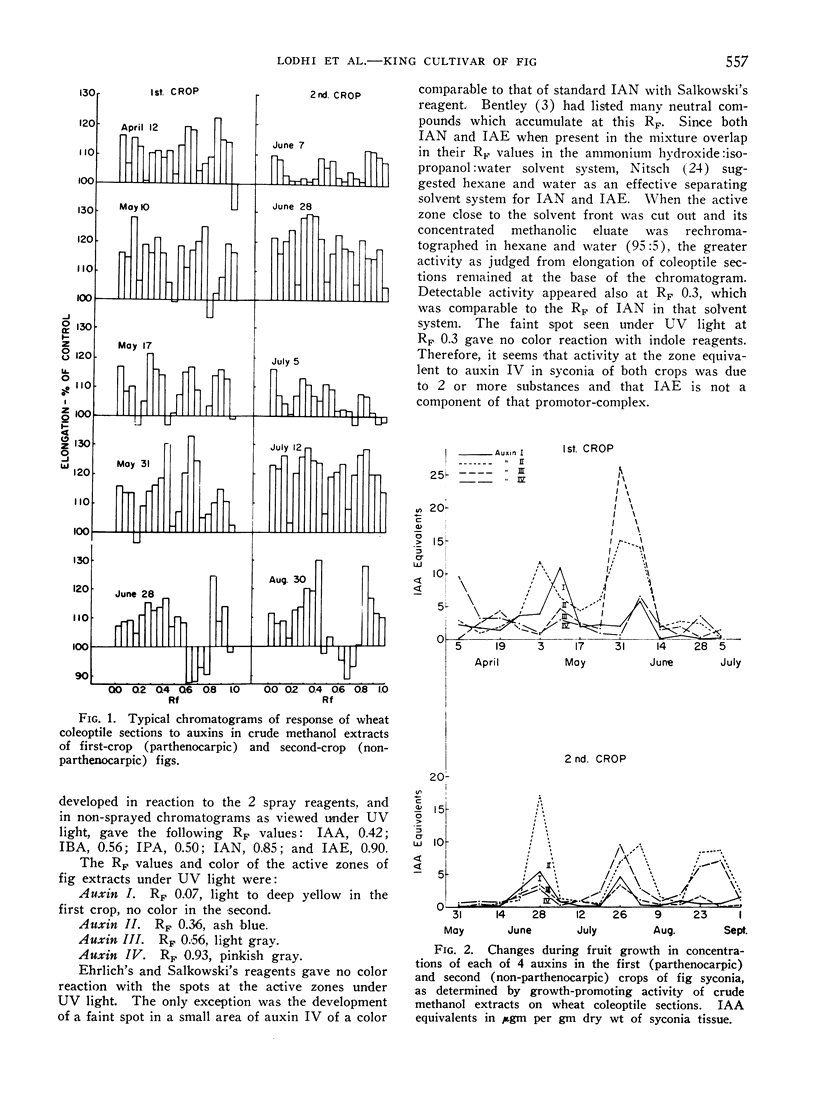
In the King cultivar of fig, the first crop is parthenocarpic, develops on previous year's growth, and a series of supernumerary ovules develops within the original ovules. The second crop, formed on current-season's growth, requires fertilization. To determine whether the 2 crops differed in types, and in patterns of concentrations of total `free' auxins and acidic gibberellins, they were extracted from weekly fruit samples. Timing of the 3 peaks of total auxins and the single peak of gibberellins was identical in the 2 crops. The first auxin peak in both occurred at the end of fruit growth period I (first rapid growth period), the second shortly before the end of period II (period of slow growth), and the rise and fall in concentrations of the third peak accompanied the rise and fall of the fruit growth rate in period III. The end of period II was marked by the single gibberellin peak. Additional peaks before the first sampling dates, of auxins in the first crop, of gibberellins in the second, were indicated by high concentrations in the first samples and subsequent rapid decline. The same 4 individual auxins appeared in both crops. Auxins I and II were highest in concentration in the first total auxin peak of both crops. In the second peak of the first crop, auxins II and III were highest, whereas in that peak of the second crop auxins II and IV were highest. Qualitative differences in gibberellins occurred in the 2 crops. In general, auxin concentrations were higher in the first than the second crop, and gibberellin concentrations higher in the second. High concentrations of gibberellins coincided with low ones of auxins, and vice versa.
Full text
PDF



Selected References
These references are in PubMed. This may not be the complete list of references from this article.
- BENNET-CLARK T. A., KEFFORD N. P. [Chromatography of the growth substances in plant extracts]. Nature. 1953 Apr 11;171(4354):645–647. doi: 10.1038/171645a0. [DOI] [PubMed] [Google Scholar]
- Hayashi F., Blumenthal-Goldschmidt S., Rappaport L. Acid & neutral gibberellin-like substances in potato tubers. Plant Physiol. 1962 Nov;37(6):774–780. doi: 10.1104/pp.37.6.774. [DOI] [PMC free article] [PubMed] [Google Scholar]
- Iwahori S., Weaver R. J., Pool R. M. Gibberellin-like Activity in Berries of Seeded and Seedless Tokay Grapes. Plant Physiol. 1968 Mar;43(3):333–337. doi: 10.1104/pp.43.3.333. [DOI] [PMC free article] [PubMed] [Google Scholar]
- Jackson D. I., Coombe B. G. Gibberellin-like Substances in the Developing Apricot Fruit. Science. 1966 Oct 14;154(3746):277–278. doi: 10.1126/science.154.3746.277. [DOI] [PubMed] [Google Scholar]
- Kende H., Lang A. Gibberellins and Light Inhibition of Stem Growth in Peas. Plant Physiol. 1964 May;39(3):435–440. doi: 10.1104/pp.39.3.435. [DOI] [PMC free article] [PubMed] [Google Scholar]
- Nitsch J. P. Free Auxins and Free Tryptophane in the Strawberry. Plant Physiol. 1955 Jan;30(1):33–39. doi: 10.1104/pp.30.1.33. [DOI] [PMC free article] [PubMed] [Google Scholar]
- Nitsch J. P., Nitsch C. Studies on the Growth of Coleoptile and First Internode Sections. A New, Sensitive, Straight-Growth Test for Auxins. Plant Physiol. 1956 Mar;31(2):94–111. doi: 10.1104/pp.31.2.94. [DOI] [PMC free article] [PubMed] [Google Scholar]