



Abstract
This study examined age, gender, and racial differences in parental and peer disapproval of alcohol use and in the relationship of these injunctive norms with drinking during adolescence. Participants included 20,239 students aged 11-19 years (average age 14.34; 47% males; 46% White and 54% Black) from two large urban and suburban school districts. Youth responded to a cross-sectional, school-administered Pride Survey in the spring of 2004. Adolescents reported how often they used alcohol in the past year and their perceptions of peer and parental disapproval of alcohol use. The results revealed that youth perceived higher disapproval from parents than peers throughout adolescence, but this parent-peer disparity in norms increased with age as a result of steeper decline in peer than parental disapproval. Black youth perceived lower disapproval from both peers and parents than Whites in earlier but not later adolescence. Females reported higher perceptions of both parental and peer disapproval than males throughout adolescence. Alcohol use was more strongly related to peer than parental norms, and the effect of parental and peer disapproval on abstinence was larger among older youth. Peer norms were more closely associated with alcohol use in females than males. Both parent and peer injunctive norms were also more strongly related to alcohol use in White than Black adolescents. Parental disapproval of drinking amplified the link between peer disapproval and lower alcohol use. These findings suggest that interventions should target both parental and peer disapproval throughout adolescence, particularly among White youth.
Keywords: injunctive norms, disapproval, alcohol use, gender differences, racial differences
The prevalence of alcohol use rises steadily throughout adolescence. For instance, 29% of 8th grade students report any alcohol use, compared with 65% of 12th grade students (Johnston, O’Malley, Bachman, & Schulenberg, 2011). A large literature documents the importance of social influences on adolescent alcohol use, primarily focusing on proximal social contexts of the family and peers (Chartier, Hesselbrock, & Hesselbrock, 2010; Petraitis, Flay, & Miller, 1995). Within these environments, alcohol-specific norms and expectations have been consistently linked with adolescents’ alcohol use (Ary, Tildesley, Hops, & Andrews, 1993; Hawkins, Catalano, & Miller, 1992). In particular, perceived disapproval of alcohol use by parents and peers (i.e., injunctive norms) is a well-established protective factor against adolescent drinking (Donovan, 2004; Li, Duncan, & Hops, 2001; Nash, McQueen, & Bray, 2005).
However, little is known about age-related changes in perceptions of parental and peer disapproval and their effects on adolescent alcohol use. Additionally, interactive effects of parental and peer disapproval, as well as gender and racial differences in their respective effects have been suggested in the literature (Cail & LaBrie, 2010; Catalano et al., 1992; Kelly et al., 2011), but not systematically studied. Better understanding of normative developmental trends and racial and gender differences in injunctive norms and their role in alcohol use would provide critical information for prevention and intervention. For instance, if injunctive norms are strongly related to alcohol use for one subgroup of youth (e.g., young adolescent females), but only weakly related within another group (e.g., Black males), interventions for these subgroups of youth may need to be tailored by including vs. excluding injunctive norms as an intervention target. Thus, this study focuses on age-related changes in perceived parental and peer disapproval of alcohol use, their additive and interactive relationships with adolescent alcohol use, and age, gender and racial differences in these relationships.
Perceptions of Disapproval and their Relationships with Alcohol Use across Adolescence
As alcohol use becomes more normative during adolescence (Johnston et al., 2011), it is likely that peer disapproval decreases. Perceived parental disapproval may also decrease as adolescents are viewed as more mature and are provided more freedoms by parents. Although no studies have addressed developmental changes in perceptions of peer disapproval of alcohol use, adolescents’ own disapproval of alcohol use decreases with age. For instance in Monitoring the Future study, 54% of 8th grade students disapproved of any drinking, compared to 31% of 12th graders (Johnston et al., 2011). Similarly, perceived alcohol use among peers (descriptive norms) rises steadily throughout adolescence (Duan, Chou, Andreeva, & Pentz, 2009). Regarding parental norms, one investigation indicated a decrease in parental disapproval of general substance use (combination of alcohol, cigarettes, and marijuana) between ages 14 and 19 (Martino, Ellickson, & McCaffrey, 2009). Thus, age-related trends in parental and peer disapproval of alcohol use are likely present, but have not been directly examined.
Additionally, the relationship between social disapproval and alcohol use may change with age. With increased individuation from parents in early adolescence, parental influences may decrease while peer influences may increase. In later adolescence, peer influences may diminish due to increased maturity and resistance to peer influences. Indeed, in some studies parental disapproval had a stronger effect on alcohol use in earlier vs. later adolescence (Biddle, Bank, & Marlin, 1980a; Reifman, Barnes, Dintcheff, Farrell, & Uhteg, 1998) and the influence of peer norms increased from early to middle adolescence (Biddle et al., 1980a). However, others have reported no age differences in the effects of peer disapproval of heavy drinking on individual students’ alcohol use between early, middle, and late adolescence (Kumar, O’Malley, Johnston, Schulenberg, & Bachman, 2002), or they found stronger social influences on substance use among late vs. middle adolescents (Mennis & Mason, 2012; Urberg, Cheng, & Shyu, 1991). Discerning a consistent pattern of results among these studies is difficult due to a variety of methodological differences, such as inclusion of different age groups and varying definitions of alcohol or substance use. Additionally, no studies directly compared the effects of both parental and peer norms throughout adolescence.
Interaction of Parental and Peer Disapproval
Research also suggests that parental and peer injunctive norms may interact with each other in predicting adolescent behaviors. In one investigation of middle adolescents, peer disapproval was more strongly related to less heavy drinking in more permissive households (Tucker, Ellickson, & Klein, 2008). Similarly, peer influences on 18-year olds’ drinking were weaker if parents were more involved in the adolescents’ lives (Wood, Read, Mitchell, & Brand, 2004). These alcohol-specific studies are consistent with a broader literature documenting the protective role of parenting for youth exposed to negative peer influences on problem behavior (e.g., Galambos, Barker, & Almeida, 2003; Lansford, Criss, Pettit, Dodge, & Bates, 2003; Mrug & Windle, 2009). However, a recent study showed that greater disparity between parental and peer injunctive norms is associated with higher alcohol use among college students (Cail & LaBrie, 2010), suggesting that parental disapproval may amplify, instead of attenuate, the negative effects of peer drinking norms. However, this pattern of results may not extend to earlier adolescence when youth still reside with parents and may be more influenced by them. These discrepant findings between adolescent and college-age studies also suggest that the protective effect of parental norms may diminish and possibly reverse over time, but this possibility has not been directly tested.
Gender and Racial Differences
Gender and racial differences in adolescent alcohol use are well documented: males drink more often and heavily than females in middle and late adolescence, and Blacks use alcohol less than Whites through adolescence (Johnston et al., 2011). Limited literature also suggests the presence of gender and racial differences in injunctive norms and their effects on alcohol use. Specifically, males perceive greater peer approval of alcohol use than females in early and late adolescence (Chawla, Neighbors, Logan, Lewis, & Fossos, 2009; Griffin, Scheier, Botvin, & Diaz, 2000). Males also report greater parental approval of alcohol use than females in late adolescence (Wood et al., 2004), but not in early adolescence (for White and Black youth; Griffin et al., 2000). Thus, gender differences appear developmentally stable for peer injunctive norms, but for parental norms they may not develop before late adolescence. Racial differences have been less studied, but White early adolescents reported more liberal injunctive norms for parents, but not peers, than Black youth (Griffin et al., 2000). In general, perceptions of peer and parental disapproval appear to mirror age, gender and racial differences in alcohol use, with males and Whites reporting more liberal norms from peers and parents, particularly in later adolescence when gender and racial differences in alcohol use become more pronounced.
The effects of injunctive norms on adolescents’ drinking also appear to vary by gender and race. For instance, the protective effect of parental disapproval on early adolescents’ alcohol use was stronger in boys (Kelly et al., 2011), but peer disapproval was more influential for drinking of 12-18 year old females than males (Pope, Smith, Wayne, & Kelleher, 1994). By contrast, neither peer nor parental disapproval was differentially associated with alcohol use among early adolescent males and females (Elek, Miller-Day, & Hecht, 2006). Among college students, the discrepancy between parental and peer injunctive norms was more strongly related to alcohol use among males than females (Cail & LaBrie, 2010), suggesting that the interactive effect of parental and peer norms may also vary by gender. For racial differences, one study reported stronger effects of parental disapproval for White than Black early adolescents’ substance use (Catalano et al., 1992). However, in a national study of 16-20 year-old youth, few differences emerged between White and Black adolescents in both parental disapproval and its relationship to adolescent drinking (Foley, Altman, Durant, & Wolfson, 2004). Thus, the literature on gender and racial differences provides inconsistent results, perhaps because gender and race have been analyzed in isolation from each other and studies included different age groups and varying definitions of alcohol use. For instance, studies with mostly White samples indicate greater susceptibility to social norms among males than females for alcohol use (Cail & LaBrie, 2010; Kelly et al., 2011) and general problem behaviors (e.g., Erickson, Crosnoe, & Dornbusch, 2000), but females appear more susceptible in mostly minority samples (Pope et al., 1994). Additionally, some risk factors (e.g., age) predict some aspects of alcohol use (e.g., any drinking), but not others (e.g., drinking quantity; Foley et al., 2004). To address these confounds, this study will examine the interactions of race, gender, and age, and include two key aspects of alcohol use: any alcohol use and frequency of use last year.
Present Study
Injunctive norms represent a potentially important intervention target, yet our understanding of how they relate to alcohol use in distinct subgroups of youth is limited. Existing literature presents an incomplete and sometimes conflicting picture of developmental, racial, and gender differences in parental and peer injunctive norms and their effects on adolescent alcohol use. Because some of the inconsistencies may be explained by a failure to consider the complex interplay of multiple demographic factors and different aspects of alcohol use, the present study provides a systematic examination of interactions between age, race, and gender in parental and peer disapproval and its relationship to alcohol use, considering both any use and frequency of use. Large, racially diverse sample provides adequate power for such complex analyses. Based on existing literature reviewed above, we expected that 1) peer and parental disapproval of alcohol use will decrease with increasing age; 2) the relationship between peer disapproval and adolescents’ alcohol use will increase at older ages, while the relationship between parental disapproval and adolescents’ alcohol use will decrease; 3) the effect of peer norms will be attenuated among adolescents reporting high levels of parental disapproval, particularly in early adolescence; 4) gender and racial differences in levels of parental and peer injunctive norms will reflect gender and racial differences in alcohol use; and 5) the relationship between parental and peer disapproval and alcohol use will vary by race and gender; it is possible that these relationships will be stronger among White males and Black females. We also expected differences between predictors of any alcohol use vs. frequency of use, with any use being more strongly predicted by social disapproval and demographics than frequency of use.
Methods
Participants and Procedures
This study utilized data collected with the PRIDE Survey in a single metropolitan area in the Southeastern U.S. The PRIDE Survey is a school-based assessment adopted by many school districts to monitor students’ substance use and violence. The present data were collected in the spring of 2004 from students attending 6th through 12th grade in two large school districts covering urban and suburban areas in the Southeastern U.S. Across the two school districts, 53% of students were eligible for free or reduced lunch. Paper surveys were administered to students in their classrooms by teachers or school counselors who explained the purpose of the survey, voluntary nature of participation, and confidentiality of answers. The surveys were anonymous and did not collect any identifying information. Participating students completed the survey privately at their desks and were able to ask questions if they needed help. The surveys were administered by the school districts to satisfy a federal Title IV requirement to measure students’ substance use, and as such were not subject to federal research regulations. Secondary analyses of the data set were approved by the Institutional Review Board at the University of Alabama at Birmingham.
A total of 25,276 students responded to the survey (approximately 80% participation rate). The racial composition of the sample was 41% White, 48% Black, 1% Hispanic, 2% Mixed, and 3% Other, with 5% missing. Because this study focused on racial differences and only White and Black students were present in sufficient numbers to be analyzed as separate racial groups, students of other races/ethnicities were excluded. Additionally, 1,152 students (5%) were excluded from analyses because they provided invalid or highly inconsistent answers, and another 1,272 (6%) were excluded because they did not provide information on gender, which as a categorical variable could not be imputed. Those excluded were more likely to be urban (12% vs. 10%), Black (12% vs. 9%), male (6% vs. 4%), older (15.0 vs. 14.4) and reporting lower levels of parental education (2.8 vs. 2.9), lower perceptions of peer and parent disapproval of alcohol use (2.9 vs. 3.2, and 2.1 vs. 2.4, respectively, and higher levels of alcohol use (2.3 vs. 1.2; all p<.001). Thus, the final sample included 20,239 students aged 11-19 years (average age 14.34, SD=1.95). The sample was comprised of 47% males and 53% females; 46% self-identified as White and 54% as Black.
Measures
Alcohol use
Students responded to three questions assessing their frequency of drinking beer, wine coolers, and liquor in the past year. Specifically, they were asked: “Within the past year, how often have you:” “Drunk beer?” “Drunk wine coolers?” “Drunk liquor?” with an 8-point response scale ranging from 0 - “Did Not Use” to 7 - “Every Day”. The three questions had adequate internal reliability (α=.85). The most highly endorsed alcohol item was used in analyses.
Parent and peer disapproval of alcohol use
Perceptions of parent and peer disapproval of alcohol use were each assessed with a single question: “Would your parents/ friends disapprove of you using alcohol?” Students answered each question using a 4-point scale ranging from 1 - “Don’t disapprove” to 2 - “Don’t know”, 3- “Disapprove”, and 4 - “Strongly disapprove”. The inclusion of “Don’t know” between “Don’t disapprove” and “Disapprove” is consistent with previous research (e.g., Gritz et al., 2003) and supported by approximately linear relationships of so coded disapproval levels with alcohol use. Both items showed adequate validity and reliability in the development of the Pride Survey questionnaire (Metze, 2000).
Demographic variables
Parental education was computed as the average of mother and father education reported by students on a 4-point scale (1 – “Some high school” to 4 – “College graduate”). Urbanicity was coded 1 for urban and 0 for suburban schools. Students also reported their grade, age, sex, and race. Grade and age were highly correlated (r = .94, p<.001), but grade information was more complete. Thus, grade was used in all analyses as a proxy for age.
Data Analysis
Missing data on continuous variables (parental education, parental and peer disapproval, alcohol use; 9% of observations) were handled with Multiple Imputation, a procedure that explicitly incorporates the uncertainty of missing data and yields more valid estimates than other methods (Enders, 2010). Specifically, five different imputed data sets were created with PROC MI in SAS 9.3 and analyzed separately, with the results combined across the five data sets to generate valid statistical inferences. Prior to main analyses, univariate distributions and bivariate associations among variables were examined. The first set of main analyses modeled parent and peer disapproval as a function of grade, race, and gender. Because peer and parent disapproval of alcohol use were approximately normally distributed, linear regressions were used. Predictors included grade and grade-squared to test whether parent and peer disapproval varied with age in a linear and/or quadratic fashion. Gender and racial differences in perceived disapproval were tested with main effects of gender and race and their interaction. The possibility that gender and racial differences further vary by age was examined with interactions of grade with gender, race, and their combination (gender by race). Parental education and urban residence were included as covariates.
The second part of the main analyses examined perceived parental and peer disapproval as predictors of alcohol use. Modeling two aspects of alcohol use, any alcohol use and frequency of use, was accomplished by utilizing zero-inflated negative binomial (ZINB) regression. Although the negative binomial model is typically used to model count data, it can be utilized for any ordinal outcome that follows the negative binomial distribution (e.g., Haynie & Piquero, 2006). The zero-inflated part of the model can be added to more accurately predict outcomes with excess zeroes. In this study, the ZINB model best fitted the overdispersed distribution of alcohol use with a large percentage of 0 (no alcohol use), as compared to the negative binomial, Poisson, and zero-inflated Poisson distributions (Vuong Z = 13.15 to 65.75, all p<.001; Vuong, 1989). The ZINB model is based on the assumption that zero scores can result from two different processes: one is a part of the general negative binomial distribution that includes all possible scores, while the other process can only generate zeros. For example, the general binomial distribution may fit the frequency of alcohol use among youth who had opportunities to drink alcohol (some of whom chose not to use, generating a zero score), while the additional zeros may occur for adolescents who did not have any opportunities to use alcohol and thus could not have a higher score than zero. Thus, ZINB regression simultaneously models the frequency of alcohol use (which includes a certain probability of zero scores) as well as abstinence (extra zeros). Using the negative binomial distribution, frequency of alcohol use is modeled as the probability of each response category (for more details, see Cheung, 2002). The ZINB regression procedure was conducted using PROC GENMOD in SAS in a hierarchical fashion with three steps. The predictors at the first step included grade, gender, race, and their 2-way interactions, as well as parental education and urbanicity. At the second step, parental disapproval, peer disapproval, and their interactions with grade, race, gender, and race by gender were entered. The third step added the 2-way interaction of peer and parental disapproval, 3-way interactions between parental and peer disapproval and each demographic variable (grade, race, gender), and a 4-way interaction of parent and peer disapproval, race, and gender. Dichotomous predictors were effect-coded (-.5 and .5) and continuous predictors were centered to a zero mean prior to computing interactions terms to prevent multicollinearity among predictors (Aiken & West, 1991). Because of the large sample size, alpha level was set at .001 instead of the conventional value of .05 to avoid interpreting effects too small to be meaningful.
Results
Descriptive statistics of all variables are listed in Table 1 together with interpretations of mean levels. Additional analyses compared key demographics by grade levels, blocked into three levels of middle school (grades 6-8), lower high school (grades 9-10), and upper high school (grades 11-12). Within the whole sample, 55% were in middle school, 27% were in lower high school, and 19% were in upper high school. The distribution of gender and race also varied somewhat with grade level, with males and Blacks being less represented in higher grades. Specifically, the proportion of males declined from 48% to 45% and 43% [χ2(2)=38.1, p<.001] and the proportion of Blacks decreased from 56% to 52% and 49% across the three grade levels [χ2(2)=72.8, p<.001]. These trends may reflect a combination of selective drop out, nonparticipation, and deletion due to invalid or missing data being more likely among older students, males, and Blacks.
Table 1.
Descriptive Statistics (N=20,239)
| Mean (SD) | |
|---|---|
| Age | 14.33 (1.95) |
| Parental education | 2.83a (0.92) |
| Parent disapproval | 3.19b (1.12) |
| Peer disapproval | 2.37c (1.21) |
| Alcohol use among users | 2.86d (1.87) |
|
| |
| N (%) | |
| Urban | 9,359 (39.10%) |
| Female | 11,524 (53.25%) |
| Black | 11,583 (53.85%) |
| No alcohol use last year | 12,842 (57.15%) |
Note:
Mean is between ‘high school graduate’ and ‘some college’
Mean is between ‘disapprove’ and ‘strongly disapprove’
Mean is between ‘don’t know’ and ‘disapprove’
Mean is between ‘6 times a year’ and ‘once a month’
Notably, over 57% of students reported no alcohol use in the last year, supporting the use of the zero inflated binomial regression model to model this variable. As expected, the proportion of students reporting some alcohol use generally increased with each grade, as did the reported frequency of alcohol use among users (see Figure 1). Racial differences in these age trends emerged, with Black students being more likely to use alcohol (χ2(1) = 104.6, p<.001) and use it more frequently (t = 3.7, p<.001) than Whites in middle school, but Whites being more likely to use alcohol in the last two years of high school (χ2(1) = 20.1, p<.001). Because these racial differences reversed between early and late adolescence, no overall racial difference in alcohol use emerged when analyzing students across grades (see Table 2). Bivariate associations revealed that parental and peer disapproval were moderately correlated (r = .46; p<.001), but students reported higher parental than peer disapproval (paired samples t = 94.48, p<.001). Additional bivariate associations are reported in Table 2 as correlations among continuous variables and mean levels for dichotomous demographics (gender, race, and urbanicity).
Figure 1.

Percentage of alcohol users and average frequency of use among users by grade and race. Frequency of use categories are: 1 – once a year; 2 – 6 times a year; 3 – once a month; 4 – twice a month; 5 – once a week; 6 – three times a week; 7 – every day.
Table 2.
Correlations among Continuous Variables and Mean Differences on Dichotomous Demographics (N=20,239)
| Parental education | Parent disapproval | Peer disapproval | Alcohol use | Female v. Male (t-value) | White v. Black (t-value) | Urban v. Suburban (t-value) | |
|---|---|---|---|---|---|---|---|
| Grade | -.06* | -.02 | -.19* | .27* | 8.50 v. 8.33* (6.81) | 8.60 v. 8.33* (10.29) | 3.22 v. 3.58* (-14.10) |
| Parental education | .05* | .07* | -.09* | 2.79 v. 2.90* (-8.71) | 2.74 v. 2.94* (-15.47) | 2.85 v. 2.82 (2.59) | |
| Parent disapproval | .46* | -.19* | 3.25 v. 3.14* (6.94) | 3.41 v. 3.02* (24.28) | 2.95 v. 3.33* (-23.51) | ||
| Peer disapproval | -.35* | 2.45 v. 2.29* (8.76) | 2.52 v. 2.24* (15.47) | 2.24 v. 2.45* (-11.93) | |||
| Alcohol use | -- | 1.21 v. 1.21 (-.29) | 1.25 v. 1.18 (-2.99) | 1.28 v. 1.19* (3.78) |
p<.001
Table 3 provides results of the linear regressions modeling peer and parental disapproval. Higher parental education was associated with greater parental and peer disapproval. Urbanicity predicted lower parental disapproval, but was not a unique predictor of peer disapproval. Perceptions of parental disapproval were stable throughout most of adolescence and declined somewhat only in late adolescence (a significant quadratic trend). By contrast, perceptions of peer disapproval declined linearly with grade level, with the decline slowing down in late adolescence. Several racial and gender differences emerged. Black students reported lower perceptions of both peer and parental disapproval in early and middle adolescence, but these racial differences disappeared by late adolescence (grades 10-12; see Figure 2). Females reported greater parental and peer disapproval than males across race and grade.
Table 3.
Linear Regressions Predicting Parent and Peer Disapproval of Alcohol Use (N=20,239)
| Parent disapproval | Peer disapproval | |||
|---|---|---|---|---|
|
| ||||
| B (SE) | p | B (SE) | p | |
| Intercept | 3.08 (.04) | <.001 | 2.04 (.04) | <.001 |
| Parental education | .08 (.01) | <.001 | .10 (.01) | <.001 |
| Urban | -.16 (.02) | <.001 | -.04 (.03) | .146 |
| Grade | .00 (.00) | .760 | -.12 (.01) | <.001 |
| Grade-squared | -.01 (.00) | <.001 | .02 (.00) | <.001 |
| Black | -.25 (.02) | <.001 | -.27 (.03) | <.001 |
| Female | .12 (.02) | <.001 | .17 (.02) | <.001 |
| Black × Female | .04 (.03) | .197 | -.04 (.03) | .269 |
| Grade × Black | .06 (.01) | <.001 | .13 (.01) | <.001 |
| Grade × Female | .01 (.01) | .534 | -.02 (.01) | .123 |
| Grade × Black × Female | .00 (.02) | .947 | .04 (.02) | .045 |
Note: Significant results (p<.001) are in bold.
Figure 2.
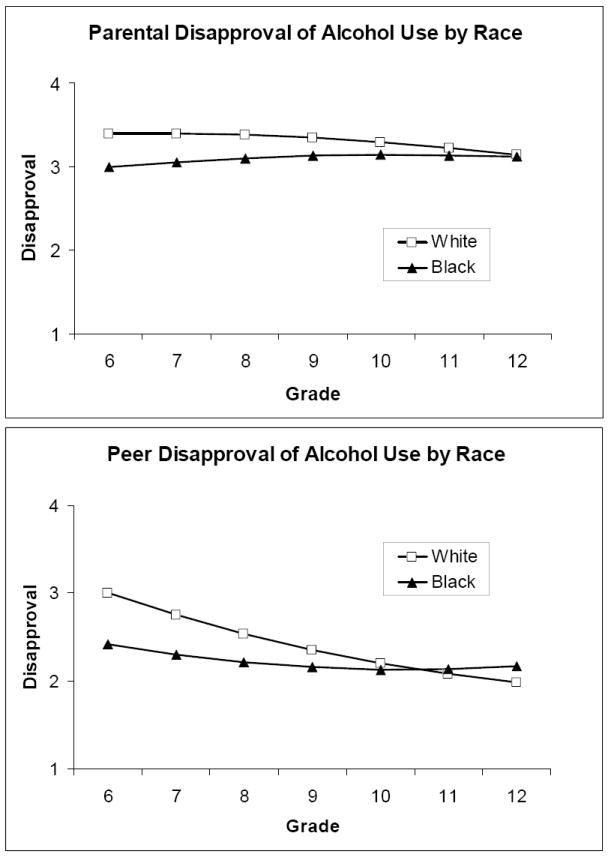
Racial differences in predicted parental and peer disapproval across adolescence.
Results of the zero-inflated negative binomial logistic regression predicting alcohol use are presented in Table 4. Some of the independent variables predicted abstinence and frequency of alcohol use in a similar fashion, while others had opposite effects or were specific to only one of these outcomes. At Step 1, higher parental education was associated with greater likelihood of abstinence (odds increased by 23% with each level of education) and lower frequency of alcohol use. Similarly, older adolescents were less likely to be abstinent (odds decreased by 30% with each grade) and use alcohol more frequently. Urban residence and male gender were associated with greater likelihood of abstinence, but among drinkers they predicted higher frequency of use. Black youth were more likely to drink than their White peers, but the grade-related increases in any use were smaller among Blacks (consistent with racial differences in Figure 1). Finally, the grade-related increase in frequency of alcohol use was higher in males than females.
Table 4.
Zero Inflated Negative Binomial Regression Predicting Frequency of Alcohol Use (N=20,239)
| Abstinence (Excess zeroes) | Frequency of alcohol use | |||||
|---|---|---|---|---|---|---|
| B (SE) | p | OR | B (SE) | p | OR | |
| Step 1 | ||||||
| Intercept | -.88 (.09) | <.001 | .82 (.04) | <.001 | ||
| Parental education | .21 (.03) | <.001 | 1.23 | -.05 (.01) | <.001 | .95 |
| Urban | .11 (.06) | .087 | 1.12 | .16 (.03) | <.001 | 1.17 |
| Grade | -.35 (.02) | <.001 | .70 | .07 (.01) | <.001 | 1.07 |
| Black | -.28 (.07) | <.001 | .76 | .00 (.03) | .935 | 1.00 |
| Female | -.31 (.05) | <.001 | .73 | -.13 (.02) | <.001 | .87 |
| Black × Female | -.06 (.09) | .483 | .94 | .02 (.05) | .612 | 1.02 |
| Grade × Black | .19 (.03) | <.001 | 1.21 | -.02 (.01) | .041 | .97 |
| Grade × Female | -.08 (.03) | .006 | .92 | -.07 (.01) | <.001 | .94 |
| Grade × Black × Female | .07 (.06) | .231 | 1.07 | -.02 (.02) | .410 | .98 |
| Step 2 | ||||||
| Peer disapproval | .59 (.02) | <.001 | 1.80 | -.21 (.01) | <.001 | .81 |
| Parent disapproval | .11 (.03) | <.001 | 1.12 | -.09 (.01) | <.001 | .91 |
| Peer dis. × Grade | .07 (.01) | <.001 | 1.07 | .02 (.01) | .003 | 1.02 |
| Parent dis. × Grade | .07 (.02) | <.001 | 1.08 | .00 (.01) | .828 | 1.00 |
| Peer dis. × Black | -.31 (.05) | <.001 | .74 | .13 (.02) | <.001 | 1.13 |
| Parent dis. × Black | -.34 (.06) | <.001 | .71 | .01 (.02) | .552 | 1.01 |
| Peer dis. × Female | .18 (.05) | <.001 | 1.19 | -.08 (.02) | <.001 | .92 |
| Parent dis. × Female | -.02 (.06) | .715 | .98 | -.02 (.02) | .232 | .98 |
| Peer dis. × Black × Female | -.18 (.10) | .059 | .83 | .08 (.04) | .084 | 1.08 |
| Parent dis. × Black × Female | -.10 (.12) | .373 | .90 | -.01 (.04) | .816 | .99 |
| Step 3 | ||||||
| Peer dis. × Parent dis. | .24 (.03) | <.001 | 1.27 | -.05 (.01) | <.001 | .95 |
| Peer dis. × Parent dis. × Grade | -.01 (.01) | .671 | .99 | .01 (.01) | .044 | 1.01 |
| Peer dis. × Parent dis. × Black | -.10 (.05) | .044 | .91 | .01 (.02) | .657 | 1.01 |
| Peer dis. × Parent dis. × Female | .04 (.06) | .514 | 1.04 | -.02 (.02) | .289 | .98 |
| Peer dis. × Parent dis. × Black × Female | -.07 (.09) | .474 | .94 | -.01 (.04) | .744 | .99 |
Note: dis. – disapproval; significant results (p<.001) are in bold.
At step 2, higher levels of both peer and parent disapproval were associated with greater likelihood of abstinence and lower frequency of alcohol use. For instance, one unit increase in perceived disapproval (e.g., from don’t know to disapproval, or from disapproval to strong disapproval) was associated with 80% greater likelihood of abstinence for peer disapproval and 12% greater likelihood of abstinence for parental disapproval. The effects of peer norms were much stronger compared to parent norms, particularly for abstinence. Peer disapproval was more strongly related to both abstinence and frequency of drinking among White students and females, and less strongly related among Black students and males. Parental disapproval was also more strongly related to abstinence (but not frequency of use) for White than Black students, but there were no gender differences in the effect of parental disapproval on alcohol use. Finally, the relationships between peer and parent disapproval and abstinence were stronger among older students, but grade did not moderate the association between perceived disapproval and frequency of alcohol use. At Step 3, the interaction between peer disapproval and parent disapproval reached significance for both abstinence and frequency of alcohol use, but it was not further moderated by grade, race, gender, or race by gender. As depicted in Figure 3, the combination of strong disapproval from both parents and peers was associated with the greatest likelihood of abstinence and lowest likelihood of more frequent alcohol use. In fact, parental disapproval appeared to amplify the protective effect of peer disapproval on both abstinence and lower frequency of alcohol use.
Figure 3.

Interaction of parent and peer disapproval in predicting abstinence and frequency of alcohol use. The combination of strong parent disapproval and strong peer disapproval is associated with the highest estimated probability of abstinence and the lowest estimated probability of more frequent alcohol use.
Note: The probability of more frequent alcohol use refers to the probability of reporting the next higher category of use (e.g., 6 times a year to once a month).
Discussion
The results of this study indicated that parental and peer injunctive norms and their relationship to alcohol use vary as a function of adolescents’ age, race, and gender. Specifically, youth perceived higher disapproval of alcohol use from parents than peers, and this parent-peer discrepancy increased with age as a result of decline in peer norms but little change in parent norms. Females reported greater perceived disapproval from both parents and peers than males. White youth reported greater parent and peer disapproval than Black adolescents, with racial differences diminishing with age. Parental disapproval was related to alcohol use less strongly than peer disapproval, but it amplified the beneficial effect of peer norms on use. Social disapproval was more closely related to alcohol use among females, Whites, and older youth.
Age Trends in Parental and Peer Disapproval and their Relationships to Alcohol Use
The age-related decline in perceived peer disapproval of alcohol use parallel developmental trends of increasing prevalence of drinking and greater acceptability of alcohol use among older adolescents (Johnston et al., 2011). As more adolescents regard drinking as acceptable and initiate alcohol use with increasing age, perceptions of peer attitudes toward alcohol use also become more favorable. The contrastingly high levels of parental disapproval across adolescence with only slight declines in late adolescence are consistent with previous research on parental disapproval of general substance use (Martino et al., 2009). However, the moderate positive correlation between peer and parental disapproval (r = .46) likely reflects affiliation with peers who hold attitudes and behaviors similar to those of the adolescents’ parents, and it is consistent with extensive literature on direct and indirect influence of parents on adolescents’ friend selection (Brown, Mounts, Lamborn, & Steinberg, 1993; Mounts, 2000; Tilton-Weaver & Galambos, 2003).
Despite their interrelatedness, both types of injunctive norms were uniquely associated with alcohol use, in congruence with a larger literature on parental and peer influences on adolescent substance use (Allen, Donohue, Griffin, Ryan, & Turner, 2003; Chassin, Presson, Sherman, Montello, & McGrew, 1986; Nash et al., 2005). However, peer disapproval was related to alcohol use more strongly than parental disapproval, particularly for abstinence, extending similar results from studies addressing other parent and peer predictors of adolescent alcohol use (e.g., Kelly et al., 2011; Nash et al., 2005; Scholte, Poelen, Willemsen, Boomsma, & Engels, 2008). Although contrary results have also been reported (e.g., Biddle, Bank, & Merlin, 1980b), a meta-analysis of parental and peer influences on alcohol use confirmed overall stronger effects of peers than parents (Allen et al., 2003).
Interestingly, both parent and peer injunctive norms were related to alcohol abstinence more closely among older adolescents, although there were no age differences in the norms’ relationships to frequency of alcohol use. It is possible that as more adolescents initiate alcohol use with age, anti-drinking norms increase in importance in one’s resolve to remain abstinent. However, once youth start drinking, injunctive norms may play a similar role in curbing the frequency of use across adolescence. Notably, the increasing role of social influences on alcohol use with age has been reported for other types of risk and protective factors in the domains of both parents (Allen et al., 2003) and peers (Cleveland, Feinberg, Bontempo, & Greenberg, 2008).
The interactive effect of parental and peer disapproval indicated that parental norms amplified the effects of peer norms on alcohol use (Figure 3). This interaction pattern parallels results from a study of parent-peer disparities in injunctive norms among college students (Cail & LaBrie, 2010), but contrasts with a pattern of weaker peer influences under stronger parental anti-drinking norms and behaviors reported in other adolescent studies (Jones, Hussong, Manning, & Sterrett, 2008; Tucker et al., 2008; Wood et al., 2004). One possible explanation of these discrepancies is the valence of peer influences measured in each study. Specifically, the pattern of results across studies suggests that parental anti-drinking attitudes and behaviors may both weaken negative peer influences and strengthen positive peer influences on adolescent alcohol use. Importantly, the interactive effect in this study was stable across age, race, and gender, suggesting that all adolescents would benefit from strong injunctive norms against alcohol use expressed jointly by parents and peers. However, it is possible that gender differences in the combined role of parental and peer norms appear post-high school, as suggested by Cail and LaBrie’s (2010) findings of greater importance of parent-peer norm discrepancies for male than female college students.
Gender and Racial Differences
Females in this study expressed higher perceptions of both parental and peer disapproval of alcohol use than males, replicating similar findings from other samples of younger and older youth (Chawla et al., 2009; Griffin et al., 2000; Wood et al., 2004). The present results extend existing literature by documenting the stability of these differences across adolescence and sources of social influence. These gender differences in injunctive norms may stem from males’ more frequent use in this study (see Table 4), heavier alcohol use (Johnston et al., 2011), and lower parental monitoring (Laird, Criss, Pettit, Dodge, & Bates, 2008; Webb, Bray, Getz, & Adams, 2002). In addition to holding higher perceptions of others’ disapproval, females also appeared to derive more benefit from their perceptions of peer norms. Although causal inferences cannot be made from this cross-sectional study, the stronger effects of peer disapproval on females’ alcohol use suggest that peer disapproval may be more influential for females’ alcohol use. The same pattern of findings has been reported in another cross-sectional study (Pope et al., 1994), but replication with prospective designs is needed. In contrast to peer norms, parental disapproval was associated with alcohol use to a similar degree for males and females, consistent with other cross-sectional results using a younger sample (Elek et al., 2006). However, stronger parental effects for males’ alcohol use have been reported for parental drinking and monitoring (Schulte, Ramo, & Brown, 2009), and a prospective Australian study reported stronger effects of parent disapproval on alcohol use for early adolescent males than females (Kelly et al., 2011). A prospective examination of gender differences in the role of multiple parental influences for U.S. adolescents’ alcohol use should help disentangle these contradictory findings.
The patterns of racial differences obtained in this study suggest that Black early and middle adolescents perceive alcohol use as more normative and acceptable within their social settings than their White counterparts, and that parental and peer attitudes may play less of a role in their alcohol use. The perceptions of greater peer and parent permissiveness parallel the higher prevalence of alcohol use among Black than White middle school students in this sample, which contrasts with lower prevalence of drinking among Black than White students in the 8th grade in nationally representative studies (Johnston et al., 2011). These discrepancies may reflect the substantial confound of socioeconomic factors and race in the present study. The majority (70%) of the Black adolescents in our sample resided in highly racially segregated, poor urban neighborhoods where 61% of families were headed by single parents and 33% were below federal poverty level. By contrast, 99% of the White students resided in relatively more advantaged neighborhoods where only 29% of families included single parents and 10% lived in poverty. Thus, the higher rates of alcohol use reported by Black youth could be partly explained by lower family and neighborhood socioeconomic status, which is associated with higher prevalence of alcohol use and other health risk behaviors (Bolland et al., 2007). Although parental education and urbanicity were included as control variables in analyses, they do not fully account for all aspects of poverty, single parenthood, and community disadvantage that may explain the higher prevalence of drinking and lower perceptions of parental disapproval among young Black students. For instance, economic hardship is associated with greater parental emotional distress and substance use, family conflict, and poorer parenting practices (Conger & Donnellan, 2007), and single parent households are generally characterized by lower parenting quality and monitoring (McConley et al., 2011; Pettit, Bates, Dodge, & Meece, 1999), all risk factors for adolescent alcohol use (Hawkins et al., 1992). Lower parental monitoring and more prevalent alcohol use may foster more permissive peer norms for drinking, particularly at younger ages when drinking is not yet normative across all sociodemographic contexts.
The weaker association of parental and peer disapproval with alcohol use in Black students is consistent with a larger literature documenting lower susceptibility to social influences on alcohol use in Black vs. White adolescents (Catalano et al., 1992; Gibbons et al., 2010; Newcomb & Bentler, 1986; Williams, Ayers, Abbott, Hawkins, & Catalano, 1999). The reasons for these differences have not been elucidated, but they may be related to broader contextual factors (e.g., socioeconomic disadvantage) or socialization practices that foster healthy mistrust of others and tendency toward independence in Black families and communities (Simmons, Black, & Zhou, 1991; Terrell & Terrell, 1981).
Different Aspects of Alcohol Use
One unique contribution of this study was the analytical approach that allowed us to simultaneously predict any alcohol use and frequency of use. Although most risk factors related to any use and frequency of use in a similar fashion, some differences emerged, generally in the direction of any use being related to more predictors. However, two predictors showed contrasting relationships with any use and more frequent use, with males and urban youth being less likely to drink, but when they drank, it occurred more often. These findings likely reflect differential processes associated with distinct levels of alcohol use, such as access to alcohol, social norms, and motivations for alcohol use. For instance, females may have more opportunities to drink alcohol through their associations with older males (Poulin, Denault, & Pedersen, 2011), but gender-specific social norms inhibit more frequent and heavier alcohol use among females (Suls & Green, 2003). Likewise, poor urban adolescents may perceive alcohol use as more acceptable (as shown in this sample) and thus be more likely to drink, but they may lack the financial resources to engage in more frequent or heavier use (Blum et al., 2000). These findings highlight the importance of considering multiple aspects of alcohol use, since a composite measure of use may mask important subgroup differences (e.g., lack of gender differences in overall frequency of use in Table 2).
Implications, Limitations, and Future Directions
The present results confirm the importance of including injunctive norms as a component of comprehensive substance use prevention programs. Such interventions may focus directly on adolescents’ perceptions of peer and parent disapproval (e.g., Barnett, Far, Mauss, & Miller, 1996; Hecht et al., 2003) or indirectly on teaching youth and their parents to effectively communicate disapproval of alcohol and other substance use to their peers and children, respectively (e.g., Hawkins, Catalano, Kosterman, Abbott, & Hill, 1999). Because the combination of strong parent and peer disapproval was associated with the lowest likelihood of alcohol use and less frequent drinking, effectiveness of prevention programs may be maximized by targeting both peer and parental disapproval. Given the normative drop in perceived peer injunctive norms with age and increased importance of both peer and parent norms for abstinence among older youth, it may be essential to target injunctive norms (in both peer and parent contexts) throughout the adolescent period, rather than just in early to middle adolescence as typically done. Such interventions may be particularly important for males who perceive less disapproval of drinking from both parents and peers, although our results also suggest that peer norm interventions may be more effective in females. Given the weaker relationship between injunctive norms and alcohol use among Black youth, norm-focused interventions may be less effective for this ethnic group. Thus, interventions in predominantly Black urban communities may need to target other protective factors that are more closely related to these students’ substance use using culturally grounded interventions (Hecht et al., 2003).
Although this study utilized a large diverse sample with a high participation rate, several limitations need to be noted. The study utilized a cross-sectional design, so developmental differences may be confounded by cohort effects and selective attrition across ages. Additionally, it cannot be determined whether the associations between injunctive norms and alcohol use reflect the effect of norms on alcohol use, the effect of alcohol use on norms, and/or the effects of other variables on both. Because the sample was drawn from a single metropolitan area, the results may not generalize to other settings, particularly rural communities or more racially and socioeconomically integrated areas. The results may also not generalize to youth similar to those not included in the sample (e.g., those attending private schools, absent or unwilling to participate, or providing invalid, inconsistent, or missing answers). In particular, male, older, urban, and Black students were less represented in the final sample, likely due to their greater likelihood of dropping out of school, being absent, and providing unusable data. The relatively large proportion of cases with invalid and missing data is also a limitation. Future school-based assessments would benefit from using computer-assisted procedures that would require answers to each question (e.g., allowing “don’t know” and “refuse” options) and that would have built-in checks for data validity. The present analyses allowed us to model both abstinence and frequency of alcohol use, but the results may not apply to other aspects of drinking such as quantity of use or frequency of binge drinking. The alcohol questions also did not explicitly define alcohol use, e.g. in terms of a whole drink vs. sip or taste. Nevertheless, the annual prevalence rates in this study were similar to those reported by the 2005 Monitoring the Future survey (MTF; Johnston, O’Malley, Bachman, & Schulenberg, 2006), supporting the validity of the questions (e.g., 62% vs. 69% in grade 12; 57% vs. 57% in grade 10). Despite the correspondence in overall rates, our results did not replicate the lower prevalence of alcohol use reported by Black students in the national MTF sample. This discrepancy may be explained by the lower age of middle school students in this study, as higher alcohol use among Black youth has been reported in several statewide surveys of younger (6th grade) students (Donovan, 2007). Another explanation may be the lower SES of Black participants in this study, given that low SES is a risk factor for higher levels of adolescents’ alcohol use (Johnston et al., 2011) and our sample overrepresented poor inner city schools serving predominantly Black students. Although including parental education as a covariate in analyses partly accounted for the confounding effects of SES, the results may not generalize to more affluent populations of Black youth.
In summary, this cross-sectional study advances research on etiology of adolescent alcohol use by simultaneously considering age, racial, and gender differences in injunctive norms and their relationship to alcohol use. The diverging results obtained for different aspects of alcohol use (any vs. more frequent use) underscores the importance of including multiple levels of alcohol use in future investigations. Although replication of the present results with longitudinal designs will be essential, the results highlight the need to consider interactive effects of parental and peer influences on substance use in addition to their additive effects. The findings also demonstrate the importance of addressing developmental, gender, and racial differences in risk and protective factors for alcohol use. For intervention research, the results support the need for comprehensive programs targeting both peer and family settings throughout adolescence, with intervention components tailored to gender, racial, and contextual characteristics of youth.
Acknowledgments
This research was supported by a grant K01DA024700 from the National Institutes of Health to the first author. Additional support was provided by the UAB Office for the Advancement of Women in Science and Engineering sponsored by the National Science Foundation.
References
- Aiken LS, West SG. Multiple regression: Testing and interpreting interactions. London: Sage; 1991. [Google Scholar]
- Allen M, Donohue WA, Griffin A, Ryan D, Turner MM. Comparing the influence of parents and peers on the first choice to use drugs. Criminal Justice and Behavior. 2003;30:163–186. [Google Scholar]
- Ary DV, Tildesley E, Hops H, Andrews J. The influence of parent, sibling, and peer modeling and attitudes on adolescent use of alcohol. International Journal of the Addictions. 1993;28:835–880. doi: 10.3109/10826089309039661. [DOI] [PubMed] [Google Scholar]
- Barnett LA, Far JM, Mauss AL, Miller JA. Changing perceptions of peer norms as a drinking reduction program for college students. Journal of Alcohol and Drug Education. 1996;41:39–62. [Google Scholar]
- Biddle BJ, Bank BJ, Marlin MM. Social determinants of adolescent drinking: What they think, what they do, and what I think and do. Journal of Studies on Alcohol. 1980a;41:215–241. doi: 10.15288/jsa.1980.41.215. [DOI] [PubMed] [Google Scholar]
- Biddle BJ, Bank BJ, Marlin MM. Parental and peer influences on adolescents. Social Forces. 1980b;58:1057–1079. [Google Scholar]
- Blum RW, Beuhring T, Shew ML, Bearinger LH, Sieving RE, Resnick MD. The effects of race/ethnicity, income, and family structure on adolescent risk behaviors. American Journal of Public Health. 2000;90:1879–1884. doi: 10.2105/ajph.90.12.1879. [DOI] [PMC free article] [PubMed] [Google Scholar]
- Bolland JM, Bryant CM, Lian BE, McCallum DM, Vazsonyi AT, Barth JM. Development and risk behavior among African American, Caucasian, and mixed-race adolescents living in high poverty inner-city neighborhoods. American Journal of Community Psychology. 2007;40:230–249. doi: 10.1007/s10464-007-9132-1. [DOI] [PubMed] [Google Scholar]
- Brown BB, Mounts NS, Lamborn SD, Steinberg LD. Parenting practices and peer group affiliation in adolescence. Child Development. 1993;64:467–482. doi: 10.1111/j.1467-8624.1993.tb02922.x. [DOI] [PubMed] [Google Scholar]
- Cail J, LaBrie JW. Disparity between the perceived alcohol-related attitudes of parents and peers increases alcohol risk in college students. Addictive Behaviors. 2010;35:135–139. doi: 10.1016/j.addbeh.2009.09.019. [DOI] [PMC free article] [PubMed] [Google Scholar]
- Catalano RF, Morrison DM, Wells EA, Gillmore MR, Iritani B, Hawkins JD. Ethnic differences in family factors related to early drug initiation. Journal of Studies on Alcohol. 1992;53:208–217. doi: 10.15288/jsa.1992.53.208. [DOI] [PMC free article] [PubMed] [Google Scholar]
- Chartier KG, Hesselbrock MN, Hesselbrock VM. Development and vulnerability factors in adolescent alcohol use. Child & Adolescent Psychiatric Clinics of North America. 2010;19:493–504. doi: 10.1016/j.chc.2010.03.004. [DOI] [PMC free article] [PubMed] [Google Scholar]
- Chassin L, Presson CC, Sherman SJ, Montello D, McGrew J. Developmental Psychology. 1986;22:327–334. [Google Scholar]
- Chawla N, Neighbors C, Logan D, Lewis MA, Fossos N. Perceived approval of friends and parents as mediators of the relationship between self-determination and drinking. Journal of Studies on Alcohol and Drugs. 2009;70:92–100. doi: 10.15288/jsad.2009.70.92. [DOI] [PMC free article] [PubMed] [Google Scholar]
- Cheung YB. Zero-inflated models for regression analysis of count data: A study of growth and development. Statistics in Medicine. 2002;21:1461–9. doi: 10.1002/sim.1088. [DOI] [PubMed] [Google Scholar]
- Cleveland MJ, Feinberg ME, Bontempo DE, Greenberg MT. The role of risk and protective factors in substance use across adolescence. Journal of Adolescent Health. 2008;43:157–164. doi: 10.1016/j.jadohealth.2008.01.015. [DOI] [PMC free article] [PubMed] [Google Scholar]
- Conger RD, Donnellan MB. An interactionist perspective on the socioeconomic context of human development. Annual Review of Psychology. 2007;58:175–199. doi: 10.1146/annurev.psych.58.110405.085551. [DOI] [PubMed] [Google Scholar]
- Donovan JE. Adolescent alcohol initiation: a review of psychosocial risk factors. Journal of Adolescent Health. 2004;35:529.e7–529.e18. doi: 10.1016/j.jadohealth.2004.02.003. [DOI] [PubMed] [Google Scholar]
- Donovan JE. Really Underage Drinkers: The Epidemiology of Children’s Alcohol Use in the United States. Prevention Science. 2007;8:192–205. doi: 10.1007/s11121-007-0072-7. [DOI] [PMC free article] [PubMed] [Google Scholar]
- Duan L, Chou CP, Andreeva VA, Pentz MA. Trajectories of peer social influences as long-term predictors of drug use from early through late adolescence. Journal of Youth and Adolescence. 2009;38:454–65. doi: 10.1007/s10964-008-9310-y. [DOI] [PubMed] [Google Scholar]
- Elek E, Miller-Day M, Hecht ML. Influences of personal, injunctive, and descriptive norms on early adolescent substance use. Journal of Drug Issues. 2006;36:147–172. [Google Scholar]
- Enders CK. Applied missing data analysis. New York: Guilford Press; 2010. [Google Scholar]
- Erickson K, Crosnoe R, Dornbusch S. A social process model of adolescent deviance: Combining social control and differential association perspectives. Journal of Youth and Adolescence. 2000;29:395–425. [Google Scholar]
- Foley KL, Altman D, Durant RH, Wolfson M. Adults’ approval and adolescents’ alcohol use. Journal of Adolescent Health. 2004;35:345.e17–26. [PubMed] [Google Scholar]
- Galambos NL, Barker ET, Almeida DM. Parents do matter: Trajectories of change in externalizing and internalizing problems in early adolescence. Child Development. 2003;74:578–594. doi: 10.1111/1467-8624.7402017. [DOI] [PubMed] [Google Scholar]
- Gibbons FX, Pomery EA, Gerrard M, Sargent JD, Weng C, Wills TA, Kingsbury J, Dal Cin S, Worth KA, Stoolmiller M, Tanski SE, Yeh H. Media as social influence: Racial differences in the effects of peers and media on adolescent alcohol cognitions and consumption. Psychology of Addictive Behaviors. 2010;24:649–659. doi: 10.1037/a0020768. [DOI] [PMC free article] [PubMed] [Google Scholar]
- Griffin KW, Scheier LM, Botvin GJ, Diaz T. Ethnic and gender differences in psychosocial risk, protection, and adolescent alcohol use. Prevention Science. 2000;1:199–212. doi: 10.1023/a:1026599112279. [DOI] [PubMed] [Google Scholar]
- Gritz ER, Prokhorov AV, Hudmon KS, Jones MM, Rosenblum C, Chang CC, Chamberlain RM, Taylor WC, Johnston D, de Moor C. Predictors of susceptibility to smoking and ever smoking: A longitudinal study in a tri-ethnic sample of adolescents. Nicotine & Tobacco Research. 2003;5:493–506. doi: 10.1080/1462220031000118568. [DOI] [PubMed] [Google Scholar]
- Hawkins JD, Catalano RF, Kosterman R, Abbott R, Hill KG. Preventing adolescent health-risk behaviors by strengthening protection during childhood. Archives of Pediatrics and Adolescent Medicine. 1999;153:226–234. doi: 10.1001/archpedi.153.3.226. [DOI] [PubMed] [Google Scholar]
- Hawkins JD, Catalano RF, Miller JY. Risk and protective factors for alcohol and other drug problems in adolescence and early adulthood: Implications for substance abuse prevention. Psychological Bulletin. 1992;112:64–105. doi: 10.1037/0033-2909.112.1.64. [DOI] [PubMed] [Google Scholar]
- Haynie DL, Piquero AR. Pubertal Development and Physical Victimization in Adolescence. Journal of Research in Crime and Delinquency. 2006;43:3–35. [Google Scholar]
- Hecht ML, Marsiglia FF, Elek E, Wagstaff DA, Kulis S, Dustman P. Culturally grounded substance use prevention: An evaluation of the keepin’ it REAL curriculum. Prevention Science. 2003;4:233–248. doi: 10.1023/a:1026016131401. [DOI] [PubMed] [Google Scholar]
- Johnston LD, O’Malley PM, Bachman JG, Schulenberg JE. Monitoring the Future national survey results on drug use, 1975–2005: Secondary school students (NIH Publication No 06-5883) I. Bethesda, MD: National Institute on Drug Abuse; 2006. [Google Scholar]
- Johnston LD, O’Malley PM, Bachman JG, Schulenberg JE. Monitoring the Future national results on adolescent drug use: Overview of key findings, 2010. Ann Arbor: Institute for Social Research, The University of Michigan; 2011. [Google Scholar]
- Jones DJ, Hussong A, Manning J, Sterrett E. Adolescent alcohol use in context: The role of parents, peers, and race. Cultural Diversity and Ethnic Minority Psychology. 2008;14:266–273. doi: 10.1037/1099-9809.14.3.266. [DOI] [PMC free article] [PubMed] [Google Scholar]
- Kelly AB, O’Flaherty M, Toumbourou JW, Connon JP, Hemphill SA, Catalano RF. Gender differences in the impact of families on alcohol use: A lagged longitudinal study of early adolescents. Addiction. 2011;106:1427–1436. doi: 10.1111/j.1360-0443.2011.03435.x. [DOI] [PMC free article] [PubMed] [Google Scholar]
- Kumar R, O’Malley PM, Johnston LD, Schulenberg JE, Bachman JG. Effects of school-level norms on student substance use. Prevention Science. 2002;3:105–24. doi: 10.1023/a:1015431300471. [DOI] [PubMed] [Google Scholar]
- Laird RD, Criss MM, Pettit GS, Bates JE, Dodge KA. Parents’ monitoring knowledge attenuates the link between antisocial friends and adolescent delinquent behavior. Journal of Abnormal Child Psychology. 2008;36:299–310. doi: 10.1007/s10802-007-9178-4. [DOI] [PMC free article] [PubMed] [Google Scholar]
- Laird RD, Pettit GS, Bates JE, Dodge KA. Parents’ monitoring-relevant knowledge and adolescents’ delinquent behavior: Evidence of correlated developmental changes and reciprocal influences. Child Development. 2003;74:752–768. doi: 10.1111/1467-8624.00566. [DOI] [PMC free article] [PubMed] [Google Scholar]
- Lansford JE, Criss MM, Pettit GS, Dodge KA, Bates JE. Friendship quality, peer group affiliation, and peer antisocial behavior as moderators of the link between negative parenting and adolescent externalizing behavior. Journal of Research on Adolescence. 2003;13:161–184. doi: 10.1111/1532-7795.1302002. [DOI] [PMC free article] [PubMed] [Google Scholar]
- Li F, Duncan TE, Hops H. Examining developmental trajectories in adolescent alcohol use using piecewise growth mixture modeling analysis. Journal of Studies on Alcohol. 2001;62:199–210. doi: 10.15288/jsa.2001.62.199. [DOI] [PubMed] [Google Scholar]
- Martino SC, Ellickson PL, McCaffrey DF. Multiple trajectories of peer and parental influence and their association with the development of adolescent heavy drinking. Addictive Behaviors. 2009;34:693–700. doi: 10.1016/j.addbeh.2009.04.006. [DOI] [PMC free article] [PubMed] [Google Scholar]
- McConley RL, Mrug S, Gilliland MJ, Lowry R, Elliott MN, Schuster MA, et al. Mediators of maternal depression and family structure on child BMI: Parenting quality and risk factors for child overweight. Obesity. 2011;19:345–352. doi: 10.1038/oby.2010.177. [DOI] [PubMed] [Google Scholar]
- Mennis J, Mason MJ. Social and geographic contexts of adolescent substance use: The moderating effects of age and gender. Social Networks. 2012;34:150–157. [Google Scholar]
- Metze L. The Pride questionnaire for grades 6 – 12: Validity and reliability study. Bowling Green, KY: Pride Surveys; 2000. http://www.pridesurveys.com/supportfiles/tr99612.pdf. [Google Scholar]
- Mounts NS. Parental management of adolescent peer relationships: What are its effects on friend selection? In: Kerns K, Contreras J, Neal-Barnett A, editors. Family and peers: Linking two social worlds. Westport, CT: Praeger; 2000. pp. 169–193. [Google Scholar]
- Mrug S, Windle M. Moderators of negative peer influence on early adolescent externalizing behaviors: The roles of individual behavior, parenting, and school connectedness. Journal of Early Adolescence. 2009;29:518–540. [Google Scholar]
- Newcomb MD, Bentler PM. Substance use and ethnicity: Differential impact of peer and adult models. Journal of Psychology. 1986;120:83–95. doi: 10.1080/00223980.1986.9712618. [DOI] [PubMed] [Google Scholar]
- Pettit GS, Bates JE, Dodge KA, Meece DW. The impact of after-school peer contact on early adolescent externalizing problems is moderated by parental monitoring, perceived neighborhood safety, and prior adjustment. Child Development. 1999;70:768–778. doi: 10.1111/1467-8624.00055. [DOI] [PMC free article] [PubMed] [Google Scholar]
- Pettit GS, Keiley MK, Laird RD, Bates JE, Dodge KA. Predicting the developmental course of mother-reported monitoring across childhood and adolescence from early proactive parenting, child temperament, and parents’ worries. Journal of Family Psychology. 2007;21:206–217. doi: 10.1037/0893-3200.21.2.206. [DOI] [PMC free article] [PubMed] [Google Scholar]
- Nash SG, McQueen A, Bray JH. Pathways to adolescent alcohol use: Family environment, peer influence, and parental expectations. Journal of Adolescent Health. 2005;37:19–28. doi: 10.1016/j.jadohealth.2004.06.004. [DOI] [PubMed] [Google Scholar]
- Petraitis J, Flay BR, Miller TQ. Reviewing theories of adolescent substance use: Organizing pieces in the puzzle. Psycho1ogical Bulletin. 1995;117:67–86. doi: 10.1037/0033-2909.117.1.67. [DOI] [PubMed] [Google Scholar]
- Pope SK, Smith PD, Wayne JB, Kelleher KJ. Gender differences in rural adolescent drinking patterns. Journal of Adolescent Health. 1994;15:359–65. doi: 10.1016/1054-139x(94)90258-5. [DOI] [PubMed] [Google Scholar]
- Poulin F, Denault AS, Pedersen S. Longitudinal Associations Between Other-Sex Friendships and Substance Use in Adolescence. Journal of Research on Adolescence. 2011;21:776–788. [Google Scholar]
- Reifman A, Barnes GM, Dintcheff BA, Farrell MP, Uhteg L. Parental and peer influences on the onset of heavier drinking among adolescents. Journal of Studies on Alcohol. 1998;59:311–317. doi: 10.15288/jsa.1998.59.311. [DOI] [PubMed] [Google Scholar]
- Scholte RHJ, Poelen EAP, Willemsen G, Boomsma DI, Engels RCME. Relative risks of adolescent and young adult alcohol use: The role of drinking fathers, mother, siblings and friends. Addictive Behaviors. 2008;33:1–14. doi: 10.1016/j.addbeh.2007.04.015. [DOI] [PubMed] [Google Scholar]
- Schulte MT, Ramo D, Brown SA. Gender differences in factors influencing alcohol use and drinking progression among adolescents. Clinical and Psychological Review. 2009;29:535–547. doi: 10.1016/j.cpr.2009.06.003. [DOI] [PMC free article] [PubMed] [Google Scholar]
- Simmons RG, Black A, Zhou Y. African-American versus White children and the transition into junior high school. American Journal of Education. 1991;99:481–520. [Google Scholar]
- Suls J, Green PJ. Pluralistic ignorance and college student perceptions of gender-specific alcohol norms. Health Psychology. 2003;22:479–486. doi: 10.1037/0278-6133.22.5.479. [DOI] [PubMed] [Google Scholar]
- Terrell F, Terrell S. An inventory to measure cultural mistrust among blacks. Western Journal of Black Studies. 1981;5:180–185. [Google Scholar]
- Tilton-Weaver LC, Galambos NL. Adolescents’ characteristics and parents’ beliefs as predictors of parents’ peer management behaviors. Journal of Research on Adolescence. 2003;13:269–300. [Google Scholar]
- Tucker JS, Ellickson PL, Klein DJ. Growing up in a permissive household: What deters at-risk adolescents from heavy drinking? Journal of Studies on Alcohol and Drugs. 2008;69:528–34. doi: 10.15288/jsad.2008.69.528. [DOI] [PMC free article] [PubMed] [Google Scholar]
- Urberg KA, Cheng CH, Shyu SJ. Grade changes in peer influence on adolescent cigarette smoking: A comparison of two measures. Addictive Behaviors. 1991;16:21–28. doi: 10.1016/0306-4603(91)90036-h. [DOI] [PubMed] [Google Scholar]
- Vuong Q. Likelihood ratio tests for model selection and non-nested hypotheses. Econometrica. 1989;57:307–334. [Google Scholar]
- Webb JA, Bray JH, Getz JG, Adams G. Gender, perceived parental monitoring, and behavioral adjustment: Influences on adolescent alcohol use. American Journal of Orthopsychiatry. 2002;72:392–400. doi: 10.1037/0002-9432.72.3.392. [DOI] [PubMed] [Google Scholar]
- Williams JH, Ayers CD, Abbott RD, Hawkins JD, Catalano RF. Racial differences in risk factors for delinquency and substance use among adolescents. Social Work Research. 1999;23:241–256. [Google Scholar]
- Wood MD, Read JP, Mitchell RE, Brand NH. Do parents still matter? Parent and peer influences on alcohol involvement among recent high school graduates. Psychology of Addictive Behaviors. 2004;18:19–30. doi: 10.1037/0893-164X.18.1.19. [DOI] [PubMed] [Google Scholar]