



Abstract
Before its collapse, Kosovo's healthcare system was an integrated part of the Former Yugoslav Republics System (known as relatively well advanced for its time). Standstill had begun in the last decade of the twentieth century as the result of political disintegration of the former state. The enthusiasm of the healthcare professionals and the people of Kosovo that at the end of the conflict healthcare services will consolidate did not prove just right. Although we can claim that reorganization of Kosovo healthcare was a serious push (especially in the first years after the conflict), the intensity of development begun to fall at the latter stages. Although the basic legislation for the operation of the Healthcare System today in Kosovo does exist, the largest cause for the reform stagnation is where the law is not implemented properly and measures are not set as to a meaningful system of accountability. Twelve years have passed by since the 1999 war-conflict and, although, Kosovo has made progress in many other spheres, it has not yet reached to consolidate a health system comparable to those of other European countries. Intending to get out of difficult situation, several healthcare strategic plans have been developed in the past decade in Kosovo, but attempts in this direction have not been particularly fruitful. This script describes the actual Healthcare complexity of a situation in Kosovo 12 years after the end of the 1999 war-conflict. Interconnection and historical background is also looked upon and is described in the flow of events. Finally, the description of transfer competencies from international administrators to the local authorities as well as the flow of strategic planning that took place since 1999 has also been analyzed.
Keywords: Kosovo, conflict, reorganization, reform, challenges, results
1. GENERAL INFORMATION
Kosovo is a small (10,877 km2) and new (independence was declared on 17 February 2008) country inhabited by people with the youngest age in Europe (53% are younger than 25 years) and with an average lifespan of 68.8 years. It is located in the heart of South-Eastern Europe, occupying a central position in the Balkan Peninsula; therefore, it represents an important junction between the Middle and Southern Europe, Adriatic and Bleak Seas. According to preliminary results of the last census (Rekos 2011) the number of inhabitants in Kosovo is a total of 1,733,872, with the overall population density of 171.7 inhabitants/km2. The population is composed by Albanian nationals (about 90%) majority and other minority groups (about 10%) such as Serbs, Turks, Bosnians, Roma, etc. As one of consecutive parts with extended autonomy, before 1999 Kosovo was part of the former Yugoslav federation. As the result, war broke out in March 1999 and it ended in June of that same year with the intervention of North Atlantic Treaty Forces (NATO), thus bringing Kosovo under United Nations administration. (1,2).
2. SOCIOECONOMIC INDICATORS IN KOSOVO
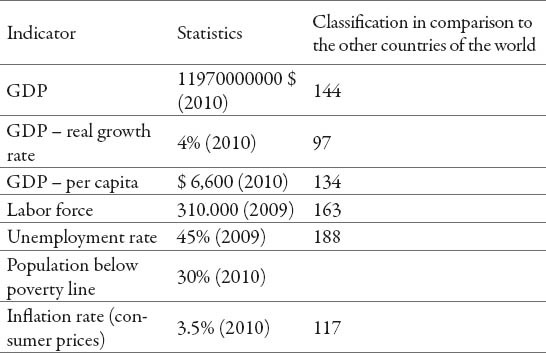
Kosovo is a newly established state, with an undeveloped economy which generally operates on a small budget (mainly gathered by customs). With approximately 1,500 € GDP per person, with a very slow economic growth (around 3% in 2006) and with an unemployment rate as high as 45%, Kosovo is still estimated to be the poorest country in Europe. In Kosovo there is general opinion that; the integration into the European Union represents an important step towards regional stability and economic prosperity including Kosovo. Kosovo's government is trying to avoid deficiencies by developing plans and programs, including the development of sect-oral strategies and by making progress toward membership in the European Union. (2,7,9).
Table 1.
Socioeconomic indicators = Source of information (CIA Fact book 2011)
2.1 The health system in Kosovo
Kosovo health system is relatively new bearing in mind the fact that Kosovo has only recently (in the last decade) begun to function as an independent entity. In the former Yugoslavia the health system was relatively well organized, advanced and comparable with health-systems of other developed European countries. As a result of dissolution of the former Yugoslav Republics and beginning of so called Serbian apartheid exercise over Kosovo, the health system was organized and has been functioning informally for more than 10 years in the so called ‘parallel system'. This has resulted in deterioration of the health status of the population up to, during and after the 1999 Kosovo war. For nearly 10 years (1990 – 1999) the parallel system in Kosovo was organized on a voluntary basis with network health (outpatient) units scattered throughout Kosovo by humanitarian association “Mother Teresa”. Since after the 1999 war, Kosovo was administered by the United Nations Interim Administration (UNMIK), Security Council Resolution 1244 (as from 10th of June 1999) and headed by the Special Representative of the Secretary – General. bIn Kosovo, healthcare today is provided in three separate levels; primary, secondary and tertiary. Primary services are provided by the 33 municipal administrative units through Family Health Centers. Secondary services are offered by Prishtina University Hospital, five regional and four city hospitals. Tertiary services are specialized services offered through health institutions associated with the Prishtina University (mainly with the University Clinical Center of Kosovo – UCC). (7,20,27).
2.2 Reorganization and organizational development of the Health System in Kosovo
With the transfer of responsibilities from UNMIK, the current internal structure of the Ministry of Health and its role within the Kosovo's government is a result of the continuous structural adjustments since 1999. As predecessor of the Ministry of Health, the Department of Health and Social Welfare has been jointly administered by the representatives of the United Nations and the local Kosovars in the so called Joint-Interim-Administrative-Structures (period spanning from 1st of February to 12th of September 2001). Consequently, as part of the ‘Provisional Self-Governing Institutions' (PSGI), the idea was that Ministry of Health, Environment and Spatial Planning is to be administered by the elected Minister and Permanent Secretary. Due to the delays in the consolidation of the Provisional Self-Governing Institutions, internationally elected officials were filling the roles of the Minister and Permanent Secretary (period spanning from 13th of September 2001 to 03rd of March 2002). As one of the government units, until 1st of September 2002, the Ministry of Health has been operating under the UNMIK regulation No. 2002/5. This was then replaced by the new executive regulation (No. 2001/19) for ‘Provisional Self-Governing Institutions' in Kosovo. From then on, the management of health sector was led by a local Minister and Permanent Secretary in line with general policies of the government. At that time, chief counselor (International Ministerial Officer) had a monitoring and advisory role as part of UNMIK. (2,3,6,29).
Health Policy Development and Strategic plans in Kosovo
One month after the end of the conflict, with the support of the World Health Organization and national experts the first document called ‘Health Strategy for Kosovo' (known as the “Blue Book”) has been drafted. After series of public consultations this strategic document was approved in September 1999 by the Department of Health and Social Welfare. Amongst its strategic goals, the aim of the strategy also was to try to find the direction and secure the stability for the international community investments. Health Sector Strategy 2010 – 2014 is the strategy that follows the reforms initiated since the end of the war. All the strategies developed in Kosovo since after the war have served as a guide for the development of the Kosovo Health System, so as to be consistent with the overall financial Kosovo government planning and based on health priorities which have been developed with the aim of achieving Millennium Goals and European health standards for all communities and citizens of Kosovo without any discrimination. (29,30).
Health System policy reform developments in Kosovo
Through international assistance (mainly by WHO), in the post war initiation of the Kosovo Healthcare reformist policy, through a consensus to make a break from the previous health system (largely approved by a healthcare personnel) a reform strategy has been established. By this document the health services were foreseen into three general levels: Primary Health Care;, Secondary Health Care; Tertiary Health Care. (5).
The majority of the objectives initiated on the health reforms in Kosovo right after the year 1999 continue to stand up to this date, such as: Development and implementation of the Health Care legal framework; Establishment, organization and completion of the Health Care infrastructure; Medical equipment in accordance with European standards (strategic priority); Development and enhancement of the so called ‘family healthcare' as the primary health cornerstone; The decentralization of primary health services at the municipal level;Development of a professional managerial system within the health institutions; Development of a Health Information System; Establishing a sustainable system of funding in Healthcare. (3,9).
3. WHERE WE ARE TODAY WITH THE REFORMS? CREATING LEGAL FRAMEWORK FOR HEALTHCARE
Today the legal framework for Healthcare in Kosovo mostly it does exist as the result of the conditioning from the international community in Kosovo so it can meet the requested standards.
Laws designed by local and international experts have been aiming to sum-up the best practices from the region and the developed countries always in an attempt to adapt to the circumstances in Kosovo. It remains as the responsibility of the local actors to deal with the implementation of those laws and as with the flowing of the events to improve and adapt them. (2,14).
3.1 Functioning, reorganization and completion of the existing health system infrastructure
Regarding the health sector, there is lack of an integrated plan for the whole of Kosovo which is based on a set of plans that involve reorganization of services that include; health care, professional human resources and medical equipment, and which should cover both; the public and the relevant parts of the private sector. The World Bank (at the request of the Ministry of Health in 2010), through the contractual international expertise has prepared a draft of such a plan, and although financial implications were quite high, for no clear explained reason the plan has not seen its approval yet. Lack of a meaningful healthcare master plan and lack of a long-term strategy based in staff advancement regarding the actual needs and possibilities has resulted in an uncoordinated health system in Kosovo. (21,32).
3.2 Development and advancement of ‘Family Healthcare' as a cornerstone of the Kosovo Healthcare system
The concept of ‘Family Healthcare' it has been brought forward in the context of reforms after the 1999 war, and which, according to health law should remain legally the cornerstone of Kosovo healthcare. Administered by the ‘Centre for Development of Family healthcare (FMDC) and with the support of “Royal College of General Practitioners” (UK), the Ministry of Health, immediately by the end of the war has started with the implementation of programs such as post-graduate studies related to the Family Healthcare (for a period of two years after the university graduation). Another program also has been providing training courses for the ‘Family Healthcare Nursing'. On the regional level there are five training centers established related to the ‘Family Healthcare'. Promotion and supporting the implementation of the ‘Family Healthcare' concept remains ongoing process, especially when we consider the fact that ‘Family Healthcare' as a new phenomenon has not yet reached within the actual consciousness of the local Kosovo population. The secondary specialists are still the peoples primary choice, who still see the ‘Family Doctors' as not very credible regarding even the simplest health issues. Furthermore, registering of the patients as to the regions they are part of has been a very slow process. The major obstacle to this is the fact that Kosovo did not have a population census (since 1981) until last year (2011). (2,3,8,28).
3.3 The decentralization of primary healthcare services at the municipal level
For the purpose of surveillance and management of Primary Health Care, in the municipalities of Kosovo, the organizing of the healthcare services in Kosovo has been made on the basis of a successful decentralization of certain financial and budgetary responsibilities for the Department of Health. The responsibility also fell to the Ministry of Health for direct management of the University Clinical Center and other regional hospitals. From 2004, the Ministry of Finance (through its ‘municipalities department') takes the complete competencies on managing the municipal health budget. Primary Health Care is foreseen to be the cornerstone of Healthcare system in Kosovo. (3,7).
3.4 Developing of an professional management system
Although there are positive indicators, there is still a great need for improvement when it comes to the management and institutional coordination in Kosovo. The so called ‘the system of reference' is one of the key area where currently there is no proper coordination as part of unique health system in Kosovo. The Tertiary (THC) and Secondary Health Care (SHC) services are actually overloaded as a result of inappropriate referrals. Motivation of professionals who deal with Management in important sector institutions of healthcare in Kosovo is still very weak. This is mostly due to the low income and interference within the administrative management, which most often brings uncertainty to the healthcare honest professionals, who consequently choose to withdraw from Managing posts.(11.14).
3.5 Health Information System Development
The Ministry of Health (office for the healthcare coordination) in cooperation with the Public Institute of Health, has drafted a document titled “Strategy for Health Information System”. This document summarizes the vision, principles, goals and objectives for an Health Information System in Kosovo. However, this document also requires further elaboration especially regarding the flow of information between primary, secondary and tertiary healthcare and the Ministry of Health. The document does not also contain the model for the physical location and the definition of ownership for data stored and classified by the different types of information.
The Information Healthcare System in the future should also foresee of how to contain financial healthcare component for all three levels (primary, secondary, tertiary). (10,17).
3.6 Establishing a sustainable funding system for the Healthcare
Speaking in general terms, Kosovo operates with a small budget which collects mainly from the border customs. Investments in health-care are very limited due to the small budget on the one hand and because health-care in post-war Kosovo has not been prioritized yet by the changing governments. Health financing is primarily managed from the central level by the Finance Ministry, thus in this regard; the involvement of the Ministry of Health has been very limited in the past. The autonomy of other health institutions has also been very small. Since after the emergency phase (1999-2001) and then construction and development phase (2002-2004), the local, likewise international experts have been attempting through the research to find a new methods for the revenue collection regarding health financing, for the purpose of creating an sustainable financing system based on mixed methods of funding. However, since then, no concrete result has been finalized. As from 1999, delays in the adoption and implementation of legislation which should have served as a base for establishment and functioning of the Health Insurance Fund, as well as support for construction of a sustainable system of financing and health insurance, is only to prove that those important issues have never been set up as a concrete priority within the agenda of any changing Kosovo governments. (4,21,25).
3.7 Discussion: what degree of consolidation has Kosovo come to reach after the conflict? What experience should we take from the case of Kosovo?
Twelve years after the end of the war in Kosovo, Healthcare System has managed to create a legislative basis for development of a health system based on European standards. Over the years, however, the concept of Family Healthcare is slowly finding its meaning with the wider population and to be understood and accepted by the majority of health professionals. Specialized training for family doctor have been and are continuing to be developed to this day, which has already resulted in generation of family doctors in all over Kosovo. The improvements can also be found in the referral system, patient registration and zoning in most municipalities. Even in the cases of the workplace rotations, project files do not always follow the basis of regular protocols. Political influence in the leading civil servant positions within the Kosovo Health Ministry is also a very acute issue which needs to be addressed. In current circumstances it influences very harmfully on an already new and fragile health system. (27.29).
4. CONCLUSION
There was a serious push in the early years after the conflict for reorganization of the Healthcare System in Kosovo, but the impression is that over the years the intensity of development has fallen. The reasons for this are many fold, however the failure to adequately implement the law and establishment of an motivated managerial structure at the top of the main healthcare institutions as for establishing a coordinated control of monitoring and accountability, is the main reason, followed by the low healthcare available budget and low salaries for healthcare professional employees. There is a need for financial support and the government's serious approach to health system development in Kosovo. Defining a clear strategic document for Healthcare Information System and its implementation, it is a necessity as to create a database system owned by the all stakeholders.
Key points
Significantly delayed as the result of the so called ‘apartheid system' exercised by the state of Serbia for over 10 years, the period after 1999 conflict was a good opportunity for Kosovo to start an initiative for a new reforms in the Healthcare System. Chances in the forecast looked great considering the initial enthusiasm of the Kosovars and the promise for international support. The challenges to be faced with during reforms were numerous in Kosovo, considering the development of the new strategy and deep reforms foreseen within the Healthcare System. Difficulties that emerged during the executions were numerous. If we were to consider the history of creation of the Kosovo state, 12 years may not seem that long, however because we are to deal with the health issue that relates directly to the human welfare, the slow consolidation has been effecting negatively the whole actual Kosovo generation. Reorganization of the Kosovo Healthcare System (which is the process of the post-conflict) is a new undertaking if we are to make a comparison with the health system practiced within the old system of the former Yugoslavia. Therefore it should take time to achieve any tangible results, however, despite all that, the achievements could have been much bigger if we were to refer to the actual expectations of the Kosovo citizens. Results show that there was a progress in the implementation of reforms, although still much remains to be done in this process if we are to achieve a level of development that will allow us to compare with the other European countries.
Footnotes
CONFLICT OF INTEREST: NONE DECLARED.
This paperwork reflects the views and the study from a Healthcare Management Doctoral Candidate, who has been involved in this field since 2001, right at the time when Kosovo began with its Healthcare Reform System. She has started as a trainee in a ambulance, then as Primary Healthcare Coordinator within the Municipal Assembly of Prizren (a municipality with about 200 000 inhabitants). Consecutively, within the same municipality (or Prizren) for five years she was the director for the Department for Health and Social Welfare and then, for a year, as a Chief Executive Officer. As from 2008 she held a post of a Deputy Minister at the Ministry of Health in Prishtina. Being in executive decision-making positions (2001-2008) and then by holding a political post (2008-2010), the author of this article Mybera Mustafa, has been able to follow closely the reforms after the 1999 conflict and she often had a chance to participated or direct health decision making working groups
REFERENCES
- 1.Constitution of Kosovo [Google Scholar]
- 2.Low on Health. Law No. 2004/4. 2004 Feb 19; [Google Scholar]
- 3.Law on Kosovo Consolidated Budget. 2009 Nr 03/N-105. [Google Scholar]
- 4.Low on the Rights and Responsibilities of the Citizens in the Health Care, 2004/38. UNMIK PISG Kosovo, Kosovo Assembly. 2004 [Google Scholar]
- 5.Low on Local Self Government.2008.Law Nr. 03/L-40. Kosovo Republic. Kosovo Assembly [Google Scholar]
- 6.Ministry of Health 2009 draft Law on health Insurance [Google Scholar]
- 7.Health and Welfare Parliamentary commission. Monitoring Report on Implementation of Health Low. 2006 [Google Scholar]
- 8.Low on Kosovo Consolidated Budget. 2009 Nr.03/N-105. [Google Scholar]
- 9.Kosovo Government. Budget books: 2001,2002,2003,2004,2005,2006,2007,2008. 2009 [Google Scholar]
- 10.Kosovo Government Ministry of Economy and Finance. Medium Term Budget Framework 2010-2013. 2010 [Google Scholar]
- 11.Prishtina: Kosovo Health Strategy, Department of Health; 1999. UNMIK. [Google Scholar]
- 12.UNMIK. Health Strategy. 2001 [Google Scholar]
- 13.Health Strategy for Kosovo. 2010-2014 [Google Scholar]
- 14.Kosovo Development Plan-Health Sector 2007-2013. Prishtina: Draft WG Paper; 2006. PISGK. [Google Scholar]
- 15.UNMIK. Interim Health Policy Guidelines. 1999 [Google Scholar]
- 16.Prishtina: 2000. Aug 11, UNMIK/REG/2000/41. [Google Scholar]
- 17.UNMIK. regulation No.2002/5 Amending UNMIK Regulation No.2001/19 on the Executive Branch of the provisional institutions of self-government in Kosovo. 2005 [Google Scholar]
- 18.UNMIK Regulation no. 2000/45 on Self-Government of Municipalities [Google Scholar]
- 19.Administrative Instruction on establishment of Family Health Centers. 15/2000. [Google Scholar]
- 20.Administrative Instruction PISG. 01/2003. The charter of Patients rights [Google Scholar]
- 21.Administrative Instruction. 28/2004. Nursing training [Google Scholar]
- 22.Administrative Instruction. 3/2003. Unique patient registration [Google Scholar]
- 23.National Institute of Public Health. Analysis people’s health in Kosovo in 2010. Annual report [Google Scholar]
- 24.Constitutional Framework for Provisional Self-Government in Kosovo. 2001 May [Google Scholar]
- 25.Eide, Kai Report on United Nations Mission in Kosovo (UNMIK) 2005 [Google Scholar]
- 26.Ahtisaari, Martti Comprehensive proposal for a Kosovo Status Settlement. 2007 [Google Scholar]
- 27.Statistical Office of Kosovo. Annual report. REKOS. 2011 [Google Scholar]
- 28.Qosaj, Berisha Transition in Health and Health Care in Kosovo. 2010 [Google Scholar]
- 29.Kosovo: WHO Office in Prishtina; 2008. Oct, Kosovo Health System Development. Draft document. [Google Scholar]
- 30.Reinvest institute. Kosovo Budget System - Policy and Sustainability, International Roundtable Forum, Research Report [Google Scholar]
- 31.RIINVEST (2003), Roundtables (2003), Kosovo Budget System - Policy and Sustainability, International Roundtable Forum, Research Report [Google Scholar]
- 32.Mybera Mustafa. Portorož: 2008. Nov 6-7, Policy analysis in health-system, leadership of applicable reforms to the Republic of Kosovo. Fatime Arenliu Qosaj. [Google Scholar]