



Abstract
John Scott Haldane was a versatile genius who solved several problems of great practical significance. His ability to look beyond the laboratory and investigate theory added crucial findings in the field of respiratory physiology. His work on high altitude physiology, diving physiology, oxygen therapy, and carbon monoxide poisoning led to a sea change in clinical medicine and improved safety and reduced mortality and morbidity in many high risk situations.
Keywords: John Scott Haldane, physiology, respiration
HIS INITIAL DAYS
John Scott Haldane [Figure 1] was born on 3rd May 1860 in Edinburgh and received his medicine degree from Edinburgh University in 1884. In 1887, Haldane joined his uncle, John Burdon-Sanderson, a Professor of Physiology at Oxford, where he became interested in the composition of air and its effects on human physiology.
Figure 1.
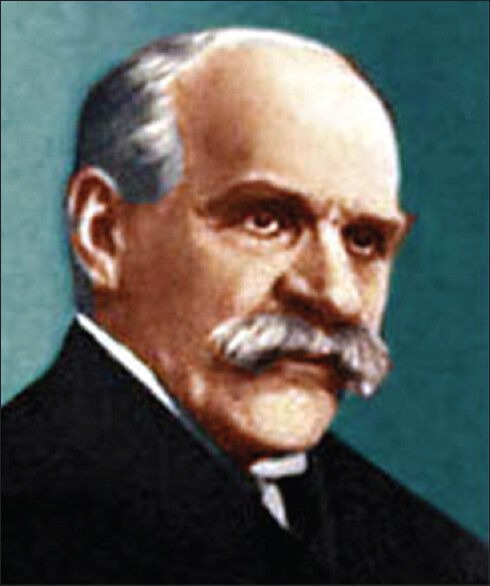
John Scott Haldane (03 May 1860-14/15 Mar 1936)
HIS CONTRIBUTIONS TO RESPIRATORY PHYSIOLOGY
In 1892, Haldane and Lorrain Smith launched a study on the blood oxygen levels in various pathophysiological conditions. In 1898, guided by Bohr, Haldane devised an improved blood gas analyser.[1]
In 1906, Haldane, together with Priestley, discovered that the respiratory reflex was triggered by an excess of carbon dioxide in the blood, rather than a lack of oxygen. They described in detail the regulation of respiratory drive by carbon dioxide and its effects on blood hydrogen ion concentration.[2] The enhanced ability of deoxygenated haemoglobin to bind with carbon dioxide was named the ‘Haldane effect’.[3]
A SAVIOUR TO MINERS
Haldane then proceeded to study asphyxia in coal miners. After breathing several toxic gases in dangerous self-experimentation, he pronounced carbon monoxide as the cause of deaths in the depths. He suggested that miners carry small animals like mice or canaries to detect dangerous levels of the gas in their working environment. Besides being portable, these animals had a high basal metabolic rate, making them exhibit symptoms of poisoning before gas levels became critical among the workers. This practice was in vogue until 1986, when they were replaced by electronic gas detectors.[4] Haldane also studied the physiology of sweating and suggested ways to treat heat stroke in miners and oil rig workers.
A SAVIOUR TO DIVERS AND MOUNTAINEERS
In 1907, Haldane designed a decompression chamber and experimented on mice in a hyperbaric environment and proved that carbon monoxide binds to haemoglobin in red blood cells and prevents its crucial role in oxygen transportation. He then studied the problem of bends or decompression sickness in divers. Experimenting with goats and on himself, Haldane discovered that ‘the formation of bubbles depends, evidently, on the existence of a state of supersaturation of the body fluids with nitrogen’.[5] Using a mathematical model, he introduced the concept of half times-the time required for a particular tissue to become half saturated with a gas, and recommended staged decompression, especially at shallower depths. Haldane then developed practical dive tables that became the foundation of all diving operations until 1956.[6,7]
In 1911, Haldane pioneered a 2 years study on the physiological responses of the human body at high altitudes. Together with Bohr and Lorrain Smith, he concluded that partial anoxia means not a mere slowing down of life, but progressive, and possibly irreparable damage to human structure’. He was the first to recommend oxygen therapy in clinical medicine based on a rational and scientific basis. Owing to unreliable methods of measuring oxygen tension in blood, Haldane erroneously concluded that oxygen was actively secreted into the blood by the cells lining the alveolar sacs and not along a diffusion gradient.[8]
All this made Haldane a consultant to engineers, while planning safety measures for construction of tunnels and diving and mining operations, and also for solutions to ventilation problems in buildings, ships, and submarines.
DISCOVERY OF TYPES OF HYPOXIA AND OXYGEN TOXICITY
Haldane was the first to classify the three types of hypoxaemia-lack of oxygen, lack of haemoglobin, or lack of circulation. He recommended up to 41% oxygen administration continuously for hypoxic patients as ‘intermittent oxygen therapy was like bringing a drowning man to the surface of the water – occasionally’. He observed that 70-80% inspired oxygen had a LD50 in mice at the end of the 12th week and was the first to describe pulmonary toxicity due to long-term oxygen therapy. He also elaborated on the concept of ventilation-perfusion mismatch and inequalities, and expounded that the administration of oxygen was at best palliative, since it did not remove the cause.[9,10]
SOLUTIONS FOR CHEMICAL WARFARE
During the First World War (1914-1918) Haldane was able to identify the use of disabling chlorine and phosgene gas by the Germans, and designed the first gas masks for use in chemical warfare and also an oxygen therapy equipment to treat its victims.[11]
AWARDS AND DISTINCTIONS
John Scott Haldane was elected as a Gifford Lecturer in the University of Glasgow, Fellow of New College, Oxford, and Honorary Professor of the University of Birmingham. He received numerous honorary degrees and instated as the President of the English Institution of Mining Engineers and Director of the Mining Research Laboratory at Doncaster and Birmingham. He was a Companion of Honour of the British Court, a Fellow of the Royal Society, a member of the Royal College of Physicians and the Royal Society of Medicine. He received the Royal Medal in 1916, the Copley Medal in 1934.[12]
His Silliman lectures at Yale in 1916 was published in 1922 and after a revision in 1935, became a standard reference manual for respiratory physiologists. He founded the Journal of Hygiene, and his published works include Organism and Environment (1917), New Physiology (1919), Respiration (1922), and The Philosophy of a Biologist (1936).
HIS LAST DAYS AND LEGACY
In 1936, Haldane died in Oxford at midnight on March 14/March 15, 1936, soon after returning from a trip to investigate cases of heat stroke in the oil refineries in Persia.
With great courage and modesty, he made lasting contributions to improved working conditions years before health and safety itself became an industry, and he never failed to give credit to colleagues. He is considered as ‘Father of Oxygen Therapy’. His genius can be estimated from the fact that when Haldane was writing in terms of ventilation-perfusion mismatch, others were recommending treatment with subcutaneous oxygen gas, oxygen enemas and oxygenated water as restoratives! Haldane showed that science can bring light into the darkness.
Footnotes
Source of Support: Nil.
Conflict of Interest: None declared
REFERENCES
- 1.Barcroft J. A method of estimating the oxygen and carbonic acid in small quantities of blood. J Physiol. 1902;28:232–40. doi: 10.1113/jphysiol.1902.sp000912. [DOI] [PMC free article] [PubMed] [Google Scholar]
- 2.Haldane J. The action of carbonic oxide on man. J Physiol. 1895;18:430–62. doi: 10.1113/jphysiol.1895.sp000578. [DOI] [PMC free article] [PubMed] [Google Scholar]
- 3.Haldane JS, Priestley JG. 2nd ed. London: Oxford University Press; 1935. Respiration. [Google Scholar]
- 4.Goodman M. Simon and Schuster Ltd; 2007. Suffer and Survive: The Extreme Life of J. S. Haldane; p. 4. [Google Scholar]
- 5.Acott C, Haldane JS, Haldane JB, Hill L, Siebe A. A brief resume of their lives. SPUMS J. 1999;29:3. [Google Scholar]
- 6.Boycott AE, Damant GC, Haldane JS. The prevention of compressed-air illness. J Hyg (Lond) 1908;8:342–43. doi: 10.1017/s0022172400003399. [DOI] [PMC free article] [PubMed] [Google Scholar]
- 7.Lang MA, Brubakk AO. Washington, D.C: Smithsonian Institution Scholarly Press, U.S.A; 2009. The Future of Diving: 100 Years of Haldane and Beyond. [Google Scholar]
- 8.Douglas CG, Haldane JS, Henderson Y, Schneider EC. Physiological observations made on Pikes peak, with special reference to adaptation to low barometric pressure. Philos Trans R Soc Lond, U.K. Ser B. 1913;203:185–318. [Google Scholar]
- 9.Haldane J, Smith JL. The oxygen tension of arterial blood. J Physiol. 1896;20:497–520. doi: 10.1113/jphysiol.1896.sp000634. [DOI] [PMC free article] [PubMed] [Google Scholar]
- 10.Haldane JS. New Haven, CT: Yale University Press; 1917. Organism and Environment as Illustrated by the Physiology of Breathing; pp. 52–7. [Google Scholar]
- 11.Haldane JS. Garden City, NY: Doran and Co; 1929. The Sciences and Philosophy: Gifford Lectures. [Google Scholar]
- 12.Addison HR, Oakes CH, Henry L, William J, Sladen DB. U.K: Haldane John Scott: Who's Who, A and C Black; 1907. p. 757. [Google Scholar]