



Abstract
The aim of this study was to estimate the total cost of bovine fasciolosis under three different scenarios (expected, optimistic and pessimistic scenarios) in Turkey. The weighted mean prevalence of infection was calculated as 1.9% and the financial losses were estimated in US$ at 2010 current prices. The total costs of bovine fasciolosis per infected beef cattle and dairy cow were estimated as 223.7 US$ (201.3–246.1, under optimistic-pessimistic scenarios) and 430.7 US$ (387.6–473.7), respectively. Total cost of the disease was estimated as 7.4 million US$ (6.1–8.8) for beef cattle and 35.4 million US$ (28.9–42.6) for dairy cows. The nation-wide total cost of the disease in Turkey for 2010 was estimated to be 42.8 million US$ (35.1–51.4). Most of the losses arise from reduced meat yield, fertility and milk yield, and smaller losses are due to condemnation of livers and disease control expenditures. As a result, the quantity of these losses may help the farmers and policy makers to give the better decision for controlling and eradication of the animal diseases in Turkey.
INTRODUCTION
Fasciolosis is a parasitic liver infection of wild and domestic ruminants caused by Fasciola hepatica (Trematoda; Fascioliadae) and/or Fasciola gigantica which have a world-wide distribution (Soulsby, 1986). Among helminth infections, fasciolosis commonly called as liver fluke disease is of paramount importance due to its wider spectrum of definitive hosts (Rondelaud et al., 2001) causing acute and chronic infections (Sampaio–Silva et al., 1996). Several experimental studies have suggested that there are considerable economic losses due to fasciolosis (Ribbeck and Witzel, 1979; Hope Cawdery, 1984; Wamae et al., 1998).
The total cost (C) of a disease is the sum of production losses (L) and control expenditures (E), in mathematical notation: C = L+E (Otte and Chilonda, 2000). Fasciolosis causes production losses (L) in livestock as a result of condemned liver, reductions in weight gain, milk yield and fertility (extended calving interval, additional service). The use of flukucides can be accepted as basic and most popular control expenditure for treatment against fasciolosis. The economic analysis of losses due to animal diseases within the national economy has a degree of uncertainty because of the variability of the losses attributed to infections. In previous studies focused on estimating the losses due to animal diseases, dynamic–stochastic model (Monte Carlo sampling technique) and deterministic–static model (expected, optimistic and pessimistic scenarios) have been used to overcome these uncertainties (Bennett et al., 1999; Schweizer et al., 2005; Sarıözkan and Yalçın, 2009).
In Turkey, reported studies about bovine fasciolosis performed in different regions (included five regions and over 10 provinces) showed an estimated prevalence of 0.5% in Thrace region (Gargılı et al., 1999), 1.6–2.2% in Elazığ (Kaplan et al., 2002; Kaplan and Başpınar, 2009), 3.7% in Istanbul (El–Meterawy and Vuruşaner, 1993), 6.0% in Afyon (Sevimli et al., 2005), 15.8–24.5% in Kayseri (Yavuz et al., 2007; Yıldırım et al., 2000; Yıldırım et al., 2007) and 25.0% in Samsun provinces (Celep et al., 1990).
According to review of Köroğlu and Şimşek (2003), under Turkish field conditions, most of the studies only calculated the cost of condemned liver due to bovine fasciolosis at a province level, and ignored the other production losses and control expenditures. However, to the author’s knowledge, there have been no attempts to assess the total cost of bovine fasciolosis at national scale in Turkey.
The objective of this study was to estimate the annual (for the current price of 2010) total cost of bovine fasciolosis under different scenarios (expected, optimistic and pessimistic scenarios) in Turkey.
MATERIALS AND METHODS
In the study, total cost (C) of bovine fasciolosis calculated by using equation (1) (adapted from Schweizer et al., 2005):
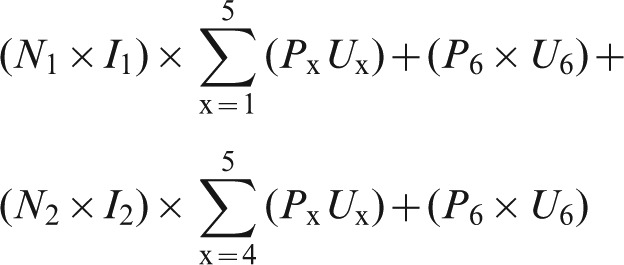 |
where N is the population size (number of dairy or beef cattle) with a rate of infection I (prevalence in dairy cows or beef cattle), and a loss parameter P for each of six effects (x1–x6) and U represents the unit cost of per parameter (U1–U6). The definitions of each symbol (letter) are given in Table 1.
Table 1. The definitions of equation* about the total cost of bovine fasciolosis in Turkey.
| Effect | Population size (N) | Infection rate (I) | Loss parameter (P) | Unit cost (U) |
| Loss of milk yield (x1) | No. of dairy cows (N1) | Prevalence in dairy cows (I1) | Loss of milk yield per cow (P1) | Price of milk (U1) |
| Extended calving interval (x2) | No. of dairy cows (N1) | Prevalence in dairy cows (I1) | No. of additional days per cow (P2) | Cost per day (U2) |
| Additional services (x3) | No. of dairy cows (N1) | Prevalence in dairy cows (I1) | No. of additional services per cow (P3) | Cost per service (U3) |
| Loss of meat (x4) | No. of beef cattle (N2) | Prevalence in beef cattle (I2) | Weight loss per cattle (P4) | Price of meat (U4) |
| Loss of livers (x5) | Condemned liver in kg (P5) | Price of liver (U5) | ||
| Treatment costs (x6) | Treated cattle per year (P6) | Cost per treatment (U6) |
Equation (1).
The details of the technical and financial data used in the analyses and their sources were presented in Table 2.
Table 2. Technical and financial parameters used in the estimating the total cost of bovine fasciolosis in Turkey.
| Parameters used in the analyses | Value | References |
| TECHNICAL PARAMETERS | ||
| Total number of cattle (2009) | 10 723 958 | Anon (2010b) |
| Number of beef cattle (2009) | 1 502 073 | Anon (2010b) |
| Number of dairy cows (2009) | 4 133 148 | Anon (2010b) |
| Reduction in weight gain (kg/year) | 26.0 (23.4–28.6) | Calculated from Bennett et al. (1999) |
| Reduction in milk yield (kg/cow)* | 152.5 (137.3–167.8)† | Calculated from Bennett et al. (1999) |
| Extended calving interval (day) | 20.0 (18.0–22.0) | Bennett et al. (1999) |
| Additional service | 0.5 (0.45–0.55) | Bennett et al. (1999) |
| Weight of condemned liver (kg) | 2.7 (2.4–3.0) | Bennett et al. (1999) |
| Mean prevalence (%) | 1.9 (1.7–2.1) | Köroğlu and Şimşek (2003) |
| Number of treated beef cattle (head/year)‡ | 1 051 451 (946 306–1 156 596) | Anon (2010c) |
| Number of treated dairy cows (head/year)‡ | 1 653 259 (1 487 933–1 818 585) | Anon (2010c) |
| FINANCIAL PARAMETERS§ | ||
| Price of meat (US$/kg) | 8.0 | Anon (2010d) |
| Price of milk (US$/kg) | 0.5 | Anon (2010e) |
| Cost of extended calving interval (US$/day) | 5.8 | Calculated from Yalçın (2000) |
| Cost of per service (US$) | 30.0 | Anon (2010c) |
| Price of liver (US$/2.7 kg) | 15.0 | Calculation |
| Cost of treatment (US$/head/year) | 1.0 | Anon (2010c) |
Decrease in milk yield was calculated over a 305-day lactation.
Optimistic and pessimistic values represented in parenthesis.
Number of treated beef cattle was calculated as 70% of total beef cattle and number of dairy cows was calculated as 40% of total dairy cows.
1.5 TL = 1 US$ in 2010.
In the analyses, cost of extended calving interval (US$/day) was calculated from Yalçın (2000) and added 3% discount rate for per annum (30% for 10 years).
Due to large variation in the reported prevalence of bovine fasciolosis in Turkey, the total cost of disease on national scale estimated under three scenarios, namely, expected (mean value), optimistic (lowered by 10%) and pessimistic (increased by 10%) scenarios. Similar to Bennett et al. (1999), and Sarıözkan and Yalçın (2009), deterministic methods were used to estimate of the annual losses due to bovine fasciolosis in Turkey.
The reported prevalence values of bovine fasciolosis varied from 0.5% to 25.0% in Turkey. Because of higher sample sizes on studies reported lower prevalences (Gargılı et al., 1999; Kaplan et al., 2002; Kaplan and Başpınar, 2009), the weighted mean prevalence was calculated as 1.9%. The weighted mean prevalence of the bovine fasciolosis was calculated from the results of reported studies conducted in different regions (included over 10 provinces) of Turkey (Table 2).
A spreadsheet model detailed in equation (1) was constructed in Microsoft Excel program to estimate annual (for the current prices of 2010) total cost of bovine fasciolosis in Turkey.
RESULTS
The total costs of bovine fasciolosis per infected beef cattle and dairy cow under different scenarios were presented in Table 3.
Table 3. The total costs of bovine fasciolosis per infected beef cattle and dairy cow.
| Total cost items | Expected estimation | Optimistic estimation | Pessimistic estimation | |||
| Beef cattle | Dairy cow | Beef cattle | Dairy cow | Beef cattle | Dairy cow | |
| Lmeat | 208.0 | 208.0 | 187.2 | 187.2 | 228.8 | 228.8 |
| Lmilk | … | 76.3 | … | 68.6 | … | 83.9 |
| Lfertility* | … | 131.0 | … | 117.9 | … | 144.1 |
| Lliver | 15.0 | 15.0 | 13.5 | 13.5 | 16.5 | 16.5 |
| Ctreatment | 0.7 | 0.4 | 0.6 | 0.4 | 0.8 | 0.4 |
| CTOTAL | 223.7 | 430.7 | 201.3 | 387.6 | 246.1 | 473.7 |
*Includes cost of extended calving interval and additional service.
The total cost per infected beef cattle was estimated as 223.7 US$ (201.3–246.1, under optimistic–pessimistic scenarios) and 430.7 US$ (387.6–473.7) per infected dairy cow. Estimated total cost of fasciolosis in an infected dairy cow is nearly two-fold higher compared to those of beef cattle. Treatment costs were 0.3% and 0.09% of total cost per infected beef cattle and dairy cow, respectively.
The total cost of bovine fasciolosis in Turkey under three different scenarios (expected, optimistic and pessimistic) were presented in Table 4.
Table 4. Nation-wide total costs of bovine fasciolosis in Turkey under different scenarios.
| Total cost items | Expected estimation | Optimistic estimation | Pessimistic estimation | |||
| Beef cattle | Dairy cow | Beef cattle | Dairy cow | Beef cattle | Dairy cow | |
| Lmeat | 5 936 192 | 16 334 201 | 4 808 316 | 13 230 703 | 7 182 793 | 19 764 383 |
| Lmilk | … | 5 987 898 | … | 4 850 198 | … | 7 245 357 |
| Lfertility* | … | 10 287 405 | … | 8 332 798 | … | 12 447 761 |
| Lliver | 428 091 | 1 177 947 | 385 282 | 1 060 152 | 470 900 | 1 295 742 |
| Ctreatment | 1 051 451 | 1 653 259 | 946 306 | 1 487 933 | 1 156 596 | 1 818 585 |
| Cbeef, dairy | 7 415 734 | 35 440 710 | 6 139 904 | 28 961 784 | 8 810 289 | 42 571 828 |
| CTOTAL | 42 856 444 | 35 101 688 | 51 382 117 | |||
*Includes cost of extended calving interval and additional service.
Total cost of bovine fasciolosis was estimated as 7.4 million US$ (6.1–8.8) for beef cattle and 35.4 million US$ (28.9–42.6) for dairy cows. The nation-wide total cost in Turkey in 2010 was estimated to be 42.8 million US$ (35.1–51.4). Estimated total cost of fasciolosis in dairy cows is nearly four- to five-fold higher compared to those of beef cattle in Turkey. Annual treatment costs for both beef cattle and dairy cows were estimated as 5.8–6.9% of total costs. In Turkey, the distributions of total cost for beef cattle and dairy cows were estimated as 17% and 83%, respectively.
DISCUSSION
There are a lot of studies which reported the prevalence of bovine fasciolosis and only estimated the losses due to condemned liver in the world. However, there have been few attempts to quantify the total costs of the infection. In the present study, the total cost of infection for the Turkish economy was estimated under three different scenarios (optimistic, expected and pessimistic). It would have been much better to analyse the total cost of bovine fasciolosis with a ‘dynamic stochastic model’ such as Monte Carlo Simulation Technique. Such model would have taken account of the knock-on effects (dynamics of the system) and uncertainties over time with and without disease situation much better. However, such advanced model building activities necessitate multidisciplinary team work as done by several developed countries, which is still lacking in Turkey. For this reason, we had to use ‘deterministic–static model’ to estimate the total cost of the disease and tried to analyse the uncertainties by analysing the results under pessimistic and optimistic scenarios. We are aware that the analyses do not provide an excellent decision support to the government officials in charge of disease control. However, considering that economic assessments of the livestock disease-induced losses and cost–benefit analysis of alternative control/eradication strategies of animal diseases are almost lacking in Turkey, we believe that the analyses provides at least some information on the magnitude of the cost of fasciolosis at national level.
In this study, the weighted mean prevalence of infection was calculated as 1.9% from the published data in Turkey. However, it could be between 0.5% and 25.0% according to different regions. Although both F. hepatica and F. gigantica are present in Turkey, F. hepatica is more prevalent species in cattle (Yıldırım et al., 2007).
The prevalence of bovine fasciolosis varies among the different countries in the world. The prevalence of infection in cattle reported as 1.1–4.8% in Iran (Ansari–Lari and Moazzeni, 2006), 3.3% in Iraq (Mahdi and Al–Baldawi, 1987), 25.5% in Pakistan (Khan et al., 2009), 10.3% in Brasil (Marques and Scroferneker, 2003), 10.9% in Switzerland (Schweizer et al., 2005), 5.0–8.5% in Scotland (Khaitsa et al., 1994), 6.5% in England and Wales (MAFF, 1980), 3.5–26.0% in Kenya (Kithuka et al., 2002; Mungube et al., 2006), 7.0% in Nigeria (Ogunrinade and Ogunrinade, 1980), 9% in Saudi Arabia (Nasher, 1990), 60.9% in Zambia (Phiri et al., 2005) and 24.3–90.7% in Ethiopia (Yılma and Mesfin, 2000; Berhe et al., 2009).
The large variation of prevalence of bovine fasciolosis in different countries and regions is depending on some factors such as environmental and climatic conditions, snail population, management systems, composition of livestock population, age and sex of cattle, and contamination level of pastures.
In Turkey, total cost of fasciolosis per infected beef cattle was estimated as between 201–246 and 388–474 US$ per infected dairy cow. In Kenya, after an experimental study, both losses of live weight gain and liver condemnations due to F. gigantica for Friesian and Boran cattle were reported as 12.1 and 23.4 US$, respectively (Wamae et al., 1998). After a retrospective study in Taveta region of Kenya, Mungube et al. (2006) estimated the losses of liver condemnations due to F. gigantica infection as 8.9 US$ per infected cattle. The losses of both carcass weight and liver condemnations were estimated as US$ 25.3 per infected cattle in Tigray region of Ethiopia (Behre et al., 2009).
In Turkey, under different scenarios, the estimated cost of fasciolosis for beef cattle and dairy cows varied between 6.1 and 8.8 million US$ and 28.9–42.6 million US$, respectively. Total cost of the disease for Turkish economy could range between 35.1 and 51.4 million US$ annually. This equates the 1.2–1.7% of the reported total losses due to fasciolosis in the world (Spithill et al., 1999) and 0.14–0.19% of the Turkey’s total livestock production value in 2009 (Anon, 2010a).
There are some studies performed in different countries/regions about financial losses due to bovine fasciolosis in the world. However, some of these studies were taken into account only the losses due to condemned liver and/or live weight reduction and others estimated the nation-wide total losses of disease as in this study.
For example, in Kenya, Kithuka et al. (2002) estimated the annual losses due to bovine fasciolosis for only liver condemnations as 0.2–0.3 million US$. In Greece, loss of condemned liver was estimated as 21.6 US$ per infected cattle (Theodoropoulos et al., 2002). Schweizer et al. (2005) estimated the total loss as 72 million US$ and loss per infected cattle as 415 US$ due to bovine fasciolosis in Switzerland. Bennett et al. (1999) estimated the low and high annual losses in the UK to be between 12 million and 86 million US$.
Despite the low mean prevalence (1.9%) of bovine fasciolosis, the estimated total cost of disease for Turkish economy and losses of per infected cattle could lead to make some new decisions by government and farmers. In short term, there are some difficulties to eliminate the bovine fasciolosis; however, the following measures could be taken for decreasing the financial impact of disease for Turkish livestock and economy:
farmers need to inform by government about the disease and prevention methods because of the high quantity of losses and cost of disease;
drugs (flukucides) should be used in correct time and dose by farmers and veterinarians for preventing the drug resistance;
disease control expenditures should be increased before the infection, for protecting the herds from fasciolosis;
cattle faeces should be examined periodically and pastures need to be ameliorated for preventing the contamination.
REFERENCES
- Anon(2010a)Türkiye İstatistik Kurumu. Haber Bültenleri. Available at: http://www.tuik.gov.tr/PreHaberBultenleri.do?id = 6256&tb_id = 4 [accessed 20 December 2010] [Google Scholar]
- Anon(2010b)Türkiye İstatistik Kurumu. Hayvancılık İstatistikleri. Available at: http://www.tuik.gov.tr/hayvancilikapp/hayvancilik.zul [accessed 12 January 2011] [Google Scholar]
- Anon(2010c)Personal communication with public and private veterinary medicines. Anon (2010d) Ankara Ticaret Borsası. Available at: http://www.atb.gov.tr/ [accessed 6 August 2010] [Google Scholar]
- Anon(2010e)Fiyat İstatistikleri. Türkiye Damızlık Sığır Yetiştiricileri Merkez Birliği. Available at: http://www.dsymb.org.tr/sutfiyatlari.htm [accessed 4 April 2010] [Google Scholar]
- Ansari-Lari M.&Moazzeni M.(2006)A retrospective survey of liver fluke disease in livestock based on abattoir data in Shiraz, south of Iran. Preventive Veterinary Medicine 7393–96. [DOI] [PubMed] [Google Scholar]
- Behre G, Berhane K.&Tadesse G.(2009)Prevalence and economic significance of fasciolosis in cattle in Mekelle Area of Ethiopia. Tropical Animal Health and Production 411503–1504. [DOI] [PubMed] [Google Scholar]
- Bennett RM, Christiansen K.&Clifton-Hadley RS.(1999)Estimating the costs associated with endemic diseases of dairy cattle. Journal of Dairy Research 66455–459. [DOI] [PubMed] [Google Scholar]
- Celep A, Açıcı M, Çetindağ M, Coşkun ŞZ.&Gürsoy S.(1990)Samsun yöresi sığırlarında helmintolojik araştırmalar. Etlik Veteriner Mikrobiyoloji Dergisi 6117–130. [Google Scholar]
- El-Meterawy T.&Vuruşaner C.(1993)An investigation of the liver flukes of slaughtered cattle in Istanbul. Turkish Journal of Infection 5203–205. [Google Scholar]
- Gargılı A, Tüzer E, Gülanber A, Toparlak M, Efil I, Keleş V.&Ulutaş M.(1999)Prevalence of liver fluke infections in slaughtered animals in Trakya (Thrace), Turkey. Turkish Journal of Veterinary and Animal Sciences 23115–116. [Google Scholar]
- Hope Cawdery MJ.(1984)Review of the economic importance of fascioliasis in sheep and cattle. Irish Veterinary News 714–22. [Google Scholar]
- Kaplan M.&Başpınar S.(2009)Elazığ’da son 5 yılda kesilen kasaplık hayvanlarda fasciolosis sıklığı ve ekonomik önemi. Fırat Tıp Dergisi 1425–27. [Google Scholar]
- Kaplan M, Kuk S.&Kalkan A.(2002)Elazığ ELET A.Ş. kesimhanesinde 1998–2000 yılları arasında kesilen hayvanlarda fasciolosis görülme sıklığı. Fırat Tıp Dergisi 7839–842. [Google Scholar]
- Khaitsa ML, Hammond J.&Opuda-Asibo J.(1994)Use of meat inspection records in veterinary planning. Bulletin of Animal Health and Production in Africa 42317–326. [Google Scholar]
- Khan MK, Sajid MS, Khan MN, Iqbal Z.&Iqbal MU.(2009)Bovine fasciolosis: prevalence, effects of treatment on productivity and cost benefit analysis in five districts of Punjab, Pakistan. Research in Veterinary Science 8770–75. [DOI] [PubMed] [Google Scholar]
- Kithuka JM, Maingi N, Njeruh FM.&Ombui JN.(2002)The prevalence and economic importance of bovine fasciolosis in Kenya — an analysis for abattoir data. Onderstepoort Journal of Veterinary Research 69255–262. [PubMed] [Google Scholar]
- Köroğlu E.&Şimşek S.(2003)Ekonomik kayıplar In FasciolosisTınar R.Korkmaz M.249–262.İzmir: Türkiye Parazitoloji Derneği, Yayın No: 18 [Google Scholar]
- MAFF(1980)Abattoir data, Animal Disease Report 328–29. [Google Scholar]
- Mahdi NK.&Al-Baldawi FA.(1987)Hepatic fasciolosis in the abattoirs of Basrah. Annals of Tropical Medicine and Parasitology 81377–379. [DOI] [PubMed] [Google Scholar]
- Marques SMT.&Scroferneker ML.(2003)Fasciola hepatica infection in cattle and buffaloes in the State of Rio Grande do Sul, Brazil. Parasitologia Latinoamericana 58169–172. [Google Scholar]
- Mungube EO, Bauni SM, Tenhagen BA, Wamae LW, Nginyi JM.&Mugambi JM.(2006)The prevalence and economic significance of Fasciola gigantica and Stilesia hepatica in slaughtered animals in the semi-arid coastal Kenya. Tropical Animal Health and Production 38475–483. [DOI] [PubMed] [Google Scholar]
- Nasher AK.(1990)Parasites of livestock in Asir Province, southwestern Saudi Arabia. Veterinary Parasitology 37297–300. [DOI] [PubMed] [Google Scholar]
- Ogunrinade A.&Ogunrınade BI.(1980)Economic importance of fascioliasis in Nigeria. Tropical Animal Health and Production 12155–160. [DOI] [PubMed] [Google Scholar]
- Otte MJ.&Chilonda P.(2000)Animal health economics: an introduction. Available at: ftp://ftp.fao.org/docrep/fao/010/ag275e/ag275e.pdf [accessed 2 April 2009] [Google Scholar]
- Phiri AM, Phiri IK, Sikasunge CS.&Monrad J.(2005)Prevalence of fasciolosis in Zambian cattle observed at selected abattoirs with emphasis on age, sex and origin. Journal of Veterinary Medicine, Series B 52414–416. [DOI] [PubMed] [Google Scholar]
- Ribbeck R.&Witzel G.(1979)Ökonomische verluste infolge fasziolose bei rind und schaf. Monatshefte für Veterinärmedizin 3456–61. [Google Scholar]
- Rondelaud D, Vignoles P, Abrous M.&Dreyfuss G.(2001)The definitive and intermediate hosts of Fasciola hepatica in the natural watercress beds in central France. Parasitology Research 87475–478. [DOI] [PubMed] [Google Scholar]
- Sampaio-Silva ML, da Costa JM, da Costa AM, Pires MA, Lopes SA, Castro AM.&Monjour L.(1996)Antigenic compounds of excretory–secretory products of adult F. hepatica recognized in human infections. American Journal of Tropical Medicine and Hygiene 54146–148. [DOI] [PubMed] [Google Scholar]
- Sarıözkan S.&Yalçın C.(2009)Estimating the production losses due to cystic echinococcosis in ruminants in Turkey. Veterinary Parasitology 163330–334. [DOI] [PubMed] [Google Scholar]
- Schweizer G, Braun U, Deplazes P.&Torgerson PR.(2005)Estimating the financial losses due to bovine fasciolosis in Switzerland. Veterinary Record 157188–193. [DOI] [PubMed] [Google Scholar]
- Sevimli FK, Köse M, Kozan E.&Doğan N.(2005)Afyon ili sığırlarında paramphistomosis ve distomatosisin genel durumu. Türkiye Parazitoloji Dergisi 2943–46. [PubMed] [Google Scholar]
- Soulsby EJL.(1986)Helminths, Arthropods and Protozoa of Domesticated Animals. 6th ed. London: Bailliere & Tindall [Google Scholar]
- Spithill TW, Smooker PM.&Copeman DB.(1999)Fasciola gigantica: epidemiology, control, immunology and molecular biology In FasciolosisDalton J P.465–525.Wallingford: CABI Publishing [Google Scholar]
- Theodoropoulos G, Theodoropoulou E, Petrakos G, Kantzoura V.&Kostopoulos J.(2002)Abattoir condemnation due to parasitic infections and its economic implications in the region of Trikala, Greece. Journal of Veterinary Medicine, Series B 49281–284. [DOI] [PubMed] [Google Scholar]
- Wamae LW, Hammond JA, Harrison LJS.&Onyango-Abuje JA.(1998)Comparison of production losses caused by chronic Fasciola gigantica infection in yearling Friesian and Boran cattle. Tropical Animal Health and Production 3023–30. [DOI] [PubMed] [Google Scholar]
- Yavuz A, Inci A, Yıldırım A, Iça A.&Düzlü Ö.(2007)Sığırlarda Fasciola hepatica’nın yayılışı. Sağlık Bilimleri Dergisi 1696–102. [Google Scholar]
- Yıldırım A, Iça A, Düzlü Ö.&Inci A.(2007)Prevalence and risk factors associated with Fasciola hepatica in cattle from Kayseri province, Turkey. Revue de médecine vétérinaire 158613–617. [Google Scholar]
- Yıldırım A, Kozan E, Kara M.&Öge H.(2000)Kayseri bölgesinde kapalı sistemde yetiştirilen sığırlarda helmint enfeksiyonlarının durumu. Ankara Üniversitesi Veteriner Fakültesi Dergisi 47333–337. [Google Scholar]
- Yalçın C.(2000)Süt sığırcılığında infertiliteden kaynaklanan mali kayıplar. Lalahan Hayvancılık Araştırma Enstitüsü Dergisi 4039–47. [Google Scholar]
- Yılma JM.&Mesfin A.(2000)Dry season bovine fasciolosis in Northwestern part of Ethiopia. Revue de médecine vétérinaire 151493–500. [Google Scholar]